Birds That Eat Wasps: The 11 Species That Will Hunt Wasps in Your Yard
Yes, birds do eat wasps. While most birds avoid the sting, at least 11 North American species actively hunt wasps, hornets, and yellowjackets, and one, the Summer Tanager, is a true specialist. Here is exactly which birds eat wasps, how they dodge the sting, and how to attract them to your yard. Among the stinging insects these birds tackle are red wasps, the aggressive paper wasps of the southeastern US.
Wasps are stinging insects that most birds avoid for obvious reasons, but a small group of bird species specialize in hunting wasps, and they’ve evolved remarkable techniques to handle the stinging defense. The most dedicated wasp predator in North America is the Summer Tanager, which catches wasps mid-air, slams them against branches to disable the stinger, and rubs the venom sac off before eating. A few wasp-eating birds in your yard can meaningfully reduce wasp populations, especially around problem nests. This guide covers the 11 birds that actually hunt wasps in North America, how they avoid getting stung, which are realistic for residential yards versus rare wilderness species, and how to attract the suburban-friendly wasp hunters to your property.
Yes, birds eat wasps. At least 11 North American species hunt wasps, hornets and yellowjackets, and the Summer Tanager is the true specialist, raiding nests and wiping the sting out of its prey before swallowing. Most other birds take wasps opportunistically rather than as a staple food.
The Honest Truth About Birds and Wasps
Most birds avoid wasps. The sting hurts, sometimes severely, and a wasp colony can mob a predator into retreat or worse. This means the universe of true wasp-eating birds is much smaller than the universe of insect-eating birds in general.
The birds that do eat wasps fall into specific categories:
- Specialists like Summer Tanagers, which have evolved specific techniques to handle the sting
- Opportunists like flycatchers and swallows, which catch wasps mid-air during normal insect-hunting
- Smart corvids (crows, magpies, ravens) that use their intelligence to attack nests strategically
- Bee-eaters (in regions where they occur), which are highly specialized but rare in most of North America
The realistic outcome: a yard with strong populations of wasp-eating birds will see modest wasp reduction, similar to the bird-mosquito relationship. Useful but not transformative. Combined with other wasp management practices (removing nests, eliminating attractants), birds contribute to the overall control strategy.
If you’re new to backyard birding overall, the complete attract birds to your yard guide covers the broader habitat framework. For the related mosquito-eating birds, see birds that eat mosquitoes. This guide focuses specifically on wasp-eating birds.
How Wasp-Eating Birds Avoid Getting Stung
This is the most fascinating part of the wasp-hunting bird story. Different species use different techniques to handle the wasp’s stinger.
The Bash-and-Rub Method (Summer Tanagers)
Summer Tanagers, the wasp specialists, use a remarkably sophisticated technique:
- Catch the wasp in flight or while it’s resting on a flower or surface
- Take it to a perch (a tree branch is ideal)
- Slam it repeatedly against the branch to disable or stun it
- Wipe the wasp along the branch to remove or detach the stinger and venom sac
- Eat the disabled wasp without getting stung
This entire sequence takes 5 to 10 seconds and works on most wasp species, including yellowjackets and paper wasps.
The Aerial Catch (Swallows, Flycatchers, Kites)
Some birds catch wasps in mid-flight before the wasp can deploy its sting:
- Eastern Kingbird, voracious aerial insect hunter; catches wasps and other stinging insects
- Tree Swallow and Barn Swallow, catch wasps while feeding on the wing
- Great Crested Flycatcher, perches and ambushes flying wasps
- Swallow-tailed Kite (rare but spectacular), Florida and Gulf Coast specialist that catches wasps in flight
The wasp typically isn’t able to sting when caught at high speed mid-air.
Corvid Intelligence
Crows, magpies, and ravens have learned that wasp larvae are highly nutritious. They attack wasp nests strategically, often at night when wasps are less active, and can rip nests open to extract the protein-rich larvae. This requires more skill than other techniques but yields significant food.
Brute Force (Eaten with Stinger Intact)
Some birds simply eat wasps quickly, with the stinger included. They can handle one or two stings (the body of a small bird absorbs limited stings without serious injury), and the protein meal outweighs the discomfort. This is risky and less efficient than the bash-and-rub method, but still works for some species.
The 11 Birds That Eat Wasps
Ranked by their effectiveness and accessibility to North American backyards:
1. Summer Tanager, The Wasp Specialist
The undisputed champion. Summer Tanagers consume more wasps per day than any other North American bird species, with diet studies showing wasps making up 25-40% of their food during certain seasons.
Range: Southern and southeastern US (summer breeding range)
Habitat: Open woodlands, deciduous forests with mature trees
Attract them: Native oak trees (where they nest), open feeding areas, water source, no pesticides
Diet preference: Yellowjackets, paper wasps, hornets, basically any wasp they can catch
If you live in Summer Tanager range and have wasp problems, attracting them is a real solution. They’re striking red-colored males and brownish-yellow females.
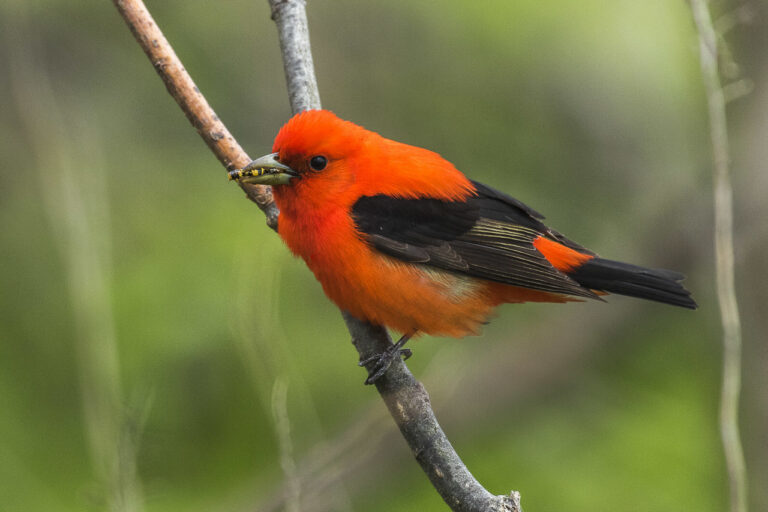
2. Scarlet Tanager
Less specialized than Summer Tanager but still effective. Eats wasps regularly as part of a broader insect diet. Range overlaps with Summer Tanager in eastern US.
Range: Eastern and central US (summer)
Habitat: Mature deciduous forests, suburban yards with large trees
Attract them: Mature trees, brush layers, water source
3. Western Tanager
The Pacific equivalent. Similar diet pattern, eats wasps as part of a varied insectivorous diet.
Range: Western US (summer)
Habitat: Coniferous and mixed forests, suburban edges
Attract them: Mature trees, water source, no pesticides
4. Eastern Kingbird
An aerial insect hunter that catches wasps mid-flight. Highly territorial, will chase away other birds (including hawks) but uses that aggression to catch wasps too.
Range: Most of eastern North America (summer)
Habitat: Open areas with scattered trees, suburban yards
Attract them: Maintain open feeding zones, provide perches (a small dead tree, a fence post)
5. Great Crested Flycatcher
Perch-and-ambush feeder that catches wasps and other large insects. Often nests in tree cavities.
Range: Eastern and central US (summer)
Habitat: Forested areas with cavities, suburban yards with mature trees
Attract them: Provide tree cavities or nest boxes for cavity-nesters, mature trees
6. Olive-sided Flycatcher
Specialized in catching flying insects from prominent perches. Wasps are a regular part of their diet.
Range: North America (summer breeding in northern forests)
Habitat: Coniferous forests, often near water
Attract them: Difficult in most residential settings (need mature coniferous forests)
7. Purple Martin
Often credited with eating “mosquitoes” but actually eats more wasps, dragonflies, and beetles. Yields some wasp control as a side effect of their general insect hunting.
Range: Eastern US (summer)
Habitat: Open areas, requires Purple Martin houses for nesting
Attract them: Install Purple Martin houses (multiple nesting compartments) in open areas with water nearby
8. Tree Swallow
Catches wasps mid-flight along with other insects. Less specialized in wasps than Summer Tanagers but contributes to overall reduction.
Range: Nearly all of North America (summer)
Habitat: Open areas near water
Attract them: Nest boxes for cavity-nesters, open feeding areas, water source. See the bird houses guide for proper dimensions.
9. Barn Swallow
Similar to Tree Swallow. Catches wasps during aerial feeding. Often nests under eaves and in barns.
Range: Most of North America (summer)
Habitat: Open feeding areas, structures for nesting
Attract them: Leave eaves and old structures accessible (don’t disturb their mud nests, federally protected)
10. Northern Mockingbird
Generalist that includes wasps in a varied insectivorous diet. Aggressive enough to dominate a wasp encounter.
Range: Southern US, expanding northward
Habitat: Suburban yards, open areas with shrubs
Attract them: Berry-producing native shrubs, water source, perches
11. Catbirds (Gray Catbird)
Insectivorous bird that includes wasps in diet. Less effective than specialists but contributes to control.
Range: Eastern and central US (summer)
Habitat: Brushy thickets, suburban hedges
Attract them: Dense native shrubs and brush, water source, no pesticides
Other Wasp Predators (Beyond Birds)
For a complete wasp control strategy, several non-bird predators are highly effective:
Solitary Wasps and Hornets
Many wasps eat other wasps. Cicada killers, Great Black Wasps, and certain hornets prey on smaller wasps. Encouraging native solitary wasps means encouraging native wasp control.
Spiders
Wolf spiders, orb-weavers, and crab spiders all capture and eat wasps. Maintaining spider habitat (don’t sweep away all webs) supports wasp reduction.
Praying Mantises
Native praying mantises (and the introduced Chinese mantis) catch and eat wasps. They’re spectacular predators but require pesticide-free habitat to thrive.
Bat Species
Several bat species eat large flying insects including wasps. Bat houses in your yard can support local bat populations that contribute to wasp reduction at dusk.
Frogs and Toads
Backyard ponds with frogs see frogs consume wasps that land near water.
Attracting Wasp-Eating Birds to Your Yard
The strategy follows the standard insectivorous-bird playbook:
Mature Trees
Tanagers especially need mature trees for nesting and feeding. Oak trees especially attract Summer and Scarlet Tanagers, they hunt insects in the oak canopy. See the plants that attract birds guide for native tree strategy.
Water Source
A bird bath, fountain, or shallow water feature attracts all insectivorous birds. Moving water attracts more effectively than still water. See the bird baths guide.
Native Plants
Native plants support the insect populations that wasp-eaters feed on. A yard with native plants has more pollinators, more caterpillars, and more bird food, including the wasps the predator birds will hunt.
Open Feeding Areas
Aerial insectivores (kingbirds, flycatchers, swallows) need open spaces to hunt. A yard with at least one open area supports more aerial-feeding birds than a yard entirely filled with dense plantings.
Nesting Habitat
Cavity nesters (some flycatchers, swallows, Tree Swallows) need nest boxes. Tanagers need mature trees with suitable nesting structure. Northern Mockingbirds and Catbirds use dense shrubs.
For specific nesting requirements, see the bird houses guide.
No Pesticides
Pesticides kill the insects that wasp-eaters feed on, AND can contaminate the food chain. A pesticide-free yard supports significantly more insectivorous bird activity.
Realistic Expectations for Bird-Based Wasp Control
What to expect even with full implementation:
- Modest wasp population reduction in your yard: typically 15-30%
- Reduced new nest establishment as predators eat scout wasps
- Healthier bird population overall, the same habitat supports many species
- Less reliance on chemical wasp control
What NOT to expect:
- Total wasp elimination from a backyard
- Immediate impact in week 1
- Wasps avoiding your yard because of bird presence (they don’t)
- Bird-only solution working without other practices
For aggressive wasp infestations or nests near high-traffic areas, direct nest removal (best done in cool weather by a professional) remains the most reliable solution. Birds work for ambient wasp reduction, not crisis management.
The Bird-Bee-Wasp Dilemma
A complication: many wasp-eating birds also eat bees. Honeybees are economically important and ecologically valuable, while wasps include some species important for native pollination too. The relationship is complicated.
Strategies to maximize bird-based wasp control while protecting bees:
Plant for Native Bee Habitat
Native bees use different flowers than honeybees often. Tubular flowers attract hummingbirds and some bees; flat-faced flowers attract butterflies and others. A diverse native flower garden supports beneficial pollinators regardless of bird predation.
Provide Multiple Bird-Friendly Habitat Elements
If birds have abundant food sources, they take fewer of any single insect type. A well-fed Summer Tanager isn’t dedicated solely to wasps, it eats various insects throughout the day.
Accept Some Trade-offs
Wild ecosystems involve trade-offs. Eating wasps inevitably means eating some bees too, the bird species that hunt by catching insects in flight can’t distinguish perfectly mid-flight. The net ecological balance is usually positive.
Which Birds Eat Yellowjackets?
The birds that take yellowjackets are the same specialists that handle paper wasps and hornets, led by the Summer Tanager, which hawks them in midair and beats the insect against a branch before eating it. Eastern Kingbirds, Great Crested Flycatchers and Purple Martins also take yellowjackets on the wing.
Yellowjackets differ from paper wasps in one way that matters to birds: they nest underground or inside wall voids, which puts the nest out of reach of a canopy hunter. That is why birds intercept yellowjackets in flight near the nest entrance rather than raiding the colony itself, and why a ground nest in your yard will not be cleared out by birds the way an exposed paper wasp nest sometimes is.
The Cornell Lab and Audubon’s field guide to the Summer Tanager both note the bird’s habit of taking bees and wasps directly from the nest, which is unusual enough among songbirds to be a defining trait of the species.
Frequently Asked Questions
What birds eat wasps?
Summer Tanagers are the most specialized wasp-eaters in North America, eating 25-40% wasps during certain seasons. Other regular wasp predators include Scarlet Tanager, Western Tanager, Eastern Kingbird, Great Crested Flycatcher, Tree Swallow, and Barn Swallow. Northern Mockingbirds and crows/magpies also eat wasps opportunistically.
How do birds avoid getting stung when eating wasps?
Summer Tanagers use a “bash-and-rub” technique, catching the wasp, slamming it against a branch to disable it, then rubbing it along the branch to detach the stinger before eating. Aerial insectivores like flycatchers and swallows catch wasps mid-flight before the wasp can deploy its sting. Some birds simply tolerate occasional stings.
Will birds eliminate wasps from my yard?
No, but they can meaningfully reduce wasp populations, typically 15-30% reduction in a well-managed bird-friendly yard. For aggressive wasp infestations or nests near high-traffic areas, direct nest removal is still the most reliable solution. Birds work for ambient wasp reduction, not crisis management.
Do Purple Martins eat wasps?
Yes, but they eat more wasps than mosquitoes (despite the popular reputation). Purple Martin diet studies show they eat dragonflies, beetles, flies, and wasps in significant quantities. They’re useful for general flying insect control, including some wasps.
What attracts Summer Tanagers to my yard?
Mature oak trees, open feeding areas, water source, and absence of pesticides. Summer Tanagers nest in oaks and other mature deciduous trees and hunt in the canopy. Brick red males are highly recognizable. They’re summer breeders in the southern US.
Can I attract wasp-eating birds to an apartment balcony?
Limited. Most wasp-eating birds need open hunting spaces, water sources, or nest boxes that don’t fit balcony setups. Chickadees and warblers may visit if there are trees nearby. The strategy works better for yards than balconies.
Do birds eat bees as well as wasps?
Yes, many wasp-eating birds also catch bees, particularly mid-flight aerial hunters like flycatchers and swallows. The relationship is complicated, eating wasps inevitably means some bees too. A well-fed bird with abundant food sources takes fewer of any single insect type.
Do crows and magpies eat wasps?
Yes, especially the larvae. Crows, magpies, and ravens have learned to attack wasp nests strategically, often at night, to extract protein-rich larvae. Their intelligence makes them effective at this. They’re useful for nest-based wasp control where present.
What’s the most aggressive wasp-eating bird?
Eastern Kingbird is famously aggressive, it will chase away hawks, eagles, and other large birds. This aggression extends to wasps, which it catches mid-flight without fear. The name “kingbird” refers to this dominance.
Do swallows eat wasps?
Yes, both Tree Swallows and Barn Swallows catch wasps during their aerial feeding. They’re not wasp specialists, but they consume wasps as part of a varied flying-insect diet.
How can I attract wasp predators without attracting wasps too?
The same habitat that supports wasp predators (native plants, water, mature trees) also creates wasp-friendly habitat. The key strategy: eliminate wasp food sources (sugary drinks, food trash, accessible fruit) while supporting predator-friendly habitat. Predators will follow once both are in place.
Will wasp-eating birds reduce my wasp problem in week 1?
No. Bird populations build over weeks to months. Establishing wasp-eating birds in your yard takes a full season at minimum. For immediate wasp problems, direct nest removal or hiring a wasp removal professional is the right approach. Birds work for long-term ambient reduction.
Related reading: Birds That Look Like Sparrows.
Related reading: Birds That Look Like Robins.
Related reading: what do ladybugs eat.
Related reading: Red Wasp.
Related reading: Red Wasp.
Related reading: Red Wasp.
Related reading: can chickens eat grapes.
Related reading: Swallow-Tailed Kite.
Related reading: Birds That Eat Ticks.
Related reading: Animals That Eat Wasps.