Birds with Red Beaks: 12 Common Species in North America with Identification (2026)
A bright red or orange beak is a standout field mark. In North America it belongs to the Northern Cardinal, several terns and gulls, oystercatchers, gallinules, and the striking Roseate Spoonbill. Here are twelve birds with red beaks and how to identify each one.
A red beak (or bill, the terms are interchangeable in birding) is one of the most striking features in birds. Red bills come in two main types: the bright orange-red conical bills of seed-eaters like Northern Cardinals, and the long, blade-like or pointed bright red bills of waterbirds like oystercatchers, terns, and skimmers. Red bills often signal breeding condition (intensity may change seasonally) and can indicate sex or age in some species. This guide covers 12 common North American birds with notable red bills, from familiar backyard species to dramatic coastal birds. Quick note: a few species often confused with ‘red bill’ birds (Pyrrhuloxia, House Finch) actually have yellow or pink bills, included here for clarification.
The birds with red beaks in North America are the Northern Cardinal, several terns and gulls, the American Oystercatcher, gallinules, the Roseate Spoonbill and the Pyrrhuloxia. Bill shape narrows it fast: a heavy cone means cardinal, a long straight blade means oystercatcher.
Quick Reference: 12 Birds with Red Beaks at a Glance
| Species | Size | Bill Description | Range |
|---|---|---|---|
| Northern Cardinal | 8.5″ | Thick conical orange-red bill | Eastern US |
| American Oystercatcher | 18.5″ | Long bright red blade-like bill | Atlantic + Gulf Coasts |
| Black Skimmer | 18″ | Red base + black tip, lower mandible longer | Atlantic + Gulf Coasts |
| Common Tern | 12″ | Orange-red bill with black tip (breeding) | Continent-wide coasts |
| Royal Tern | 20″ | Large bright orange-red bill | Atlantic + Gulf Coasts |
| Caspian Tern | 21″ | Huge bright coral-red bill | Continent-wide |
| Forster’s Tern | 14.5″ | Orange bill with black tip | Continent-wide |
| Common Gallinule | 14″ | Bright red bill with yellow tip | Eastern US wetlands |
| Purple Gallinule | 13″ | Red bill with yellow tip + frontal shield | Southeastern US |
| Black-Bellied Whistling-Duck | 21″ | Pink-red bill + long pink legs | Southern US |
| Roseate Spoonbill | 32″ | Gray-pink spoon-shaped bill | Gulf Coast, Florida |
| Pyrrhuloxia | 8.5″ | (YELLOW bill, NOT red), included for ID clarity | Southwest |
Species Identification
Northern Cardinal
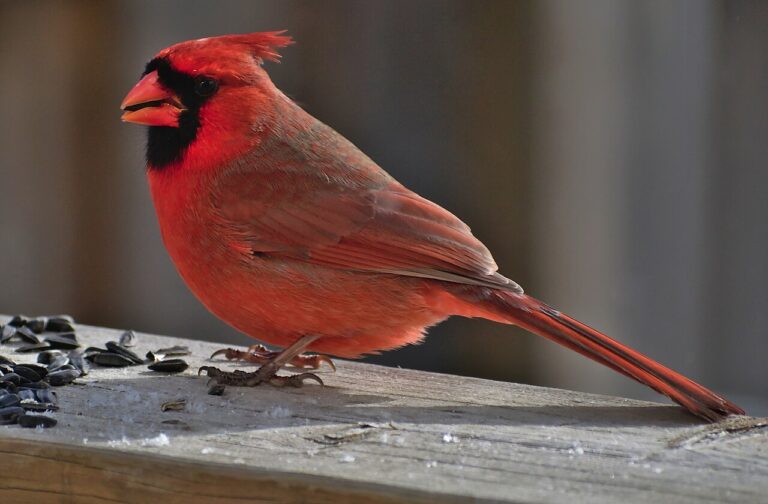
The most familiar bird with a red bill in North America. Male and female Northern Cardinals both have thick conical orange-red bills designed for cracking seeds. The bill color is consistently orange-red throughout the year. Juveniles have dark bills that turn orange-red as they mature.
Range: Eastern and central US year-round.
Habitat: Backyards, woodland edges, parks, gardens.
Key ID: Thick orange-red conical bill + crested head + red body (male) or tan body (female). The bill shape (conical) is distinctive from longer red bills.
Where to see: Backyard feeders with sunflower or safflower seed. Hopper and platform feeders preferred.
American Oystercatcher
A striking shorebird with a dramatic long red bill. American Oystercatchers have a long, blade-like bright red bill (3+ inches long), black head and neck, brown back, and white underparts. The bill is used to pry open mussels and oysters.
Range: Atlantic and Gulf Coasts.
Habitat: Coastal beaches, mudflats, oyster bars.
Key ID: Very long bright red bill + black-and-brown plumage + coastal habitat. The longest red bill in North America.
Where to see: Coastal beaches and mudflats. Most active during low tide.
Black Skimmer
A unique seabird with a remarkable bill structure. Black Skimmers have a long, knife-like bill with a bright red base and black tip. Uniquely, the lower mandible is significantly longer than the upper, the only bird in the world with this feature, used for skimming the water surface for fish.
Range: Atlantic and Gulf Coasts year-round.
Habitat: Coastal lagoons, sounds, calm coastal waters.
Key ID: Red-and-black bill with longer lower mandible + black above, white below. Distinctive flying behavior, skimming the water surface.
Where to see: Watch them fly over calm coastal water with their lower bill in the water.
Common Tern
A common coastal tern. Breeding Common Terns have an orange-red bill with a black tip, black cap, gray upperparts, and white underparts. The black tip on the bill is a key field mark distinguishing them from other terns.
Range: Continent-wide coastal areas in summer.
Habitat: Coastal beaches, inland lakes, coastal lagoons.
Key ID: Orange-red bill with black tip + black cap + medium size. Most widespread tern in the US.
Where to see: Coastal beaches and inland lakes during summer breeding season.
Royal Tern
A large tern with a distinctive bill. Royal Terns have a large bright orange-red bill (no black tip), shaggy black crest (more prominent in non-breeding), and gray-and-white plumage. Larger than Common Tern.
Range: Atlantic and Gulf Coasts year-round.
Habitat: Coastal beaches, lagoons.
Key ID: Large bright orange-red bill (no black tip) + larger than Common Tern + shaggy crest. Common at Atlantic and Gulf Coast beaches.
Where to see: Atlantic and Gulf Coast beaches. Often resting in mixed flocks with other terns.
Caspian Tern
The largest tern in the world. Caspian Terns have a massive bright coral-red bill (the largest bright red bill on any tern), black cap, gray-and-white plumage. The bill is so large it looks almost out of proportion with the body.
Range: Continent-wide coastal and inland waters.
Habitat: Coastal beaches, inland lakes, large rivers.
Key ID: Huge bright coral-red bill + largest tern size (21 inches) + black cap. The most obvious bright red bill among terns.
Where to see: Both coastal and inland waters. More widespread than other terns.
Forster’s Tern
Similar to Common Tern but with distinctive features. Breeding Forster’s Terns have an orange bill with a slight black tip (less than Common Tern’s), a paler appearance overall, and a longer pure white tail with deeper fork.
Range: Continent-wide in summer.
Habitat: Coastal beaches, inland lakes, marshes.
Key ID: Orange bill (less black tip than Common Tern) + paler gray + longer tail. Best distinguished by tail length and bill detail.
Where to see: Coastal and inland water bodies during breeding season.
Common Gallinule
A small marsh bird with a striking bill. Common Gallinules have a bright red bill with a yellow tip, red frontal shield extending up the forehead, dark slate-gray body, and white markings on the flanks and undertail.
Range: Eastern and southern US wetlands.
Habitat: Marshes, ponds, slow-moving water with vegetation.
Key ID: Bright red bill with yellow tip + red frontal shield + dark gray body. Walks on lily pads.
Where to see: Wetlands with cattails and aquatic vegetation. Often quite tame.
Purple Gallinule
A spectacular tropical marsh bird. Purple Gallinules have a bright red bill with yellow tip (similar to Common Gallinule), pale blue frontal shield, brilliant purple-blue head and underparts, green back, and yellow legs.
Range: Southeastern US (Florida year-round, Gulf Coast in summer).
Habitat: Freshwater marshes with floating vegetation.
Key ID: Red-and-yellow bill + purple-blue plumage + yellow legs. One of the most colorful North American birds.
Where to see: Florida wetlands. Often walks on lily pads.
Black-Bellied Whistling-Duck
A distinctive tropical duck. Black-Bellied Whistling-Ducks have a bright pink-red bill, long pink legs, chestnut-colored body, gray face with white eye-ring, and black belly. They often perch in trees.
Range: Southern US year-round.
Habitat: Wetlands, ponds, agricultural areas with water.
Key ID: Pink-red bill + chestnut body + black belly + long pink legs. Often heard (‘whistling’ call) before seen.
Where to see: Southern US wetlands, often in trees rather than on water.
Roseate Spoonbill
A spectacular pink wading bird with a unique bill. Roseate Spoonbills have a gray-pink spoon-shaped bill (uniquely flat and rounded at the tip), brilliant pink body, white neck, and bare green-gray head. Often confused with flamingos.
Range: Gulf Coast, Florida, parts of Texas.
Habitat: Coastal marshes, mangrove swamps, lagoons.
Key ID: Spoon-shaped pink bill + brilliant pink body + bald head. Unmistakable. (Note: bill is more pink than red, but commonly grouped with red-billed birds.)
Where to see: Florida and Gulf Coast wetlands. Striking pink color visible from a great distance.
Pyrrhuloxia (NOT actually red-billed)
Often searched for as a ‘red-billed bird’ because it looks similar to Northern Cardinal. The Pyrrhuloxia actually has a YELLOW bill, not red. The body has reddish wash on face, crest, breast, and wings, but the bill itself is bright yellow.
Range: Southwestern desert (Arizona, New Mexico, southern Texas).
Habitat: Desert scrubland, mesquite thickets.
Key ID: YELLOW bill (not red) + gray body with red highlights + crest. Cardinal-like silhouette but different bill color.
Where to see: Southwest desert. Visit cardinal-friendly feeders in their range.
Attracting Red-Billed Birds
Different red-billed birds have very different habits:
Northern Cardinal: The classic red-billed feeder bird. Sunflower or safflower seed in hopper or platform feeders. Native shrubs for nesting cover.
Pyrrhuloxia (yellow bill): Same approach as Cardinal, sunflower and safflower seed in Southwest yards.
Coastal/waterbirds (Oystercatcher, Skimmer, Terns, Gallinules, Spoonbill, Whistling-Duck): Don’t visit yards or feeders. These are habitat-specific birds. To see them, visit appropriate coastal or wetland habitats.
Tip for waterbird viewing: Coastal national wildlife refuges, state parks with wetlands, and Audubon sanctuaries are the best places to see these dramatic red-billed species. Bring binoculars for close viewing.
Conservation note: Several red-billed waterbirds (Black Skimmer, Roseate Spoonbill) have been affected by habitat loss and disturbance. Visit sites that protect their habitats.
What Bird Is Black With a Red Beak?
A black bird with a red bill in North America is most likely an American Oystercatcher on the coast, a Common Gallinule on fresh water, or a Black Skimmer if the bill is red at the base and black at the tip. Habitat separates them before you need any other field mark.
The American Oystercatcher is a heavy shorebird with a black head, dark brown back, white belly and a long straight bill that is genuinely carrot orange-red, used to pry open shellfish. The Common Gallinule is a dark slate marsh bird with a red frontal shield running up onto the forehead above a red bill tipped yellow, swimming among reeds. Inland, the same description sometimes belongs to a domestic Muscovy duck with red facial skin, which is not a wild species at all.
Brown Birds With a Red Beak
A brown bird with a red or orange bill is usually a female Northern Cardinal, which has the same heavy coral-red cone bill as the male but a warm buff-brown body with red washes on the crest, wings and tail. It is by far the most common answer at a feeder.
Two others turn up regularly. The female Pyrrhuloxia of the southwest is gray-brown with a stubby, strongly curved yellow to orange bill. Juvenile terns and gulls can show a dull orange-red bill while still in mottled brown first-year plumage, which throws people who expect a clean gray and white adult. Audubon’s American Oystercatcher account is a good reference for bill color and shape at different ages.
Frequently Asked Questions
What’s the most common bird with a red beak?
Northern Cardinal, the most familiar red-billed bird across the eastern and central US. Both males and females have thick orange-red conical bills. Common at backyard feeders and one of the easiest red-billed birds to observe.
What’s the difference between Northern Cardinal and Pyrrhuloxia’s bill?
Cardinal’s bill is orange-red. Pyrrhuloxia’s bill is YELLOW. Despite Pyrrhuloxia being called the ‘desert cardinal,’ it does NOT have a red bill. This is a common mistake, both birds have similar body shape and crest, but bill color reliably distinguishes them.
What waterbird has the longest red bill?
American Oystercatcher has the longest bright red bill of any common North American bird, 3+ inches of dramatic blade-like red bill used for prying open shellfish. Caspian Tern has the largest red bill among terns.
What bird has a red bill with a yellow tip?
Common Gallinule and Purple Gallinule both have bright red bills with yellow tips. Common Gallinule has dark gray body; Purple Gallinule has spectacular purple-blue plumage with green back. Both inhabit wetlands and walk on floating vegetation.
Why do birds have red bills?
Red bill color often signals sexual maturity and breeding condition, birds with more vivid red bills attract better mates. Red coloration comes from carotenoid pigments (similar to red feathers). Some species’ bill colors intensify during breeding season and fade outside it.
What’s that black bird with a red bill skimming the water?
Black Skimmer, a unique seabird with the only asymmetric bill in the world (lower mandible longer than upper). They fly low over water with the lower bill cutting the surface to catch small fish. Found on Atlantic and Gulf Coasts.
Are flamingos common in North America?
No, wild American Flamingos are rare in the US, found primarily in southern Florida and occasionally other Gulf Coast locations. Pink wading birds in the US are typically Roseate Spoonbills, not flamingos. The spoon-shaped bill of the Spoonbill versus the bent/hooked bill of the flamingo distinguishes them.
Related reading: Birds with Long Tails.
Related reading: Birds with Crests.