Birds with Long Tails: 12 Common Species in North America (2026)
Birds with long tails are some of the easiest to identify by silhouette alone. In North America the standouts are grackles, magpies, the Scissor-Tailed Flycatcher, mockingbirds, thrashers, roadrunners, and pheasants. Here are twelve long-tailed birds and the shape, color, and behavior that set each one apart.
A long tail dramatically changes a bird’s silhouette and makes for unmistakable identification from a distance. From the keel-shaped tails of grackles to the flowing streamers of Scissor-Tailed Flycatchers, long-tailed birds span multiple families. Some use long tails for display and courtship; others use them for maneuverability in flight, balance while perching, or social signaling. This guide covers 12 common North American birds with notably long tails, defined as tails that appear long relative to the body. Quick identification keys: shape (keel/fan/forked/pointed), color (iridescent black, white markings, etc.), and habitat.
The long-tailed birds of North America are grackles, magpies, the Scissor-tailed Flycatcher, mockingbirds, thrashers, roadrunners and pheasants. Tail shape narrows it fast: deeply forked means scissor-tail, keel-shaped means grackle, and long with white edges flicked while foraging means mockingbird.
Quick Reference: 12 Birds with Long Tails at a Glance
| Species | Size | Tail Description | Range |
|---|---|---|---|
| Mourning Dove | 12″ | Long pointed tail with white edges | Continent-wide |
| Common Grackle | 12.5″ | Long keel-shaped (V-shape) tail | Eastern US |
| Great-Tailed Grackle | 17″ | Very long keel tail (male) | SW US, expanding |
| Boat-Tailed Grackle | 16.5″ | Very long keel tail | Coastal SE US |
| Black-Billed Magpie | 19″ | Very long pointed tail, half the body length | Western US |
| Yellow-Billed Magpie | 16.5″ | Long pointed tail + yellow bill | California only |
| Scissor-Tailed Flycatcher | 13″ | Extremely long forked tail (streamers) | South-Central US |
| Northern Mockingbird | 10″ | Long with white outer feathers in flight | Continent-wide |
| Brown Thrasher | 11.5″ | Long curved tail + yellow eye | Eastern US |
| Greater Roadrunner | 23″ | Very long pointed tail + ground bird | Southwest desert |
| Ring-Necked Pheasant | 21″ | Extremely long pointed tail (male) | Northern US |
| Yellow-Billed Cuckoo | 12″ | Long tail with white spots underneath | Eastern US |
Species Identification
Mourning Dove
One of the most familiar yard birds in North America. Mourning Doves have a sleek tan-brown body, small head, and a distinctive long pointed tail with white edges. The tail makes up nearly half the body length and the white tail edges flash in flight.
Range: Continent-wide year-round.
Habitat: Open habitat, suburbs, farms, parks, yards.
Key ID: Long pointed tail + small head + tan-brown body. Distinctive whistling wings in flight.
Where to see: Ground feeders or platform feeders with mixed seed. Often in pairs.
Common Grackle
A common backyard bird with a distinctive long tail. Common Grackles have iridescent purple-blue-green sheens on a dark body, a yellow eye, and a long keel-shaped tail (V-shaped or boat-shaped from below).
Range: Eastern US year-round.
Habitat: Open habitat, lawns, parks, agricultural fields.
Key ID: Long keel-shaped tail + iridescent dark body + yellow eye. Larger than Red-Winged Blackbirds.
Where to see: Common backyard visitor. Will visit any feeder with corn, sunflower, or peanut pieces.
Great-Tailed Grackle
A southwestern grackle with an exceptionally long tail. Male Great-Tailed Grackles are glossy black with a very long keel-shaped tail (almost as long as the body) and bright yellow eyes. Range expanding rapidly northward.
Range: Southwestern US, expanding north into Midwest.
Habitat: Open areas, agricultural lands, parks, parking lots.
Key ID: Very long tail (longer than Common Grackle) + larger size + glossy black + yellow eye.
Where to see: Common in Southwestern cities and towns. Often in noisy flocks.
Boat-Tailed Grackle
A southeastern coastal grackle. Male Boat-Tailed Grackles are similarly long-tailed and glossy black, with a yellow eye in northern populations (some southern populations have dark eyes). Coastal habitat distinguishes it from Common Grackle.
Range: Atlantic and Gulf Coasts.
Habitat: Coastal areas, marshes, saltwater habitats.
Key ID: Very long keel-shaped tail + glossy black + coastal habitat. Range overlaps with Great-Tailed in Texas.
Where to see: Coastal Southeast. Often in parking lots near beaches and marshes.
Black-Billed Magpie
A spectacular western corvid with a long iridescent tail. Black-Billed Magpies have black-and-white plumage with iridescent blue-green wing and tail feathers. The very long tail is half the bird’s total length.
Range: Western US year-round.
Habitat: Open habitat with scattered trees, ranches, towns.
Key ID: Very long iridescent tail + bold black-and-white pattern + western range. Unmistakable.
Where to see: Western US, especially the Rocky Mountain region. Common in towns and ranches.
Yellow-Billed Magpie
A California specialty. Yellow-Billed Magpies look nearly identical to Black-Billed Magpies but have a distinctive yellow bill and yellow patch around the eye. Found only in California’s Central Valley and adjacent areas.
Range: California only (Central Valley and Coast Ranges).
Habitat: Open oak woodlands, agricultural areas.
Key ID: Yellow bill + California range. Otherwise identical to Black-Billed Magpie.
Where to see: California Central Valley. Endangered by West Nile virus, populations declining.
Scissor-Tailed Flycatcher
Perhaps the most spectacular long-tailed bird in North America. Adult Scissor-Tailed Flycatchers have extraordinarily long forked tails (longer than the body) with pinkish flanks and pale gray bodies. The state bird of Oklahoma.
Range: South-central US (Texas, Oklahoma, surrounding states) in summer.
Habitat: Open habitat with scattered trees, fields, ranches, roadsides.
Key ID: Extremely long forked tail (streamers) + pale gray body + pink flanks. Often perches on fence lines.
Where to see: Open habitat in Texas/Oklahoma during summer. Easy to spot perched on fences.
Northern Mockingbird
A familiar songbird with a notably long tail. Northern Mockingbirds have gray-white plumage with darker wings, bold white wing flashes visible in flight, and a long tail that they often hold cocked upward when perched.
Range: Continent-wide year-round.
Habitat: Suburban yards, parks, open habitat with scattered shrubs.
Key ID: Long tail + gray-white + white wing flashes in flight. Often holds tail upward.
Where to see: Suburban yards. Listen for their varied songs, often imitating other birds.
Brown Thrasher
A large brown bird with a distinctive long, downcurved tail. Brown Thrashers have rich rust-brown upperparts, bright yellow eyes, heavily streaked breast, and a tail that’s often cocked upward, looking longer than expected.
Range: Eastern US year-round.
Habitat: Dense thickets, hedgerows, brushy areas.
Key ID: Large size + long curved tail + yellow eye + heavily streaked breast. Bigger than most songbirds.
Where to see: Listen for their varied song from dense brush. Often heard but not seen.
Greater Roadrunner
An iconic Southwestern bird with a very long pointed tail. Greater Roadrunners have streaked brown-and-buff plumage, a long pointed tail held horizontally, large feet for running, and a small crest. The state bird of New Mexico.
Range: Southwestern US year-round.
Habitat: Desert scrubland, open arid country.
Key ID: Long pointed tail + running on ground + crested head + desert habitat. Unmistakable.
Where to see: Southwest desert habitats. Often seen running across roads (hence the name).
Ring-Necked Pheasant
An introduced game bird with the longest tail of any non-tropical bird in North America. Male Ring-Necked Pheasants have colorful plumage and extremely long pointed tails that can reach 20 inches in length.
Range: Northern US year-round (introduced from Asia).
Habitat: Agricultural fields, grasslands, brushy areas.
Key ID: Extremely long pointed tail + colorful body + ground bird. Often heard (‘cackling’ call) before seen.
Where to see: Agricultural areas in the northern US. Often along roadsides at dawn and dusk.
Yellow-Billed Cuckoo
A subtle, secretive bird with a long, distinctive tail. Yellow-Billed Cuckoos have warm brown upperparts, white underparts, a yellow lower mandible, and a long tail with bold white spots underneath (visible from below).
Range: Eastern US in summer.
Habitat: Deciduous forests with dense understory.
Key ID: Long tail with white spots underneath + yellow bill + slim body. Often slim and hidden in foliage.
Where to see: Eastern forests in summer. Listen for their distinctive ‘kowp-kowp-kowp’ call.
Attracting Long-Tailed Birds to Your Yard
Different long-tailed birds respond to different attractants:
Mourning Dove: Ground or platform feeders with mixed seed, millet, sunflower, or cracked corn. Often in pairs.
Grackles (Common, Great-Tailed, Boat-Tailed): Will visit any feeder. Many birders consider them nuisance species, use feeders designed to exclude larger birds if undesirable.
Magpies (Black-Billed, Yellow-Billed): Will visit platform feeders with peanuts and meat scraps. More common in rural Western settings.
Scissor-Tailed Flycatcher: Doesn’t visit feeders. Provide open habitat with scattered perches.
Northern Mockingbird: Visits fruit feeders (grape jelly, raisins), suet, and mealworms. Plant native berry-producing shrubs.
Brown Thrasher: Offer mealworms and suet. Dense thickets for cover.
Greater Roadrunner: Desert-specific habitat. Will visit yards with mealworms in their range.
Ring-Necked Pheasant: Will visit cracked corn scattered on the ground in rural areas.
Yellow-Billed Cuckoo: Doesn’t visit feeders. Provide mature deciduous trees and pesticide-free yards (they eat caterpillars including pest species).
What Bird Has a Long, Skinny Tail?
A long, narrow tail on a slim body points to one of four groups in North America. Mockingbirds and thrashers carry a long straight tail on a gray or brown body and spend most of their time low in shrubs. Grackles have a longer tail still, but it is keeled, folding into a V shape in flight, which no thrasher does.
The Scissor-tailed Flycatcher is the extreme case: a pale gray bird with salmon-pink flanks and streaming tail forks that can be longer than the rest of the bird, usually seen perched on fence wires across the south-central states. Magpies are unmistakable once seen, black and white with a long iridescent green-black tail. Roadrunners and Ring-necked Pheasants add a fifth silhouette, both ground birds with long stiff tails held straight behind them while running.
Brown Birds With Long Tails
Most reports of a brown bird with a long tail resolve to a Brown Thrasher in the east or a Curve-billed Thrasher in the southwest. Both are rufous or gray-brown, heavily streaked below, with a long tail and a yellow eye, and both skulk in dense cover rather than perching in the open.
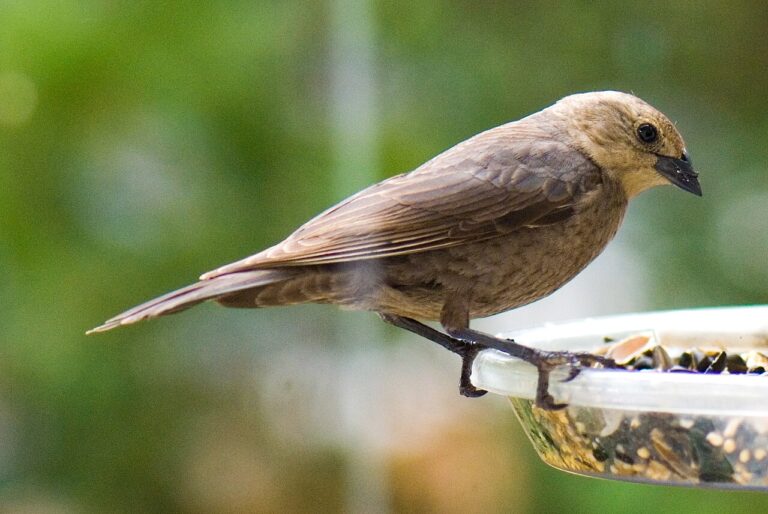
Two others come up often. A female Ring-necked Pheasant is a large mottled brown ground bird with a long pointed tail, far bigger than any thrasher. A female Great-tailed Grackle is warm brown rather than black, with the same long keeled tail as the male but at roughly two-thirds the size, which regularly gets reported as an unfamiliar species. Audubon’s Scissor-tailed Flycatcher account is a useful size reference for judging tail length against body length.
Frequently Asked Questions
What bird has the longest tail in North America?
The male Ring-Necked Pheasant has the longest tail of any common North American bird, up to 20 inches long. Among native species, the Scissor-Tailed Flycatcher has dramatic tail streamers (8-9 inches on top of a 6-inch body). The Greater Roadrunner has a very long tail relative to body size.
Why do some birds have such long tails?
Long tails serve multiple functions: sexual display (males with longer tails attract more mates in some species), maneuverability in flight, balance while perching, and visual signaling within social groups (like grackle flocks). The Scissor-Tailed Flycatcher’s tail is primarily a display feature, males use it during aerial courtship displays.
What’s the difference between Common and Great-Tailed Grackle?
Great-Tailed Grackles are larger (17 inches vs 12.5 inches) and have proportionally longer tails. Range used to be a reliable distinguisher (Great-Tailed in SW only) but Great-Tailed has expanded rapidly north and now occurs throughout the Midwest. Females are noticeably different, Great-Tailed females are tan-brown while Common Grackle females are dark.
What long-tailed bird lives in California only?
Yellow-Billed Magpie, found only in California’s Central Valley and adjacent areas. Endangered by West Nile virus. Black-Billed Magpie has a wider Western range but doesn’t occur in California’s Yellow-Billed Magpie range.
Does a long tail help birds fly?
Yes, in specific ways. Long tails increase maneuverability, making it easier to make sharp turns and steer through complex environments (forest canopy, swarms of insects). However, long tails also create drag, making sustained flight more energy-expensive. Birds with long tails often combine flight with frequent perching.
What’s the small bird with white stripes in its tail?
Most likely Northern Mockingbird, gray-white plumage with bold white wing flashes AND white outer tail feathers visible in flight. The white markings are the most visible field marks.
Do all long-tailed birds visit feeders?
No. Mockingbirds, mourning doves, grackles, and magpies will visit feeders. Scissor-Tailed Flycatcher, Yellow-Billed Cuckoo, and many other long-tailed birds are insectivores that don’t typically visit seed feeders. Habitat-specific birds (Roadrunner, Pheasant) only visit yards in their specific ranges.
Related reading: Birds with Red Beaks.
Related reading: Birds with Striped Heads.
Related reading: how long do betta fish live.