Bird Feeder Not Working? 12 Causes and How to Fix Each One
You set up a feeder. You did everything right, at least, you thought so. But the birds aren’t coming, or they were coming and suddenly stopped. Whether your bird feeder is not working because birds ignore it or because the feeder itself is clogged or broken, the problem is almost always one of twelve specific causes, and you can fix each one, and the fix usually takes minutes once you’ve identified the right one. This guide walks through each cause systematically, in roughly the order of how often it’s the actual culprit, with the diagnostic question and the fix for each. Start with the first cause that matches your situation and stop reading when one of them clicks.
A bird feeder that is not working is almost always too new or filled with the wrong seed. Birds need 2 to 6 weeks to find and trust a new feeder, and longer in winter. Switch generic mix for black oil sunflower, then leave the feeder alone.
First, Identify Your Scenario
There are two completely different versions of “no birds at my feeder,” and they have different causes.
Scenario A: My new feeder has never attracted birds. It’s been up for days or weeks, and no birds have visited. This is the most common situation for new backyard birders and is almost always a setup issue, wrong placement, wrong seed, or simple time required.
Scenario B: Birds were coming, but suddenly stopped. You had regular activity, then within a few days it dropped to zero. This is almost always an environmental change, a predator nearby, food source shift, or seed/water problem.
The diagnostic causes below are arranged for both scenarios. We’ll flag which ones tend to apply to each.
If you haven’t yet set up your feeder following best practices, the step-by-step guide to attracting birds to a feeder covers the right initial setup.
Cause 1: Your Feeder Is Too New (Most Common)
This is the single most common cause of “no birds at my new feeder.” New feeders typically take 1 to 3 weeks before birds find them, trust them, and visit reliably. Some yards see first visitors in days; others take a month. Anything under 4 weeks of waiting is normal and not a problem.
The diagnostic question: How long has the feeder been up?
- Under 2 weeks: Be patient. Don’t change anything yet. The discovery process is still happening.
- 2 to 4 weeks: Still normal, especially if your yard is in an area with low existing bird traffic. Check the other causes below as a precaution.
- Over 4 weeks: Something is genuinely wrong. Run through the remaining causes systematically.
Applies to: Scenario A. Not relevant for Scenario B (sudden stops).
Cause 2: Wrong Seed (Generic “Wild Bird Mix”)
The second most common cause. Most cheap “wild bird mix” sold in grocery stores and hardware stores is heavy on filler seeds, milo, red millet, cracked corn, wheat, that backyard songbirds either ignore or eat reluctantly. The good seeds get picked out; the rest accumulates on the ground.
The diagnostic question: What seed is in your feeder right now?
- If it’s a generic mixed seed: Replace with single-ingredient black oil sunflower seed. This single change resolves more “no birds” problems than any other intervention.
- If you’re using black oil sunflower already: Skip to Cause 3.
- If you’re using thistle/nyjer: Make sure it’s not stale. Once a bag is open, nyjer goes stale within 6 to 8 weeks. Stale nyjer is one of the most common reasons goldfinches stop visiting.
The complete bird seed guide covers every seed type and the species each one attracts.
Applies to: Both scenarios. For Scenario B (sudden stop), check if seed has gotten wet or moldy.
Cause 3: Feeder Placement Is Wrong
The third most common cause, and the one most beginners don’t realize matters. Birds need cover within 10 to 15 feet of the feeder. Without it, they feel exposed to predators and avoid visiting. Yards with treeless lawns or feeders placed in the middle of open space see far less activity than the same feeder placed near a shrub or tree.
The diagnostic checklist:
- Within 10 feet of dense cover? Required for safety.
- Within 30 feet of the house? Closer than 30 feet (but more than 3 feet) is the window-strike danger zone. Most feeders should be either under 3 feet from a window (where birds can’t reach injurious speed) or more than 30 feet away.
- Visible from passing flight paths? A feeder tucked under heavy overhead foliage may be invisible to passing birds.
The fix: move the feeder. Frequent moves restart the discovery process, so commit to a new location for at least 3 to 4 weeks before judging.
You’ll sometimes see references to a “5-7-9 rule” for bird feeders online. This isn’t an established rule from any major ornithological organization (Cornell Lab, National Audubon, American Bird Conservancy). The actual evidence-based distances are: feeders should be within 10 to 15 feet of cover, and either under 3 feet or over 30 feet from windows. Anything beyond that varies by yard, climate, and species.
Applies to: Both scenarios. For Scenario B, has anything in the yard changed recently, was cover removed, was the yard mowed extra-short, did a tree come down?
Cause 4: Predator Activity (Especially Cats)
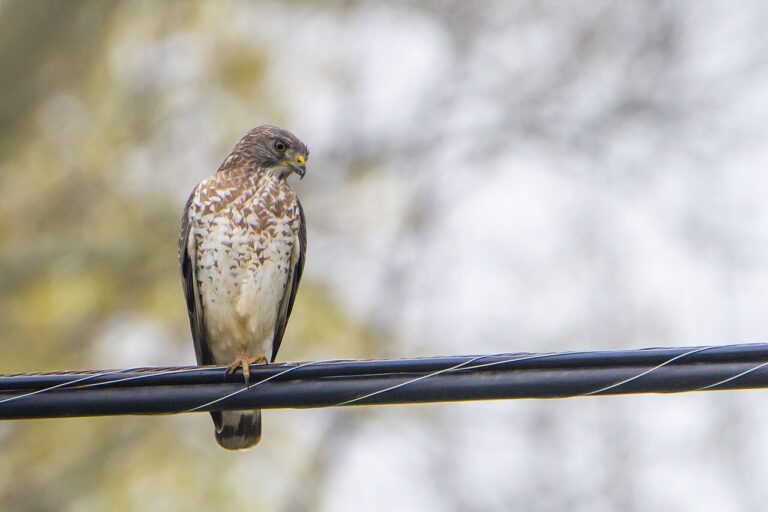
Outdoor cats and Cooper’s Hawks suppress feeder activity dramatically. A cat that regularly patrols your yard can shut down feeder traffic entirely; birds learn quickly that yards with cats are dangerous and avoid them.
The diagnostic question: Have you seen outdoor cats in the yard? Has a hawk been in the neighborhood?
- If yes to cats: This is likely your cause. Solutions: physical fencing, scare devices, motion-activated sprinklers, and complaints to neighbors with outdoor cats. Indoor-only cat ownership is the only complete solution.
- If yes to a hawk: Cooper’s Hawks specifically target feeders. Birds will sometimes vacate a feeder for 1 to 2 weeks if a hawk has been patrolling, then return. Move the feeder location to a different yard area; the hawk usually shifts territory.
Applies to: Both scenarios, but especially Scenario B (sudden stops often happen when a hawk starts patrolling).
Cause 5: Dirty Feeder or Spoiled Seed
Birds avoid feeders with rotten or moldy seed. Wet seed mats together, develops black mold, and can transmit avian disease. A feeder that started clean but hasn’t been refilled or cleaned in 3+ weeks often becomes a repellent rather than an attractant.
The diagnostic check: Open your feeder right now and look at the seed.
- Black or fuzzy mold visible: Empty completely, scrub the feeder with 1:9 bleach-to-water solution, rinse thoroughly, dry completely, refill with fresh seed.
- Strong musty or sour smell: Same as above.
- Clumped, wet seed: Same as above. The dampness is preventing flow and breeding fungus.
- Looks fine: Move to the next cause.
Cleaning schedule going forward: every 2 weeks normally, weekly during damp or hot weather, immediately if you see sick birds in your yard. The bird feeders guide covers full maintenance protocols.
Applies to: Both scenarios. Often the cause of “sudden stops” because birds notice spoilage before humans do.
Cause 6: No Water Source Nearby
A feeder without water often attracts limited species. Robins, thrushes, warblers, orioles, and many other species visit yards primarily for water. Without it, your visible bird traffic is restricted to seed-only species, which may be a small subset of what’s actually in your neighborhood.
The diagnostic question: Is there a clean water source within 15 feet of your feeder?
- No: Add even a shallow ceramic saucer (1.5 to 2 inches deep) of water. Refresh every 1 to 3 days. This single addition often doubles species variety within 2 to 4 weeks.
- Yes, but stagnant: Refresh it. Stagnant water repels rather than attracts.
The complete bird baths guide covers water source options at every budget.
Applies to: Scenario A primarily. For Scenario B, has your existing water source dried up or become contaminated?
Cause 7: Wrong Time of Year
Bird activity at feeders varies dramatically by season. Summer is the hardest season for new feeders because nesting birds are spread out across territories, focused on insect protein for nestlings, and less interested in seed feeders. Winter and early spring see the highest feeder traffic.
The seasonal reality:
- Summer (June, August): Lower feeder activity in most regions. Birds focus on insects for nesting and use feeders less. Don’t expect winter-level traffic.
- Fall (September, November): Activity ramps up as migrants pass through and resident birds prepare for winter.
- Winter (December, February): Peak feeder activity. Natural food is scarce, birds depend on supplemental feeding.
- Spring (March, May): Active again, especially during migration. Many transient species pass through.
If you started your feeder in midsummer and nothing’s happening, this is likely your cause. Wait until fall or winter; the feeder will work then.
Applies to: Scenario A primarily.
Cause 8: Competition from Established Feeders
Neighbors with well-established feeders hold the local bird population. Local birds learn where reliable food sources are and stay loyal to them. A new feeder in a neighborhood saturated with established feeders may take much longer to attract birds.
The diagnostic question: Do you know of any neighbors with active feeders within a few houses’ radius?
- Yes: Patience is the answer. Birds will eventually expand their territory to include your feeder, but it can take 1 to 3 months instead of 1 to 3 weeks.
- No idea: Take a walk around the block and look. Active feeders are easy to spot.
Applies to: Scenario A. For Scenario B, did a neighbor recently start a new, better feeder? You may be losing your birds to better competition.
Cause 9: Squirrel or Wildlife Disturbance
Heavy squirrel, raccoon, or chipmunk activity at a feeder can scare off birds. Birds avoid feeders where they have to share with aggressive mammals, especially when those mammals throw the feeder around or knock it down. Some squirrels are also outright aggressive toward birds.
The diagnostic check:
- Is the feeder being emptied or knocked down regularly? Squirrels.
- Are pieces of the feeder chewed or missing? Squirrels or raccoons.
- Is the area below the feeder a churned-up mess of dropped seed and tracks? Ground-level wildlife.
The fix: pole-mounted feeder with a baffle. See the squirrel-proof bird feeders guide for specific products.
Applies to: Both scenarios. For Scenario B, did squirrels recently figure out access to your feeder?
Cause 10: Pesticide Use or Yard Chemistry
A chemically-treated yard supports fewer birds than an untreated one. Pesticides kill the insects that nesting birds feed to their young. Herbicides eliminate the “weeds” (dandelions, plantain, native sedges) that produce edible seeds. Long-term yard chemistry shifts the entire bird-carrying capacity of your local environment.
The diagnostic question: Has your yard been recently treated with pesticides, herbicides, or other chemicals? Has a lawn service been at neighboring yards?
- Yes, recently: Reduce or stop treatments going forward. The effect on bird populations isn’t immediate, but birds will return to chemically-clean yards within a season or two.
- No: Skip to the audit checklist below.
This is rarely the only cause but is often a contributing factor. Bird-friendly yards and chemically-managed yards are largely incompatible, especially during nesting season.
Applies to: Long-term scenario. Less relevant for “sudden stop” except after a single major treatment.
Cause 11: The Feeder Itself Is Broken or Clogged (Mechanical Fixes)
Sometimes the feeder is the problem, not the birds. If birds land, peck, and leave, or seed levels never drop, check whether seed is actually dispensing. The most common mechanical failure is moisture: rain or humidity makes seed clump into a solid plug that blocks the feeding ports. Empty the feeder completely, let it dry, discard the clumped seed, and clear each port with a cleaning rod or a thin dowel. A gentle tap on the tube often loosens minor clogs on the spot.
Weight-activated squirrel-proof feeders add a second failure mode: the spring mechanism can jam or the metal leaves that cover the ports can bend out of alignment, closing the ports even when only a small bird lands. Inspect the moving parts, bend covers gently back into shape, and work the mechanism by hand a few times. Mixes with large nuts can also wedge inside these feeders; break oversized pieces up or offer them separately on a platform feeder.
Also check the perches and drainage. A cracked perch keeps birds from landing comfortably, and blocked drainage holes let water pool and spoil seed within a day. Brands like Aspects, Squirrel Buster, and Woodlink cover many of these parts under warranty, so a broken component is often a free replacement rather than a new feeder.
Cause 12: Smart or Camera Feeder Not Working
Camera and AI recognition feeders fail differently: the seed side works, but the electronics stop. If the unit will not power on, charge it for a full 24 hours with a known-good cable before assuming it is dead, since depleted lithium batteries can take hours to show any sign of life. If it powers on but behaves erratically, hold the reset button (usually on the back or underside) for about 10 seconds to reboot the system.
For motion or bird detection problems, clean the sensor and camera lens with a soft dry cloth, since pollen and dust films are the most common cause of missed visits. Connectivity issues are usually band related: most smart feeders only join 2.4 GHz Wi-Fi networks, so create a 2.4 GHz network or enable that band on your router if the app cannot find the feeder. Keep the firmware updated through the app, and if none of this works, contact the manufacturer’s support with your model number, since sensor and battery failures within the warranty period are typically replaced.
The Quick Audit Checklist
If you’re not sure which cause is yours, run through this 60-second checklist:
- ☐ Has the feeder been up at least 2 weeks?
- ☐ Is the feeder filled with black oil sunflower (not generic mix)?
- ☐ Is the feeder within 10 to 15 feet of dense cover?
- ☐ Is the feeder either under 3 feet or over 30 feet from windows?
- ☐ Have you seen outdoor cats in the yard recently?
- ☐ Is the seed visibly fresh (no mold, no clumping, no off-smell)?
- ☐ Is there a water source within 15 feet?
- ☐ Is it currently winter, fall, or spring (not midsummer)?
- ☐ Are squirrels controlled?
- ☐ Is the yard chemical-free (no recent pesticide/herbicide treatments)?
If you have 8+ checkboxes ticked and still no birds after 4 weeks, the cause is likely a local factor we can’t diagnose remotely, neighbor with a much better feeder, persistent hawk, or simply an unusual local situation.
The Coffee Grounds Question
You may have seen viral content suggesting that sprinkling coffee grounds around bird feeders deters squirrels. This circulates regularly online. The honest answer: there’s no reliable evidence that coffee grounds repel squirrels. Some squirrels may avoid them temporarily; others walk right through. The reliable squirrel solution remains a pole-mounted feeder with a baffle.
Coffee grounds also have some real downsides: they can make the soil acidic in concentrated quantities, potentially affecting nearby plants. Used in small amounts as compost, they’re fine. As a squirrel deterrent, they’re at best a placebo.
What Is the 5 7 9 Rule for Bird Feeders?
The 5 7 9 rule is a squirrel proofing guideline for where a feeder hangs: at least 5 ft off the ground, 7 ft from the nearest launch point such as a fence, deck rail, tree trunk or roof edge, and 9 ft below any branch a squirrel could drop from. A gray squirrel can jump roughly that far horizontally and further downward, so a feeder inside that triangle is reachable no matter which baffle you add.
The rule fixes a placement problem, not a bird problem. If squirrels empty the feeder overnight, birds arrive to an empty tube every morning and stop checking it. Move the feeder so all three distances are satisfied, then add a baffle, and only then judge whether the seed or the location is at fault.
What Should You Put on the Ground Under a Bird Feeder?
Put something under the feeder that you can rake or hose down, such as pavers, a gravel tray, mulch you replace each season, or a seed catch tray fitted to the pole. Bare lawn under a busy feeder turns into a mat of hulls and droppings within weeks, and that mat is where spoiled seed, mold and disease transmission start.
Ground feeding birds are part of the calculation too. Juncos, doves and sparrows prefer to feed below a feeder rather than on it, so a swept hard surface or a low platform keeps them coming while giving you a way to clear the waste. Rake the area weekly, and move the feeder a few feet every couple of months if the ground under it will not stay clean.
Why Do People Put a Potato in a Bird Feeder?
There is no evidence that a potato in a feeder does anything for wild birds. The idea travels on social media rather than from any banding station or feeding study, and a raw potato sitting in a seed tube mostly adds moisture, which is the fastest way to spoil the seed around it.
The one piece of truth underneath it is that plain cooked potato is edible for birds. Leftover boiled, baked or mashed potato with no salt, butter or oil appears on the kitchen scraps lists published by the RSPB, and thrushes, starlings and corvids will take it from an open ground tray. That makes it a scraps tray item rather than a feeder item, and it belongs well away from the seed.
Frequently Asked Questions
Why isn’t my new bird feeder attracting birds?
The most common reasons: the feeder is still new (1 to 3 weeks of patience is normal), the seed is generic mix instead of black oil sunflower, the placement is too exposed or too close to windows, there’s no cover within 10 to 15 feet, or it’s midsummer (low feeder season).
Why did birds suddenly stop coming to my feeder?
The most common causes for sudden stops: a Cooper’s Hawk has started patrolling, an outdoor cat is in the yard, the seed has gotten wet or moldy, a neighbor’s new feeder is drawing your birds, or seasonal migration is causing temporary species turnover.
How long should I wait before declaring my feeder a failure?
At minimum 4 weeks. Most setups attract first visitors within 2 to 14 days, with established traffic by week 3 to 4. Yards in low-activity areas may take longer. Don’t give up before week 6 if you’ve followed setup best practices.
What’s the 5-7-9 rule for bird feeders?
It’s a commonly cited rule online but isn’t an established standard from major ornithological organizations. The actual evidence-based distances: feeders should be within 10 to 15 feet of cover, and either under 3 feet or over 30 feet from windows. Other distances vary by yard and species.
Will sprinkling coffee grounds around my feeder deter squirrels?
Not reliably. There’s no robust evidence that coffee grounds repel squirrels. Effective squirrel solutions are physical: pole-mounted feeders with baffles, weight-triggered feeders, or safflower seed (which most squirrels dislike).
Do birds avoid feeders with old or stale seed?
Yes. Stale seed loses oil content and aroma, and moldy seed actively repels birds (and can transmit disease). Sniff-check seed before refilling, fresh seed has a faint nutty smell; stale or moldy seed has a sour or musty smell.
Can outdoor cats really make birds avoid my feeder?
Yes, dramatically. A single regularly-patrolling outdoor cat can shut down feeder activity entirely. Birds learn cat-frequented yards are dangerous and avoid them. This is one of the most-suppressed-but-fixable causes of feeder failure.
Should I move my feeder if no birds are coming?
Not immediately. Frequent moves restart the discovery process. Commit to a new location for at least 3 to 4 weeks before judging. Only move if you’ve identified a specific placement problem (too exposed, too close to windows, in cat-ambush range).
Can I attract birds back after they’ve stopped coming?
Yes, usually within 1 to 4 weeks of fixing the underlying cause. Birds remember good feeders and return once the issue (predator, spoiled seed, disruption) resolves. Trust takes time to rebuild but isn’t permanent.
Should I take down my feeder if no birds come?
Not for at least 4 to 6 weeks. Removing a feeder before discovery completes guarantees failure. If after 6 weeks with proper setup nothing has changed, taking it down for a season and trying again in fall or winter often produces better results than continuing through summer.
How do I fix a bird feeder that is not dispensing seed?
Empty it, discard clumped or wet seed, let the feeder dry, and clear each port with a cleaning rod. On weight-activated feeders, check that the spring mechanism moves freely and the port covers are not bent shut. Refill with dry seed and store your seed supply in an airtight container to prevent repeat clogs.