Backyard Birds of Missouri: 15 Common Species (2026 Identification Guide)
Missouri’s central US location at the convergence of the Mississippi and Missouri Rivers, plus its varied geography from the Ozark Highlands to the bootheel bottomlands to the prairie remnants of the north, creates a richly diverse backyard bird community. The state hosts 430+ recorded bird species, with 30-45 commonly visiting suburban yards. Missouri’s position along the Mississippi Flyway makes spring and fall migration spectacular, Eagle Bluffs Conservation Area and Loess Bluffs National Wildlife Refuge are world-class migration hotspots. From St. Louis to Kansas City to Springfield and the Ozarks, Missouri offers distinctive backyard bird communities by region. This guide covers the 15 most common backyard birds across Missouri with field marks, regional ranges, and proven attraction strategies for the state’s four-season climate.
Quick Reference: 15 Common Backyard Birds of Missouri
| Species | Size | Key ID Feature | Where in MO |
|---|---|---|---|
| Eastern Bluebird (state bird) | 7″ | Blue back + rust breast + white belly | Statewide year-round |
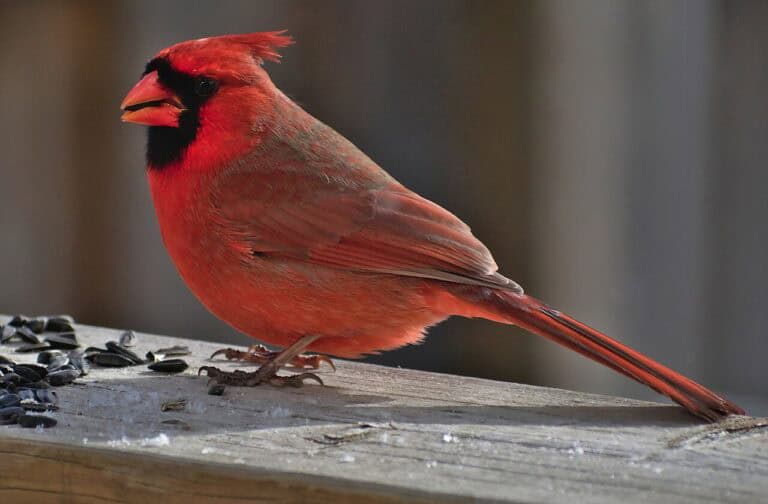
| Northern Cardinal | 8.5″ | All red (male) + crest + black face mask | Statewide year-round |
| Carolina Chickadee | 4.75″ | Black cap + white cheeks + black bib | Statewide year-round |
| Carolina Wren | 5.5″ | Rust-brown + bold white eyebrow | Statewide year-round |
| Tufted Titmouse | 6.5″ | Gray crest + buff flanks + black eye | Statewide year-round |
| Blue Jay | 11″ | Blue crest + black necklace + white below | Statewide year-round |
| Mourning Dove | 12″ | Tan + long pointed tail + small head | Statewide year-round |
| House Finch | 5.5″ | Red head/breast (male) + streaky belly | Statewide year-round |
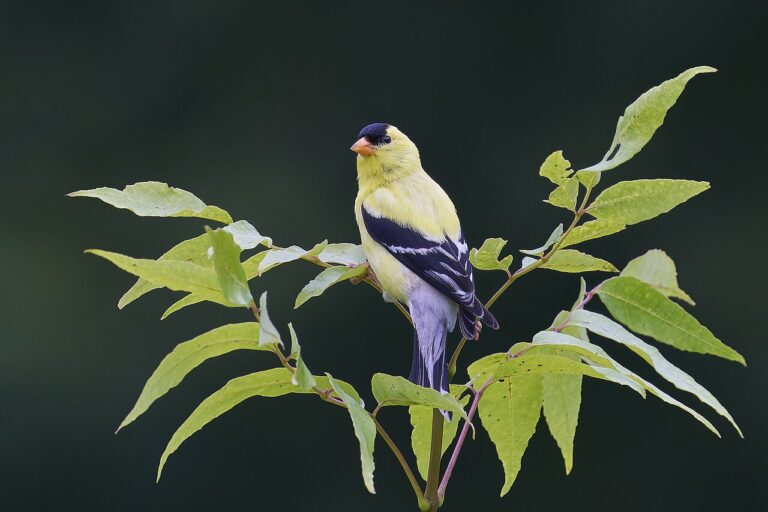
| American Goldfinch | 5″ | All yellow (summer male) + black wings | Year-round |
| Downy Woodpecker | 6.75″ | Small + short bill + checkered wings | Statewide year-round |
| Red-Bellied Woodpecker | 9.25″ | Red cap + zebra back + tan belly | Statewide year-round |
| Dark-Eyed Junco | 6″ | Slate-gray + white belly + pink bill | Winter (Oct-Apr) |
| American Robin | 10″ | Rust-orange breast + gray-brown back | Year-round |
| Ruby-Throated Hummingbird | 3.5″ | Iridescent green + ruby throat (male) | Summer (Apr-Oct) |
| Eastern Phoebe | 7″ | Gray-brown + tail-wagging behavior | Year-round |
Species Identification
Eastern Bluebird (State Bird)
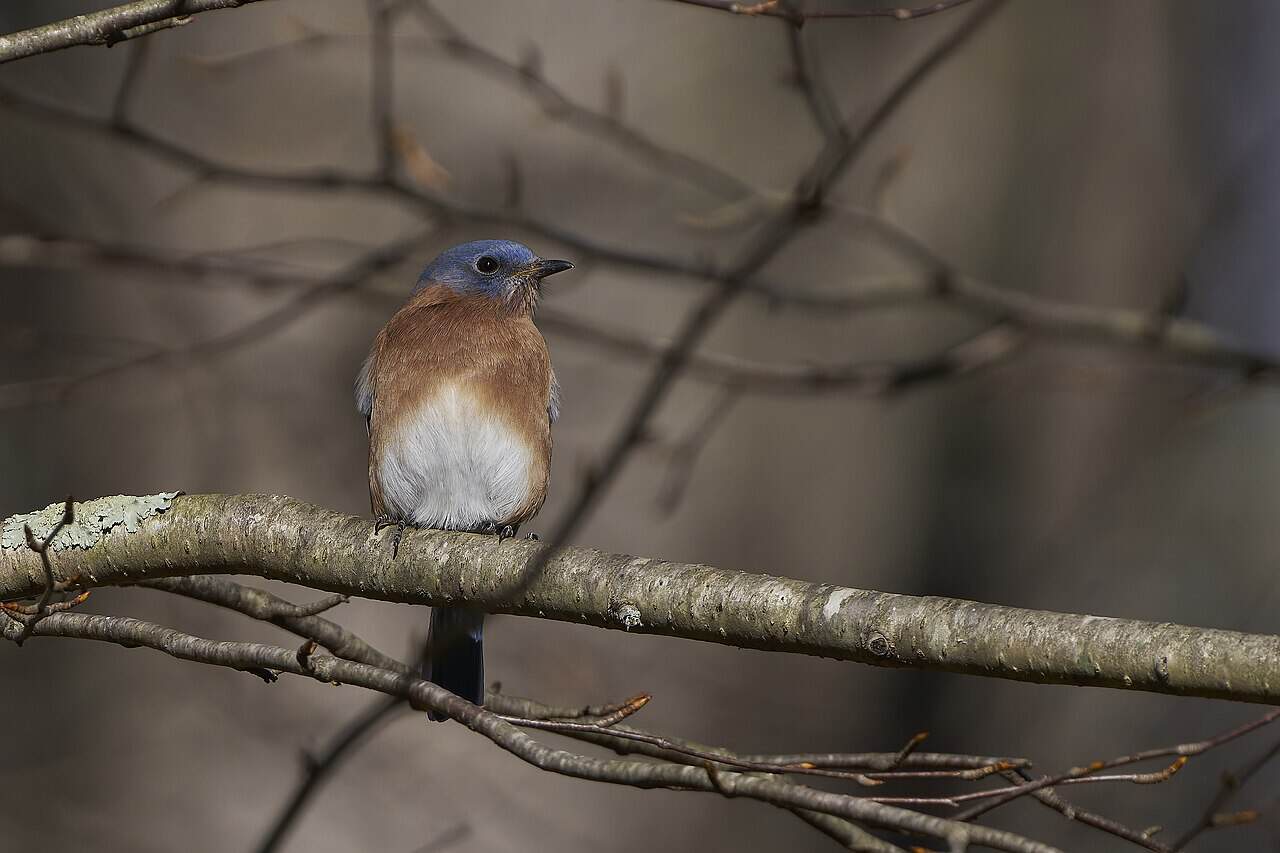
Missouri’s official state bird, designated in 1927. Male Eastern Bluebirds have brilliant royal-blue heads and backs, rust-orange throats and breasts, and clean white bellies. Females are paler. Missouri has very active bluebird trail networks across the state.
Range in Missouri: Statewide year-round.
Habitat: Open habitat with scattered trees, pastures, golf courses, parks, suburbs with old trees.
Key ID: Bright blue back + rust-orange breast + clean white belly.
Where to see: Install NABS-approved bluebird nest boxes on poles in open areas. Provide mealworms. Plant native berry shrubs (Eastern Red Cedar, Winterberry Holly).
Northern Cardinal
Missouri’s beloved year-round red bird. Male Northern Cardinals are brilliant red overall with a pointed red crest, black face mask, and thick orange-red bill. Cardinals are nonmigratory in Missouri.
Range in Missouri: Statewide year-round.
Habitat: Yards with shrubby cover, parks, woodland edges, urban areas with brush.
Key ID: Brilliant red + pointed crest + black face mask + thick orange-red bill (male).
Where to see: Hopper or platform feeders with sunflower or safflower seed.
Carolina Chickadee
Missouri’s small year-round companion. Carolina Chickadees have a black cap, black throat/bib, white cheeks, gray back, and buffy flanks. Missouri is the western edge of Carolina Chickadee range, Black-Capped Chickadees only occur in the very northwest corner.
Range in Missouri: Statewide year-round.
Habitat: Wooded yards, parks, forests.
Key ID: Black cap + black bib + white cheeks + small size.
Where to see: Common at sunflower, peanut, and suet feeders. Will use small nest boxes (1.125 inch hole).
Carolina Wren
Missouri’s loudest backyard voice. Carolina Wrens have rich rust-brown upperparts, buff underparts, and a striking bold white eyebrow stripe. Loud, ringing ‘tea-kettle’ song carries throughout Missouri yards year-round.
Range in Missouri: Statewide year-round.
Habitat: Wooded yards, gardens with brush, edges of forests.
Key ID: Rich rust color + bold white eyebrow + loud voice.
Where to see: Common at suet feeders. Will visit platform feeders. Provide brush piles for cover.
Tufted Titmouse
Missouri’s perky crested feeder companion. Tufted Titmice have a clean gray back, white underparts with buff flanks, a pointed gray crest, large black eyes, and a small black forehead patch.
Range in Missouri: Statewide year-round.
Habitat: Mature deciduous forests, parks, suburban yards.
Key ID: Gray crest + buff flanks + black eye + small size.
Where to see: Common at backyard feeders with sunflower seed, peanuts, and suet.
Blue Jay
Missouri’s familiar crested blue bird. Blue Jays have bright blue heads, wings, and backs (with black markings), white chests, and a prominent blue crest. Loud, intelligent, and dominant at feeders.
Range in Missouri: Statewide year-round.
Habitat: Forests, parks, suburban backyards with mature trees.
Key ID: Blue + black necklace + prominent crest + white below.
Where to see: Platform feeders with peanuts in shell, sunflower seed, and corn.
Red-Bellied Woodpecker
Missouri’s medium woodpecker. Red-Bellied Woodpeckers have a red cap and nape (males) or just red nape (females), a barred black-and-white zebra-pattern back, and tan-buff underparts.
Range in Missouri: Statewide year-round.
Habitat: Wooded yards, parks, forests with mature trees.
Key ID: Red cap/nape + zebra-pattern back + tan belly. The red is on the HEAD, not the belly.
Where to see: Common at suet feeders.
Downy Woodpecker
Missouri’s smallest backyard woodpecker. Clean black-and-white checkered pattern on the wings, white back stripe, white underparts. Males have small red patch on the back of the head.
Range in Missouri: Statewide year-round.
Habitat: Forests, parks, backyards with mature trees.
Key ID: Small size + short bill + checkered pattern + small red nape (male).
Where to see: Common at suet feeders.
American Goldfinch
Missouri’s brightest summer bird. Summer male American Goldfinches are brilliant lemon-yellow overall with jet-black wings and a black cap.
Range in Missouri: Statewide year-round.
Habitat: Open habitat with weeds, gardens, parks, suburban yards.
Key ID: Brilliant yellow (summer male) + black wings + black cap.
Where to see: Nyjer (thistle) feeders. Will also visit sunflower feeders.
Ruby-Throated Hummingbird
Missouri’s only common breeding hummingbird. Male Ruby-Throated Hummingbirds have an iridescent green back and a brilliant ruby-red throat.
Range in Missouri: Statewide in summer (April-October).
Habitat: Gardens, parks, woodland edges with flowering plants.
Key ID: Iridescent green back + ruby throat (male) + tiny size.
Where to see: Hummingbird feeders (4:1 sugar-water ratio, no red dye). Plant native cardinal flower, bee balm.
Eastern Phoebe
Missouri’s common backyard flycatcher. Eastern Phoebes have a grayish-brown body, slightly darker head, white throat and belly with grayish wash on chest, and a distinctive habit of pumping/wagging their tails when perched. They build nests under eaves, bridges, and overhangs.
Range in Missouri: Statewide year-round (some southern Missouri populations) or summer breeding only in northern areas.
Habitat: Yards near water or with eaves/overhangs, woodland edges, parks.
Key ID: Gray-brown + tail-wagging behavior + perches in open + slow head bobs. The tail wagging is diagnostic.
Where to see: Don’t visit feeders but eat insects in your yard. Nest under house eaves, porch overhangs, and bridges. Will use Phoebe nest shelves.
Mourning Dove
Missouri’s most widespread dove. Sleek tan-brown bodies, small heads, and long pointed tails with white edges. Distinctive whistling wing sound on takeoff.
Range in Missouri: Statewide year-round.
Habitat: Open habitat, suburbs, parks, agricultural areas.
Key ID: Tan-brown + long pointed tail + small head.
Where to see: Ground feeders or platform feeders with mixed seed.
Regional Variations Across Missouri
Missouri’s geographic spread creates distinct backyard bird communities. The Ozarks (Springfield, Branson, southern Missouri) host the most distinctive ecosystem. Eastern Phoebes nest abundantly. Pileated Woodpeckers common in mature Ozark forests. Bachman’s Sparrows (declining) in pine-oak woodlands. The Ozarks support 90+ tree species, among the highest tree diversity in eastern North America.
Northern Missouri (Kansas City, St. Joseph, Hannibal) is prairie-influenced. More agricultural landscapes. Eastern Meadowlarks in remnant grasslands. Dickcissels (summer breeding) in prairie patches. Backyards mix typical Cardinal/Chickadee community with occasional grassland species.
Central Missouri (Columbia, Jefferson City) hosts typical Missouri backyard birds with strong river-corridor influence from the Missouri River. Wabash riverine forest species along the river.
St. Louis metro hosts urban-adapted populations. Backyards see typical species at high densities. Spring migration through Forest Park (St. Louis) is famous, woodland warblers concentrate during May migration.
Bootheel region (southeastern Missouri lowlands, New Madrid, Caruthersville) has bottomland hardwood forests and Southern-affinity species. Prothonotary Warblers in bottomlands (summer). Mississippi Kites (summer). Different community than the rest of Missouri.
Loess Bluffs National Wildlife Refuge in northwestern Missouri hosts spectacular waterfowl migration, sometimes a million Snow Geese in late fall. Backyards near the refuge see waterfowl plus typical species.
The Eastern Bluebird: Missouri’s State Bird
The Eastern Bluebird (Sialia sialis) was designated Missouri’s official state bird on March 30, 1927. Missouri is one of two states (with New York) that chose this species. The Eastern Bluebird was chosen as a symbol of happiness and as a reminder of the importance of conservation.
Eastern Bluebird populations crashed dramatically in the early 20th century, from millions to perhaps hundreds of thousands of pairs nationally. Three main threats: competition for nest sites from introduced House Sparrows and European Starlings, pesticide use (especially DDT), and habitat loss. Missouri was among the first states to establish bluebird nest box trail networks to recover populations.
Today, Missouri Eastern Bluebird populations are healthy and increasing, a major conservation success story. The Missouri Bluebird Society and similar organizations maintain thousands of nest boxes statewide. The state’s recovery is celebrated as a model for other species recovery efforts.
Bluebirds prefer open habitat with scattered trees, pastures, golf courses, cemeteries, parks, rural roadsides. They’re insectivorous during breeding season but switch to fruit and berries in winter. Mealworm feeders are remarkably effective for attracting bluebirds.
To attract Eastern Bluebirds to your Missouri yard, install a NABS-approved bluebird nest box (1.5 inch entrance hole) on a pole 5-6 feet high in an open area with scattered trees. Position the box facing away from prevailing winds. Provide mealworms (live or freeze-dried) in a shallow dish. Plant native berry shrubs (Eastern Red Cedar, Winterberry Holly, American Holly). Bluebirds won’t use boxes in dense forests.
How to Attract Missouri Backyard Birds
Missouri’s four-season climate creates year-round backyard birding opportunities. Winter (December-February) feeder activity is most rewarding, natural food sources are scarce.
Winter feeding strategy: black oil sunflower seed in tube and hopper feeders, suet in cage feeders, peanuts (shelled, raw), nyjer (thistle) seed for goldfinches.
Heated bird baths are valuable Missouri equipment December-February.
Spring migration (April-May) brings warblers, vireos, thrushes, tanagers, and orioles. Most migrants appreciate fruit (oranges, grape jelly for orioles), mealworms, and water features.
Summer (May-August) is breeding season. Provide nest boxes for cavity nesters: Eastern Bluebirds (1.5 inch hole), Carolina Chickadees (1.125 inch). Eastern Phoebes use Phoebe nest shelves under eaves.
Hummingbird feeders are essential April through October. Use 4:1 water-to-sugar ratio, no red dye.
Native plant landscaping outperforms turfgrass dramatically. Missouri-native plants support 10-100x more bird food than non-native landscaping.
Manage outdoor cats. Missouri outdoor cats kill millions of birds annually.
Avoid pesticides. Most lawn ‘pests’ (grubs, caterpillars) are actually critical food for nesting birds.
Top Native Missouri Plants for Backyard Birds
**White Oak (Quercus alba) or Northern Red Oak (Q. rubra):** Missouri-native oaks support hundreds of caterpillar species. Acorns feed Blue Jays, woodpeckers, Tufted Titmice.
**Flowering Dogwood (Cornus florida):** Missouri’s state tree. Native small tree producing bright red berries in fall that feed 36+ bird species. Spring white flowers attract pollinators.
**Eastern Red Cedar (Juniperus virginiana):** Native conifer producing blue-gray berries feeding Cedar Waxwings, American Robins, Yellow-Rumped Warblers, Eastern Bluebirds (state bird!).
**Serviceberry (Amelanchier species):** Native small tree producing dark purple berries in early summer.
**American Beautyberry (Callicarpa americana):** Native shrub producing dramatic clusters of bright purple-violet berries in fall.
**Coral Honeysuckle (Lonicera sempervirens):** Native vine with tubular red flowers attracting Ruby-Throated Hummingbirds. Native, NOT the invasive Japanese honeysuckle.
Frequently Asked Questions
What’s the most common backyard bird in Missouri?
Eastern Bluebird (the state bird), Northern Cardinal, Carolina Chickadee, Carolina Wren, Mourning Dove, Tufted Titmouse, House Finch, and Blue Jay are all extremely common across Missouri year-round. American Goldfinches add abundance throughout the year.
How do I attract Eastern Bluebirds (Missouri’s state bird) to my yard?
Install a NABS-approved bluebird nest box (1.5 inch entrance hole) on a pole 5-6 feet high in an open area with scattered trees. Provide mealworms (live or freeze-dried). Plant native berry shrubs (Eastern Red Cedar, Winterberry Holly). Bluebirds won’t use boxes in dense forests, they need open habitat. Position the box facing away from prevailing winds.
When do hummingbirds arrive in Missouri?
Ruby-Throated Hummingbirds typically arrive in Missouri by mid-April. They breed statewide and stay through October. Most migrate to Central America by early November.
What’s that bird with the tail-wagging behavior in my Missouri yard?
Eastern Phoebe, a common Missouri backyard flycatcher. Gray-brown body, slightly darker head, white throat and belly with grayish chest wash, and distinctive habit of pumping/wagging the tail when perched. They build mud nests under house eaves, porch overhangs, and bridges. Will use Phoebe nest shelves.
Why are Missouri Ozarks so good for birding?
The Ozarks support 90+ tree species, among the highest tree diversity in eastern North America. Mature hardwood forests support Pileated Woodpeckers, Eastern Phoebes, abundant woodland warblers during migration. Spring migration through Ozark river corridors is excellent. Backyards near mature Ozark forests host more diverse species than surrounding agricultural areas.
Do Black-Capped Chickadees occur in Missouri?
Only in the very northwest corner of Missouri (Atchison, Holt, Nodaway counties). Most of Missouri has Carolina Chickadees only. They look nearly identical, distinguished best by voice. Black-Capped sing ‘fee-bee’ two-note whistle; Carolina sing ‘fee-bee-fee-bay’ four-note pattern.
What’s special about Loess Bluffs NWR in Missouri?
Loess Bluffs National Wildlife Refuge in northwestern Missouri hosts spectacular waterfowl migration, sometimes a million Snow Geese in late fall (November). Bald Eagles concentrate at the refuge during winter (200+ eagles on some days). Yards near the refuge see waterfowl plus typical species. The fall Snow Goose spectacle is among the most impressive bird gatherings in the central US.
What native plants attract the most Missouri birds?
White Oak and Northern Red Oak are the single most productive plantings. Other top natives: Flowering Dogwood (state tree!), Eastern Red Cedar, Serviceberry, American Beautyberry, Coral Honeysuckle. Plant native, not non-native ornamentals.