House Finch: Complete Identification, Diet, and Behavior Guide (2026)
The House Finch (Haemorhous mexicanus) is one of North America’s most common backyard birds, found across nearly the entire continent from coast to coast. With the male’s distinctive red wash over the head, breast, and rump, plus brown-streaked flanks and a conical seed-cracking bill, House Finches are familiar feeder visitors. But the species has one of the most remarkable origin stories in North American birding: House Finches are NATIVE to the western US and Mexico, but they’re an INTRODUCED species across the eastern half of North America, all eastern House Finches descend from a few illegally-released birds in 1940s New York. The species has also been at the center of a major bird disease epidemic since the 1990s. This comprehensive guide covers House Finch identification (and how to distinguish them from Purple Finches and Cassin’s Finches), range, diet, behavior, breeding, vocalizations, and proven strategies for attracting them to your backyard.
House Finch: Key Facts at a Glance
| Attribute | Detail |
|---|---|
| Scientific Name | Haemorhous mexicanus |
| Family | Fringillidae (True finches) |
| Size | 5-6 inches (13-15 cm) length |
| Wingspan | 7.9-9.8 inches (20-25 cm) |
| Weight | 0.6-0.9 oz (16-27 g) |
| Lifespan | 1 year average; up to 11 years recorded |
| Diet | Almost entirely seeds (97% of diet) |
| Habitat | Urban, suburban, agricultural areas |
| Range | All of North America (native west, introduced east) |
| Population Status | Very common, 40 million estimated North American population |
| Conservation Status | Least Concern (IUCN) |
| Distinctive Feature | Red on head/breast (male) + brown-streaked flanks |
| Eastern Origin | Illegally released in NY in 1940s; spread across East |
| Disease Status | Major outbreak of conjunctivitis (eye disease) since 1990s |
| Song | Long musical warble |
House Finch Identification
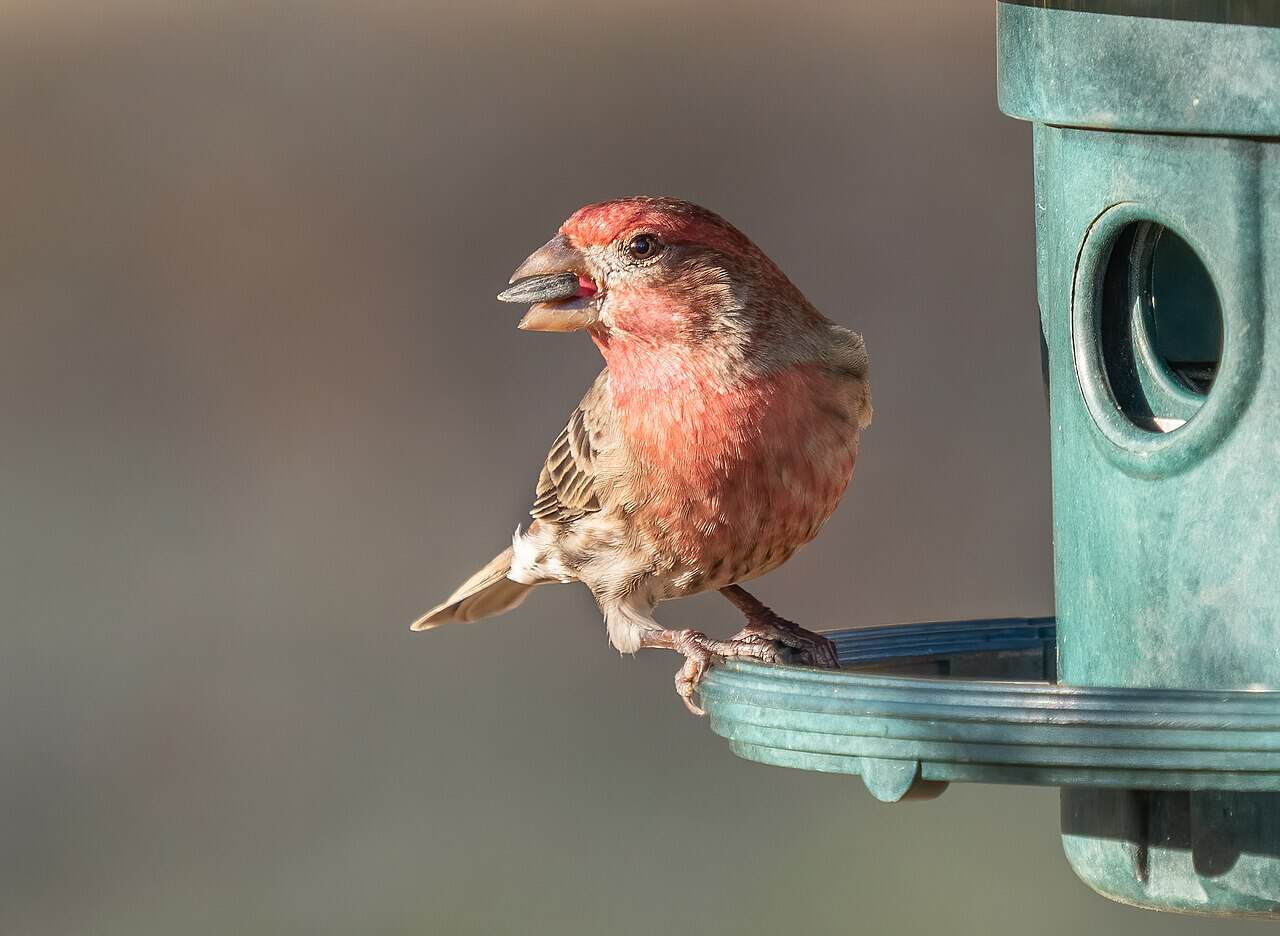
Male House Finches have a distinctive appearance: bright red wash over the head, breast, and rump (varying from orange-red to brilliant red depending on diet); brown back with subtle streaking; brown-streaked flanks; pale buff belly; and a thick conical bill (typical seed-cracker shape). The red coloration is brightest during breeding season.
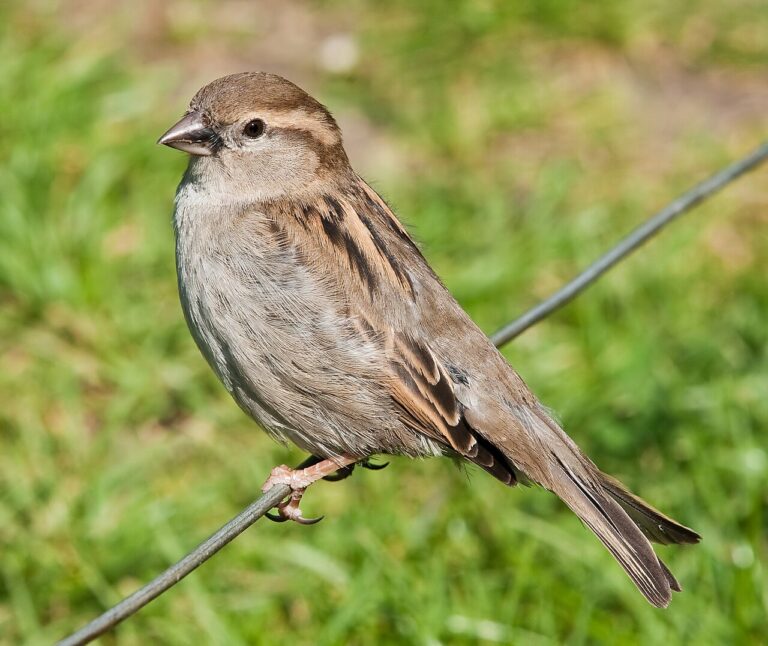
Female House Finches lack red entirely, they’re uniformly brown-streaked above and below, with grayish underparts. They look like typical streaky sparrows. The lack of bold markings (no eyebrow, no rump patch) helps distinguish them.
Juveniles look like females, brown-streaked with no red. They develop the red plumage during their first fall as they molt.
Diet-dependent coloring: Male House Finch red color comes from carotenoid pigments in their diet. Males with the richest diet (lots of carotenoid-rich seeds, fruits, and berries) develop the brightest red. Birds with poor diets may show only orange or yellow rather than red. Females prefer males with the brightest red, making diet quality a signal of overall health.
Size: House Finches are 5-6 inches long, small but distinctly larger than goldfinches (5 inches). Smaller than Northern Cardinals (8.5 inches).
House Finch vs Purple Finch: The classic identification challenge. Purple Finches are slightly LARGER and males are described as ‘a sparrow dipped in raspberry juice’, the red is more uniformly distributed and ‘raspberry-colored.’ Female Purple Finches have BOLD WHITE EYEBROW STRIPES (House Finches don’t). Purple Finches are less common at feeders and prefer mature woodlands.
House Finch vs Cassin’s Finch: Western US comparison. Cassin’s Finches are slightly larger. Males have brighter, more uniform red on the head and breast with cleaner edges. Females have less heavily-streaked underparts. Cassin’s Finches prefer mountain forests.
House Finch Range and Habitat
House Finches have a fascinating dual origin story in North America. Western populations: NATIVE, found across the western United States, Mexico, and parts of Central America. They’ve been documented in the West for millennia. Eastern populations: INTRODUCED, all eastern House Finches descend from a small population illegally released in Long Island, New York in 1940. House Finches were sold by pet stores as ‘Hollywood Finches.’ When the New York Police Department warned pet stores about the illegal trade, several stores released their birds. The released birds established a small population, spread westward, and now cover the entire eastern half of North America.
By the 1990s, eastern House Finches had spread to meet the western native populations, and the two genetically distinct populations met in the central plains. The eastern and western populations now overlap, with extensive interbreeding occurring.
Habitat: House Finches thrive in human-modified landscapes, urban, suburban, and agricultural areas. They’re significantly less common in natural forests, wilderness, and treeless deserts. Their range expansion across North America has paralleled the expansion of human settlement.
Year-round residents: House Finches are non-migratory throughout their range. The same individual birds stay in your yard year-round. They may shift slightly during severe winter weather but don’t undertake true migration.
Adaptability: House Finches are highly adaptable. They’ll nest in flower pots, hanging baskets, light fixtures, and other unusual locations. They’ve evolved to use human structures and gardens effectively. The species has thrived in suburban yards where their natural habitat (open shrubland) is absent.
House Finch Diet
House Finches are almost entirely granivorous, seeds make up approximately 97% of their diet. The remaining 3% includes small fruits and rare insects. They’re among the most exclusively seed-eating songbirds in North America.
Natural diet: Wild seeds, including thistle seeds, dandelion seeds, sunflower seeds, mustard seeds, mulberries (occasional), and various grass and weed seeds. Agricultural seeds (corn, wheat, sorghum) are heavily used near farmland.
Carotenoid sources: To develop bright red plumage, male House Finches need carotenoid-rich foods. Top sources: red and yellow berries, marigold flowers, and certain insects (though insects are rare in their diet). Birds with poor diets develop orange or yellow rather than red plumage.
At feeders: Top food choices include black oil sunflower seed (universal favorite), nyjer (thistle) seed, safflower seed, sunflower hearts, and cracked corn. House Finches prefer tube feeders, hopper feeders, and platform feeders. They can use a wide variety of feeder designs.
Feeding behavior: House Finches often visit feeders in small flocks. They feed for extended periods (10-20 minutes), unlike many species that grab one seed and leave. They’re more efficient at extracting seed from feeders than many other species.
Water requirements: House Finches drink considerably more water than many backyard birds because of their dry seed diet. They visit bird baths multiple times daily. They drink by scooping water and tipping back to swallow (typical bird drinking).
House Finch Behavior
House Finches are social, vocal, and generally tame around humans. Their behavior makes them rewarding to observe.
Flock behavior: House Finches form flocks of 5-30 birds, especially during fall and winter. Flocks include both sexes and multiple age classes. They forage together, fly together, and roost together at night.
Pair bonds: House Finches form pair bonds during breeding season. Bonds typically last one breeding season. Pairs may change between seasons. During breeding, males perform courtship songs from prominent perches and may feed females during nesting.
Tame around humans: House Finches are notably tame around humans. They readily nest in flower pots on porches, hanging baskets, light fixtures, and other human structures. They show less fear of human presence than many other backyard birds.
Disease vulnerability, Mycoplasmal Conjunctivitis: Since 1994, eastern House Finch populations have been affected by a major bacterial eye disease called mycoplasmal conjunctivitis. Affected birds develop swollen, crusty, sometimes blinded eyes. The disease can be fatal directly or through making blinded birds vulnerable to starvation and predation. The disease spread westward from Maryland and has affected populations across much of North America. House Finches at backyard feeders are major disease transmission points, keeping feeders clean (regular cleaning with 10% bleach solution) helps reduce disease spread.
Population fluctuations: Eastern House Finch populations grew rapidly after their 1940s introduction but have since stabilized or declined slightly. The disease (mycoplasmal conjunctivitis) has been a major factor in population reduction. Population estimates currently show 30-50 million House Finches in North America.
Lifespan: Wild House Finches have been recorded surviving 11 years. Average lifespan is 1 year due to high mortality. Adults that survive their first year live 2-4 years. Major mortality factors: disease (mycoplasmal conjunctivitis), predation by Cooper’s Hawks, window strikes, and winter starvation in northern regions.
House Finch Breeding and Nesting
House Finches have a long breeding season, extending from March through August in most regions. Most pairs raise 2-3 broods per year (occasionally more).
Nest construction: Both male and female participate in nest building, with the female doing most of the work. Nests are cup-shaped, made of grass, twigs, fine roots, and sometimes human-made materials (string, paper). Construction takes 3-7 days.
Nest placement: House Finches use a wide variety of nest sites, tree branches, building ledges, hanging plants, flower pots, light fixtures, gutters, and various other locations. The flexibility in nest sites is one reason they’ve adapted so well to human environments. Many homeowners have House Finches nesting in their porch hanging baskets or window planters.
Eggs: Each clutch contains 4-5 eggs (typically 4). House Finch eggs are pale bluish-white with sparse brown spotting. Incubation takes 12-14 days, performed almost entirely by the female. The male feeds the female during incubation.
Nestling period: Both parents feed nestlings, primarily seeds (regurgitated and softened in the parents’ crops). Nestlings remain in the nest for 12-19 days. After fledging, juveniles remain with parents for 1-2 weeks while learning to forage.
Multiple broods: With a long breeding season and 2-3 broods per year, House Finches are remarkably productive. A successful pair may fledge 8-15 young per year. This high productivity supports their abundance despite high adult mortality.
Yard nesting: House Finches readily nest in yards. They prefer hanging plants and similar sheltered locations. Once a pair establishes a nest in your yard, they may use the same site (or new sites nearby) for multiple seasons. Many homeowners have generations of House Finches nesting on their property.
House Finch Vocalizations
House Finches have one of the longest and most musical songs of any North American songbird.
Song: A long, complex warble of musical notes, often 1-2 seconds in duration, with bursts and trills. The song is highly variable between individuals. Each male has a slightly different song pattern. The variety has made House Finch song study a popular research topic.
Singing period: House Finches sing primarily during breeding season (March-August), with peak singing in spring. Some singing occurs year-round, especially during warm winter days.
Calls: Soft ‘chip’ calls between flock members; sharp ‘cheep’ alarm calls; various contact calls used between paired birds.
Acoustic mimicry: House Finches don’t significantly mimic other species. Their vocal complexity comes from their long, varied warbles.
Female singing: Female House Finches sometimes sing as well, though female songs are quieter and less complex than male songs. The female singing helps maintain pair bonds.
Comparison with similar species: House Finch songs are distinctly different from Purple Finch (longer, more elaborate, more ‘warbling’) and Cassin’s Finch songs (different rhythm).
House Finch Subspecies and Regional Variations
House Finches are divided into 12 recognized subspecies across their North American and Mexican range. Most variations are subtle, but the eastern (introduced) vs western (native) population difference is significant.
Eastern House Finch (descendants of 1940s introduction): These birds derive from a small founding population, so they show LESS genetic diversity than western birds. Eastern birds have spent 80 years adapting to eastern environments and now look subtly different from western birds. Some eastern populations are now genetically distinct from their western ancestors.
Western House Finch subspecies (multiple): Found across the western US and Mexico. Native populations with much greater genetic diversity. Several subspecies recognized across different regions.
Mexican House Finches (H. m. mexicanus): The original southern population, with slightly different appearance and behavior than US populations.
Diet-based variation: The species shows dramatic variation in male coloring based on diet quality. Birds in different regions develop different colors depending on locally-available carotenoid sources. Western mountain birds often have brighter red than southern birds.
Disease impacts: The mycoplasmal conjunctivitis outbreak has affected eastern populations more than western. Future genetic studies may reveal evolutionary adaptations to the disease in eastern birds.
How to Attract House Finches to Your Backyard
House Finches are among the easiest backyard birds to attract, they readily visit nearly any seed feeder. A few key strategies maximize House Finch abundance.
1. Offer black oil sunflower seed. Universal favorite for House Finches and most backyard birds. Use tube feeders, hopper feeders, or platform feeders. House Finches are versatile with feeder types.
2. Provide nyjer (thistle) seed. House Finches love nyjer seed. Use specialized nyjer feeders with small ports designed for finch bills. House Finches and American Goldfinches often share these feeders.
3. Try safflower seed. Many backyard birders use safflower seed because squirrels and grackles generally avoid it, but Cardinals, House Finches, and chickadees love it. Use hopper or platform feeders.
4. Plant native flowering plants. Native sunflowers, coneflowers, native asters, and other seed-producing flowers provide natural House Finch food. These plants support House Finches throughout summer and fall.
5. Provide a quality bird bath. House Finches drink considerably more water than many species due to their dry seed diet. Use a shallow bath with reliable fresh water; add a heated bath in winter for year-round water access.
6. Keep feeders clean to reduce disease. House Finches are major carriers of mycoplasmal conjunctivitis (the eye disease). Clean feeders regularly with 10% bleach solution (rinse thoroughly), this helps protect the broader bird community. Sick House Finches (with swollen, crusty eyes) at your feeders are a major disease vector.
7. Provide nest sites. House Finches readily nest in hanging plants, flower pots, light fixtures, and other sheltered locations. Many homeowners have House Finches nesting on their porches year after year.
8. Avoid pesticides. Pesticides can affect House Finch food supply.
9. Manage outdoor cats. Outdoor cats kill many House Finches, especially during ground feeding. Keeping cats indoors substantially improves House Finch survival.
10. Don’t worry about over-attraction. House Finches are not threatened, they’re among the most abundant backyard birds. Supporting them doesn’t compete with conservation of other species. They share feeders peacefully with most other birds.
Related reading: House Finch vs Purple Finch.
Related reading: Finch vs Sparrow.
Frequently Asked Questions
Where did House Finches come from?
House Finches have a fascinating dual origin in North America. Western populations are NATIVE, present across the western US and Mexico for millennia. Eastern populations are INTRODUCED, all eastern House Finches descend from a small population illegally released in Long Island, New York in 1940. The released birds (which had been sold as ‘Hollywood Finches’ by pet stores) established a population that spread westward. By the 1990s, eastern and western populations met in the central plains, and they now interbreed extensively.
What’s the difference between House Finch and Purple Finch?
Purple Finch males look like ‘a sparrow dipped in raspberry juice’, the red is more uniformly distributed and ‘raspberry-colored.’ House Finch males have red ONLY on the head, breast, and rump, with brown streaking on the flanks. Female Purple Finches have BOLD WHITE EYEBROW STRIPES; female House Finches don’t. Purple Finches are slightly larger and prefer mature woodlands. House Finches prefer urban/suburban areas.
Why is my House Finch’s eye swollen and crusty?
Your House Finch likely has mycoplasmal conjunctivitis, a bacterial eye disease that has affected eastern House Finch populations since 1994. Affected birds develop swollen, crusty, sometimes blinded eyes. The disease can be fatal. House Finches at backyard feeders are major disease transmission points. To help: clean your feeders regularly with 10% bleach solution (rinse thoroughly). Remove sick birds (handling with gloves) and contact local wildlife rehabilitation if needed. The disease has affected millions of House Finches across the continent.
Why are some male House Finches red and others orange or yellow?
Male House Finch color comes from carotenoid pigments in their diet. Birds with the richest diet (lots of carotenoid-rich seeds, fruits, and berries) develop bright red. Birds with poor diets develop orange or yellow rather than red. The color is a signal of overall health, females prefer males with the brightest red. So the variation reflects real diet quality differences between individual birds.
Do House Finches mate for life?
Mostly no. House Finch pair bonds typically last one breeding season. Pairs may change between seasons. During breeding, however, pair bonds are strong, both parents work together on nest building, incubation, and offspring care. The female does most incubation; the male feeds the female.
Do House Finches migrate?
No, House Finches are non-migratory throughout their range. The same individual birds stay in your yard year-round. They may shift slightly during severe winter weather but don’t undertake true migration. The same banded birds have been documented visiting the same feeders for 5-8 years.
What native plants attract House Finches?
Native sunflowers (Helianthus species), coneflowers (Echinacea), native asters, and other seed-producing native flowers. These plants produce seeds House Finches eat directly from plants. They also support insects that house finches occasionally consume. Native plants support House Finches throughout summer and fall.
How long do House Finches live?
Wild House Finches have been recorded surviving 11 years. Average lifespan is 1 year due to high mortality (especially from disease since the 1990s eye disease outbreak). Adults that survive their first year live 2-4 years. Major mortality factors: mycoplasmal conjunctivitis (disease), predation by Cooper’s Hawks, window strikes, and winter starvation in northern regions.
Related reading: female house finch identification, types of finches.