American Robin: Complete Identification, Diet, and Behavior Guide (2026)
The American Robin (Turdus migratorius) is one of the most recognizable and beloved birds in North America. Found in nearly every backyard from Alaska to Mexico, robins are the harbingers of spring across most of the United States, their cheerful ‘cheerily-cheer-up’ songs mark the season’s arrival. American Robins are surprisingly complex birds: they’re members of the thrush family (Turdidae), they can detect earthworms underground through both sight and hearing, and they have one of the most photographed nesting cycles in North American birding. This comprehensive guide covers everything you need to know about American Robin identification, range, diet, behavior, nesting, vocalizations, regional subspecies variations, and proven strategies for attracting robins to your backyard.
The American Robin is a large gray brown thrush with a brick orange breast, a yellow bill and a white eye ring, common on lawns and in gardens across North America. It eats earthworms by day and fruit in winter, and its clear caroling song is one of the first sounds of spring.
American Robin: Key Facts at a Glance
| Attribute | Detail |
|---|---|
| Scientific Name | Turdus migratorius |
| Family | Turdidae (Thrushes) |
| Size | 10 inches (25 cm) length |
| Wingspan | 12-16 inches (31-41 cm) |
| Weight | 2.7 oz (77 g) |
| Lifespan | 5-13 years in wild (record 14 years) |
| Diet | Earthworms, insects, fruit, berries |
| Habitat | Lawns, fields, woodlands, parks, gardens |
| Range | All of North America (year-round in south, breeding in north) |
| Population Status | Common, 380 million estimated North American population |
| Conservation Status | Least Concern (IUCN) |
| State Bird Of | Connecticut, Michigan, Wisconsin |
| Distinctive Feature | Rust-orange breast + gray-brown back + yellow bill |
| Song | ‘Cheerily-cheer-up’ melodic phrases |
| Migration | Most populations migrate; some southern populations year-round |
American Robin Identification: How to Identify a Robin
Adult American Robins are unmistakable: round-bodied songbirds with a bright rust-orange (sometimes described as brick-red) breast, gray-brown back and wings, dark head with broken white eye-rings, and a long yellow bill. The bird’s posture is upright and alert, often standing motionless on lawns before suddenly hopping forward to grab a worm.
Adult males have darker, more vibrant rust-orange chests and almost black heads. Adult females are slightly paler with grayer heads, but the difference is subtle.
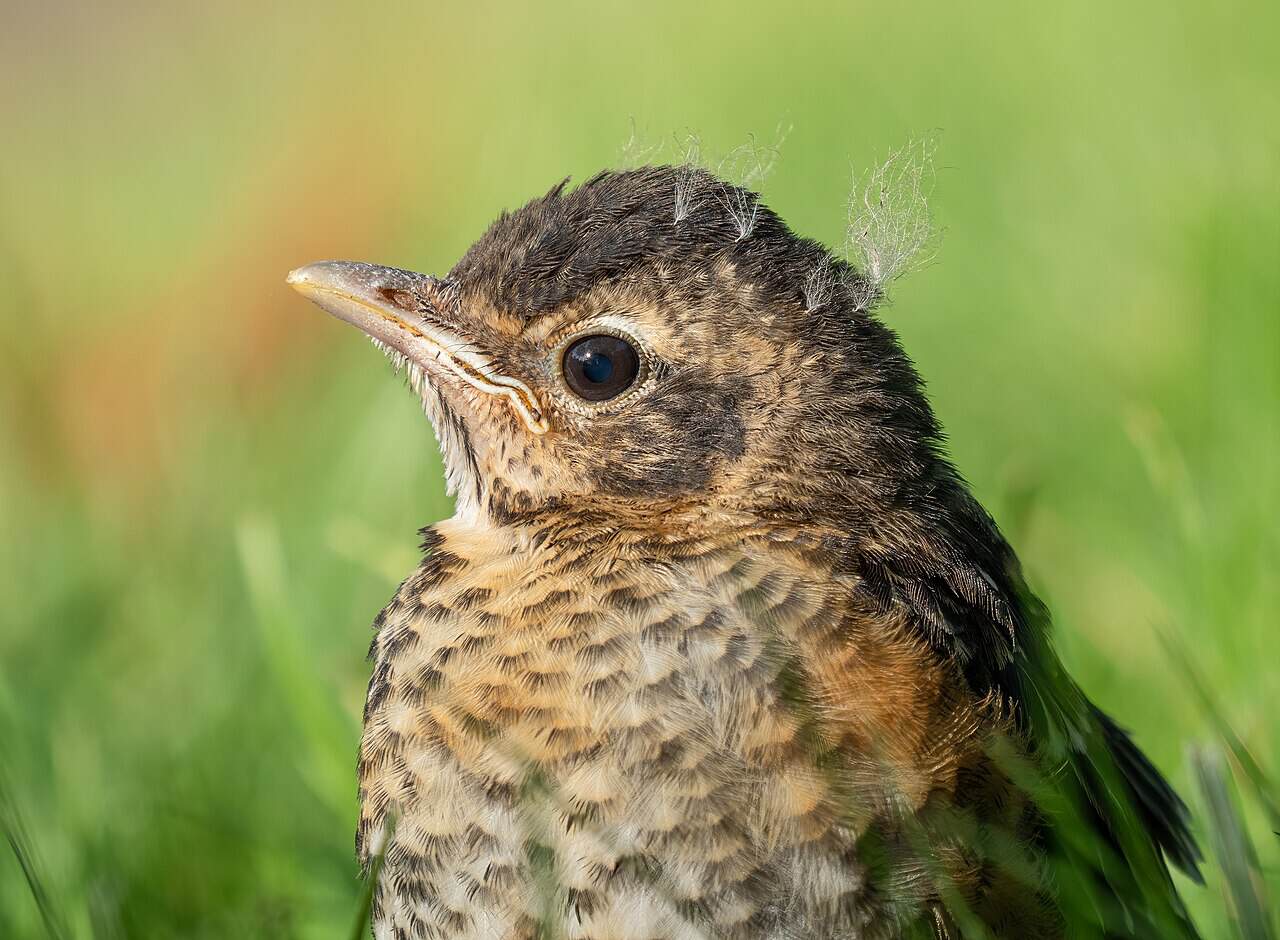
Juvenile robins (just-fledged birds) look remarkably different from adults, they have brown spotted breasts (rather than rust-orange), with pale buff coloring underneath. The spotted breast clearly identifies them as thrushes and connects them to other thrush relatives like Wood Thrushes. As they molt into adult plumage during their first fall, the rust-orange chest gradually emerges.
Size comparison: American Robins are approximately 10 inches long, significantly larger than most backyard songbirds. They’re noticeably bigger than House Sparrows (6 inches), comparable in size to Northern Cardinals (8.5 inches) and Blue Jays (11 inches), but with a much rounder, plumper body shape than either.
American Robins have a distinctive run-and-stop hunting pattern on lawns. They run a few steps, stop, cock their heads (looking and listening for worms), then pounce. This behavior is diagnostic, no other backyard bird hunts this way.
American Robin Range and Habitat
American Robins have one of the most extensive ranges of any North American bird. They breed throughout all 50 US states, all Canadian provinces and territories, and parts of Mexico. Year-round populations occur in the southern US, Mexico, and along the Pacific Coast as far north as Alaska in mild winters. Migratory populations breed in Alaska and Canada and winter throughout the southern US and Mexico.
American Robins are habitat generalists, they thrive in lawns, parks, golf courses, agricultural land, suburban yards, woodland edges, gardens, and even high-elevation alpine meadows during summer. They generally avoid the deepest forests and the driest deserts.
Robins are perhaps the most strongly human-adapted of all native North American songbirds. The conversion of native landscapes to lawns, parks, and gardens over the past two centuries has dramatically expanded suitable Robin habitat. The species is now far more abundant in human-modified landscapes than it was historically.
Northern Robins (Alaska, Canada, northern US) are migratory, they head south in fall and return in spring. The arrival of robins in spring is one of the most celebrated nature events in North American culture, though many regions actually have year-round robin populations that simply become more visible in spring when they begin singing and foraging on lawns.
Robins are highly nomadic in winter. Flocks of dozens or hundreds may wander widely in search of fruit and berries. A neighborhood might be entirely without robins for weeks, then suddenly host a flock of 50+ stripping fruit from a Mountain Ash or Holly tree over 1-3 days.
American Robin Diet: What Do Robins Eat?
American Robins are omnivores with a famously variable diet that shifts seasonally. The two main components are invertebrates (especially earthworms) and fruit/berries. The seasonal split is roughly: spring/summer breeding season is invertebrate-heavy (40% of diet); fall/winter is fruit-heavy (90% of diet).
Spring and summer diet: Robins primarily eat earthworms, but their diet also includes caterpillars, beetles, grasshoppers, spiders, snails, and other invertebrates. Earthworms are critical food for nestlings, adult robins may collect 20+ earthworms per hour during peak feeding periods. The protein supports rapid nestling growth.
Fall and winter diet: Robins switch dramatically to fruits and berries. Top choices include American Beautyberry, Eastern Red Cedar berries, Winterberry Holly, Mountain Ash, Crabapple, Hawthorn, Pyracantha (firethorn), Sumac, Pokeberry, and Virginia Creeper. Robins are major dispersers of native berry-producing plants, seeds pass through their digestive systems and germinate in new locations.
Robins are NOT typical bird-feeder visitors. They rarely eat sunflower seeds, nyjer seeds, or other typical bird seed. However, they readily eat mealworms (live or freeze-dried) and will visit feeders specifically offering mealworms. Some robins also eat suet, especially in winter.
American Robins detect earthworms through a combination of vision (looking for soil disturbance and worm casts) and hearing (yes, they can actually hear worms moving underground!). When a robin cocks its head sideways on a lawn, it’s not looking up at the sky, it’s positioning one eye downward and one ear close to the ground to triangulate worm location.
American Robin Behavior and Social Structure
American Robins show dramatic seasonal behavior shifts. Spring and summer are territorial, breeding pairs aggressively defend nesting territories of 0.25 to several acres. Males sing prominently from elevated perches to advertise territory boundaries and attract mates. Fights between males over territory boundaries are common in spring.
Fall and winter behavior is entirely different. Robins form large nomadic flocks (50-1000+ birds) that wander widely in search of fruit. These flocks roost communally at night in dense vegetation, sometimes thousands of robins in a single roost. The same individual robin that fiercely defended its lawn territory in summer becomes part of a peaceful winter flock.
Robin alarm calls are distinct, a sharp ‘tut-tut-tut’ or ‘yeep’ call alerts other birds to danger. Their behavior during alarm calls is highly observable: they freeze in alert posture, then often dive for cover.
Robins are surprisingly long-lived for songbirds. Wild robins have been recorded surviving 14 years (banded bird), though average lifespan is closer to 2-3 years due to high first-year mortality. After surviving their first winter, robins typically live 5-7 years.
Mortality patterns: First-year robins have very high mortality (~80%) from predation, window strikes, and starvation. Adults that survive to age 2+ have much better odds. Major threats include outdoor cats (responsible for ~7% of annual robin mortality), window strikes (~2%), pesticides (declining since DDT ban), and habitat loss.
American Robin Breeding and Nesting
American Robin nesting begins in late March in the southern US, mid-April across the central US, and May in northern regions. The breeding season extends through July, allowing time for 2-3 broods per year (occasionally 4 in southern regions).
Nest construction takes 2-6 days. Females do most of the construction, using mud as the foundation, a distinctive nesting feature among North American songbirds. Robins gather mud from puddles, drainage areas, and even garden hoses, then mix it with twigs, grasses, and other plant materials. The completed nest is cup-shaped, ~6 inches across, and lined with fine grass.
Nest placement: Robins build nests in remarkably varied locations, tree branches (typical), house gutters, porch lights, window ledges, hanging plants, security cameras, mailboxes, and more. They generally prefer 5-25 feet above ground. The flexibility in nest sites is one reason American Robins are so well-adapted to human environments.
Eggs and incubation: Each clutch contains 3-5 eggs (typically 4). Robin eggs are the famous ‘robin’s egg blue’, a distinctive turquoise blue that has given its name to a color. Incubation takes 12-14 days, performed almost entirely by the female. The male feeds the female during incubation and helps guard the nest.
Nestling period: After hatching, both parents feed the nestlings, primarily earthworms during the first days, then more varied invertebrates as nestlings grow. Nestlings grow remarkably fast, from hatchlings to fledging takes only 13-14 days. After fledging, juveniles spend another 2-3 weeks following parents and learning to forage before becoming independent.
American Robin nests are vulnerable to predation. Major nest predators include Blue Jays, American Crows, raccoons, snakes, and outdoor cats. Approximately 60-75% of robin nests fail due to predation. The high failure rate explains why robins attempt 2-3 broods per year.
American Robin Vocalizations and Songs
The American Robin’s song is one of the most familiar bird sounds in North America. The song consists of a series of clear, whistled phrases often described as ‘cheerily, cheer-up, cheerily, cheer-up.’ Each phrase typically consists of 2-3 syllables. The song is melodic, rising and falling in pitch, lasting several seconds before a brief pause and continuing.
Males do most of the singing, especially during dawn chorus (the first 30-90 minutes after sunrise). Robins are typically among the first birds to start singing each morning, sometimes 30+ minutes before sunrise. This ‘dawn chorus’ position makes them prominent in spring soundscapes.
Singing peaks during territory establishment (April-May) and reduces dramatically after pair formation. By July, robins sing primarily at dawn rather than throughout the day. Singing is rare in fall and winter.
Robin calls (distinct from songs) include the ‘tut-tut-tut’ alarm call (warning of ground threats), the sharp ‘yeep’ (warning of aerial threats), the ‘churr’ (communication between mates), and various contact calls used between flock members in winter.
Robin songs vary regionally. Western American Robins have slightly different song patterns than Eastern populations. The variation is subtle and only apparent to experienced birders or with audio analysis. The songs of robins also vary by individual, each robin has a slightly different song pattern, allowing researchers to identify specific individuals by voice.
American Robin Subspecies and Regional Variations
American Robins are divided into seven recognized subspecies across their massive North American range. The differences are subtle and most are appreciated only by experienced birders and ornithologists, but they do reflect important regional adaptations.
Eastern Robin (T. m. migratorius): The most familiar subspecies across the eastern and central US and Canada. Medium-darkness back, classic rust-orange breast.
Newfoundland Robin (T. m. nigrideus): Breeds in Labrador and Newfoundland. Darker than other subspecies, males have nearly black backs and intensely dark rust-red chests.
Northwestern Robin (T. m. caurinus): Breeds in coastal Pacific Northwest. Slightly darker overall than Eastern Robins.
Western Robin (T. m. propinquus): Breeds across western North America. Slightly paler and grayer than Eastern Robins.
San Lucas Robin (T. m. confinis): The most distinctive subspecies, found only in the Cape Region of Baja California, Mexico. Significantly paler than other subspecies, almost gray-and-buff rather than rust-orange. So distinct that some ornithologists argue it should be considered a separate species.
Robins also show clinal variation, birds in the southern US tend to be slightly larger and paler than birds farther north. Florida robins are often noticeably paler than New England robins. The cline reflects adaptation to different climates and habitats across the species’ range.
How to Attract American Robins to Your Backyard
American Robins are not typical seed-feeder birds, so traditional bird-feeding approaches don’t work well for them. Successful Robin attraction requires different strategies focused on lawn habitat, water features, fruit-producing plants, and mealworm feeders.
1. Maintain pesticide-free lawns. Robins primarily forage on lawns for earthworms and other invertebrates. Pesticides directly kill these food sources and can also poison robins through accumulated toxins. Organic lawn care is the single most important factor for attracting robins. Lawns with abundant earthworms can host 5-10 robins per acre during breeding season.
2. Plant native berry-producing trees and shrubs. Robins are major fruit consumers in fall and winter, top picks include American Beautyberry (Callicarpa americana), Eastern Red Cedar, Mountain Ash, Crabapple, Hawthorn, Winterberry Holly, and Sumac. Plant a variety to provide food across multiple seasons. A single mature fruiting tree can support 50+ robins for several days during winter.
3. Provide a quality bird bath. Robins are enthusiastic bathers, among the most reliable bird bath users of any backyard species. Use a shallow bath (2-3 inches deep) or a heated bath in winter. Adding a dripper or fountain doubles robin visitation. Position the bath in dappled shade for cleanliness.
4. Offer mealworms in a shallow dish. Both live and freeze-dried mealworms work. Place them in a shallow open dish during nesting season (May-July) when adults feed nestlings. This is the most reliable way to attract robins to a ‘feeder’ setting.
5. Provide nesting opportunities. Install nest shelves (open platforms 8 inches square) under eaves, on porch posts, or in protected garden spots. Robins readily use these nest shelves, which provide some protection from predators and rain. Many homeowners have generations of robins nesting on the same shelf.
6. Leave leaves and provide habitat diversity. Fallen leaves harbor invertebrates that robins eat. Skip excessive leaf removal, instead, push leaves to garden beds where robins (and many other species) can forage.
7. Avoid window collisions. Robins are major victims of window strikes. Install window film, decals, or screens within 4 inches of glass to prevent collisions, especially on large windows facing your bird bath or feeding area.
8. Manage outdoor cats. Outdoor cats are responsible for approximately 7% of annual American Robin mortality. Keeping cats indoors is the single most effective bird protection strategy.
American Robins are perhaps the easiest backyard bird to please because their requirements (lawns, water, berries) align perfectly with what most homeowners already maintain. A pesticide-free lawn, a bird bath, and a few native fruit-producing trees are enough to attract regular robin visitors.
Related reading: Baby Robin.
Related reading: Robin Symbolism.
What Is the Difference Between a Robin and an American Robin?
They are two unrelated birds that happen to share a name. The American Robin (Turdus migratorius) is a thrush about 10 in long with a brick orange breast, a yellow bill and a white eye ring, and it lives across North America. The European Robin (Erithacus rubecula) is a chat barely 5 in long with an orange face and throat, a thin dark bill and no eye ring, and it does not occur in North America at all.
The name travelled with homesick settlers, who called the big orange breasted thrush they found in America after the small orange breasted bird they knew at home. When a British reader talks about a robin on a Christmas card, that is the European bird. When an American talks about robins on the lawn, it is this one. If you are after the folklore rather than the biology, see our guide to what it means when you see a red robin.
What Bird Is Often Mistaken for a Robin?
The birds most often reported as robins are the Varied Thrush, the Eastern Towhee and the Spotted Towhee, which are the same three that head the similar species list the Cornell Lab keeps for this species. The Varied Thrush of the Pacific Northwest is the closest match, with an orange breast crossed by a dark chest band and orange wing bars that a robin never shows. Both towhees carry rusty orange flanks against a black hood and white belly, which reads as robin coloring at a glance in a shaded yard.
Two more come up regularly. The Black-headed Grosbeak has a warm orange body but a massive pale conical bill instead of the robin’s slim yellow one. Juvenile American Robins confuse people in their own right, since their breast is heavily spotted for the first weeks out of the nest and looks nothing like the clean orange of the adult.
Why Do Robins Sing at 3am?
Robins sing at 3am because artificial light convinces them dawn has arrived. A male in a well lit street, parking lot or yard starts his dawn song hours before sunrise, and the effect is strongest in spring while he is holding a territory. It is normal behavior running on a shifted clock, not a sign that anything is wrong with the bird.
Noise plays a part as well. In towns where daytime traffic drowns out song, males shift more of their singing into the quiet hours before the morning rush, because a song nobody can hear does not hold a territory. If a robin is singing outside your window at 3am, the practical fix is shading or redirecting the nearest light rather than anything at the nest.
What Does It Mean When a Robin Chirps?
A short repeated chirp is usually an alarm rather than a song. The sharp peek or tut tut tut a robin fires off from a low branch means it has seen a cat, a hawk, a snake or a person standing too close to a nest, and other birds in the yard react to it. The rising laughing whinny is a milder version of the same message, used for general agitation.
The full carol, the rolling cheerily cheer up cheerio, is a different message: a male advertising a territory and a mate. Separating the two tells you whether a robin is simply present or actively defending something within a few feet of where you are standing.
Frequently Asked Questions
Are American Robins related to European Robins?
No, despite the name, American Robins and European Robins are not closely related. American Robins are thrushes (family Turdidae), while European Robins are Old World Flycatchers (family Muscicapidae). European settlers in North America named the American bird ‘Robin’ because its rust-red chest reminded them of the smaller European Robin. Today, the two birds occupy similar ecological niches in their respective continents, common garden birds with red/orange breasts, but they’re not closely related.
Why do robins hop on lawns and tilt their heads?
Robins hop forward, stop, then tilt their heads to locate earthworms. They use BOTH vision (seeing soil disturbance from worm casts) AND hearing (yes, they can actually hear worms moving underground!) to locate prey. When a robin cocks its head sideways, it’s positioning one eye downward and one ear close to the ground to triangulate worm location. This behavior is so distinctive that it’s diagnostic, no other backyard bird hunts this way.
Are robins really a sign of spring?
Sometimes yes, sometimes no. In many regions, robins are year-round residents, they’re simply less visible in winter when they’re nomadic and quiet. Spring ‘arrival’ is often the migration of NORTHERN robin populations into central regions, plus increased visibility as resident robins begin singing and foraging on lawns. Many residents who think ‘the robins are back’ may actually be seeing the same year-round individuals become active again.
What’s that small bird with brown spotted breast that looks like a robin?
Most likely a juvenile American Robin. Just-fledged robins have brown spotted breasts (rather than rust-orange) for several weeks until they molt into adult plumage. The spotted breast clearly identifies them as thrushes. By late summer or fall, they’ll molt into adult plumage with the typical rust-orange chest.
Do robins eat from bird feeders?
Rarely from typical seed feeders. Robins don’t eat sunflower seeds, nyjer, or millet. They will readily eat mealworms (live or freeze-dried), suet, and fruit (sliced apples, raisins soaked in water). Place these in shallow dishes or platform feeders. The best ‘feeder’ for robins is a fruit-producing native plant, a single mature Mountain Ash can feed 50+ robins.
Why are robin’s eggs blue?
The famous ‘robin’s egg blue’ color comes from biliverdin, a pigment that’s deposited on the eggshell. The blue color may serve multiple purposes: it could provide UV protection for developing embryos, signal egg quality to the female (allowing her to invest more in higher-quality eggs), or camouflage against blue-sky views from above. The color has become so iconic that it’s named in paint colors, fashion, and design as ‘robin’s egg blue.’
How long do American Robins live?
Wild robins have been recorded surviving 14 years (banded bird), but average lifespan is closer to 2-3 years due to high first-year mortality. After surviving their first winter, robins typically live 5-7 years. The high first-year mortality (~80%) reflects predation by Blue Jays, crows, raccoons, snakes, and outdoor cats.
Why do robins eat berries instead of worms in winter?
Earthworms are unavailable when soil freezes, winter forces robins to switch to fruit and berries. Native plants that hold fruit through winter (Eastern Red Cedar, Winterberry Holly, Mountain Ash, Crabapple) are critical robin food sources. Plant these in your yard to support overwintering robins. Robins are major seed dispersers of these native plants, they spread berries far from parent plants through droppings.
Related reading: female robin identification, what it means to see a red robin.
Related reading: types of orange birds.