Backyard Birds of Colorado: 15 Common Species (2026 Identification Guide)
Colorado’s dramatic elevation gradient from the eastern plains at 3,500 feet to Rocky Mountain peaks above 14,000 feet creates one of the most diverse backyard bird communities in the United States. The state hosts 500+ recorded bird species, with 30-50 commonly visiting suburban yards depending on region and elevation. Colorado’s location at the intersection of the Great Plains, the Rocky Mountains, and the western basins creates dramatically different bird communities within a single state. Denver and Front Range cities sit at the foot of the mountains where plains and mountain species mix. From the High Plains east of Denver to the Continental Divide peaks to the western slope and Colorado Plateau, the state offers distinctive backyard bird communities by elevation and region. This guide covers the 15 most common backyard birds across Colorado with field marks, regional ranges, and proven attraction strategies for the state’s varied climate zones.
The most common backyard birds in Colorado are the Black-billed Magpie, House Finch, Black-capped and Mountain Chickadees, Steller’s Jay, Dark-eyed Junco, American Robin and Northern Flicker. The Lark Bunting is the state bird but is a prairie species rather than a yard bird.
Quick Reference: 15 Common Backyard Birds of Colorado
| Species | Size | Key ID Feature | Where in CO |
|---|---|---|---|
| Lark Bunting (state bird) | 7″ | All black with white wing patches (summer male) | Eastern Plains (summer) |
| Black-Billed Magpie | 19″ | Black-and-white + very long tail + iridescent | Statewide year-round |
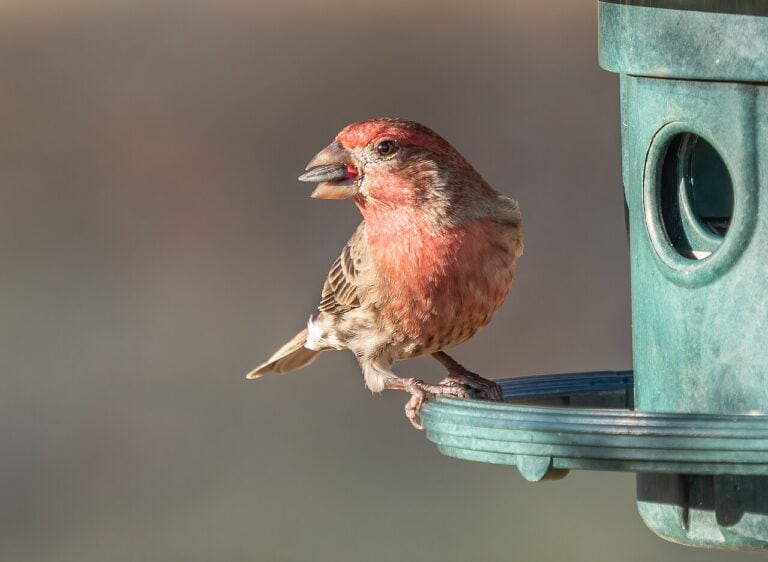
| House Finch | 5.5″ | Red head/breast (male) + streaky belly | Statewide year-round |
| Mourning Dove | 12″ | Tan + long pointed tail + small head | Statewide year-round |
| Eurasian Collared-Dove | 13″ | Pale gray + black neck collar | Statewide year-round |
| Black-Capped Chickadee | 5.25″ | Black cap + white cheeks + black bib | Mid-elevation forests |
| Mountain Chickadee | 5.25″ | Black cap + WHITE EYEBROW STRIPE | Higher mountain forests |
| Steller’s Jay | 11.5″ | Black head + crest + deep blue body | Mountain forests |
| Western Scrub-Jay | 11.5″ | Blue + gray back + no crest + white throat | Western slope + foothills |
| Dark-Eyed Junco (Gray-Headed form) | 6″ | Gray hood + rufous back + pink bill | Mountains breeding |
| Broad-Tailed Hummingbird | 4″ | Iridescent rose throat (male) + wing trill | Mountain summer |
| Mountain Bluebird | 7.25″ | All sky-blue (male) + no rust breast | Statewide mountains |
| American Robin | 10″ | Rust-orange breast + gray-brown back | Statewide year-round |
| Northern Flicker (Red-Shafted) | 12.5″ | Brown spotted + red wing flashes | Statewide year-round |
| Pine Siskin | 5″ | Brown-streaked + yellow wing edges | Year-round mountains |
Species Identification
Lark Bunting (State Bird)
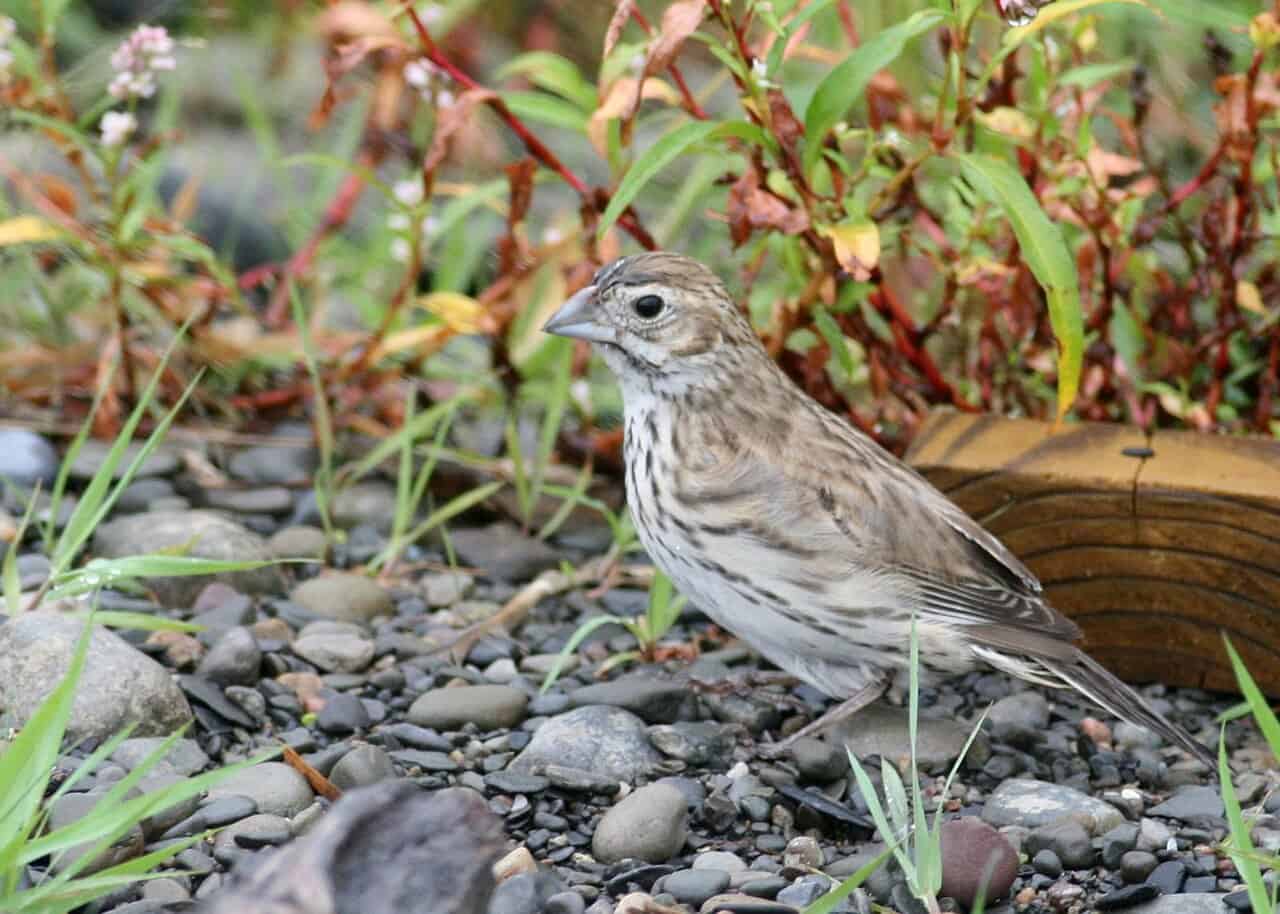
Colorado’s official state bird, designated in 1931, Colorado is the ONLY US state with this species as state bird, making Lark Buntings uniquely identifying for Colorado. Breeding male Lark Buntings are striking: jet-black overall with large white wing patches that flash in flight or during display flights. Non-breeding males and females are sparrow-like, brown-streaked with hints of the wing patches. Colorado schoolchildren chose this species through a vote.
Range in Colorado: Eastern Plains in summer (April-October). Migrate to Mexico for winter.
Habitat: Short and mid-grass prairie, sagebrush, agricultural edges. Not typical backyard birds, they prefer open grasslands. Yards adjacent to remaining prairie may host them.
Key ID: All black with bold white wing patches (breeding male), unmistakable. Non-breeding birds sparrow-like.
Where to see: Visit grasslands in Eastern Plains during May-July. Pawnee National Grassland is the best site. Drive county roads at dawn for males performing display flights, they sing while parachuting down with wings spread, showing off the white patches.
Black-Billed Magpie
Colorado’s most distinctive backyard bird, and one of the most spectacular American corvids. Black-Billed Magpies are large (19 inches with the tail), with bold black-and-white plumage: black head and chest, white belly and shoulder patches, very long iridescent blue-green-black tail. They’re highly intelligent, social, and sometimes raucous.
Range in Colorado: Statewide year-round (less common at very highest elevations).
Habitat: Open habitat, riparian zones, suburbs, parks, rural areas with scattered trees.
Key ID: Very large + black-and-white + very long iridescent tail. Unmistakable.
Where to see: Common in Colorado yards. Will visit platform feeders with sunflower seed, peanuts, and table scraps. Highly intelligent, will solve simple problems to access food.
Mountain Chickadee
Colorado’s high-elevation chickadee specialty, and one of the easiest ways to identify Colorado mountain elevation birds. Mountain Chickadees have a black cap, black throat/bib, white cheeks, BLACK STRIPE through the eye, and a distinctive WHITE EYEBROW STRIPE that separates the cap from the eye line. The white eyebrow is diagnostic, no other US chickadee has it.
Range in Colorado: Higher mountain forests (above approximately 7,000 feet).
Habitat: Coniferous forests at mid-to-high elevation (Lodgepole Pine, Engelmann Spruce, Ponderosa Pine).
Key ID: Black cap + WHITE EYEBROW STRIPE + black eye stripe + white cheeks. The white eyebrow is the diagnostic feature.
Where to see: Common at sunflower and suet feeders in mountain yards. Will use small nest boxes (1.125 inch hole).
Steller’s Jay
Colorado’s mountain forest jay. Steller’s Jays have a charcoal-black head with a prominent crest, deep blue body, wings, and tail. Loud and dominant at mountain feeders.
Range in Colorado: Mountains and foothills statewide.
Habitat: Coniferous forests, parks with mature trees, mountain suburban yards.
Key ID: Black head with prominent crest + deep blue body. Very different from the eastern Blue Jay (no crest blue body, all-blue head with black necklace).
Where to see: Platform feeders with peanuts in shell, sunflower seed, and corn.
Broad-Tailed Hummingbird
Colorado’s primary summer hummingbird. Male Broad-Tailed Hummingbirds have an iridescent rose-magenta throat (gorget) and bright green back. The distinctive wing-trill sound (high-pitched buzzy whistle) made by males in flight is diagnostic, you can hear them coming. Females have green backs with white throats showing small green-bronze spots.
Range in Colorado: Statewide in summer (April-September), most common in mountains.
Habitat: Mountain meadows, gardens, parks at mountain elevations.
Key ID: Iridescent rose-magenta throat (male) + wing trill in flight. The wing sound is unique among Colorado hummingbirds.
Where to see: Hummingbird feeders (4:1 water-to-sugar ratio, no red dye). Plant native salvias, columbine, penstemons.
Mountain Bluebird
Colorado’s iconic sky-blue bluebird, the only US bluebird species that doesn’t have a rust-orange breast. Male Mountain Bluebirds are entirely sky-blue overall, head, back, wings, tail, and breast all the same brilliant blue. Females are pale gray with bluish wash on wings and tail. The all-blue color is unmistakable.
Range in Colorado: Statewide at mid-to-high elevations.
Habitat: Open mountain meadows with scattered trees, agricultural areas at high elevations.
Key ID: Entirely sky-blue (male), no rust on chest. Distinguished from Eastern and Western Bluebirds by all-blue (not blue-and-orange) coloring.
Where to see: Install NABS-approved Mountain Bluebird nest boxes (1.5 inch hole) on poles in open habitat. Provide mealworms. Plant native juniper for berries.
Dark-Eyed Junco (Gray-Headed Form)
Colorado hosts a distinctive Junco subspecies, the ‘Gray-Headed’ Dark-Eyed Junco. Gray-Headed Juncos have a uniformly gray head and chest, with a rufous (rust-colored) back, white belly, and pink bill. Different from the eastern ‘Slate-Colored’ form and the western ‘Oregon’ form.
Range in Colorado: Mountains breeding (summer); statewide in winter.
Habitat: Coniferous forests in summer; backyards, gardens, and edges in winter.
Key ID: Gray hood + rufous back + white belly + pink bill. The rufous back distinguishes from other Junco forms.
Where to see: Winter feeders. Ground-feeding birds, prefer platform feeders or scattered seed.
Western Scrub-Jay
Colorado’s other distinctive jay (besides Steller’s). Western Scrub-Jays (now officially split into Woodhouse’s Scrub-Jay in Colorado’s range) are blue overall with a gray back patch, no crest, blue head, and a white throat with blue ‘necklace.’ Different shape than Steller’s Jay, no crest, longer tail.
Range in Colorado: Western Slope and southern foothills, with expanding range along the Front Range.
Habitat: Pinyon-juniper woodlands, oak-juniper scrublands.
Key ID: Blue + gray back + NO CREST + white throat. Different shape than Steller’s Jay.
Where to see: Platform feeders with peanuts, sunflower seed. Will visit yards in pinyon-juniper habitat.
Northern Flicker (Red-Shafted)
Colorado’s common large woodpecker. Northern Flickers in Colorado are the ‘Red-Shafted’ western form. Brown back with black bars, black-spotted belly, black chest crescent, and brilliant red underwings/tail visible in flight. Males have a red ‘mustache’ stripe; females lack it. Often seen on the ground hunting ants.
Range in Colorado: Statewide year-round.
Habitat: Open woodlands, parks, suburban yards with grass and trees.
Key ID: Brown spotted body + red wing/tail flashes + ground-feeding behavior. The eastern ‘Yellow-Shafted’ form has yellow underwings, most Colorado birds show red.
Where to see: Will visit suet feeders. Often seen on lawns hunting ants.
House Finch
Colorado’s most common feeder finch. Male House Finches have red wash over the head, breast, and rump with brown-streaked flanks. Females are uniformly brown-streaked. Native to the West, Colorado is part of their original range.
Range in Colorado: Statewide year-round.
Habitat: Urban, suburban, agricultural areas.
Key ID: Red on head/breast (male) + brown-streaked flanks. Conical bill.
Where to see: Tube feeders with nyjer or sunflower seed.
Eurasian Collared-Dove
Colorado’s introduced dove (now ubiquitous). Eurasian Collared-Doves are pale gray-tan overall with a distinctive thin black collar/necklace on the back of the neck. Larger and paler than Mourning Doves. They arrived in North America in the 1980s and have spread continent-wide. Colorado is one of the most heavily-colonized states.
Range in Colorado: Statewide year-round.
Habitat: Urban and suburban areas, agricultural settlements.
Key ID: Pale gray + black neck collar + larger than Mourning Dove + square tail.
Where to see: Common at platform feeders and on the ground.
Pine Siskin
Colorado’s small streaked finch. Pine Siskins are brown-streaked overall (look like sparrows at first glance) with bright yellow edges on their wings and tail.
Range in Colorado: Year-round in mountains; statewide in irruption winters.
Habitat: Coniferous forests, mixed forests, suburban yards near forest cover.
Key ID: Brown-streaked overall + yellow wing edges + small pointed bill. The yellow flash is diagnostic.
Where to see: Common at nyjer (thistle) feeders. Often in mixed flocks with American Goldfinches.
Regional Variations Across Colorado
Colorado’s dramatic elevation gradient creates the most varied backyard bird communities of any US state. Eastern Plains (below 5,500 feet, east of Denver, including Yuma, Lamar, Sterling) host grassland species. Lark Buntings (state bird!) breed in summer. Western Meadowlarks, Mountain Plovers (declining), and other grassland specialists. Cropland mixed with shortgrass prairie.
Front Range cities (Denver, Boulder, Fort Collins, Colorado Springs) sit at the meeting point of plains and mountains. Backyards see species from both communities. House Finches, Mourning Doves, Eurasian Collared-Doves, plus visiting mountain species in winter. Spring migration along the Front Range can be exceptional.
Foothills (5,500-8,000 feet, Boulder canyon, Larimer foothills) host Western Scrub-Jays in pinyon-juniper, Townsend’s Solitaires in winter, plus typical Front Range backyard birds.
Mid-Elevation Mountains (8,000-10,000 feet, Estes Park, Vail, Aspen, Breckenridge, Crested Butte) host coniferous forest species. Mountain Chickadees, Steller’s Jays, Pine Siskins, Red-Breasted Nuthatches, Cassin’s Finches. The chickadee species changes from Black-Capped (mid-elevation) to Mountain (high elevation).
High Mountains and Continental Divide (above 10,000 feet, Rocky Mountain National Park higher elevations, Mt. Evans, Pikes Peak): Spruce-fir forest and alpine tundra. White-Tailed Ptarmigan (year-round), American Pipits, Brown-Capped Rosy-Finches, plus mountain chickadees and other high-elevation species. Limited backyard birding at these elevations.
Western Slope (Grand Junction, Montrose, Durango) and Colorado Plateau host pinyon-juniper specialty species. Pinyon Jays (declining), Black-Throated Gray Warblers (summer), Western Scrub-Jay. Yards in pinyon-juniper habitat see different species than Front Range yards.
San Luis Valley in southern Colorado is a high-elevation desert basin, different community again. Sandhill Cranes migrate through twice annually in spectacular concentrations.
The Lark Bunting: Colorado’s Unique Prairie State Bird
The Lark Bunting (Calamospiza melanocorys) was designated Colorado’s official state bird on April 29, 1931. Colorado is the ONLY US state with this species as state bird, making it one of the most uniquely-identifying state bird choices.
Lark Buntings are grassland sparrows, not typical backyard birds. Colorado schoolchildren chose this species through a 1931 vote, partly because it was an excellent representative of Colorado’s eastern plains heritage. The state has historically been associated with both the eastern grasslands AND the mountains, the Lark Bunting represents the plains side.
Breeding male Lark Buntings are striking: jet-black overall with large white wing patches that flash in flight or during display flights. Non-breeding males and females are sparrow-like, brown-streaked. The black-and-white breeding plumage is unique among American sparrow-relatives.
Male Lark Buntings perform spectacular aerial display flights, they sing while flying upward, then ‘parachute’ down with wings spread, showing off the white wing patches. This display is performed over the bird’s territory to attract females and warn off rivals.
Lark Buntings nest on the ground in grasslands. They’re highly migratory, Colorado breeders winter in Mexico. Habitat loss (conversion of grassland to cropland) is reducing Lark Bunting populations across their range. Colorado’s eastern plains remain a critical stronghold.
Lark Buntings aren’t typical backyard birds. To see them, visit grasslands in Colorado’s Eastern Plains during May-July. Pawnee National Grassland (northeastern Colorado) is the best site. Drive county roads at dawn for males performing display flights. Some yards adjacent to remaining grasslands may host Lark Buntings, but they’re rarely yard birds in the traditional sense. The species is best appreciated in its native habitat, Colorado’s vast eastern prairies.
How to Attract Colorado Backyard Birds
Colorado’s dramatic climate variation by elevation requires different strategies for plains versus mountain yards. Front Range cities (Denver, Boulder, Fort Collins, Colorado Springs) at 5,000-6,500 feet have hot dry summers and cold dry winters. Mountain yards at 8,000+ feet have shorter growing seasons and longer winters.
Year-round feeding works statewide. Black oil sunflower seed in tube and hopper feeders (universal favorite). Suet (in cage feeders) is especially important during Colorado’s long, cold winters. Peanuts (shelled, raw) for Steller’s Jays, magpies, and chickadees. Nyjer (thistle) seed for goldfinches, Pine Siskins, and Cassin’s Finches.
Heated bird baths are valuable Colorado equipment. Front Range water freezes regularly November-March. Mountain water freezes November-April. A heated bath becomes a reliable water source unmatched by anything else in Colorado’s dry climate.
Hummingbird feeders are essential April through September. Broad-Tailed Hummingbirds are the primary species. Rufous Hummingbirds pass through during late summer migration (July-August). Black-Chinned Hummingbirds occur in some areas. Use 4:1 water-to-sugar ratio, no red dye. Clean every 3-4 days during summer heat.
Native plant landscaping is critical in Colorado’s dry climate. Non-native plants need extensive irrigation; native plants provide bird food with minimal water. Plant native sagebrush, rabbitbrush, native penstemons, columbine, native salvias.
Mountain yards above 8,000 feet: Suet consumption stays high year-round. Mountain Chickadees, Pine Siskins, Cassin’s Finches, and Pygmy Nuthatches are reliable feeder visitors. Install Mountain Chickadee nest boxes for breeding.
Plains yards below 6,000 feet: Western Meadowlarks in adjacent open habitat. Lark Bunting (state bird) in summer if grasslands are nearby. House Finches, Mourning Doves, Eurasian Collared-Doves abundant year-round.
Window strikes are particularly devastating in Colorado due to clear high-altitude air. Add window film, decals, or screens within 4 inches of the glass to prevent bird collisions.
Avoid pesticides. Most lawn ‘pests’ are actually critical food for nesting birds.
Top Native Colorado Plants for Backyard Birds
**Ponderosa Pine (Pinus ponderosa):** Colorado’s iconic mountain tree. Provides essential cover and food. Hosts Pygmy Nuthatches (specialty species). Drought-tolerant once established.
**Rocky Mountain Juniper (Juniperus scopulorum):** Native conifer producing blue-gray berries that feed Cedar Waxwings, American Robins, Mountain Bluebirds, and many other species. Provides essential winter cover.
**Rocky Mountain Columbine (Aquilegia coerulea), Colorado State Flower:** Native flower producing distinctive blue-and-white blooms attracting Broad-Tailed and Rufous Hummingbirds. Drought-tolerant mountain native.
**Native Penstemons (Penstemon species):** Various native species (Rocky Mountain Penstemon, Sidebells Penstemon) with tubular flowers attracting hummingbirds. Drought-tolerant.
**Rabbitbrush (Ericameria nauseosa):** Native shrub with yellow flowers in late summer/fall. Critical food source for nectar-feeders and late-season migrants. Drought-tolerant.
**Sagebrush (Artemisia tridentata):** Native shrub providing cover and food for many species. Critical for sagebrush-obligate species. Drought-tolerant Western native.
Backyard Birds in Denver and the Front Range
Front Range yards sit at the meeting point of plains and foothills, which gives Denver, Boulder, Fort Collins and Colorado Springs a mixed community. The constants at a feeder are House Finches, Black-capped Chickadees, Black-billed Magpies, House Sparrows, Eurasian Collared-Doves, Dark-eyed Juncos in winter and Northern Flickers year round.
What distinguishes the Front Range from the eastern plains is the foothill species that drop down in cold weather. Steller’s Jays, Mountain Chickadees, Pygmy Nuthatches and Townsend’s Solitaires appear in yards along the western edge of the metro area in winter and largely withdraw upslope in summer, so the same yard has two different winter and summer lists.
How Elevation Changes the Birds at Your Feeder
Colorado’s elevation range does more to shape a yard list than latitude does. On the eastern plains below about 5,500 feet you get plains species: Western Meadowlarks, Lark Buntings, Horned Larks and Eurasian Collared-Doves. Between roughly 5,500 and 8,000 feet, the foothill zone brings Steller’s Jays, Mountain Chickadees, Spotted Towhees and Broad-tailed Hummingbirds.
Above 8,000 feet the montane community takes over, with Gray Jays, Clark’s Nutcrackers, Pine Grosbeaks and Cassin’s Finches, and the feeding season compresses sharply. The practical consequence is that a bird list from a yard 20 miles west of another may share barely half its species, and that seasonal altitudinal migration, birds moving down in winter rather than south, explains most of the surprises people report. Audubon’s Lark Bunting account covers why the state bird stays on the plains.
Frequently Asked Questions
What’s the most common backyard bird in Colorado?
Depends on elevation. Front Range cities (Denver, Boulder, Fort Collins): House Finch, Mourning Dove, Eurasian Collared-Dove, Black-Billed Magpie, House Sparrow, American Robin. Mountain yards: Mountain Chickadee, Steller’s Jay, Pine Siskin, Cassin’s Finch, plus Front Range species. The state bird Lark Bunting is grassland-only, rare in yards.
What’s that black-and-white bird with the very long tail in my Colorado yard?
Black-Billed Magpie, one of Colorado’s most distinctive backyard birds. Large (19 inches with tail), bold black-and-white plumage, very long iridescent blue-green-black tail. Common across Colorado year-round. Highly intelligent, social, and sometimes loud. Will visit platform feeders.
How do I tell Mountain Chickadee from Black-Capped Chickadee in Colorado?
WHITE EYEBROW STRIPE. Mountain Chickadees have a distinctive white eyebrow stripe separating the cap from the eye line, no other US chickadee has it. Black-Capped Chickadees have no eyebrow stripe, just black cap, white cheeks, black bib. Mountain Chickadees occur at higher elevations (above 7,000 feet); Black-Capped at mid-elevations.
When do hummingbirds arrive in Colorado?
Broad-Tailed Hummingbirds typically arrive in Front Range by mid-April; mountain yards by late April to mid-May. They breed across the state. Rufous Hummingbirds pass through during late summer migration (July-August), they breed further north. Black-Chinned Hummingbirds occur in some southern Colorado areas. Have hummingbird feeders up by April 15.
What’s the all-blue bird in my Colorado mountain yard?
Mountain Bluebird, male Mountain Bluebirds are entirely sky-blue overall (head, back, wings, tail, AND breast all the same brilliant blue, no rust orange). Females are pale gray with bluish wash. Different from Eastern Bluebird (blue back, rust breast) and Western Bluebird (blue back with rust breast). The all-blue color is unique to Mountain Bluebird.
Are there Black-Capped Chickadees in Colorado?
Yes, Black-Capped Chickadees occur at mid-elevations (below 7,000 feet) across Colorado. Mountain Chickadees replace them at higher elevations. Front Range cities (Denver, Boulder) at 5,000-6,500 feet typically have Black-Capped Chickadees in yards. Mountain towns (Vail, Aspen) above 7,000 feet have Mountain Chickadees.
What’s the best place to see Colorado’s state bird, the Lark Bunting?
Pawnee National Grassland in northeastern Colorado is the best site. Visit during May-July (peak breeding season). Drive the gravel county roads at dawn for males performing aerial display flights, they sing while parachuting down with wings spread, showing off the white wing patches. Lark Buntings prefer shortgrass prairie habitat. They’re not typical backyard birds, yards adjacent to remaining grasslands may host them, but they’re rare in yards.
What native plants attract the most Colorado birds?
Ponderosa Pine and Rocky Mountain Juniper are the most productive plantings for Colorado yards. Other top natives: Rocky Mountain Columbine (state flower!), native penstemons, rabbitbrush, sagebrush. Plant native, not non-native ornamentals, native plants need much less water in Colorado’s dry climate AND support 10-100x more bird food.