Backyard Birds of Maryland: 15 Common Species (2026 Identification Guide)
Maryland’s compact geography from the Atlantic coast to the Allegheny Mountains creates remarkable bird diversity for its size. The state hosts 460+ recorded bird species, with 30-40 commonly visiting suburban yards depending on region and season. Maryland’s position along the Atlantic Flyway, combined with the Chesapeake Bay’s massive ecosystem, makes it one of the most birding-rich states on the East Coast. Maryland is unique among US states for choosing the Baltimore Oriole as its state bird, a brilliant orange-and-black bird that returns each spring to nest in Maryland’s mature trees. From the Chesapeake Bay shoreline to Baltimore and DC suburbs to the Catoctin Mountains and Appalachians, Maryland offers distinctive backyard bird communities by region. This guide covers the 15 most common backyard birds across Maryland with field marks, regional ranges, and proven attraction strategies.
Quick Reference: 15 Common Backyard Birds of Maryland
| Species | Size | Key ID Feature | When in MD |
|---|---|---|---|
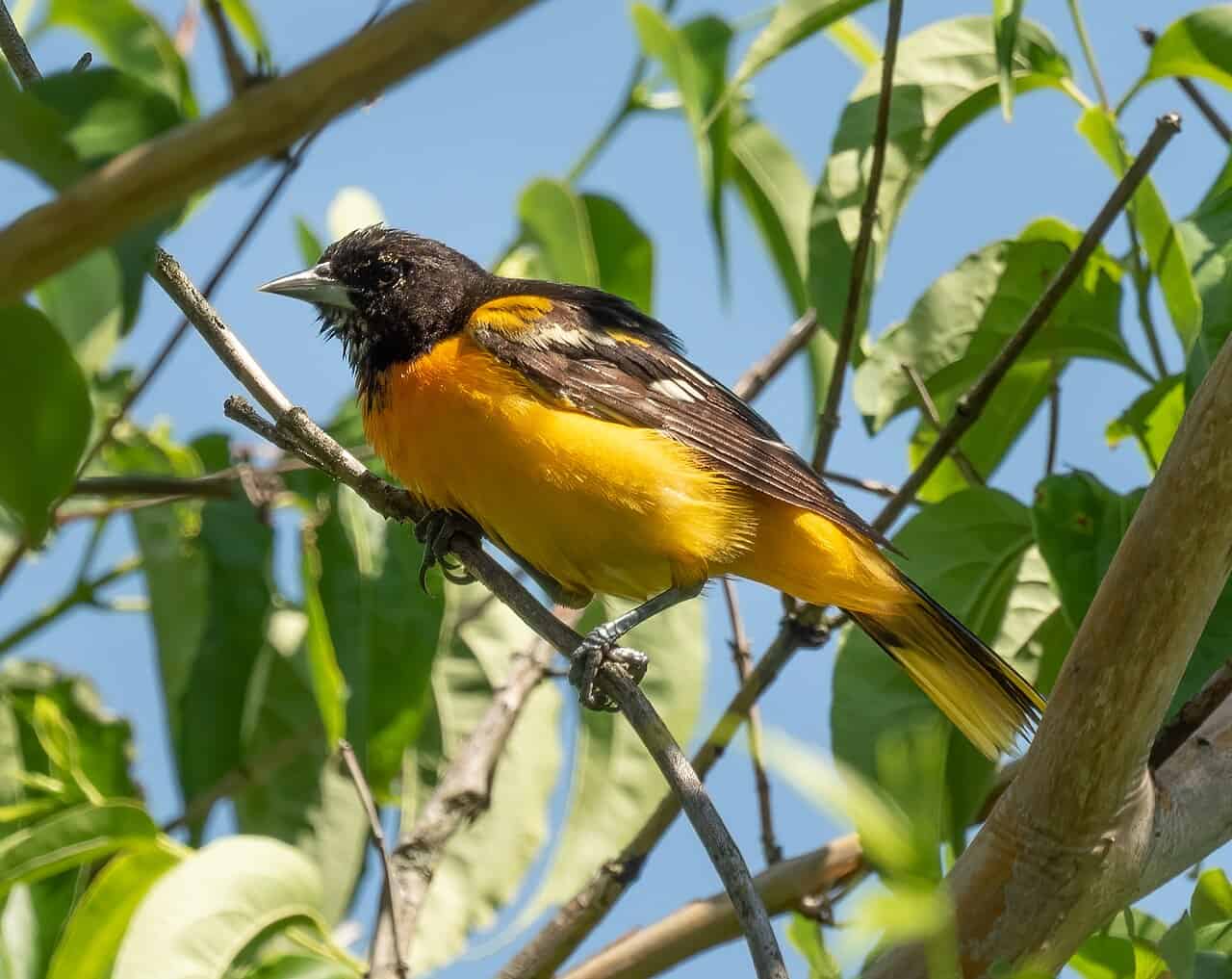
| Baltimore Oriole (state bird) | 8.75″ | Brilliant orange + black head (male) | Summer (Apr-Sep) |
| Northern Cardinal | 8.5″ | All red (male) + crest + black face mask | Statewide year-round |
| Carolina Chickadee | 4.75″ | Black cap + white cheeks + black bib | Statewide year-round |
| Carolina Wren | 5.5″ | Rust-brown + bold white eyebrow | Statewide year-round |
| Tufted Titmouse | 6.5″ | Gray crest + buff flanks + black eye | Statewide year-round |
| Blue Jay | 11″ | Blue crest + black necklace + white below | Statewide year-round |
| Mourning Dove | 12″ | Tan + long pointed tail + small head | Statewide year-round |
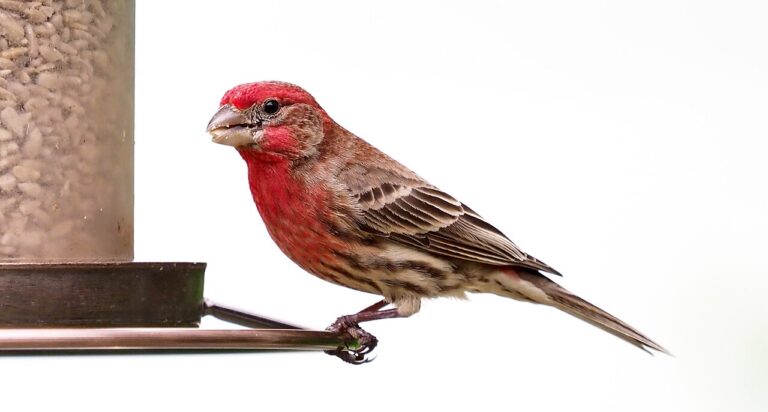
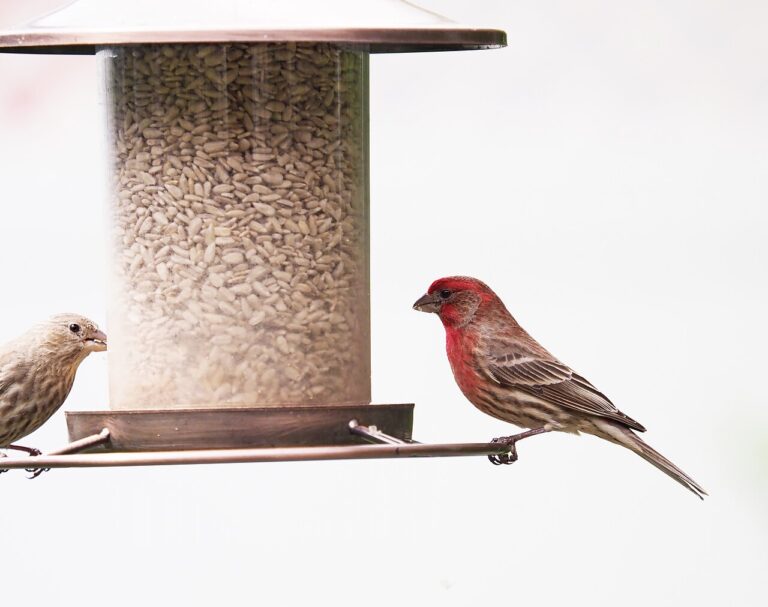
| House Finch | 5.5″ | Red head/breast (male) + streaky belly | Statewide year-round |
| American Goldfinch | 5″ | All yellow (summer male) + black wings | Year-round |
| Eastern Bluebird | 7″ | Blue back + rust breast + white belly | Statewide year-round |
| Downy Woodpecker | 6.75″ | Small + short bill + checkered wings | Statewide year-round |
| Red-Bellied Woodpecker | 9.25″ | Red cap + zebra back + tan belly | Statewide year-round |
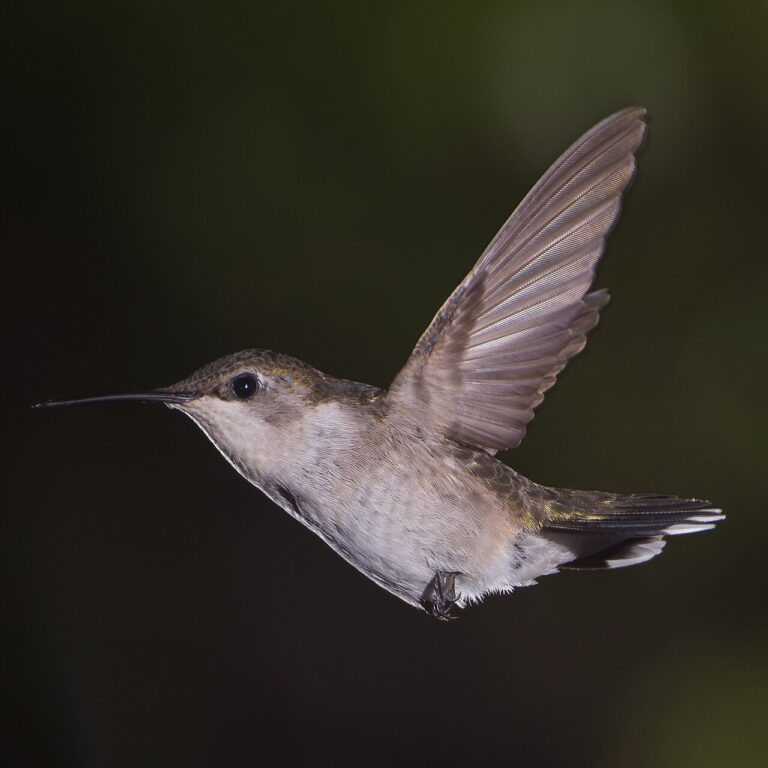
| Ruby-Throated Hummingbird | 3.5″ | Iridescent green + ruby throat (male) | Summer (Apr-Oct) |
| American Robin | 10″ | Rust-orange breast + gray-brown back | Year-round |
| Brown-Headed Nuthatch | 4.5″ | Brown cap + gray back + pine forests | Eastern Shore pine forests |
Species Identification
Baltimore Oriole (State Bird)
Maryland’s iconic state bird, designated in 1947. Male Baltimore Orioles are stunning: brilliant flame-orange overall with a jet-black head and back, black wings with white wing bars and orange shoulder patches, and a sharp pointed bill. Females are duller yellowish-orange below with grayish-olive backs and brown wings. The species is named for the state, both share the orange-and-black colors of Maryland’s founder Lord Baltimore (George Calvert).
Range in Maryland: Statewide in summer (April-September). Migrate to Central America for winter (September-March).
Habitat: Open deciduous forest, parks, mature suburban yards with large trees. Build distinctive woven hanging pouch nests in the outer tips of tall deciduous trees (especially elms, maples, sycamores).
Key ID: Brilliant orange-and-black (male) + woven hanging nest. Female orioles look superficially like American Robins but have orange (not rust) breast and slimmer build.
Where to see: Oriole-specific feeders with sliced oranges and grape jelly are extremely effective. Will also visit sugar-water feeders designed for orioles (larger ports than hummingbird feeders). Plant native trees with hanging branches (elms, maples, sycamores) for nesting.
Northern Cardinal
Maryland’s familiar year-round red bird. Male Northern Cardinals are brilliant red overall with a pointed red crest, black face mask, and thick orange-red bill. Cardinals are nonmigratory in Maryland.
Range in Maryland: Statewide year-round.
Habitat: Yards with shrubby cover, parks, woodland edges, urban areas with brush.
Key ID: Brilliant red + pointed crest + black face mask + thick orange-red bill (male).
Where to see: Hopper or platform feeders with sunflower or safflower seed.
Carolina Chickadee
Maryland’s small year-round companion. Carolina Chickadees have a black cap, black throat/bib, white cheeks, gray back, and buffy flanks. Carolina is the species across most of Maryland, Black-Capped Chickadees only occur in the very western mountains.
Range in Maryland: Statewide year-round.
Habitat: Wooded yards, parks, forests.
Key ID: Black cap + black bib + white cheeks + small size.
Where to see: Common at sunflower, peanut, and suet feeders. Will use small nest boxes (1.125 inch hole).
Carolina Wren
Maryland’s loudest backyard voice. Carolina Wrens have rich rust-brown upperparts, buff underparts, and a striking bold white eyebrow stripe. Loud, ringing ‘tea-kettle’ song carries throughout Maryland yards year-round.
Range in Maryland: Statewide year-round.
Habitat: Wooded yards, gardens with brush, edges of forests.
Key ID: Rich rust color + bold white eyebrow + loud voice.
Where to see: Common at suet feeders. Will visit platform feeders.
Tufted Titmouse
Maryland’s perky crested feeder companion. Tufted Titmice have a clean gray back, white underparts with buff flanks, a pointed gray crest, large black eyes.
Range in Maryland: Statewide year-round.
Habitat: Mature deciduous forests, parks, suburban yards.
Key ID: Gray crest + buff flanks + black eye + small size.
Where to see: Common at backyard feeders with sunflower seed, peanuts, and suet.
Blue Jay
Maryland’s familiar crested blue bird. Blue Jays have bright blue heads, wings, and backs (with black markings), white chests, and a prominent blue crest.
Range in Maryland: Statewide year-round.
Habitat: Forests, parks, suburban backyards with mature trees.
Key ID: Blue + black necklace + prominent crest + white below.
Where to see: Platform feeders with peanuts in shell, sunflower seed, and corn.
Eastern Bluebird
Maryland’s bluebird species. Male Eastern Bluebirds have brilliant royal-blue heads and backs, rust-orange throats and breasts, and clean white bellies.
Range in Maryland: Statewide year-round.
Habitat: Open habitat with scattered trees, pastures, golf courses, parks, suburbs.
Key ID: Bright blue back + rust-orange breast + clean white belly.
Where to see: Install NABS-approved bluebird nest boxes on poles in open areas. Provide mealworms.
Brown-Headed Nuthatch (Eastern Shore Specialty)
Maryland’s pine forest specialty. Brown-Headed Nuthatches are very small (4.5 inches), with a brown cap and nape, blue-gray back, and white face and underparts. They use small twigs as tools to pry up bark.
Range in Maryland: Eastern Shore pine forests (Worcester, Wicomico, Dorchester counties).
Habitat: Mature loblolly pine forests on the Delmarva Peninsula.
Key ID: Very small + brown cap + gray back + white underparts. The tool-using behavior is diagnostic.
Where to see: Yards adjacent to mature pine forests. Will visit suet and peanut feeders. Will use small nest boxes.
Red-Bellied Woodpecker
Maryland’s medium woodpecker. Red-Bellied Woodpeckers have a red cap and nape (males) or just red nape (females), a barred black-and-white zebra-pattern back, and tan-buff underparts.
Range in Maryland: Statewide year-round.
Habitat: Wooded yards, parks, forests with mature trees.
Key ID: Red cap/nape + zebra-pattern back + tan belly. The red is on the HEAD, not the belly.
Where to see: Common at suet feeders.
Downy Woodpecker
Maryland’s smallest backyard woodpecker. Clean black-and-white checkered pattern, white back stripe, white underparts, small red patch on back of head (males).
Range in Maryland: Statewide year-round.
Habitat: Forests, parks, backyards with mature trees.
Key ID: Small size + short bill + checkered pattern + small red nape (male).
Where to see: Common at suet feeders.
Ruby-Throated Hummingbird
Maryland’s only common breeding hummingbird. Male Ruby-Throated Hummingbirds have an iridescent green back and a brilliant ruby-red throat.
Range in Maryland: Statewide in summer (April-October).
Habitat: Gardens, parks, woodland edges with flowering plants.
Key ID: Iridescent green back + ruby throat (male) + tiny size.
Where to see: Hummingbird feeders. Plant native cardinal flower, bee balm, native salvias.
American Goldfinch
Maryland’s brightest summer bird. Summer male American Goldfinches are brilliant lemon-yellow overall with jet-black wings and a black cap.
Range in Maryland: Statewide year-round.
Habitat: Open habitat with weeds, gardens, parks, suburban yards.
Key ID: Brilliant yellow (summer male) + black wings + black cap.
Where to see: Nyjer (thistle) feeders. Will also visit sunflower feeders.
Regional Variations Across Maryland
Maryland’s compactness still creates distinct backyard bird communities by region. The Chesapeake Bay shoreline and Eastern Shore (Ocean City, Cambridge, Salisbury, Easton) hosts Brown-Headed Nuthatches in pine forests, Boat-Tailed Grackles near saltwater, and coastal migrants. Smith Island and Tangier Island host distinctive coastal bird communities.
Central Maryland and DC suburbs (Baltimore, Bethesda, Frederick, Columbia, Annapolis) host typical Mid-Atlantic backyard birds at suburban densities. Spring migration along the Potomac River is excellent.
Western Maryland (Frederick, Hagerstown, Cumberland) transitions to Appalachian habitat. Mountain elevations in Garrett County host higher-elevation species: Black-Capped Chickadees at the highest elevations, Hermit Thrushes in summer, occasional irruptive winter species (Pine Siskin, Common Redpoll). Pileated Woodpeckers more common in mature mountain forests.
Catoctin and Frederick Mountains create elevation gradients within central Maryland. Yards in higher elevations see more woodland species than valley locations.
Patuxent Wildlife Research Refuge (between Baltimore and DC) is a famous federally-managed area. Yards adjacent to the refuge see diverse migrants.
Assateague Island (national seashore) hosts wild ponies plus coastal birds. Backyards near Assateague see typical Eastern Shore birds plus migration concentrations.
The Baltimore Oriole: Maryland’s Iconic Orange-and-Black Beauty
The Baltimore Oriole (Icterus galbula) was designated Maryland’s official state bird on July 19, 1947. Maryland is the ONLY US state with this species as state bird, making Baltimore Orioles uniquely identifying for Maryland.
The Baltimore Oriole takes its name from Maryland history. George Calvert, the first Lord Baltimore (1579-1632), was Maryland’s founder. His family heraldic colors were orange (representing Calvert) and black, the same colors as the Baltimore Oriole’s plumage. When Carolus Linnaeus first described the species scientifically in 1758, he named it ‘Baltimore’ in honor of Lord Baltimore’s coat-of-arms. Maryland’s state bird is thus connected to the state’s founding heritage.
Baltimore Orioles are striking birds, male orioles are brilliant flame-orange with jet-black heads and backs, black wings with white wing bars, and a sharp pointed bill. Females are duller yellowish-orange below with grayish-olive backs.
Baltimore Orioles are migratory. They arrive in Maryland in late April and depart for Central America by September. The Major League Baseball team and the NFL Ravens both reference Maryland’s bird heritage (Orioles directly; Ravens for the city’s literary connection to Edgar Allen Poe).
Baltimore Orioles build remarkable nests, woven pouches hung from the outer tips of branches in tall deciduous trees. The female weaves the nest over 5-8 days, using plant fibers, hair, string, and other materials. Each nest takes thousands of stitching motions to construct. The hanging pouch design protects eggs and nestlings from many predators.
Maryland Baltimore Orioles feed on insects (especially caterpillars during breeding), nectar, and fruit. They have an unusual feeding behavior called ‘gaping’, inserting their closed bill into fruit, then opening it to spread the fruit and feed on juice and pulp.
To attract Baltimore Orioles to your Maryland yard, install oriole-specific feeders with sliced oranges and grape jelly (Welch’s Concord Grape Jelly is the preferred brand for many oriole enthusiasts). Sugar-water feeders designed for orioles (larger ports than hummingbird feeders) work well. Plant native trees with hanging branches, elms (where they tolerate Dutch elm disease), maples, sycamores. Orioles often return to the same trees year after year. Have feeders up by April 15 to greet returning birds.
How to Attract Maryland Backyard Birds
Maryland’s mild-to-moderate climate creates year-round backyard birding opportunities. The state’s compactness means backyard birding strategies work statewide with minor regional adjustments.
Winter feeding strategy (December-February): black oil sunflower seed in tube and hopper feeders, suet in cage feeders, peanuts (shelled, raw), nyjer (thistle) seed for goldfinches. Heated bird baths valuable in winter when water freezes.
Spring is the most spectacular season for Maryland backyard birds, Baltimore Orioles return in late April. Hang oriole feeders by April 15 with sliced oranges and grape jelly. Spring migration brings warblers, vireos, thrushes, tanagers, plus orioles. Mealworms and water features draw migrants.
Summer (May-August) is breeding season. Provide nest boxes for cavity nesters: Eastern Bluebirds (1.5 inch hole), Carolina Chickadees (1.125 inch). Baltimore Orioles don’t use nest boxes, they prefer hanging in trees.
Hummingbird feeders are essential April through October. Use 4:1 water-to-sugar ratio, no red dye.
Native plant landscaping outperforms turfgrass dramatically. Maryland-native plants support 10-100x more bird food than non-native landscaping.
For Baltimore Orioles specifically: Plant tall native deciduous trees (elms, maples, sycamores, tulip trees). Orioles weave nests in the outer tips of branches in tall trees. Mature backyard trees are essential for breeding orioles.
Manage outdoor cats. Maryland outdoor cats kill millions of birds annually.
Avoid pesticides. Pesticides reduce caterpillar populations essential for breeding orioles and other birds.
Top Native Maryland Plants for Backyard Birds
**White Oak (Quercus alba), Maryland State Tree:** Maryland’s state tree (the famous Wye Oak was a famous specimen). Native oaks support hundreds of caterpillar species, the most productive single plantings for Maryland yards. Acorns feed Blue Jays, woodpeckers, Tufted Titmice.
**American Sycamore (Platanus occidentalis):** Native large tree with distinctive peeling bark. Baltimore Orioles weave nests in the outer branches of sycamores. Provides essential breeding habitat for Maryland’s state bird.
**Tulip Tree (Liriodendron tulipifera):** Native large tree producing yellow-orange tulip-shaped flowers attracting Ruby-Throated Hummingbirds and Baltimore Orioles. Seeds feed birds in late summer/fall.
**Eastern Red Cedar (Juniperus virginiana):** Native conifer producing blue-gray berries feeding Cedar Waxwings, American Robins, Yellow-Rumped Warblers. Essential winter cover.
**American Beautyberry (Callicarpa americana):** Native shrub producing dramatic clusters of bright purple-violet berries in fall.
**Coral Honeysuckle (Lonicera sempervirens):** Native vine with tubular red flowers attracting Ruby-Throated Hummingbirds. Native, NOT the invasive Japanese honeysuckle.
Frequently Asked Questions
What’s the most common backyard bird in Maryland?
Northern Cardinal, Carolina Chickadee, Carolina Wren, Mourning Dove, Tufted Titmouse, House Finch, and Blue Jay are all extremely common across Maryland year-round. Baltimore Orioles (the state bird) are common in summer (April-September). American Goldfinches and Eastern Bluebirds add abundance throughout the year.
When do Baltimore Orioles (Maryland’s state bird) arrive?
Baltimore Orioles typically arrive in Maryland in late April. They breed across the state and stay through September before migrating to Central America for winter. Have oriole feeders up by April 15 to greet returning birds. Orioles often return to the same trees and feeders year after year.
How do I attract Baltimore Orioles to my Maryland yard?
Install oriole-specific feeders with sliced oranges (orange halves on a spike) and grape jelly (Welch’s Concord Grape Jelly is favored). Sugar-water feeders designed for orioles (larger ports than hummingbird feeders) work well. Plant native tall deciduous trees (American Sycamore, native maples, tulip tree) where orioles weave their distinctive hanging nests. Position oriole feeders in mid-canopy height, orioles prefer feeding in trees, not on the ground.
Why is the bird called ‘Baltimore Oriole’?
The species takes its name from Maryland history. George Calvert, the first Lord Baltimore (1579-1632), was Maryland’s founder. His family heraldic colors were orange and black, the same colors as the Baltimore Oriole’s plumage. Carolus Linnaeus named the species ‘Baltimore’ in 1758 to honor Lord Baltimore. Maryland’s state bird connects to the state’s founding heritage.
What’s that small bird with the brown cap on my Maryland Eastern Shore pine tree?
Brown-Headed Nuthatch, a Maryland Eastern Shore pine forest specialty. Very small (4.5 inches) with a brown cap and nape, blue-gray back, and white face and underparts. Found in mature loblolly pine forests on the Delmarva Peninsula. Uses twigs as tools to pry up bark, among the few tool-using bird species.
When do hummingbirds arrive in Maryland?
Ruby-Throated Hummingbirds typically arrive in southern Maryland by late April. Maryland mountains by mid-May. They breed statewide and stay through October. Have hummingbird feeders up by April 20.
Do I have Carolina or Black-Capped Chickadees in Maryland?
Almost everywhere in Maryland it’s Carolina Chickadees. Only the highest elevations in Garrett County (far western Maryland) have Black-Capped Chickadees. They look nearly identical, distinguished best by voice. Black-Capped sing ‘fee-bee’ two-note whistle; Carolina sing ‘fee-bee-fee-bay’ four-note pattern.
What native plants attract the most Maryland birds?
White Oak (Maryland’s state tree) and other native oaks are the most productive plantings. Other top natives: American Sycamore (Baltimore Oriole nest tree!), Tulip Tree, Eastern Red Cedar, American Beautyberry, Coral Honeysuckle. Plant native, not non-native ornamentals, native plants support 10-100x more bird food.