Downy Woodpecker: Complete Identification, Diet, and Behavior Guide (2026)
The Downy Woodpecker (Dryobates pubescens) is North America’s smallest and most common woodpecker, a familiar visitor to bird feeders across nearly the entire continent. With a clean black-and-white plumage, a small red patch on males, and a remarkably small bill, Downy Woodpeckers are well-adapted for foraging on small branches, weed stems, and even goldenrod galls that larger woodpeckers can’t reach. They’re also among the easiest woodpeckers to attract to backyard feeders, making them favorites of backyard birders learning to identify woodpeckers. This comprehensive guide covers Downy Woodpecker identification (including how to distinguish them from their nearly-identical larger cousins, Hairy Woodpeckers), range, diet, behavior, nesting, vocalizations, and proven strategies for attracting Downy Woodpeckers to your yard.
Downy Woodpecker: Key Facts at a Glance
| Attribute | Detail |
|---|---|
| Scientific Name | Dryobates pubescens (formerly Picoides pubescens) |
| Family | Picidae (Woodpeckers) |
| Size | 5.5-6.7 inches (14-17 cm) length |
| Wingspan | 9.8-12 inches (25-30 cm) |
| Weight | 0.7-1.0 oz (21-28 g) |
| Lifespan | 1-2 years average; up to 12 years recorded |
| Diet | Insects (75%), seeds, fruits, suet |
| Habitat | Open woodlands, parks, suburban yards, weedy fields |
| Range | All of US and Canada except deserts and far north tundra |
| Population Status | Very common, 14 million estimated North American population |
| Conservation Status | Least Concern (IUCN) |
| Distinctive Feature | Smallest woodpecker + checkered wings + small bill |
| Key Distinguishing Feature | SHORT BILL (1/3 head length), distinguishes from Hairy Woodpecker |
| Call | Sharp ‘pik!’ + descending whinny rattle |
| Migration | Non-migratory, year-round residents throughout range |
Downy Woodpecker Identification: How to Identify a Downy
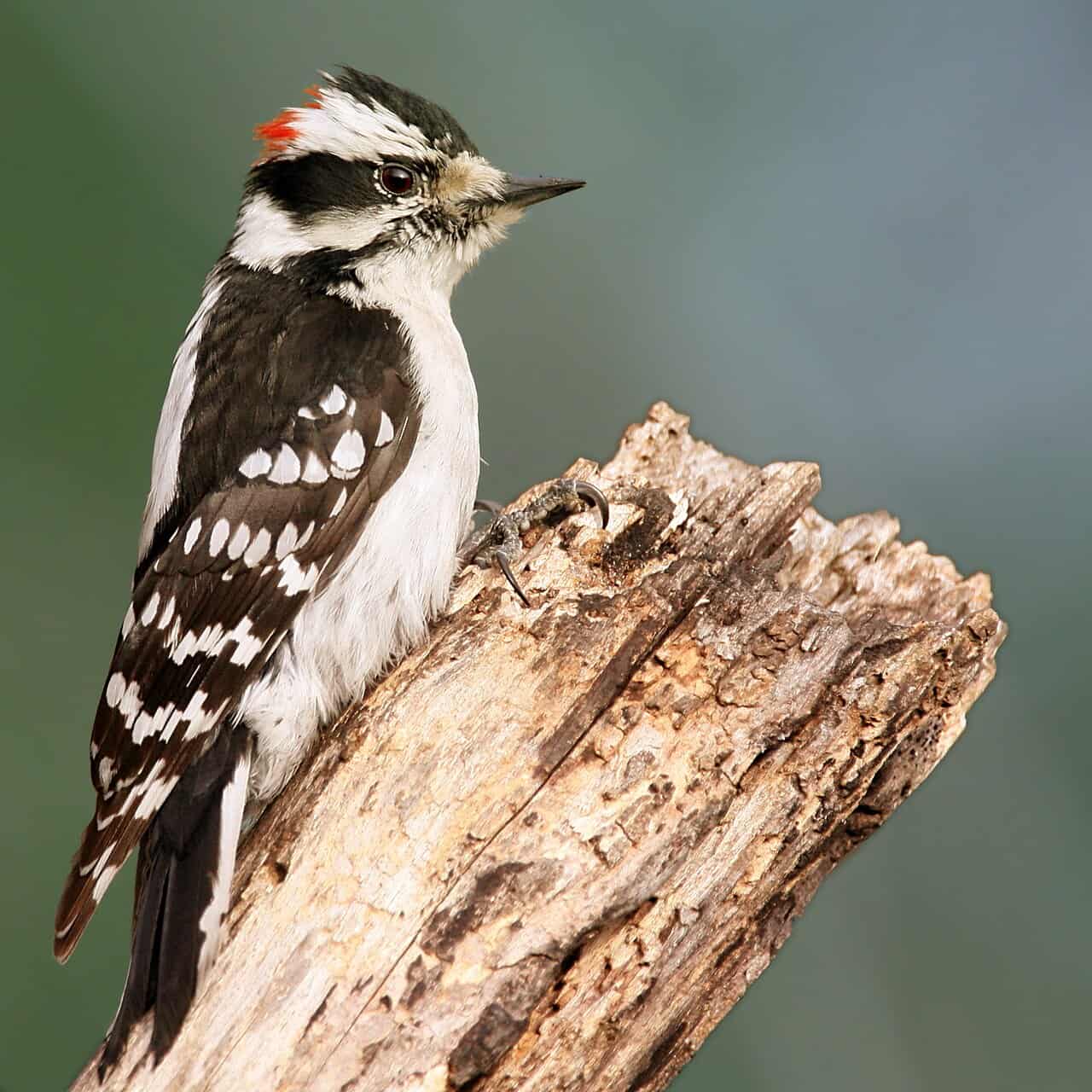
Downy Woodpeckers are small and distinctive: black-and-white checkered pattern on the wings, white face with two black stripes (one through the eye, one across the cheek), white back stripe, white underparts, and a notably SHORT, stubby bill (approximately 1/3 the length of the head). Males have a small red patch on the back of the head; females lack the red patch.
Size: Downy Woodpeckers are 5.5-7 inches long, the smallest North American woodpecker. About the size of a House Sparrow (6 inches), smaller than expected for a ‘woodpecker.’ This small size is one of the easiest ways to identify Downies.
Male vs Female: Adult males have a small red patch on the back of the head (nape), distinguishing them from females, who lack the red patch entirely. Juveniles may have red on the top of the head (forehead), this fades as they mature.
Downy vs Hairy Woodpecker, the classic identification challenge: Downy and Hairy Woodpeckers look almost identical. Both species have nearly the same plumage pattern. The key differences:
1) Size: Downy is 5.5-7 inches; Hairy is 7-10 inches. Hairy is noticeably larger.
2) Bill: Downy bill is SHORT (approximately 1/3 head length); Hairy bill is LONG (approximately the same length as the head). The bill difference is the most reliable identifier.
3) Outer tail feathers: Downy outer tail feathers have black SPOTS or BARS. Hairy outer tail feathers are pure white (no spots). This requires good views but is diagnostic.
4) Voice: Downy calls are higher-pitched and quieter than Hairy. The Hairy ‘pik!’ call is sharper and louder.
5) Habitat: Downy prefers smaller branches and weed stems; Hairy prefers larger tree trunks.
Many backyard birders find the Downy/Hairy distinction confusing for years. Bill size (proportional to head) is the most reliable single feature. Practice on photos before relying on field identification.
Downy Woodpecker Range and Habitat
Downy Woodpeckers have one of the most extensive ranges of any North American bird, they’re year-round residents across nearly the entire continent. Their range covers all 50 states (except southwestern desert regions), all Canadian provinces (south of the Arctic), and parts of Mexico.
Habitat: Downy Woodpeckers are remarkable habitat generalists. They thrive in open deciduous woodlands, mixed forests, parks, suburban yards with mature trees, urban green spaces, agricultural windbreaks, weedy fields, and even riparian thickets in arid regions. They generally avoid pure coniferous forests and treeless deserts.
Downy Woodpeckers have benefited substantially from human-modified landscapes. Suburban yards with mature trees provide excellent habitat. Bird feeders provide reliable winter food. The species has likely increased in abundance over the past century.
Range and abundance: Downy Woodpeckers are one of the easiest woodpeckers to encounter, they’re typically the first woodpecker most North American backyard birders learn to identify. Suburban yards with mature deciduous trees can host 1-3 pairs year-round.
Nonmigratory: Unlike many North American birds, Downy Woodpeckers are non-migratory. The same individuals stay in your yard year-round. They establish territories in fall and may use the same territories for multiple years. Banded Downies have been documented visiting feeders for 8+ years.
Downy Woodpecker Diet: What Do Downies Eat?
Downy Woodpeckers are primarily insectivorous, with insects forming approximately 75% of their diet. The remaining diet consists of seeds, fruits, plant materials, and suet at backyard feeders.
Natural diet: Downy Woodpeckers eat caterpillars, ants, beetle larvae (especially wood-boring beetle grubs from inside dead branches), spiders, weevils, and other insects. They also eat goldenrod galls, they specifically search out the round galls on goldenrod stems where fly larvae develop inside. The small Downy bill is perfect for breaking into these galls.
Seasonal variation: Insect consumption is highest in spring/summer when insects are abundant. Fall and winter shift toward more seeds, fruits, and suet at feeders.
Foraging behavior: Downy Woodpeckers forage on small branches, twigs, and weedy stems, areas that larger woodpeckers can’t reach. They probe into crevices, peck at bark, and explore goldenrod galls. The small size makes them efficient foragers in areas inaccessible to other species.
At feeders: Downy Woodpeckers are reliable feeder visitors year-round. They love suet (most preferred food at feeders), black oil sunflower seeds, peanuts, peanut butter, mealworms, and sometimes nyjer (thistle) seed. Suet is so attractive to Downies that adding a suet feeder to your yard typically guarantees Downy visits within days.
Feeding technique at suet: Downy Woodpeckers prefer suet feeders accessible from multiple sides. They cling to the cage and peck at the suet. They can spend 5-10 minutes at a single suet visit. Multiple Downies may share a suet feeder if it’s large enough.
Downy Woodpecker Behavior and Social Structure
Downy Woodpeckers are usually solitary except during breeding season. They maintain individual territories year-round. They often forage in mixed-species flocks with chickadees, titmice, and nuthatches during winter, these mixed flocks provide better predator detection and may help find food.
Pair behavior: Mating pairs form in fall and remain together through breeding season. Pairs are not as tightly bonded as some woodpeckers, pair changes occur between seasons. Both members of a pair work together during nest excavation and offspring care.
Drumming: Like all woodpeckers, Downy Woodpeckers communicate through drumming, rapid rapping on resonant surfaces. Drumming serves multiple purposes: territory advertisement, mate attraction, and pair communication. Downies drum less loudly than larger woodpeckers, partly because their small size limits force generation. Both males and females drum, though males drum more.
Hammering vs drumming: Drumming (communication) sounds different from feeding hammering. Drumming is a rapid ‘rat-tat-tat’ burst, usually 15-25 strikes per second, lasting 1-2 seconds. Feeding hammering is slower, more methodical, and irregular. Practice listening to both, they’re easy to distinguish once familiar.
Mixed-species winter flocks: Downy Woodpeckers regularly join winter flocks with Black-Capped or Carolina Chickadees, Tufted Titmice, White-Breasted Nuthatches, and other species. The mixed flocks travel together through woodlands, sharing predator detection. This makes Downies very common backyard birds during winter, they arrive at your feeder as part of these mobile flocks.
Lifespan: Wild Downies have been recorded surviving 12 years (banded bird), though typical lifespan is 1-2 years due to high first-year mortality. Adults surviving first year may live 4-6 years. Major mortality factors: predation by Cooper’s Hawks (especially at feeders), Sharp-Shinned Hawks, owls, snakes, and outdoor cats. Also vulnerable to window strikes.
Downy Woodpecker Breeding and Nesting
Downy Woodpecker breeding begins in April-May across most of their range. Most pairs raise one brood per year, though occasional second broods occur in southern regions.
Nest excavation: Like all woodpeckers, Downies excavate their own nest cavities in dead trees, dead branches, or dead portions of live trees. Both male and female participate in excavation. The cavity is typically 6-12 inches deep with a 1.25-inch round entrance. Excavation takes 1-3 weeks.
Nest site selection: Downies prefer dead deciduous trees or branches for nesting. Sometimes they use dead branches in otherwise-live trees. The wood must be soft enough for their small bill to excavate. Aspen, willow, and dead deciduous trees are common nest sites.
Eggs: Each clutch contains 4-5 eggs (occasionally 3-7). Downy Woodpecker eggs are pure white (typical for cavity-nesting birds where eggs don’t need camouflage). Incubation takes 11-13 days, with both parents participating, males typically take nighttime shifts, females take daytime shifts.
Nestling period: Both parents feed nestlings. Nestlings remain in the nest cavity for 20-25 days. After fledging, juveniles remain with parents for 2-4 weeks while learning to forage.
Cavity importance: Downy Woodpecker nest cavities are critical resources for many other species. After Downies abandon their nest cavities (typically used only one season for breeding), many other species use them, Black-Capped Chickadees, House Wrens, Tree Swallows, Eastern Bluebirds, and even small flying squirrels. This makes Downy Woodpeckers crucial ‘ecosystem engineers’ creating nesting habitat for many other species.
Yard nesting: Downy Woodpeckers nest in yards with appropriate dead trees or dead branches. Leaving safe dead branches in yards supports Downy nesting. Concerns about dead trees should be evaluated case-by-case, branches that don’t pose human safety risks can remain standing as Downy nesting habitat.
Downy Woodpecker Vocalizations and Sounds
Downy Woodpeckers produce several distinctive sounds, plus drumming displays.
Primary call: ‘Pik!’ or ‘pic!’, a sharp, sudden call. Used for various contact and alert situations. Sometimes given in series. Higher-pitched and softer than the equivalent call of the Hairy Woodpecker (which sounds like ‘PEEK!’).
Whinny call: A descending series of rapid notes, often described as a ‘whinny’ sound. Used for pair contact, mild alarm, and territorial advertisement. The descending pattern (starting high, ending lower) is distinctive.
Drumming: Rapid ‘rat-tat-tat’ bursts on resonant surfaces (dead branches, gutters, metal posts). Drumming is faster than feeding hammering, typically 15-25 strikes per second, lasting 1-2 seconds per burst. Both sexes drum. Males drum more for territory advertisement; females drum for pair communication.
Drumming surface preferences: Downies often drum on the most resonant surfaces they can find, sometimes including human structures (rain gutters, metal vents, wooden siding). Backyard drumming on metal surfaces can be remarkably loud and is occasionally a nuisance to homeowners.
Begging calls from nestlings: Inside their nest cavities, Downy nestlings make begging calls. The sounds are typically muffled by the cavity but can be heard at close range.
Compared to other woodpeckers: Downy calls are notably softer and higher-pitched than Hairy Woodpecker calls. Pileated Woodpecker calls are dramatically louder and more raucous. Red-Bellied Woodpecker calls are different, a ‘churrr’ sound rather than the sharp ‘pik!’ of Downies.
Downy Woodpecker Subspecies and Regional Variations
Downy Woodpeckers are divided into seven recognized subspecies across their North American range. The variations are subtle and most birders identify all as ‘Downy Woodpecker.’
Eastern Downy Woodpecker (D. p. medianus): The most familiar subspecies across the eastern and central US and Canada. Standard Downy appearance.
Pacific Downy Woodpecker (D. p. gairdnerii): Pacific Northwest coast. Slightly darker overall than Eastern Downies, with grayer markings.
Newfoundland Downy Woodpecker (D. p. pubescens): Newfoundland. Slightly larger than other subspecies.
Rocky Mountain Downy Woodpecker (D. p. leucurus): Rocky Mountains. Paler than Eastern Downies with whiter underparts.
Sonoran Downy Woodpecker (D. p. turati): Sonoran Desert riparian zones. Smallest subspecies, paler overall.
Most variations involve subtle differences in plumage shade and size. The basic Downy pattern (checkered black-and-white, small size, short bill) is consistent across all subspecies.
Genetic studies: Recent genetic studies have shown that some Downy Woodpecker populations are genetically more distinct than the subspecies designations suggest. Future taxonomic revisions may split or rearrange the current subspecies.
How to Attract Downy Woodpeckers to Your Backyard
Downy Woodpeckers are among the easiest woodpeckers to attract to backyard feeders. A few key strategies dramatically increase Downy visits, most yards can attract reliable Downy visitors within days of adding the right feeders.
1. Offer suet in a cage feeder. Suet is the single most attractive food for Downy Woodpeckers. Use a wire cage suet feeder positioned 5-6 feet above ground on a pole or hung from a branch. Buy quality suet cakes (avoid ‘no-melt’ suet during winter when birds need maximum calories; use ‘no-melt’ suet for hot summer months).
2. Provide black oil sunflower seed. Universal favorite for most backyard birds including Downies. Use hopper feeders or tube feeders with stable perches. Downies can perch on tube feeders despite their small clinging-bird body design.
3. Offer peanut butter (when not too hot). Spread peanut butter on tree bark or in feeder cups. Downies love it. Avoid peanut butter in hot weather (above 80°F) to prevent melting and contamination.
4. Try mealworms. Live or dried mealworms attract Downies, especially during breeding season when adults need extra protein for nestlings.
5. Plant native deciduous trees. Native oaks, maples, dogwoods, and other deciduous trees provide insect food and nesting habitat. A mature oak tree supports more Downy food than years of feeder visits could provide. Native trees are the foundation of Downy habitat.
6. Leave dead branches if safe. Downies excavate nest cavities in dead branches. Leaving safe dead branches (those that don’t pose human safety risks) provides natural nesting habitat. Consider working with an arborist if dead branches require evaluation.
7. Provide nest boxes specifically for Downy Woodpeckers. Boxes with 1.25-inch entrance holes can attract Downies for nesting if natural cavities are scarce. Mount on tree trunks, 12-15 feet above ground.
8. Provide year-round water source. Downies visit bird baths. Use a shallow bath in summer; heated bath in winter for year-round water access.
9. Avoid pesticides. Pesticides reduce caterpillar populations that Downies eat. Native plant landscaping supports the insect community that supports Downy foraging.
10. Manage outdoor cats. Outdoor cats kill many Downy Woodpeckers, especially during winter when birds spend more time on the ground or low branches. Keeping cats indoors substantially improves Downy survival.
Once Downies discover your suet feeder, they typically become daily visitors, often multiple times per day. The same individual Downy may visit your yard for 5-10+ years. Many backyard birders develop personal relationships with ‘their’ Downies over time.
Related reading: what do woodpeckers eat.
Frequently Asked Questions
What’s the difference between Downy and Hairy Woodpecker?
The classic identification challenge. Key differences: 1) SIZE, Downy is 5.5-7 inches; Hairy is 7-10 inches. 2) BILL, Downy bill is SHORT (1/3 head length); Hairy bill is LONG (same length as head). 3) Outer tail feathers, Downy outer tail feathers have black spots/bars; Hairy outer tail feathers are pure white. 4) Voice, Downy calls are higher-pitched and quieter. Bill size proportional to head is the most reliable feature.
Are Downy Woodpeckers male or female if there’s no red?
If there’s NO red patch on the head, it’s a female Downy Woodpecker. Adult males have a small red patch on the back of the head (nape). Females lack the red entirely. Juveniles may have red on the TOP of the head (forehead), this fades as they mature into adult plumage. So: no red = adult female; small red patch on nape = adult male; red on top = juvenile (sex undetermined until they mature).
Do Downy Woodpeckers migrate?
No, Downy Woodpeckers are non-migratory throughout their range. The same individuals stay in your yard year-round. They may shift slightly toward areas with reliable food during severe weather, but they don’t undertake true migration. Banded Downies have been documented visiting the same feeders for 8+ years.
Why do woodpeckers peck on my house?
Several possible reasons: 1) Drumming (communication), they’re announcing territory or attracting mates. House siding, gutters, and metal vents can be remarkably resonant. 2) Searching for insects, they may detect insect activity in your siding. 3) Excavating cavity, rare but possible. Solutions: install reflective tape, scarecrow streamers, or commercial repellents on the pecking surfaces. If insects are involved, address the underlying insect issue. Drumming usually stops after breeding season.
How long do Downy Woodpeckers live?
Wild Downies have been recorded surviving 12 years (banded bird). Typical lifespan is 1-2 years due to high first-year mortality. Adults surviving their first year may live 4-6 years. Major mortality factors include predation by Cooper’s Hawks and Sharp-Shinned Hawks (especially at feeders), owls, snakes, outdoor cats, and window strikes.
Do Downy Woodpeckers eat seeds or only insects?
Downy Woodpeckers eat both. Insects make up approximately 75% of their diet (caterpillars, ants, beetle larvae, weevils). The remaining 25% includes seeds, fruits, suet at backyard feeders, peanut butter, and other plant materials. Their omnivorous diet helps explain their adaptability, they can use whatever foods are seasonally available.
Can I attract Downy Woodpeckers without suet?
Yes, but suet is by far the most reliable attractant. Without suet, you can still attract Downies with: black oil sunflower seed (in hopper or platform feeders), peanut butter (smeared on tree bark), peanuts, mealworms, and native deciduous trees that support insect populations. However, adding a suet feeder is the most effective single change for attracting Downies, typically successful within days of installation.
Do Downies use nest boxes?
Yes, occasionally. Provide a nest box with 1.25-inch entrance hole, mounted on a tree trunk 12-15 feet above ground. The box should have sufficient depth for them to excavate the wood inside (since they prefer creating their own cavities). However, Downies more commonly use natural dead branches or trees for nesting. Nest boxes work best in yards with limited natural cavity options.
More in this series: downy vs hairy woodpecker.