Tufted Titmouse: Complete Identification, Diet, and Behavior Guide (2026)
The Tufted Titmouse (Baeolophus bicolor) is a small, perky songbird with a distinctive pointed gray crest and one of the most familiar voices in eastern North American backyards. With its loud, clear ‘peter-peter-peter’ song carrying through suburban woodlands year-round, the Tufted Titmouse is among the most common feeder visitors east of the Great Plains. Tufted Titmice are remarkable for their intelligence, family-group social structure, hoarding behavior, and dramatic northward range expansion over the past century. This comprehensive guide covers everything you need to know about Tufted Titmouse identification, range, diet, behavior, breeding, vocalizations, and proven strategies for attracting them to your backyard.
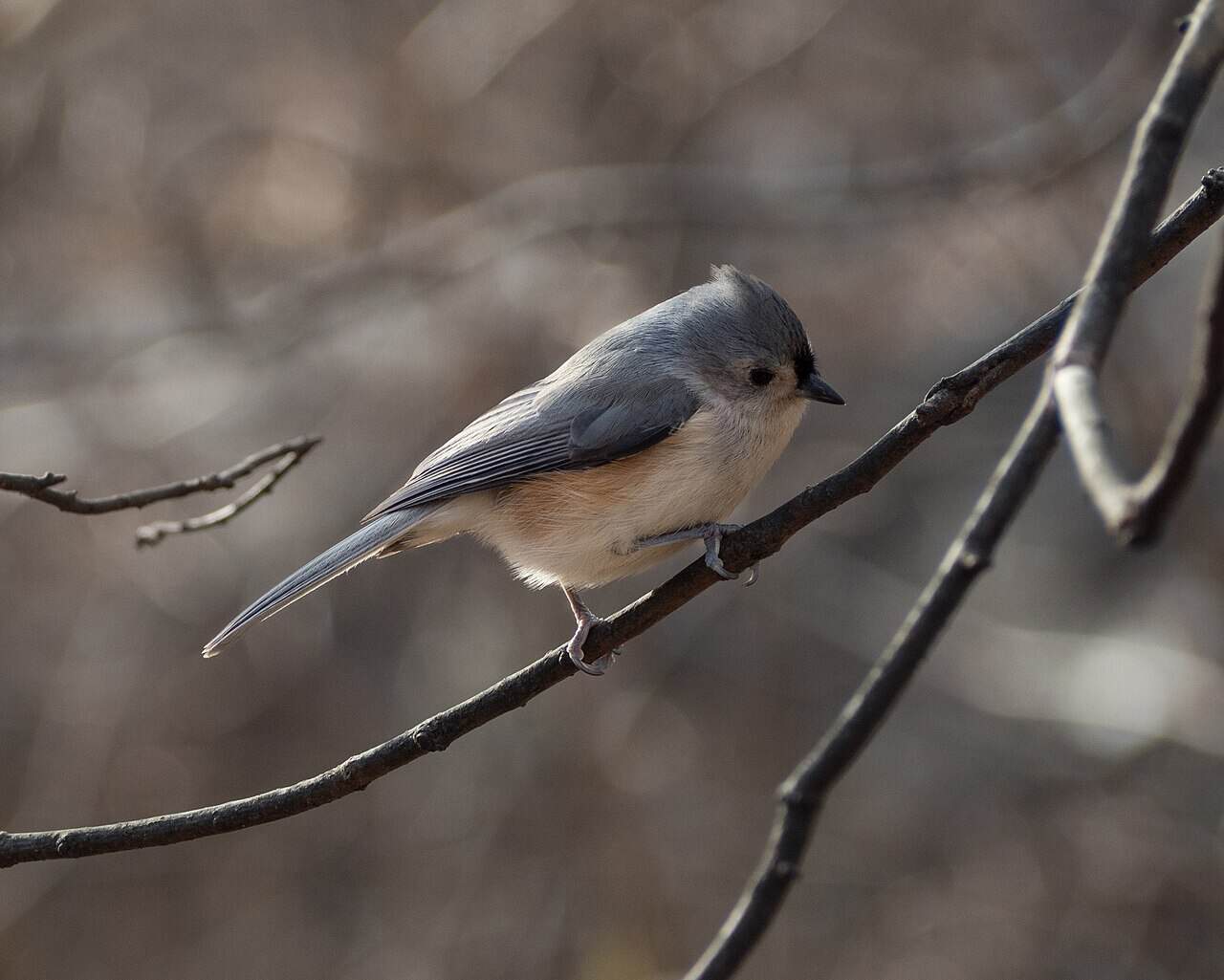
A Tufted Titmouse is a small crested gray songbird 5.5 to 6.3 in long, with a white face, a black patch above the bill, large dark eyes and peach-buff flanks. It is the only small crested gray bird at eastern feeders, which separates it from chickadees and nuthatches at a glance.
Tufted Titmouse: Key Facts at a Glance
| Attribute | Detail |
|---|---|
| Scientific Name | Baeolophus bicolor |
| Family | Paridae (Tits and chickadees) |
| Size | 5.5-6.3 inches (14-16 cm) length |
| Wingspan | 7.9-10.2 inches (20-26 cm) |
| Weight | 0.6-0.9 oz (17-26 g) |
| Lifespan | 2 years average; up to 13 years recorded |
| Diet | Insects (summer) + seeds, nuts, berries (winter) |
| Habitat | Deciduous and mixed forests, parks, suburban yards |
| Range | Eastern and central US (expanding north) |
| Population Status | Common, 12 million estimated North American population |
| Conservation Status | Least Concern (IUCN) |
| Distinctive Feature | Pointed gray crest + buff flanks + large black eye + small black forehead patch |
| Song | Loud ‘peter-peter-peter’ whistled phrases |
| Migration | Non-migratory, year-round residents |
| Range Expansion | Pushed dramatically northward over past century |
Tufted Titmouse Identification
Tufted Titmice are small, plump songbirds with a distinctive appearance: clean blue-gray back, wings, and tail; white face and underparts with buff-colored flanks; large black eyes that give them a ‘big-eyed’ alert appearance; a small black forehead patch above the bill; and a prominent pointed gray crest that can be raised or lowered.
Male and female Tufted Titmice look identical, there’s no significant sexual dimorphism. Both sexes have the same crest, plumage pattern, and coloring. Birds can only be sexed during breeding behavior or by molt patterns.
Juveniles look like duller versions of adults, with slightly browner tones and slightly smaller crests. They develop full adult plumage by their first fall.
Size: Tufted Titmice are 5.5-6.3 inches long, small but notably larger than chickadees (4.75 inches). The crest makes them look slightly bigger than their actual body size.
Crest behavior is informative: A Tufted Titmouse with its crest fully raised is alert, alarmed, or excited. A relaxed bird has the crest flat or slightly raised. This visual cue helps interpret what the bird is experiencing.
Tufted Titmouse vs Black-Crested Titmouse: Black-Crested Titmice (formerly considered the same species, now split) occur in Texas and parts of Oklahoma. Black-Crested have BLACK crests (rather than gray), and the two species hybridize in zones where their ranges overlap. Outside the hybrid zone, both species are reliably distinguished by crest color.
Tufted Titmouse vs Chickadees: Both are small backyard birds in the same family. Differences: Titmice are LARGER, have prominent CRESTS, and have BUFF FLANKS. Chickadees are smaller, have black caps and bibs but no crest, and have gray (not buff) flanks. The crest is the easiest distinguishing feature.
Tufted Titmouse Range and Habitat
Tufted Titmice occupy a vast range across eastern and central North America, from Florida and Texas north through southern Canada, west to the eastern edges of the Great Plains. The range covers approximately the eastern half of the United States.
Dramatic range expansion: Tufted Titmice have expanded northward dramatically over the past century. Historically a primarily Southern bird, they now breed across most of the Midwest, New England, and southern Canada. The expansion is attributed to climate change, the proliferation of bird feeders (which provide reliable winter food), and increasing maturity of suburban tree cover. The species continues expanding, making it likely to appear in regions where it was historically absent.
Habitat: Tufted Titmice prefer mature deciduous and mixed forests, parks, suburban yards with mature trees, woodland edges, and stream-side forests. They avoid open habitats without trees and pure coniferous forests.
Tufted Titmice are perhaps the most suburban-adapted member of their family (Paridae). They thrive in human-modified landscapes, mature suburban yards often host higher densities than nearby natural forests. Their range expansion has paralleled the maturation of suburban tree cover across North America.
Nonmigratory: Tufted Titmice are non-migratory throughout their range. The same individuals stay in your yard year-round. They establish family group territories and may use the same areas for multiple generations. Banded Titmice have been documented visiting the same feeder station for 8+ years.
Tufted Titmouse Diet
Tufted Titmice are omnivores with strongly seasonal diets. Summer breeding diet is heavily insect-based (~70% insects); fall and winter diet shifts to seeds and nuts (~75% plant material).
Spring/summer diet: Caterpillars (major nestling food), beetles, spiders, snails, ants, and other invertebrates. The protein supports rapid nestling growth.
Fall/winter diet: Acorns, beech nuts, hickory nuts, pine seeds, native berries (Eastern Red Cedar, Winterberry Holly, native viburnum berries), and feeder offerings.
Hoarding behavior: Tufted Titmice are dedicated food hoarders. They cache thousands of seeds each fall in scattered locations across their territory, bark crevices, knot holes, ground caches. They remember cache locations with remarkable spatial memory and retrieve cached food during winter food scarcity. A single Tufted Titmouse may cache 50,000+ seeds in a single fall.
At feeders: Top food choices include black oil sunflower (universal favorite), shelled peanuts, peanut butter (especially in cold weather), suet, mealworms, and safflower seed. Tufted Titmice prefer tube feeders, hopper feeders, and platform feeders. They DON’T eat at the feeder, they grab one seed at a time and fly to a nearby branch to crack it open. This single-seed habit means a Tufted Titmouse may visit your feeder 10-20 times in 30 minutes, taking one seed each time.
Tufted Titmouse Behavior
Tufted Titmice are highly intelligent, social, and territorial birds with complex family structure. They’re more complex socially than most backyard birds.
Family groups: Tufted Titmouse pairs maintain large territories year-round. Their offspring often remain with parents into their second year as ‘helpers,’ assisting with subsequent broods. This ‘helper at the nest’ behavior is unusual in North American songbirds and contributes to higher offspring survival.
Mixed-species winter flocks: Tufted Titmice regularly join winter flocks with Black-Capped or Carolina Chickadees, White-Breasted Nuthatches, Downy Woodpeckers, Brown Creepers, and Golden-Crowned Kinglets. The mixed flocks travel together through woodlands, sharing predator detection. These flocks make Tufted Titmice common backyard visitors, they arrive at your feeder as part of these mobile flocks.
Hand-feeding potential: Tufted Titmice are among the easiest backyard birds to hand-feed. With patience (offering peanut bits or sunflower seeds from an outstretched palm consistently for days or weeks), many Titmice will accept seed from human hands. Their boldness around humans and intelligence makes them excellent hand-feeding subjects.
Vocal complexity: Tufted Titmice produce dozens of distinct calls and song variations. Different sounds communicate different threats, identity, food availability, and emotional state. Researchers have identified at least 10 distinct call types in Tufted Titmice, making their vocal repertoire among the most complex of backyard birds.
Lifespan: Wild Titmice have been recorded surviving 13 years. Typical lifespan is 2-3 years for adults, with high first-year mortality. Major mortality factors: predation (Cooper’s Hawks, Sharp-Shinned Hawks, owls), window strikes, outdoor cats.
Tufted Titmouse Breeding and Nesting
Tufted Titmouse breeding begins in March-April. Most pairs raise one brood per year, though occasional second broods occur.
Nest construction: Tufted Titmice are cavity nesters, they nest in tree cavities (typically natural holes or old woodpecker cavities) or in nest boxes. Both parents participate in lining the cavity with soft materials, moss, grass, hair (sometimes plucked directly from living mammals including dogs, cats, and humans!).
Hair-plucking behavior: Tufted Titmice are famous for plucking hair from live mammals to line their nests. They’ve been documented pulling hair from sleeping dogs, cats, and even humans. The behavior is risky but reflects their preference for soft, insulating nest lining.
Eggs: Each clutch contains 5-6 eggs (occasionally 3-9). Tufted Titmouse eggs are white with brown spotting. Incubation takes 12-14 days, performed mostly by the female. The male feeds the female during incubation.
Nestling period: Both parents (plus ‘helper’ young from previous year if present) feed nestlings. Nestlings remain in the nest cavity for 15-16 days. After fledging, juveniles remain with parents for several weeks while learning to forage. Many remain with the family group into their second year.
Nest boxes: Tufted Titmice readily use nest boxes with 1.25-inch entrance holes, mounted on trees 10-15 feet above ground. Boxes that work for chickadees (1.125 inches) are too small; boxes designed for bluebirds (1.5 inches) may admit too many competing species.
Tufted Titmouse Vocalizations
The Tufted Titmouse’s signature song is one of the most recognizable bird sounds in eastern North America: loud, clear, whistled ‘peter-peter-peter’ phrases (each phrase 2 syllables, repeated 3-11 times). The song is distinctive and easy to learn.
Variations: Different individuals sing slightly different versions. Some sing ‘peter-peter-peter’ clearly; others sing ‘witty-witty-witty’ or ‘cheer-cheer-cheer.’ The basic pattern (repeating 2-syllable phrases) is consistent across variations.
Singing period: Tufted Titmice sing primarily during breeding season (February-July), with peak singing in spring. Some singing occurs year-round, especially during warm winter days.
Calls: Tufted Titmice produce a wide variety of calls, sharp ‘chick-a-chee-chee’ (related to chickadee calls), various contact calls, alarm calls, begging calls, and other vocalizations. Their complex vocal repertoire serves the complex social structure of family groups.
Alarm calls: Tufted Titmouse alarm calls vary based on threat type. Different calls warn of aerial predators (hawks) vs ground predators (cats, snakes) vs small mammalian predators. The acoustic structure differs depending on the threat, making the calls genuinely informative for other birds in mixed flocks.
Tufted Titmouse Subspecies and Regional Variations
Tufted Titmice are now considered monotypic, no recognized subspecies within the current species definition. However, the species was historically grouped with Black-Crested Titmice (now considered a separate species).
Black-Crested Titmouse (Baeolophus atricristatus): Found in southern Texas and parts of Oklahoma. Has a BLACK crest rather than gray. Considered a separate species from Tufted Titmouse, but the two interbreed where their ranges meet in central Texas, creating a hybrid zone with mixed-crest birds.
Tufted Titmouse range expansion: Birds at the northern range edge (Quebec, Maine, Wisconsin) tend to be slightly larger than birds in the southern range. This may reflect adaptation to colder climates (Bergmann’s Rule).
Climate change impacts: As Tufted Titmice expand northward, they’re encountering new habitat types and competitors. Genetic studies will likely reveal how the species is adapting to expanded range conditions over coming decades.
Future taxonomic changes: Some ornithologists suggest the Tufted Titmouse/Black-Crested Titmouse species split may be revisited. The species are clearly closely related and interbreed where they meet.
How to Attract Tufted Titmice to Your Backyard
Tufted Titmice are among the easiest and most rewarding backyard birds to attract. A few key strategies dramatically increase Titmouse visits.
1. Offer black oil sunflower seed. Universal favorite for Tufted Titmice and many other species. Use tube feeders, hopper feeders, or platform feeders with stable perches. Titmice can perch easily on most feeders.
2. Provide shelled peanuts. Peanuts are a top Tufted Titmouse food, perfect for both immediate eating and caching. Use peanut feeders or scatter peanuts on platform feeders. Titmice grab whole peanuts and fly off to crack them open or cache them.
3. Add suet, especially in winter. Tufted Titmice readily visit suet feeders during cold weather. Use cage-style suet feeders accessible from multiple sides. They’ll visit multiple times daily during winter.
4. Try peanut butter (in cool weather). Spread peanut butter on tree bark or in feeder cups during cool weather. Titmice love peanut butter as a high-calorie food. Don’t use peanut butter in hot weather (above 80°F), it can melt and contaminate.
5. Provide native deciduous trees. Native oaks, maples, dogwoods, and other deciduous trees provide both insect food (especially caterpillars during breeding season) and nesting cavities. A mature native oak supports more Titmouse food than years of feeder visits.
6. Install a nest box. Use a box with 1.25-inch entrance hole, mounted on a tree trunk 10-15 feet above ground. Tufted Titmice readily use nest boxes when natural cavities are limited.
7. Provide cover for escape routes. Tufted Titmice are wary at feeders, they prefer feeders within 10 feet of dense cover (shrubs, evergreens, brush piles). They retreat to cover between feeder visits.
8. Train to hand-feed. With patience over weeks, many Tufted Titmice accept peanut bits or sunflower seeds directly from an outstretched hand. This is one of the most rewarding backyard birding experiences possible. Start by holding seeds near a feeder for several minutes at a time; gradually move your hand closer to the feeding spot.
9. Provide a quality bird bath. Tufted Titmice visit baths regularly. Use a shallow bath with reliable fresh water; add a heated bath in winter for year-round water access.
Once Tufted Titmice discover your yard, they typically become daily visitors, often multiple times per day. The same family group may visit for many years, raising generations of offspring in your area.
What Bird Looks Similar to a Titmouse?
The birds most often mistaken for a Tufted Titmouse are the Carolina and Black-capped Chickadee, the White-breasted Nuthatch, and the Dark-eyed Junco. All four are small gray backyard birds that share feeders with titmice, but only the titmouse carries a pointed crest. Crest, cap pattern and feeding posture separate them in a few seconds.
| Species | Length | Crest | Quickest tell |
|---|---|---|---|
| Tufted Titmouse | 5.5 to 6.3 in | Yes, pointed gray | Black patch above the bill, peach-buff flanks, large dark eye |
| Carolina or Black-capped Chickadee | 4.7 to 5.3 in | No | Black cap and black bib, smaller and rounder |
| White-breasted Nuthatch | 5.1 to 5.5 in | No | Creeps head down on trunks, black cap, very short tail |
| Dark-eyed Junco | 5.5 to 6.3 in | No | Feeds on the ground, pink bill, white outer tail feathers in flight |
| Black-crested Titmouse | 5.5 to 6.3 in | Yes, black | Central and southern Texas only, black crest |
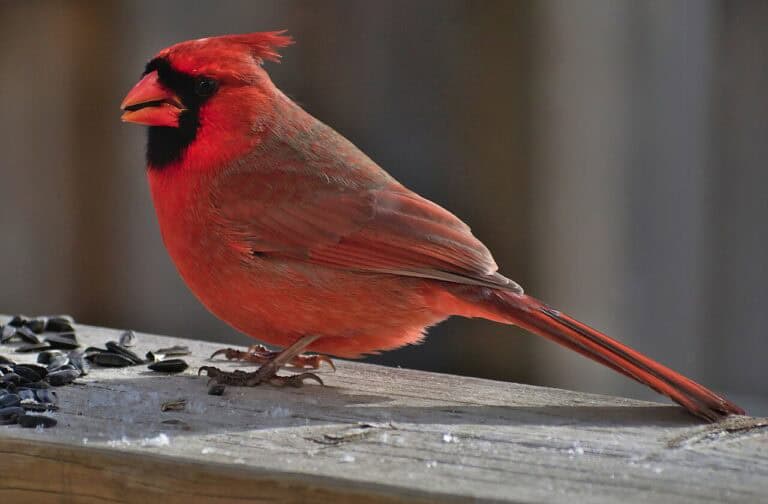
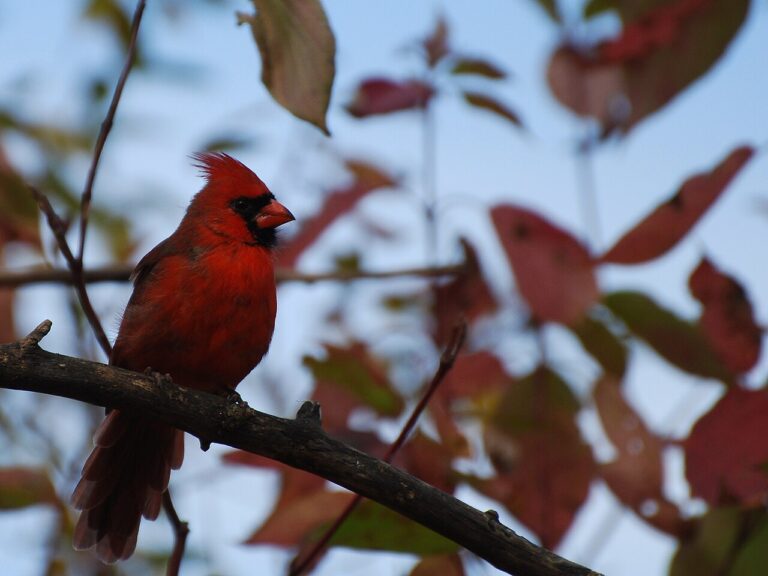
If the bird is gray, crested and about the size of a chickadee, it is a titmouse. The other crested birds at eastern feeders, Blue Jay and Northern Cardinal, are larger and obviously colored. Range settles the last question: the Tufted Titmouse holds everything east of the Great Plains, the Black-crested Titmouse holds central and southern Texas, and the two interbreed only in the narrow band where their ranges meet.
Frequently Asked Questions
How rare is a Tufted Titmouse?
Not rare at all. The Tufted Titmouse is one of the most common feeder birds in eastern and central North America, its population runs into the millions, and its range has been expanding north for more than a century. Seeing one in the right range is ordinary rather than lucky.
Are tufted titmice aggressive?
Not toward people, but they are assertive for their size. Tufted Titmice outrank chickadees at feeders, hold a territory year-round, and scold loudly at cats, snakes and owls. They rarely brawl with other feeder birds; they take one seed and leave.
Why do they call it a titmouse?
The name has nothing to do with mice. It comes from Old English and Old Norse roots: tit for something small, and mase, an old word for a small bird. Mase drifted into mouse over the centuries, which is why the plural is titmice.
What is a titmouse’s favorite food?
Black oil sunflower seed, with shelled peanuts a close second. A Tufted Titmouse takes one seed at a time, carries it to a nearby perch, and hammers it open while holding it with its feet. Suet and peanut butter blends pull them in through winter.
Do tufted titmouses mate for life?
Mostly yes. Tufted Titmice form long-term pair bonds and hold the same territory together year-round, often for life. If one bird dies, the survivor usually pairs again the following season. Young from the previous brood sometimes stay on and help raise the next one.
Why put a potato in the bird feeder?
This is a social media hack, not an ornithological one. The claim is that a potato distracts squirrels or adds moisture. There is no good evidence that it works, and raw potato and its green parts contain solanine, which is toxic. Leave it out.
Why should you sprinkle coffee grounds around your bird feeder?
You should not. Coffee grounds get promoted as a squirrel and ant deterrent, but caffeine is toxic to birds and the deterrent effect is weak and short-lived. A baffle on the feeder pole solves the squirrel problem without putting a stimulant where birds feed.
What does it mean when a Tufted Titmouse visits you?
Practically speaking, a Tufted Titmouse visit means your yard offers good food (especially sunflower seeds or peanuts), water, and likely some nearby tree cover. The species is increasingly common across eastern and central North America. Various folk traditions assign symbolic meanings to bird visits, but scientifically, Tufted Titmouse visits simply indicate suitable habitat and food in your yard.
Why does the Tufted Titmouse take only one seed at a time?
Tufted Titmice take individual seeds and fly to perches to eat or cache them. This behavior is typical of their family (Paridae). Possible reasons: they crack seeds open by holding them in their feet while pecking, which requires a stable perching surface (the feeder isn’t always ideal); they have small bills and stomachs and need to eat one seed at a time; they may cache excess seeds rather than eating them. This habit makes Titmice appear to consume more seed than they actually eat.
Do Tufted Titmice and Chickadees fight at feeders?
Generally no, they often coexist peacefully at feeders. Both species are in the same family (Paridae) and have similar diets. They often join the same mixed-species winter flocks. Tufted Titmice are slightly larger and may displace Chickadees temporarily, but the displacement is usually brief. Most backyard feeders accommodate both species without conflict.
Why are Tufted Titmice’s eyes so big?
Tufted Titmice are among the most distinctively large-eyed backyard birds. The large eyes serve practical purposes: better detection of predators (especially aerial threats), better vision for finding small insects on bark and twigs, and better vision in low-light conditions (dawn and dusk feeding). The ‘big-eyed’ appearance is a real adaptation, not just a visual impression.
How can I tell male from female Tufted Titmouse?
You can’t tell them apart by appearance, Tufted Titmice show no sexual dimorphism. Males and females look identical to human eyes. Birds can only be sexed during breeding behavior (the male feeding the female during incubation is a clear sign) or through detailed feather analysis. Many backyard birders just call all visitors ‘Tufted Titmouse’ without distinguishing sex.
Why do Tufted Titmice pluck hair from animals?
Tufted Titmice line their nests with hair, and they actively pluck hair from live mammals to obtain it. They’ve been documented plucking hair from sleeping dogs, cats, and even humans. The behavior is risky (they could be injured) but reflects their preference for soft, insulating nest lining. The plucking is fast and usually doesn’t wake the host animal. If you have a Tufted Titmouse visiting your yard with pets, you may eventually witness this remarkable behavior.
Are Tufted Titmice migrating?
No, Tufted Titmice are non-migratory throughout their range. The same individual birds stay in your yard year-round. They may form winter flocks with other species but don’t undertake true migration. Banded birds have been recorded visiting the same feeder for 8+ years.
What’s the difference between Tufted Titmouse and Black-Crested Titmouse?
Black-Crested Titmice are a separate species found in southern Texas and parts of Oklahoma. They have BLACK crests rather than gray. The two species interbreed where their ranges meet in central Texas, creating a hybrid zone with mixed-crest birds. Outside that hybrid zone, both species are reliably distinguished by crest color. Black-Crested are the only Titmouse species in southern Texas and surrounding areas.