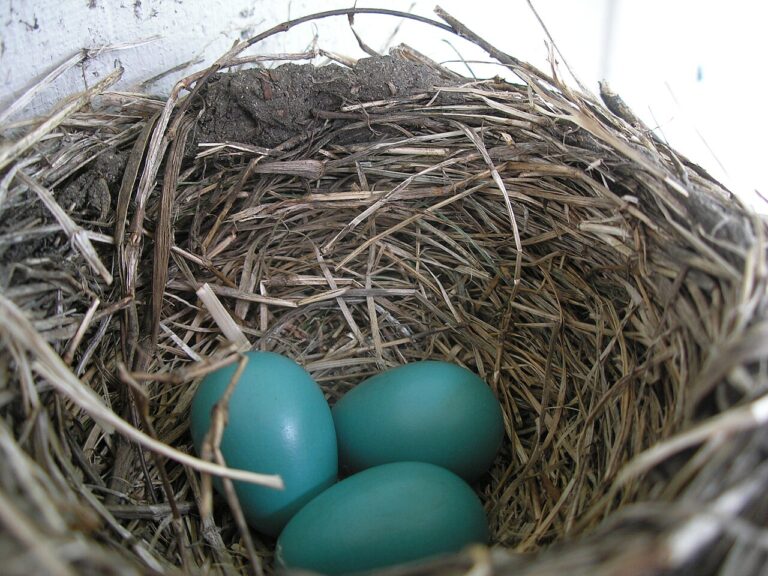
Birds That Look Like Robins: 12 Common Look-Alikes (2026)
Many birds get mistaken for American Robins because the robin’s orange breast, upright stance, and lawn-hopping habit are so familiar. The most common look-alikes are the Varied Thrush, the two bluebirds, the Black-Headed Grosbeak, towhees, and other thrushes. Here are twelve birds confused with robins and how to tell each one apart.
The American Robin is so familiar that any orange-breasted bird becomes a potential ‘robin’ to non-birders. Several species share the robin’s basic template, orange or rust breast contrasted with darker upperparts, but belong to different bird families with distinct behaviors and habitats. This guide covers 12 common North American birds that look like robins (or that robins look like, depending on which you saw first). Key differences: bluebirds are smaller with shorter tails; thrushes have spotted breasts; towhees have black/orange patterns; grosbeaks have heavy bills. Learning these robin look-alikes is one of the most useful skills for backyard birders.
The birds most often mistaken for American Robins are the Varied Thrush, Eastern and Western Bluebirds, Black-headed Grosbeak, the towhees and the Baltimore Oriole. Orange breast plus upright posture and lawn-hopping is the robin; a similar bird perched high in cover usually is not.
Quick Reference: 12 Robin Look-Alikes at a Glance
| Species | Size | Key ‘Not Robin’ Feature | Range |
|---|---|---|---|
| Varied Thrush | 9.5″ | Orange + black chest band + slate-gray back | Pacific NW |
| American Robin (juvenile) | 10″ | Spotted breast (no solid orange yet) | Continent-wide |
| Eastern Bluebird | 7″ | Bright BLUE back + smaller size | Eastern US |
| Western Bluebird | 7″ | Blue back + rust flanks + smaller | Western US |
| Black-Headed Grosbeak | 8.25″ | Black head + heavy conical bill | Western US |
| Spotted Towhee | 8.5″ | Black hood + orange flanks + white belly | Western US |
| Eastern Towhee | 8.5″ | Black hood + orange flanks (East version) | Eastern US |
| Wood Thrush | 7.75″ | Spotted breast + rust head | Eastern forests |
| Hermit Thrush | 6.75″ | Spotted breast + rusty tail | Continent-wide |
| Brown Thrasher | 11.5″ | Heavily streaked breast + yellow eye + curved tail | Eastern US |
| Northern Flicker | 12.5″ | Spotted underparts + woodpecker shape | Continent-wide |
| Cedar Waxwing | 7″ | Crest + yellow tail tip + black mask | Continent-wide |
Species Identification
Varied Thrush
The most robin-like of all robin look-alikes. Varied Thrushes have bright orange underparts (similar to robin) with a distinctive black band across the chest, slate-gray back, orange eyebrow stripe, and orange wing bars. Same size as American Robin.
Range: Pacific Northwest year-round; some winter migration south.
Habitat: Dense coniferous forests, especially with moss.
Key ID vs Robin: Black chest band (no robin has this) + slate-gray back (vs robin’s brown-gray) + Pacific NW habitat. Often more secretive than robins.
Where to see: Pacific Northwest forests. May visit yards in winter for berries and cracked corn.
American Robin (Juvenile)
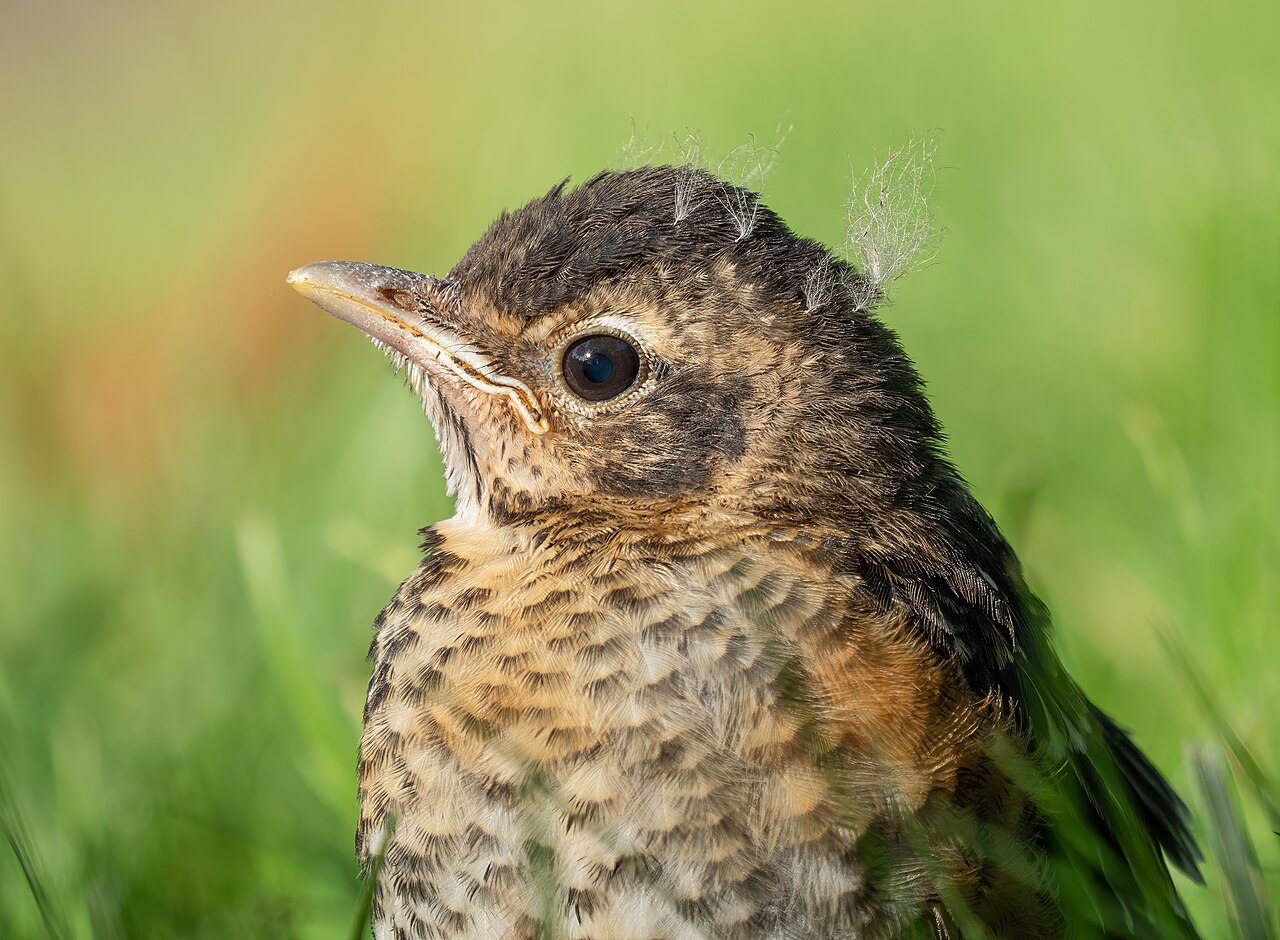
Sometimes people don’t recognize their own American Robins. Juvenile American Robins have heavily spotted brown breasts (not solid orange) and look very different from adults. The overall body is duller brown than adult robins.
Range: Continent-wide.
Habitat: Lawns, parks, gardens, suburban yards.
Key ID: Spotted brown breast + robin size + horizontal posture. The breast becomes solid orange over the first year.
Where to see: Visible in summer after broods leave the nest. Often hopping on lawns with adult robins nearby.
Eastern Bluebird
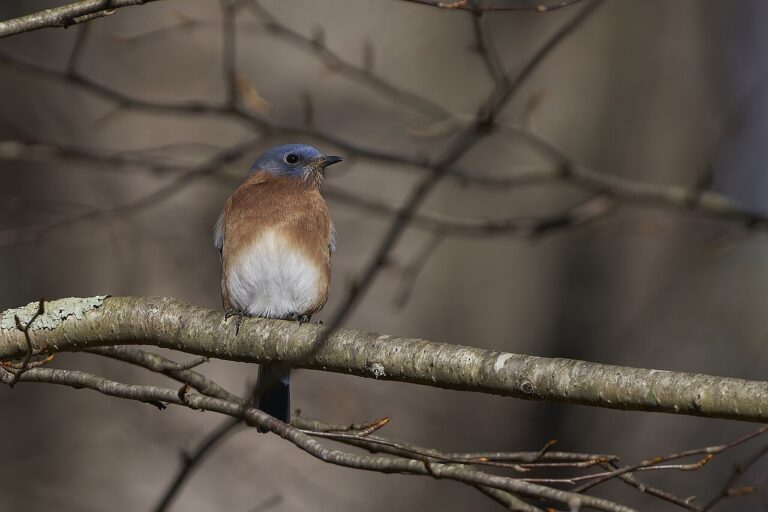
The most commonly confused ‘robin’ due to similar color pattern at a distance. Eastern Bluebirds have a bright royal-blue back (not gray-brown like robin) and rust-orange throat/breast. Size is smaller, 7 inches vs 10 inches for robins.
Range: Eastern US year-round.
Habitat: Open habitat with scattered trees, fields, orchards, parks.
Key ID vs Robin: Bright BLUE back (robin’s back is gray-brown) + smaller size + shorter tail. Once you see the blue, the confusion ends.
Where to see: Open habitat with scattered trees. Will use bluebird nest boxes.
Western Bluebird
Western counterpart to Eastern Bluebird with similar robin-confusion potential. Western Bluebirds have bright blue back and head, rust-orange on breast AND flanks (extending down sides), and smaller body than robin.
Range: Western US year-round.
Habitat: Open woodlands, especially pine-oak forests.
Key ID vs Robin: Blue back + smaller size + extensive rust on flanks. The blue is unmistakable up close.
Where to see: Western forests and adjacent open habitat. Uses bluebird nest boxes.
Black-Headed Grosbeak
Western counterpart to Rose-Breasted Grosbeak with robin-like coloration. Male Black-Headed Grosbeaks have a black head, orange-cinnamon breast and underparts (similar to robin), and black wings with white markings. The heavy conical bill is the key ‘not robin’ feature.
Range: Western US in summer.
Habitat: Open woodlands, especially riparian areas.
Key ID vs Robin: Black head (robin has gray-brown head) + heavy conical bill (robin has thin bill) + black-and-white wings.
Where to see: Western backyards in summer. Will visit feeders for sunflower seed.
Spotted Towhee
Western towhee with robin-like color pattern but different body shape. Spotted Towhees have a black hood (head, throat, and back), bright orange flanks, white belly, and white wing spots. Tail is longer than robin’s and held differently.
Range: Western US year-round.
Habitat: Brushy areas, gardens with cover, forest edges.
Key ID vs Robin: Black hood (extending to back) + white spots on wings + red eye + longer tail. Ground-scratching behavior in leaf litter.
Where to see: Western backyards with dense shrubs. Ground-feeding.
Eastern Towhee
Eastern counterpart to Spotted Towhee. Eastern Towhees have a similar pattern, black hood, orange flanks, white belly, but without white spots on the wings. Same robin-confusion potential.
Range: Eastern US year-round.
Habitat: Brushy areas, woodland edges, dense thickets.
Key ID vs Robin: Black hood + orange flanks (not solid breast) + red eye + ground-scratching behavior. Listen for their ‘drink-your-tea’ song.
Where to see: Eastern backyards with dense cover. Ground-feeding bird.
Wood Thrush
A spectacular forest thrush often confused with American Robin from a distance. Wood Thrushes have a bright rust-red head and back contrasted with a white breast heavily marked with large round black spots. The spotted breast is the key ‘not robin’ feature.
Range: Eastern US in summer.
Habitat: Mature deciduous forests with dense understory.
Key ID vs Robin: Spotted white breast (robin has solid orange) + rusty head + slightly smaller size. Found in forest interior, not yards.
Where to see: Forest interior during summer. Their flute-like song is one of the most beautiful in eastern forests.
Hermit Thrush
A widespread thrush with subtle but distinctive features. Hermit Thrushes have a brown back, distinctive rusty-colored tail (contrasting with the rest of the body), and spotted breast. The tail-bobbing behavior is diagnostic.
Range: Continent-wide. Northern North America in summer, southern US in winter.
Habitat: Forest understory, especially mixed and coniferous forests.
Key ID vs Robin: Rusty tail (contrasts with brown back) + spotted breast + smaller size + tail-bobbing. Less common in yards than American Robin.
Where to see: Winter in southern US (one of few thrushes that overwinters north).
Brown Thrasher
A large brown bird sometimes mistaken for a robin. Brown Thrashers have rich rust-brown upperparts (similar warmth to robin’s back) but a heavily streaked breast (not solid orange), bright yellow eyes, and a long curved tail.
Range: Eastern US year-round.
Habitat: Dense thickets, hedgerows, brushy areas.
Key ID vs Robin: Heavily streaked breast + long curved tail + yellow eye + bigger size. The heavy streaking is unique among ‘robin-like’ birds.
Where to see: Brushy areas in summer. Listen for varied song from dense brush.
Northern Flicker
A unique woodpecker often mistaken for a robin when on the ground. Northern Flickers have brown bodies with black spots on the breast, a black necklace, and a brown-and-tan barred back. They feed on the ground (unlike most woodpeckers) hunting ants.
Range: Continent-wide year-round.
Habitat: Open habitats with scattered trees, lawns, parks.
Key ID vs Robin: Spotted breast + black necklace + woodpecker shape (long body, pointed tail) + ground-feeding for ants. White rump in flight is distinctive.
Where to see: Open habitats with trees. Common in yards. Will visit suet feeders.
Cedar Waxwing
An elegant social bird sometimes confused with robins. Cedar Waxwings have soft brown-and-gray plumage (similar earthy tones) with a sleek pointed crest, black mask, yellow tail tip, and red wing markings. Size is smaller than robin.
Range: Continent-wide. Nomadic.
Habitat: Forests, parks, neighborhoods with fruit-bearing trees.
Key ID vs Robin: Sleek crest (robins don’t have crests) + black mask + yellow tail tip + sweeter coloration. Often in flocks.
Where to see: Wherever there’s fruit. Mountain ash, cherry, juniper, crabapple trees. Will visit bird baths.
How to Tell Robins from Look-Alikes
Key features that separate American Robins from similar birds:
Body shape: American Robins have a distinctive horizontal posture when perched, with body parallel to the ground. Thrushes are more upright. Bluebirds are smaller and rounder. Towhees have longer tails.
Tail length: Robins have medium-length tails with rounded edges. Towhees have longer tails. Cedar Waxwings have shorter tails with yellow tips.
Bill shape: Robins have thin pointed bills designed for worms and berries. Grosbeaks have heavy conical bills. Thrashers have long downcurved bills.
Behavior: Robins hop on lawns hunting earthworms. Towhees scratch in leaf litter. Flickers feed on the ground hunting ants. Thrushes are more secretive (forest interior).
Habitat: Robins prefer open lawns and gardens. Wood Thrushes prefer forest interior. Bluebirds prefer open habitats with scattered trees. Towhees prefer dense brush.
Sounds: American Robin has a distinctive ‘cheerily-cheer-up-cheerio’ song. Wood Thrush has flute-like ‘ee-oh-lay’ song. Bluebirds have soft warbling. Northern Flicker has loud ‘wick-wick-wick’ call.
Looks Like a Robin but Has No Red Breast?
This is one of the most common versions of the question, and it usually points to one of three answers. If the bird has the robin’s shape and upright posture but a plain grey or brown breast instead of orange, look first at a juvenile American Robin, whose breast is heavily spotted and pale before the orange grows in. Next consider the Gray Catbird, a slim slate-grey bird of the same rough size that skulks in shrubs. If the breast is warm brown rather than grey, a female or immature towhee or a Hermit Thrush is likely. The tail, the bill shape, and whether the bird hops on the lawn or hides in cover will separate them quickly.
Winter Birds That Look Like Robins
In winter the confusion narrows to a handful of species, and where you are decides which. In the Pacific Northwest and along the west coast, the Varied Thrush is the main one: robin-sized and orange-breasted, but with a black breast band, orange wing bars and an orange eyebrow stripe, and far more likely to be under dense conifers than out on a lawn.
Across the east and midwest, winter robins themselves throw people, because flocks switch from lawns to fruiting trees and behave nothing like the solitary lawn-hopper of spring. Alongside them, Eastern Bluebirds hold territory through winter and get reported as small robins, and Cedar Waxwings feeding in the same berry trees are sometimes mistaken for them at a distance.
Robin vs Towhee: How to Tell Them Apart
Towhees are the closest thing to a robin among ground-feeding birds, and the colour pattern is what separates them. An American Robin has a plain gray-brown back with a uniformly orange breast and belly and a yellow bill. An Eastern or Spotted Towhee has a solid black head and back on males, bright rufous restricted to the flanks, a clean white belly, a dark conical bill and a red eye.
Behaviour helps as much as plumage. Robins run and stop across open lawn, cocking the head to locate worms. Towhees stay in and under dense cover and feed with a distinctive double-scratch, kicking backwards with both feet at once to clear leaf litter, a motion no robin makes. Audubon’s Varied Thrush account covers the western species that causes most of the winter confusion.
Frequently Asked Questions
What bird looks most like an American Robin?
The Varied Thrush is the most robin-like of all robin look-alikes, same size, similar orange underparts. The black chest band and slate-gray back are the key distinguishers. In the East, the Wood Thrush is similarly-sized but has a heavily spotted white breast (not solid orange like robin).
Why does my yard ‘robin’ look spotted?
It’s most likely a juvenile American Robin, the spotted brown breast pattern is normal for young birds. Within their first year, the spots are replaced by solid orange. If the bird has a heavily marked white breast and a rust-red head, it might be a Wood Thrush (in eastern forests).
How can I tell a bluebird from a robin?
The blue back is unmistakable in good light. Eastern and Western Bluebirds both have bright blue upperparts contrasted with rust-orange breasts. American Robins have gray-brown backs (no blue). Bluebirds are also significantly smaller (7 inches vs robin’s 10 inches).
What ‘robin-like’ bird has a black hood?
Spotted Towhee (West) or Eastern Towhee (East), both have black hoods extending down the back, orange flanks, white bellies, and red eyes. Their pattern looks robin-like from a distance but reveals itself as different up close.
Is the Black-Headed Grosbeak related to robins?
No, Black-Headed Grosbeak is in the grosbeak/cardinal family (Cardinalidae) while American Robin is in the thrush family (Turdidae). The similar orange breast is convergent evolution. The grosbeak’s heavy conical bill is designed for seeds while the robin’s thin bill is for worms and berries.
What bird looks like a robin but is found in the Pacific Northwest?
Varied Thrush, same size as American Robin, similar orange underparts. The distinctive black chest band and slate-gray back distinguish it. Often more secretive than robins and primarily a forest bird.
Why do so many birds look like robins?
The ‘robin pattern’, earth-toned upperparts with orange/rust underparts, has evolved independently in multiple bird families. This is convergent evolution, different birds in similar habitats develop similar coloration for similar reasons (camouflage from above, signal from below). The American Robin is just one of many birds with this pattern.
Related reading: Birds That Look Like Sparrows.
Related reading: what do robins eat.
Related reading: birds look like hummingbirds.
Related reading: bugs that look like silverfish.