Small Grey Birds: 12 Common Species in North America with Identification (2026)
Small grey birds are among the most common and most confusing backyard visitors. Most are chickadees, titmice, juncos, kinglets, gnatcatchers, or nuthatches, told apart by size, crest, wing bars, and behavior rather than color. This guide walks through 15 small grey birds of North America and the quick field marks that separate them.
Grey is one of the most common base colors in North American birds, a subtle, neutral palette that helps birds blend with bark, shadows, and dappled light. From the slate-gray Dark-Eyed Junco to the elegant Gray Catbird, small grey birds occupy diverse habitats and are easily overlooked compared to their more colorful relatives. This guide covers 12 small grey birds (under 9 inches) with the specific features that separate similar species: head pattern, eye-ring, bill color, posture, and behavior all matter. Many small grey birds are common feeder visitors, while others are forest specialists requiring patient observation.
Quick Reference: 12 Small Grey Birds at a Glance
| Species | Size | Key ID Feature | Range |
|---|---|---|---|
| Dark-Eyed Junco | 6″ | Slate gray + white belly + pink bill | Continent-wide |
| Tufted Titmouse | 6.5″ | Gray + crest + black eye + buff flanks | Eastern US |
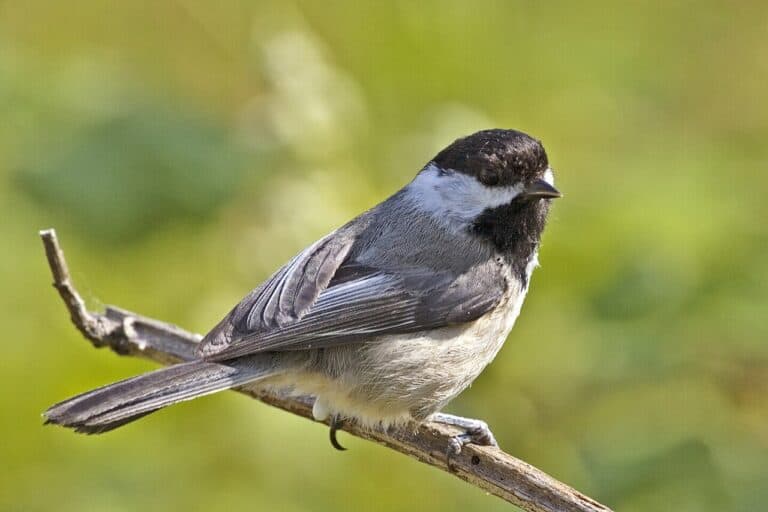
| Black-Capped Chickadee | 5.25″ | Gray back + black cap/bib + white cheeks | Northern US |
| Carolina Chickadee | 4.75″ | Smaller Black-Capped + range | Southern US |
| White-Breasted Nuthatch | 5.75″ | Gray back + black cap + walks down trees | Continent-wide |
| Gray Catbird | 8.5″ | All slate-gray + black cap + rust under tail | Eastern US |
| Eastern Phoebe | 7″ | Brownish-gray + pale belly + tail bobs | Eastern US |
| Blue-Gray Gnatcatcher | 4.25″ | Tiny + blue-gray + white eye-ring + long tail | Continent-wide |
| Bushtit | 4.5″ | Tiny + plain gray + long tail + in flocks | Western US |
| Mountain Chickadee | 5.25″ | Like Black-Capped + white eyebrow stripe | Western mountains |
| Townsend’s Solitaire | 8.5″ | Slate gray overall + white eye-ring + thin bill | Western mountains |
| American Dipper | 7.5″ | Stocky gray + short tail + lives in streams | Western mountains |
Species Identification
Dark-Eyed Junco
A common winter sparrow throughout much of the US. Dark-Eyed Juncos vary by region, eastern ‘Slate-Colored’ form is uniformly slate-gray above and white below; western forms have more brown. All have a pink conical bill and white outer tail feathers visible in flight.
Range: Northern North America in summer; continent-wide in winter.
Habitat: Forests in summer; backyards and feeders in winter.
Key ID: Slate-gray + white belly + pink bill + white outer tail. Often called ‘snowbirds’ for their winter arrival.
Where to see: Winter feeders throughout the US. Ground-feeding birds, prefer platform feeders or scattered seed.
Tufted Titmouse
A small, perky bird of eastern forests. Tufted Titmice have a clean gray back, white underparts with buff flanks, a prominent gray crest, large black eyes, and a black forehead.
Range: Eastern US year-round.
Habitat: Mature deciduous forests, parks, suburban yards with mature trees.
Key ID: Gray crest + buff flanks + black eye + small size. Constantly active and vocal.
Where to see: Common at backyard feeders. Will eat sunflower seed, peanuts, and suet. Often in mixed flocks with chickadees and nuthatches.
Black-Capped Chickadee
The most familiar chickadee across much of northern North America. Black-Capped Chickadees have a distinctive black cap, black bib (throat), white cheeks, gray back and wings, and buffy flanks.
Range: Northern US and Canada year-round.
Habitat: Forests, parks, backyards.
Key ID: Black cap + black bib + white cheeks + gray back. The classic ‘chickadee’ look.
Where to see: Backyard feeders. Will eat sunflower seed, peanuts, and suet.
Carolina Chickadee
Southern counterpart to Black-Capped Chickadee. Carolina Chickadees look nearly identical but slightly smaller. Range mostly determines which species you’re seeing, Black-Capped in the North, Carolina in the South, with a narrow hybrid zone.
Range: Southeastern US year-round.
Habitat: Forests, parks, suburban yards.
Key ID: Same pattern as Black-Capped but smaller + range. Faster, higher-pitched call.
Where to see: Southern backyards. Same feeder preferences as Black-Capped.
White-Breasted Nuthatch
A common backyard bird with distinctive habits. White-Breasted Nuthatches have a blue-gray back, black cap (males) or gray cap (females), pure white face and underparts, and chestnut on the lower belly/undertail.
Range: Continent-wide year-round.
Habitat: Mature deciduous forests, parks, mature suburban trees.
Key ID: Gray back + black/gray cap + white face. Walks DOWN tree trunks headfirst.
Where to see: Common at sunflower and suet feeders. Often pairs with chickadees and titmice in mixed flocks.
Gray Catbird
An elegant slate-gray songbird with distinctive features. Gray Catbirds are uniformly slate-gray overall with a black cap, dark eye, and a chestnut patch under the tail (visible when tail is raised). Named for their cat-like ‘mew’ call.
Range: Eastern US in summer; some south Atlantic year-round.
Habitat: Dense thickets, hedgerows, brushy yards.
Key ID: All slate-gray + black cap + rust undertail. Distinctive ‘mew’ call.
Where to see: Brushy yards in summer. Will visit fruit feeders for grape jelly and raisins. Mimics other birds (related to mockingbirds and thrashers).
Eastern Phoebe
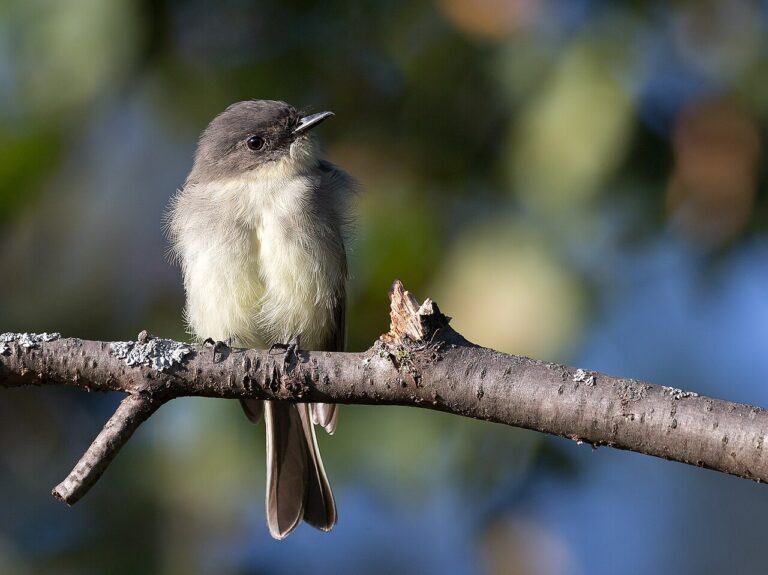
A common flycatcher of eastern North America. Eastern Phoebes have a brownish-gray back, pale gray belly with subtle yellow wash, dark head, and a distinctive tail-bobbing behavior. The first flycatcher to return north each spring.
Range: Eastern US in summer.
Habitat: Open areas near water, bridges, buildings (often nests under eaves).
Key ID: Brown-gray + pale belly + constant tail-bobbing. The tail-pump is diagnostic.
Where to see: Open habitat near water. Often nests on buildings, bridges, and porches.
Blue-Gray Gnatcatcher
A tiny, active forest bird. Blue-Gray Gnatcatchers have a soft blue-gray back, pale gray underparts, white eye-ring, and a long black-and-white tail that they constantly flick. Often heard before seen.
Range: Eastern and southern US in summer.
Habitat: Forests, especially with mature trees.
Key ID: Tiny size (4.25 inches) + blue-gray + white eye-ring + long tail. Very active.
Where to see: Forests during summer. Listen for their thin wheezy call.
Ruby-Crowned Kinglet
One of the smallest grey birds in North America, the Ruby-Crowned Kinglet is a tiny, round, olive-grey bird that never seems to sit still. It flicks its wings constantly and shows bold white wing bars and a broken white eyering. Males have a hidden ruby crown patch that flashes only when they are excited. In winter these kinglets spread across most of the United States and often join mixed flocks in yards and woodland edges.
Golden-Crowned Kinglet
Even tinier than a chickadee, the Golden-Crowned Kinglet is a grey-and-olive mite with a brilliant yellow-and-orange crown stripe bordered in black. It favors conifers and works high in the branches, giving thin, high-pitched calls. In the colder months it ranges across the northern and central states, and it is one of the smallest birds you can hope to see at the edge of a winter yard.
Northern Mockingbird
Larger and longer-tailed than the other birds here, the Northern Mockingbird is a slim, pale grey bird with two white wing bars and bold white wing patches that flash in flight. It is famous for stringing together the songs of other birds, often singing for long stretches from an exposed perch. Found year-round across the southern two-thirds of the country, it is one of the most conspicuous grey birds in suburban yards.
Bushtit
A tiny, social western bird. Bushtits are plain pale gray overall with a long tail. Always in flocks of 10-40 birds. They twitter constantly while moving through shrubs.
Range: Western US year-round.
Habitat: Shrubs, suburban gardens, oak woodlands.
Key ID: Tiny + plain gray + long tail + in flocks. Hard to miss when a flock arrives, and hard to spot solo birds.
Where to see: Western backyards. Often arrive in noisy flocks at suet feeders.
Mountain Chickadee
Western mountain counterpart to Black-Capped Chickadee. Mountain Chickadees have the same general chickadee pattern (black cap, black bib, white cheeks) but with a distinctive white eyebrow stripe through the black cap.
Range: Western mountains year-round.
Habitat: Coniferous forests at higher elevations.
Key ID: White eyebrow stripe through black cap = Mountain Chickadee. Otherwise similar to other chickadees.
Where to see: Western mountain campgrounds and forests. Will visit feeders for sunflower seed and suet.
Townsend’s Solitaire
A subtle but elegant western thrush. Townsend’s Solitaires are uniformly slate-gray with a white eye-ring, buff wing patches, and a long tail with white outer feathers. Often perches conspicuously and sings beautifully.
Range: Western mountains year-round.
Habitat: Coniferous forests at higher elevations.
Key ID: Slate gray overall + white eye-ring + slim profile. Often on exposed perches.
Where to see: Western mountains. Listen for their beautiful song. May visit yards in winter for berries.
American Dipper
A unique songbird that lives in mountain streams. American Dippers are stocky slate-gray birds that walk underwater in fast streams, hunting aquatic insects. The only North American songbird with this aquatic lifestyle.
Range: Western mountains year-round.
Habitat: Fast-flowing mountain streams.
Key ID: Stocky gray + short tail + bobbing behavior + STREAM habitat. Cannot be confused with other birds in their habitat.
Where to see: Mountain streams in the West. Watch for them swimming underwater.
How to Attract Small Grey Birds to Your Yard
Different grey birds respond to different attractants:
Dark-Eyed Juncos: Ground feeding with millet and small seeds. Scatter seed on the ground or use platform feeders in winter.
Tufted Titmouse: Sunflower seed, peanuts, and suet in any feeder type. Common at virtually any feeder.
Chickadees (Black-Capped, Carolina, Mountain): Sunflower seed, peanuts, suet. Will use nest boxes with 1.125 inch entrance holes.
White-Breasted Nuthatch: Same as chickadees, sunflower, peanuts, suet.
Gray Catbird: Grape jelly, raisins, fruit offerings. Plant native shrubs with berries.
Eastern Phoebe: Doesn’t visit feeders. Will nest on building structures.
Blue-Gray Gnatcatcher, Bushtit: Don’t typically visit feeders. Bushtits occasionally visit suet in flocks. Provide native plants supporting insects.
Townsend’s Solitaire, American Dipper: Don’t visit feeders. Habitat-specific birds requiring their preferred ecosystems.
Frequently Asked Questions
What small grey bird visits my feeder most?
Most likely Tufted Titmouse (East), chickadees (continent-wide), and White-Breasted Nuthatch. In winter, Dark-Eyed Juncos become very common at ground feeders. All eat sunflower seed and visit suet feeders.
What’s the smallest grey bird?
Blue-Gray Gnatcatcher at 4.25 inches is the smallest grey bird in this guide. Bushtit is also tiny at 4.5 inches. Both are smaller than most warblers.
What grey bird has a crest?
Tufted Titmouse is the most common grey crested bird, with a prominent gray crest. Black-crested Titmouse (a Texas/Mexico variant) has a black crest. Other crested birds tend to be more colorful (Northern Cardinal, Blue Jay).
What grey bird walks down trees?
White-Breasted Nuthatch, the distinctive ‘upside-down bird.’ They walk down tree trunks headfirst, opposite the direction of woodpeckers and Brown Creepers. Red-Breasted Nuthatch does the same but is smaller and has a black eye-stripe.
Why do birds turn grey?
Grey plumage comes from melanin pigments, the same pigments that make black plumage. Grey is generally produced by structural feathers without the melanin density needed for solid black. Grey provides excellent camouflage in many habitats, especially against bark, rocks, and dappled light.
What’s the difference between Black-Capped and Carolina Chickadee?
Visually nearly identical. Black-Capped is slightly larger with crisper white edges on wing feathers. Carolina is smaller with less white in wings. Range is the most reliable distinguisher, Black-Capped in the North, Carolina in the South, with a hybrid zone in the middle.
What grey bird makes a cat-like sound?
Gray Catbird makes the characteristic ‘mew’ call that gives it its name, sounding remarkably like a domestic cat’s meow. They also make varied other sounds, mimicking other birds.