Long-eared Owl: Identification, Sounds, and Facts
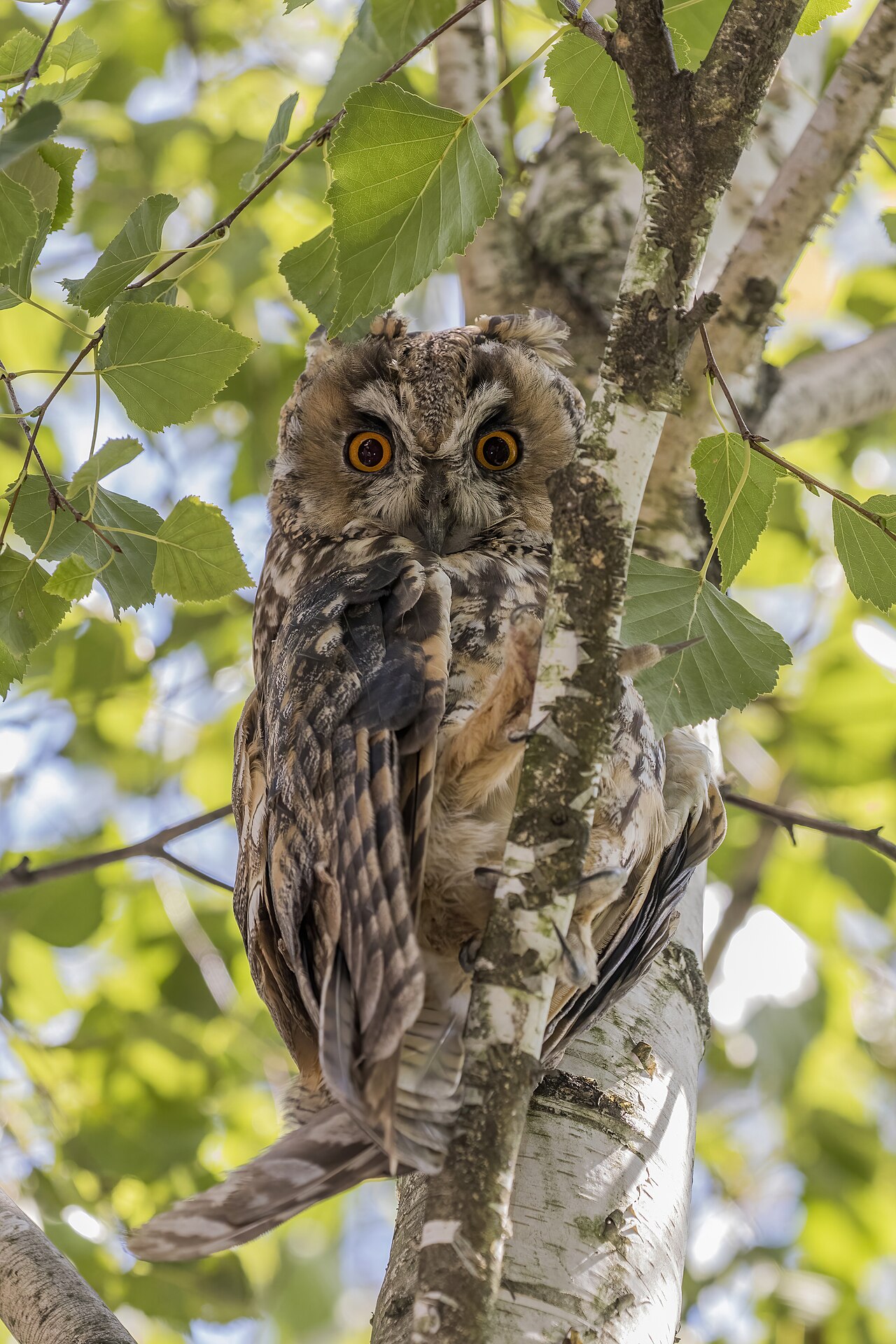
The Long-eared Owl is a slender, medium-sized woodland owl with tall, close-set ear tufts, a warm orange facial disk, and intense yellow eyes, one of the most elegant and secretive owls in North America. A master of concealment, it roosts by day in dense thickets and evergreens, stretching tall and thin to mimic a broken branch, and it hunts by night over open country nearby. Because it is so retiring, it is far less often seen than heard, and finding one is a highlight for any birdwatcher. This guide covers how to identify a Long-eared Owl, its low hooting calls, diet, its remarkable communal winter roosts, nesting, and conservation.
| Feature | Detail |
|---|---|
| Scientific name | Asio otus |
| Length | 13 to 16 in (35 to 40 cm) |
| Wingspan | 34 to 40 in (86 to 102 cm) |
| Weight | 7.5 to 15 oz (220 to 435 g) |
| Habitat | Dense woods near open hunting grounds |
| Diet | Voles and other small mammals |
| Conservation | Least Concern (secretive) |
How to identify a Long-eared Owl
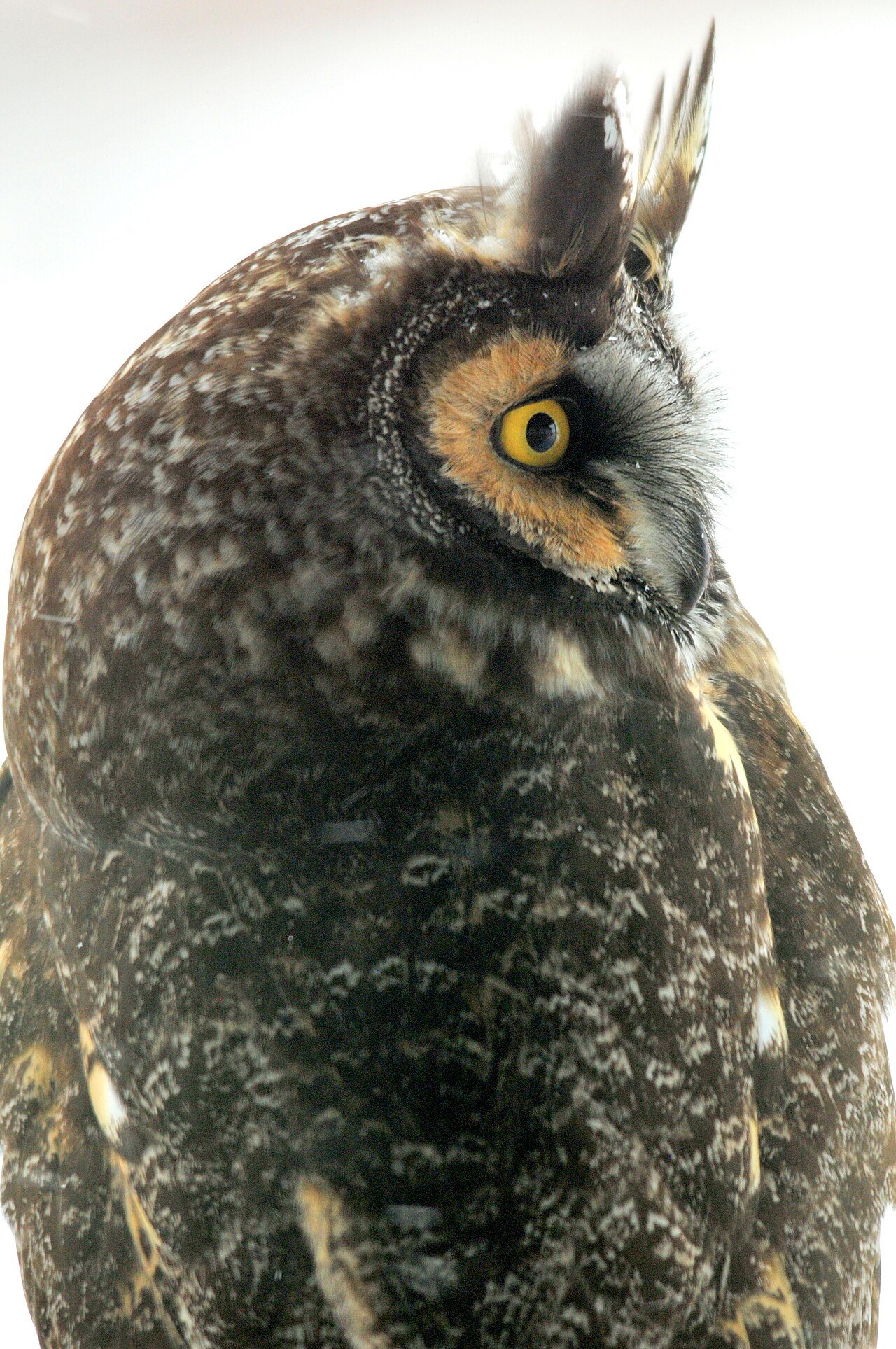
The Long-eared Owl is a slim, medium-sized owl with long, closely spaced ear tufts that stand tall on its head, a warm rusty-orange facial disk, and bright yellow-orange eyes. Its plumage is intricately streaked and mottled in brown, buff, and gray, superb camouflage against tree bark. When alarmed it compresses its body into a tall, thin post and raises its ear tufts, transforming into what looks like a broken branch stub, a disguise that fools most passersby.
The tall ear tufts and orange face distinguish it from the Short-eared Owl, which has tiny ear tufts, a pale face, and hunts by day. Its slender build and nocturnal, cover-loving habits also set it apart from the bulkier Great Horned Owl, whose ear tufts are wider set. If you find a tall, slim, orange-faced owl roosting tight against a trunk in dense cover, you have found a Long-eared Owl. Compare relatives in our owl types guide.
Range and habitat
The Long-eared Owl is widespread across the Northern Hemisphere, breeding across Canada, the northern and western United States, Europe, and Asia. In North America it favors a mix of dense woodland or thick shelterbelts for roosting and nesting, set beside open grassland, meadow, or shrubland where it hunts. This need for both cover and open ground shapes where it occurs, often in riparian groves, conifer stands, and wooded field edges.
In winter many Long-eared Owls move south and gather in traditional roost sites, and their distribution becomes patchy and hard to predict. Because they are so secretive and cryptically colored, they are almost certainly more common than records suggest, slipping through the landscape unseen. Birders often locate them only by searching known roosts or listening for their calls on still spring nights.
What Long-eared Owls eat
The Long-eared Owl is a small-mammal specialist, feeding mainly on voles, deer mice, and other small rodents, with some small birds taken opportunistically. Its diet closely tracks rodent abundance, and in vole-rich years it raises larger families. Like the Barn Owl, it hunts primarily by sound, coursing low over open ground on silent wings in the dark and dropping onto prey it hears in the grass.
It hunts almost entirely at night, leaving its wooded roost at dusk to work the surrounding open country, which is one reason it is so rarely seen hunting. Studies of the pellets it leaves beneath roosts reveal a diet overwhelmingly composed of small mammals, making it, like several owls in our guide to owl diets, an important natural control on rodent populations.
Sounds and communal winter roosts

The Long-eared Owl’s advertising call is a low, soft, evenly spaced series of hoots, a single mellow hoo repeated every few seconds, given by the male mostly on spring nights. It is far quieter and less carrying than the calls of larger owls, so it is easy to miss. Near the nest the birds add a startling variety of squeals, barks, and cat-like wails, and alarmed adults may snap their bills.
One of the species’ most remarkable habits is communal winter roosting. Outside the breeding season, Long-eared Owls often gather in groups, sometimes a dozen or more, packed into a single dense grove or windbreak, where they spend the day motionless and camouflaged. These traditional roosts can be used for many years and are treasured, and carefully guarded, sites among birdwatchers, since a cluster of these elusive owls in one tree is an unforgettable sight.
Nesting and conservation
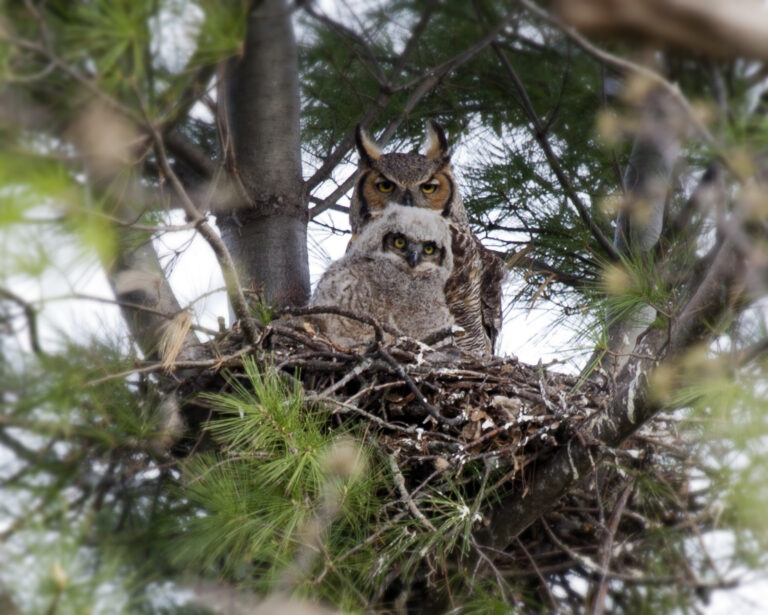
Like several other owls, the Long-eared Owl does not build its own nest. It takes over the abandoned stick nests of crows, magpies, ravens, or hawks, usually in a tree within dense cover, and occasionally uses cavities or nest baskets provided for it. The female lays a clutch, often four to six eggs, that varies with food supply, and she incubates while the male hunts. The young clamber out to nearby branches before they can fly, as many owlets do.
Globally the Long-eared Owl is listed as Least Concern, but its secretive nature makes populations hard to monitor, and there is evidence of regional declines tied to the loss of the mixed woodland-and-open-country habitat it needs, along with the roost groves it depends on in winter. Protecting shelterbelts, riparian groves, and traditional roosts helps this elusive owl, which according to Audubon remains one of the most under-recorded owls on the continent because of its secretive habits. Owls of every kind feature in owl symbolism and the beliefs behind seeing an owl. Regional guides such as types of owls in Texas show which owls live near you.
How to find a Long-eared Owl roost responsibly
Long-eared Owls are among the hardest owls to find, but knowing their winter habits helps. Outside the breeding season they gather at traditional communal roosts, often in dense conifer stands, thick shelterbelts, or tangled riparian groves, where a cluster of owls may spend the day pressed motionless against branches. Signs of a roost include a buildup of pellets and whitewash on the ground beneath a dense evergreen, sometimes the only hint that owls are hidden above.
These roosts demand care. Long-eared Owls are extremely sensitive to disturbance, and repeated visits, close approaches, or flushing can cause them to abandon a site that may have been used for years. The responsible approach is to view briefly from a distance, avoid sharing exact locations publicly, and never deliberately flush the birds. Treated with respect, a long-eared roost is one of the great winter rewards for a patient owl watcher.
Long-eared Owl versus Great Horned Owl
Because both have tall ear tufts, the Long-eared Owl is sometimes mistaken for a small Great Horned Owl, but several features separate them. The Long-eared Owl is much slimmer and smaller, with ear tufts set close together near the center of the head, giving a tall, narrow look, while the Great Horned Owl is bulky with widely spaced tufts. The Long-eared Owl’s face is a warm rusty orange, and the bird often stretches thin to mimic a branch, whereas the Great Horned Owl looks broad and powerful.
Habitat and behavior help too. The Long-eared Owl hides in dense cover and hunts open ground by night, keeping a low profile, while the Great Horned Owl is bold, vocal, and found almost everywhere. Against the Short-eared Owl, the long ear tufts and orange face are the giveaway. These comparisons round out a group explored fully in our owl types guide.
Frequently Asked Questions
How do you identify a Long-eared Owl?
Look for a slim, medium-sized owl with tall, close-set ear tufts, a rusty-orange facial disk, and yellow-orange eyes. When alarmed it stretches tall and thin to mimic a broken branch.
What does a Long-eared Owl sound like?
The male gives a low, soft, evenly spaced series of single hoots, repeated every few seconds on spring nights. It is much quieter than the calls of larger owls and easy to overlook.
How do you tell a Long-eared Owl from a Short-eared Owl?
The Long-eared Owl has tall ear tufts, an orange face, and hunts by night from wooded cover. The Short-eared Owl has tiny ear tufts, a pale face, and hunts by day over open fields.
What do Long-eared Owls eat?
Mainly voles, deer mice, and other small rodents, with occasional small birds. They hunt by sound at night over open ground and are important natural controllers of rodent populations.
Do Long-eared Owls roost together?
Yes. In winter they often gather in communal roosts, sometimes a dozen or more packed into a single dense grove. These traditional roosts can be used for many years.
Where do Long-eared Owls live?
Across the Northern Hemisphere in a mix of dense woodland or shelterbelts for roosting and nesting beside open grassland for hunting. In winter they move south and gather at roost sites.
Why are Long-eared Owls so hard to see?
They are secretive, nocturnal, and superbly camouflaged, roosting motionless in dense cover by day and hunting only after dark. Most are found only at known roosts or by their quiet calls.
Where do Long-eared Owls nest?
They reuse the old stick nests of crows, magpies, ravens, or hawks in dense cover rather than building their own, and occasionally use cavities or provided nest baskets.