White-Breasted Nuthatch: Complete Identification, Diet, and Behavior Guide (2026)
The White-Breasted Nuthatch (Sitta carolinensis) is among the most distinctive and entertaining backyard birds in North America, famous for walking HEADFIRST DOWN tree trunks (the only bird family that routinely descends trees this way). With a clean blue-gray back, sharp black cap (in males), pure white face and underparts, and the characteristic upside-down walking behavior, White-Breasted Nuthatches are one of the most reliable backyard birds across eastern and central North America. This comprehensive guide covers White-Breasted Nuthatch identification, range, diet, behavior, the famous descent behavior, breeding, vocalizations, and proven strategies for attracting them to your backyard.
White-Breasted Nuthatch: Key Facts at a Glance
| Attribute | Detail |
|---|---|
| Scientific Name | Sitta carolinensis |
| Family | Sittidae (Nuthatches) |
| Size | 5.1-5.5 inches (13-14 cm) length |
| Wingspan | 8-10 inches (20-26 cm) |
| Weight | 0.6-1.1 oz (18-30 g) |
| Lifespan | 2 years average; up to 9 years recorded |
| Diet | Insects (60%) + seeds, nuts (40%), heavy seed eater in winter |
| Habitat | Mature deciduous and mixed forests, parks, suburban yards |
| Range | All of US (except southwest deserts), southern Canada |
| Population Status | Common, 10 million estimated North American population |
| Conservation Status | Least Concern (IUCN) |
| Distinctive Feature | Walks DOWN trees headfirst, diagnostic behavior |
| Family Specialty | Only bird family that routinely descends trees headfirst |
| Call | Distinctive nasal ‘yank-yank-yank’ |
| Migration | Non-migratory, year-round residents |
White-Breasted Nuthatch Identification
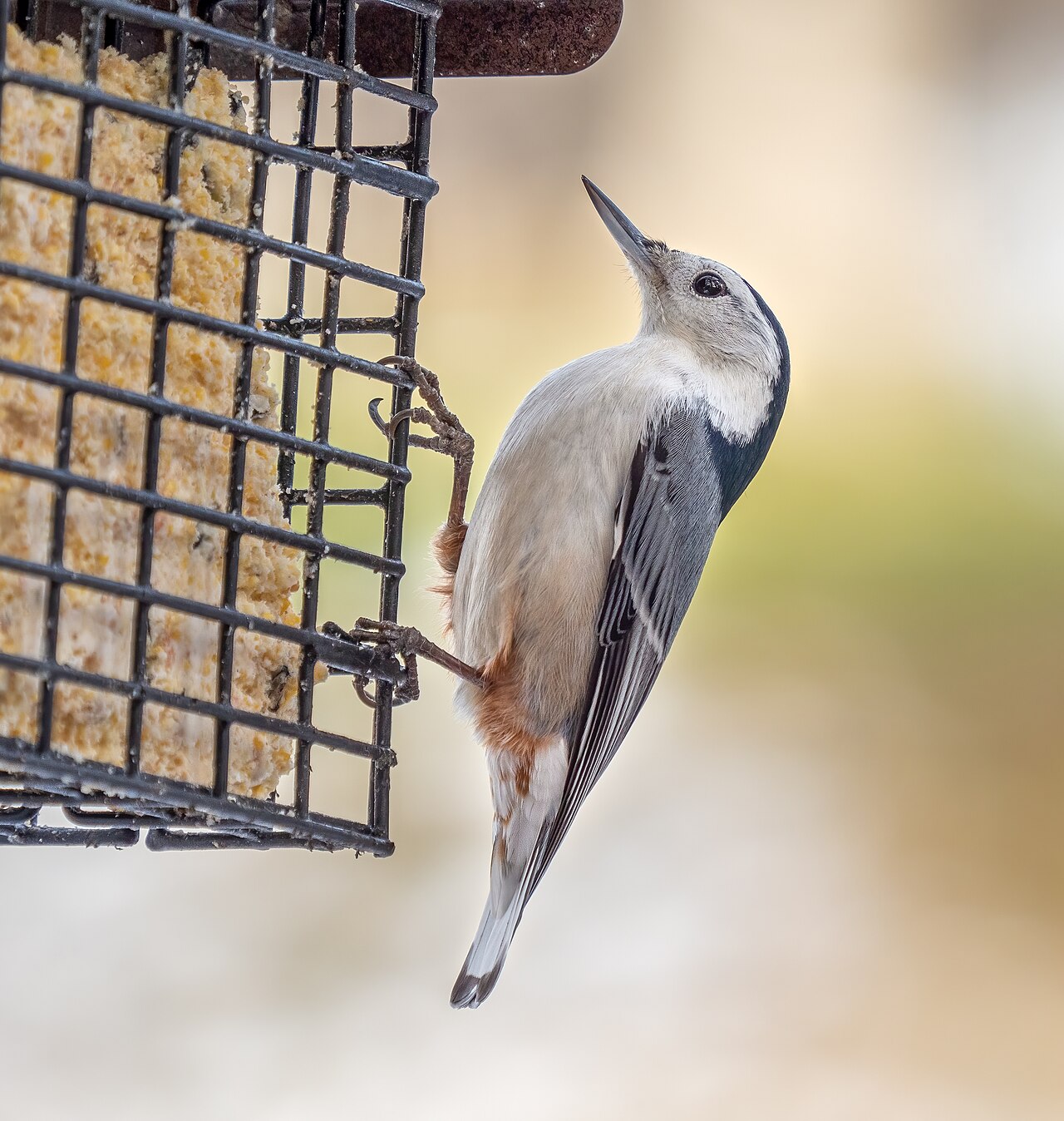
White-Breasted Nuthatches have a distinctive appearance: clean blue-gray back, wings, and tail; pure white face and underparts; chestnut on the lower belly and undertail (often not visible); thin pointed bill (longer than chickadee bills); short tail; and powerful feet for clinging upside-down to tree trunks.
Male vs Female: Adult males have a BLACK cap and nape. Adult females have a GRAY cap (with subtle indication of a partial cap). The cap color is the easiest way to distinguish sexes in the field.
Juvenile White-Breasted Nuthatches look like duller versions of adults, with grayish-tan caps. They develop adult plumage by their first fall.
Size: White-Breasted Nuthatches are 5-5.5 inches long, small but distinctly larger than chickadees (4.75 inches).
White-Breasted vs Red-Breasted Nuthatch: Both are common North American nuthatches but distinct species. White-Breasted: larger, white underparts, BLACK BAND from cap to back of neck (males) or partial black band (females). Red-Breasted: smaller (4.5 inches), rust-red underparts, BOLD WHITE EYEBROW STRIPE, range mostly farther north and in coniferous forests.
Pygmy Nuthatch and Brown-Headed Nuthatch: Two smaller nuthatch species occur in specific regions. Pygmy Nuthatch (Western US ponderosa pine forests) and Brown-Headed Nuthatch (Southeastern US pine forests) are both noticeably smaller and have brown caps instead of black/gray.
White-Breasted Nuthatch Range and Habitat
White-Breasted Nuthatches have an extensive range across nearly all of North America. They breed throughout most of the United States (except southwestern deserts) and southern Canada. They’re year-round residents throughout their range.
Habitat: White-Breasted Nuthatches prefer mature DECIDUOUS and mixed forests. They strongly favor large trees (especially oaks and maples) with rough bark, necessary for their foraging style. Suburban yards with mature trees provide ideal habitat. Coniferous forests are less suitable.
Tree dependency: White-Breasted Nuthatches are critically dependent on mature trees. They cannot use suburban yards lacking mature trees. Yards with newly-planted trees won’t host nuthatches until trees mature (typically 30+ years).
Year-round residency: White-Breasted Nuthatches are non-migratory throughout their range. The same individuals stay in their territories year-round. They may forage more widely in winter, but they don’t undertake migration.
Population stability: White-Breasted Nuthatch populations are stable across their range. Some local declines due to loss of mature trees (suburban development that removes old trees) and possibly disease, but the species is not threatened.
Range expansion: Slow range expansion into some western regions where mature trees have established (planted oaks in cities and suburbs across the Great Plains). The expansion is much slower than that of some other backyard birds.
White-Breasted Nuthatch Diet
White-Breasted Nuthatches are omnivores with strongly seasonal diets. Spring/summer breeding diet is approximately 60% insects; fall/winter diet shifts to approximately 60% seeds and nuts.
Spring/summer diet: Caterpillars (essential for nestlings), beetles, ants, spiders, weevils, and other invertebrates. The protein supports rapid nestling growth.
Fall/winter diet: Acorns, beech nuts, hickory nuts, native berries (Eastern Red Cedar berries, sumac berries, native viburnum berries), pine seeds (occasionally), and feeder offerings.
Hoarding behavior: White-Breasted Nuthatches cache seeds in bark crevices, knot holes, and tree bark crevices across their territory. They remember cache locations with good spatial memory and retrieve cached food during winter scarcity. Caching is less extensive than in chickadees but still significant.
Foraging technique: White-Breasted Nuthatches forage by walking DOWN tree trunks headfirst. This unique foraging style allows them to spot insects and seeds that other species miss. Most birds (woodpeckers, creepers) climb up trees, finding food from one angle. Nuthatches descending headfirst see the bark from a different angle, often spotting food other species pass by.
At feeders: Top food choices include shelled peanuts (top favorite), black oil sunflower seed, suet, peanut butter (in cool weather), and mealworms. White-Breasted Nuthatches prefer feeders that allow stable cling-perching, tube feeders work well, as do hopper feeders and suet cages. They typically grab one seed and fly to a nearby tree to crack it open or cache it.
White-Breasted Nuthatch Behavior
White-Breasted Nuthatches are highly distinctive in their behavior, the downward-walking pattern alone makes them recognizable.
Downward walking: The most diagnostic behavior. White-Breasted Nuthatches walk HEADFIRST DOWN tree trunks, the only bird family (along with other Sittidae nuthatches) that routinely descends trees this way. They have specialized feet with one toe pointing backward and one outward, allowing them to grip rough bark while pointed any direction. Other tree-climbing birds (woodpeckers, Brown Creepers) climb UP trees and use their tail for support; nuthatches descend headfirst.
Pair bonds: White-Breasted Nuthatches form lasting pair bonds. Many pairs remain together for multiple breeding seasons. The bond is moderately strong but not lifelong.
Territorial behavior: White-Breasted Nuthatches defend year-round territories of 5-15 acres. They drum on bark (similar to woodpecker drumming, though softer) and vocalize to maintain territories. Pairs typically stay together within their territory year-round.
Mixed-species flocks: White-Breasted Nuthatches regularly join winter flocks with Black-Capped or Carolina Chickadees, Tufted Titmice, Downy Woodpeckers, Brown Creepers, and Golden-Crowned Kinglets. The flocks travel together through woodlands, sharing predator detection.
Boldness around feeders: Once nuthatches discover your feeders, they become reliable visitors. They’re moderately bold around humans, though less tame than chickadees. Some individual nuthatches can be hand-trained with patient feeding, though this is harder than training chickadees or titmice.
Lifespan: Wild White-Breasted Nuthatches have been recorded surviving 9 years. Average lifespan for adults is 2-3 years. First-year mortality is high (~50%) due to learning challenges and winter survival. Major mortality factors: predation by Cooper’s Hawks (major predator), Sharp-Shinned Hawks, owls, outdoor cats, and severe winter weather.
White-Breasted Nuthatch Breeding and Nesting
White-Breasted Nuthatches breed in April-May across most of their range. Most pairs raise one brood per year.
Cavity nesting: White-Breasted Nuthatches are cavity nesters. They use natural tree cavities or old woodpecker holes, they cannot excavate their own cavities (unlike chickadees and woodpeckers). This makes them dependent on natural cavities and reliable cavity-nesting partners.
Site selection: Pairs select cavities in mature deciduous trees, typically 15-50 feet above ground. They prefer cavities with smaller entrance holes (1.25-1.5 inches) that exclude larger competitors. Pairs may use the same cavity year after year.
Nest preparation: The female lines the cavity with bark fibers, fur, and other soft materials. The male helps gather materials but mostly observes.
Eggs: Each clutch contains 5-9 eggs (typically 7-8). White-Breasted Nuthatch eggs are creamy white with brown spotting. Incubation takes 13-14 days, performed primarily by the female. The male feeds the female during incubation.
Nestling period: Both parents feed nestlings, primarily insects (caterpillars and other invertebrates). Nestlings remain in the cavity for 20-27 days. After fledging, juveniles remain with parents for several weeks while learning to forage.
Single brood: Most White-Breasted Nuthatch pairs raise only one brood per year. The late spring breeding and long nestling period leave little time for a second brood.
Anti-predator behaviors: Nuthatches use crushed insects, plant materials, and other items to ‘sweep’ the area around their nest cavity. The smell may deter predators. This anti-predator behavior is unusual among backyard birds and reflects the species’ sophisticated behaviors.
White-Breasted Nuthatch Vocalizations
White-Breasted Nuthatches have distinctive nasal calls, easy to identify once familiar.
Primary call: A nasal ‘yank-yank-yank’ or ‘wha-wha-wha’, given in series. The call carries far through woodlands and serves multiple functions: territory advertisement, pair contact, and alarm. The nasal tone is distinctive.
Variations: Different contexts produce different versions. Slower, softer ‘yank-yank’ may be contact between mates. Faster, more excited ‘yank-yank-yank-yank!’ often indicates alarm.
Song: A series of low, whistled notes, quieter and softer than the calls. Songs are given primarily during breeding season.
Other calls: Various contact calls between paired birds; sharp alarm calls; begging calls from juveniles.
Acoustic identification: The ‘yank-yank’ call is so distinctive that most birders can identify White-Breasted Nuthatches by sound alone, even when birds aren’t visible. The nasal tone differs from any other backyard bird sound.
White-Breasted Nuthatch Subspecies and Regional Variations
White-Breasted Nuthatches are divided into nine recognized subspecies across their North American range. The subspecies show interesting acoustic and morphological variation.
Eastern White-Breasted Nuthatch (S. c. carolinensis): The familiar eastern subspecies across the eastern US and Canada.
Western White-Breasted Nuthatch (S. c. tenuissima, S. c. aculeata): Found in the western US. Smaller body size; different call patterns (slower, lower-pitched).
Interior West subspecies (S. c. nelsoni, S. c. mexicana): Found in the Rocky Mountains and Mexican mountains. Different plumage shades.
Acoustic differentiation: Eastern and western White-Breasted Nuthatch populations have notably different call patterns. Eastern birds have higher-pitched, faster ‘yank-yank’ calls; western birds have slower, lower-pitched calls. The differences are strong enough that some ornithologists argue the populations should be split into separate species.
Genetic studies: Recent genetic research suggests significant genetic differences between Eastern and Western White-Breasted Nuthatches. Future taxonomic revisions may split the species.
Future taxonomic changes: The complexity of regional variation in White-Breasted Nuthatches makes them likely subjects of future taxonomic reassessment. Birders should pay attention to potential species splits.
How to Attract White-Breasted Nuthatches to Your Backyard
White-Breasted Nuthatches can be reliably attracted to yards with mature trees. A few key strategies dramatically increase Nuthatch abundance.
1. Maintain mature trees. White-Breasted Nuthatches absolutely require mature deciduous trees (oaks, maples, beeches, sycamores, hickories) for foraging and nesting. Without mature trees, you can’t attract nuthatches. Mature suburban yards (homes with 30+ year old trees) are ideal habitat.
2. Offer shelled peanuts. Peanuts are the top White-Breasted Nuthatch attractant. Use peanut feeders or platform feeders. Nuthatches grab whole peanuts and fly off to crack them open or cache them.
3. Provide black oil sunflower seed. Universal favorite for most backyard birds. Use tube feeders, hopper feeders, or platform feeders. Nuthatches can cling to most feeder designs.
4. Add suet, especially in winter. White-Breasted Nuthatches visit suet feeders regularly, particularly during cold weather. Use cage-style suet feeders accessible from multiple sides.
5. Try peanut butter (in cool weather). Spread peanut butter on tree bark or in feeder cups during cool weather. Nuthatches love peanut butter. Don’t use in hot weather (above 80°F), can melt and contaminate.
6. Provide a quality bird bath. White-Breasted Nuthatches visit bird baths regularly. Use a shallow bath with reliable fresh water; add a heated bath in winter for year-round access.
7. Leave dead branches if safe. White-Breasted Nuthatches use natural cavities (often old woodpecker holes in dead branches). Leaving safe dead branches (those that don’t pose human safety risks) provides natural nesting habitat.
8. Install nest boxes. Use boxes with 1.25-1.5 inch entrance holes, mounted on tree trunks 15-30 feet above ground. Nest boxes can supplement natural cavities, especially in yards with limited dead branches.
9. Avoid pesticides. Pesticides reduce the insect populations Nuthatches eat during breeding. Native plant landscaping supports the insect community.
10. Manage outdoor cats. Outdoor cats kill many backyard birds, including nuthatches. Keeping cats indoors substantially improves nuthatch survival.
Once White-Breasted Nuthatches establish your yard as part of their territory, they typically remain for years. The same individual pair may visit your feeders for 4-7 years, often nesting in nearby trees and bringing fledglings to your feeders.
Frequently Asked Questions
Why does the White-Breasted Nuthatch walk down trees headfirst?
White-Breasted Nuthatches are uniquely adapted to descend trees headfirst, they’re the only North American bird family that routinely does this. They have specialized feet with one toe pointing backward and one outward, plus strong leg muscles. Walking down trees lets them spot food (insects, seeds) that other bark-foraging species miss, most birds climb up trees and find food from one angle, while nuthatches descending see bark from a different angle. The behavior is diagnostic, once you see a bird walking headfirst down a trunk, you’ve identified a nuthatch.
What’s the difference between male and female White-Breasted Nuthatches?
Males have a BLACK cap and nape. Females have a GRAY cap (with subtle indication of a partial cap). The cap color is the easiest way to distinguish sexes in the field. Otherwise, the two sexes look identical, same body pattern, size, and behavior.
How do I tell White-Breasted from Red-Breasted Nuthatch?
White-Breasted Nuthatch: LARGER (5.5 inches), WHITE underparts, BLACK BAND from cap to back of neck. Red-Breasted Nuthatch: SMALLER (4.5 inches), RUST-RED underparts, BOLD WHITE EYEBROW STRIPE, range mostly farther north and in coniferous forests. The size and underpart color are the easiest distinguishers.
Do White-Breasted Nuthatches use bird feeders?
Yes, White-Breasted Nuthatches are reliable feeder visitors. Top foods: shelled peanuts (favorite), black oil sunflower seed, suet, peanut butter (cool weather), mealworms. They typically grab one seed and fly off to crack it open or cache it. Use tube feeders, hopper feeders, platform feeders, or suet cages.
Why is the White-Breasted Nuthatch called an ‘upside-down bird’?
The name comes from their unique behavior of walking down trees headfirst, appearing to be ‘upside-down’ compared to how most birds approach tree foraging. Most tree-climbing birds (woodpeckers, Brown Creepers) climb UP trees with their head up; nuthatches descend HEAD-DOWN. The unusual posture makes them appear inverted from human perspective. They’re sometimes called ‘upside-down bird,’ ‘topsy-turvy bird,’ or ‘tree mouse.’
Do White-Breasted Nuthatches migrate?
No, White-Breasted Nuthatches are non-migratory throughout their range. The same individual birds stay in their territories year-round. They may forage more widely in winter but don’t undertake migration. Banded birds have been documented visiting the same feeders for 7+ years.
How long do White-Breasted Nuthatches live?
Wild White-Breasted Nuthatches have been recorded surviving 9 years. Average lifespan for adults is 2-3 years. First-year mortality is high (~50%) due to learning challenges and winter survival. Major mortality factors: predation by Cooper’s Hawks, Sharp-Shinned Hawks, owls, outdoor cats, and severe winter weather.
Why do White-Breasted Nuthatches make nasal ‘yank-yank’ sounds?
The nasal ‘yank-yank-yank’ call is the species’ signature vocalization. It serves multiple purposes: territory advertisement, pair contact, and alarm signaling. The nasal tone is distinctive, easy to learn and helpful for identification. Different patterns of the call communicate different things: slower softer calls between mates; faster more excited calls during alarm or excitement.
Related reading: types of nuthatches.