Spotted Owl: Identification, Facts, and Conservation
The Spotted Owl is a medium-large, dark-eyed owl of the mature and old-growth forests of western North America, and one of the most famous birds in the history of American conservation. Covered in white spots on a rich brown body, it looks like a spotted cousin of the Barred Owl, and the two are indeed close relatives now locked in a fateful struggle. Once at the center of the “timber wars” over logging ancient forests, the Spotted Owl remains threatened today, squeezed by habitat loss and by the aggressive spread of the Barred Owl into its range. This guide covers how to identify a Spotted Owl, where it lives, what it eats, its calls, how it nests, and the conservation crisis that surrounds it.
| Feature | Detail |
|---|---|
| Scientific name | Strix occidentalis |
| Length | 16 to 19 in (41 to 48 cm) |
| Wingspan | 39 to 43 in (100 to 110 cm) |
| Weight | 1.3 to 1.8 lb (0.6 to 0.8 kg) |
| Eyes | Dark brown |
| Diet | Flying squirrels, woodrats, small mammals |
| Conservation | Near Threatened; Northern subspecies federally Threatened |
How to identify a Spotted Owl
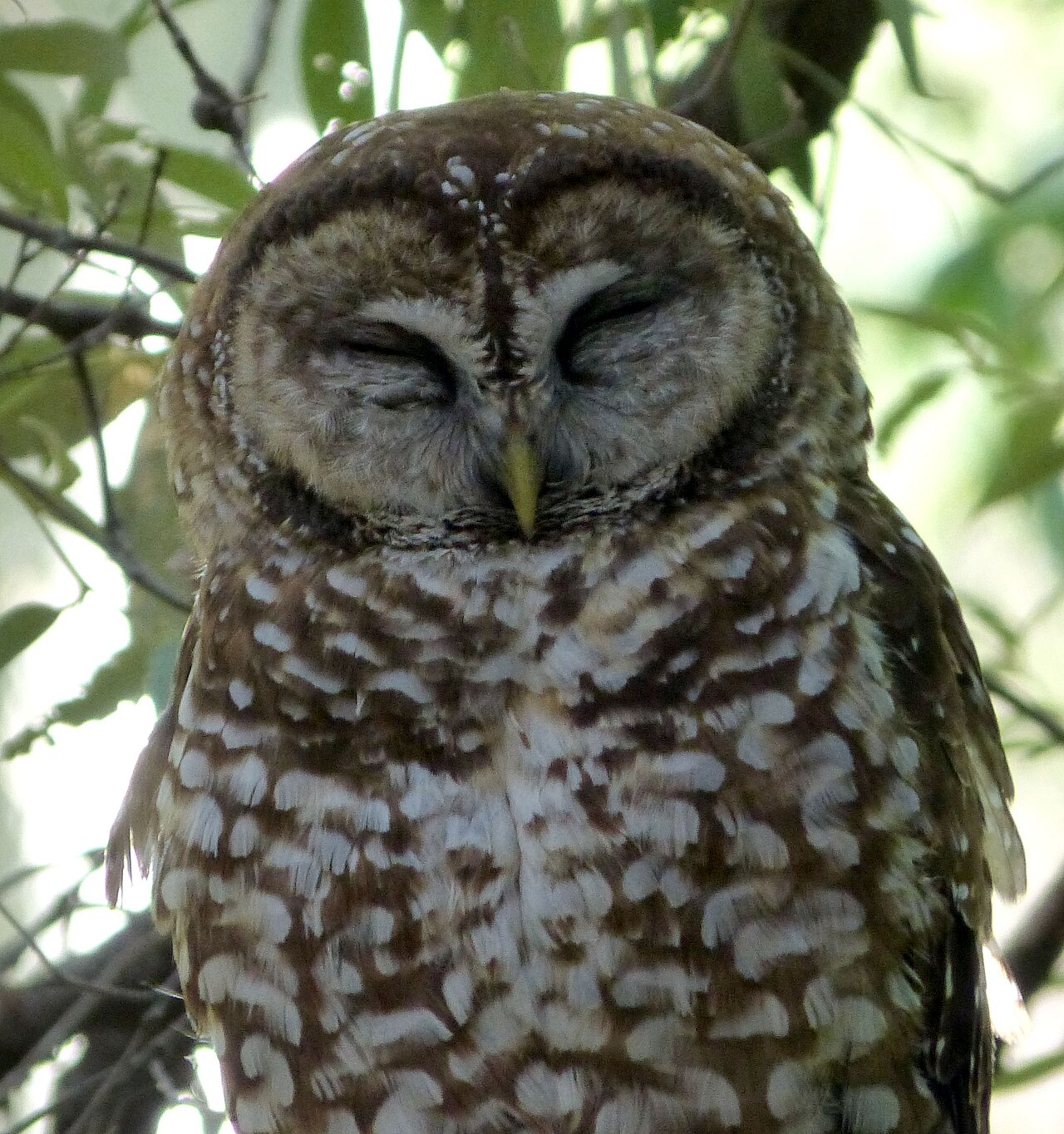
The Spotted Owl is a medium-large, rounded-headed owl with no ear tufts, dark brown eyes, and chocolate-brown plumage liberally marked with white or pale spots across the head, back, and underparts. The spotting is the key field mark and the source of its name, and it gives the bird a softly dappled look quite different from any barred or streaked owl. Like its relative the Barred Owl, it has dark eyes rather than the yellow eyes of most owls.
The most important comparison is with the Barred Owl, which is now expanding into Spotted Owl territory. The two are similar in size and both have dark eyes, but the Spotted Owl is covered in rounded white spots, while the Barred Owl shows horizontal bars across the chest and vertical streaks down the belly. This spots-versus-bars distinction is the single most useful way to tell them apart. See how it fits among relatives in our owl types guide.
Range, subspecies, and habitat
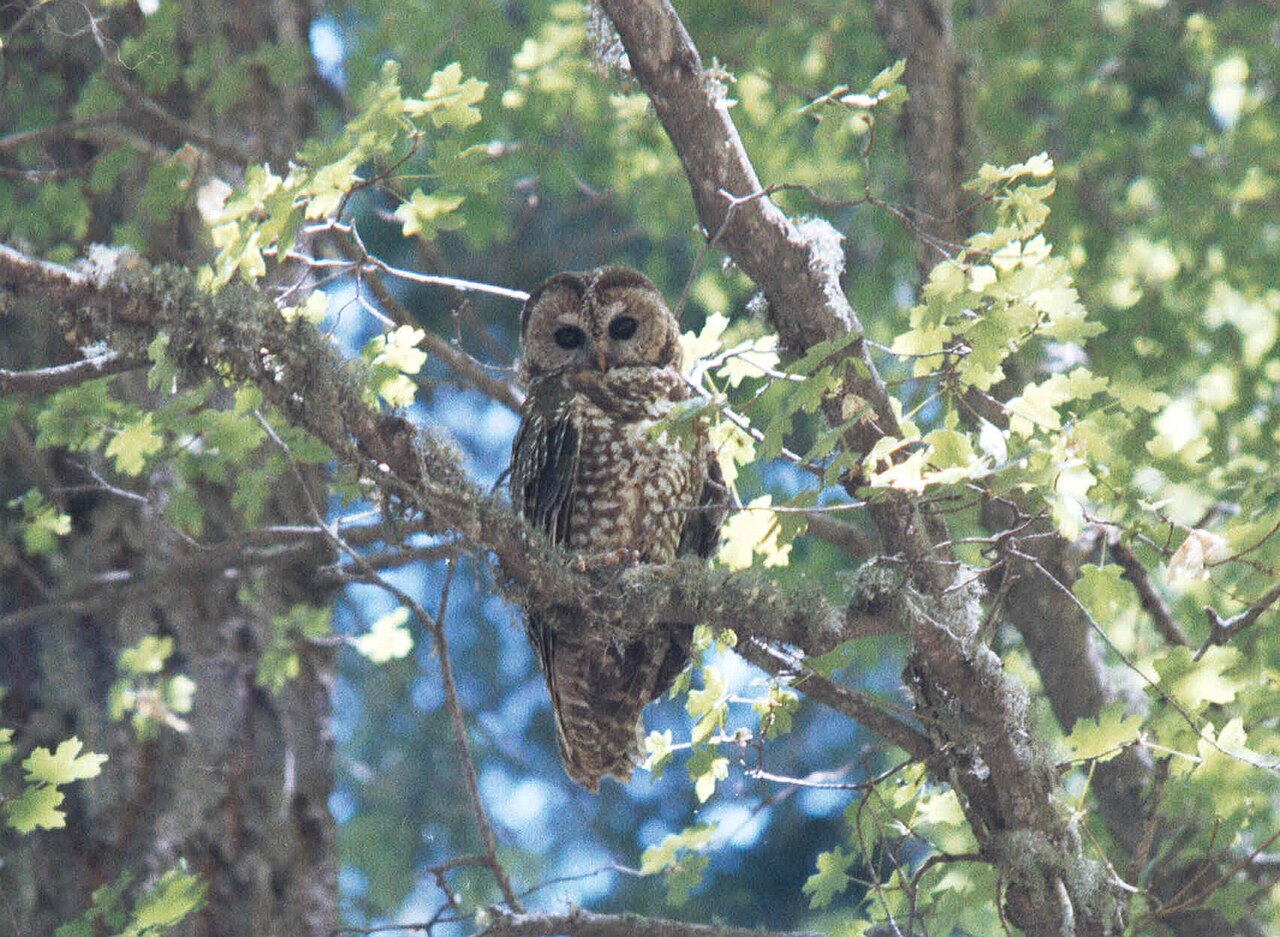
The Spotted Owl is a bird of the West, occurring in three recognized subspecies. The Northern Spotted Owl inhabits the moist old-growth forests of the Pacific Northwest, from British Columbia through Washington and Oregon into northern California. The California Spotted Owl lives in the Sierra Nevada and coastal ranges of California, and the Mexican Spotted Owl occupies the canyon and montane forests of the southwestern United States and Mexico.
Across all three, the common thread is a need for structurally complex, mature forest, ideally old growth, with big trees, dense canopy, and plenty of cavities and broken-topped snags for nesting. This tight association with ancient forest is exactly what placed the Spotted Owl at the heart of one of the fiercest environmental conflicts in American history, because the forests it depends on are also prized for timber.
What Spotted Owls eat
The Spotted Owl is a nocturnal hunter that specializes in small mammals, and its exact menu varies by region. In the Pacific Northwest, the northern flying squirrel is the staple prey, while in California and the Southwest, woodrats take on greater importance, supplemented by other rodents, rabbits, and occasionally birds and insects. This reliance on particular forest-dwelling mammals ties the owl closely to the health of its old-growth home.
It hunts by night from a perch, using excellent low-light vision and hearing to detect prey moving through the understory, then dropping silently to seize it. Because its favored prey are themselves creatures of mature forest, the Spotted Owl cannot simply move into young plantations or cleared land, which is a central reason habitat loss hits it so hard. Its specialized diet stands in contrast to the broad menus of many owls in our guide to what owls eat.
Spotted Owl sounds
The Spotted Owl’s most characteristic call is a series of four hoots delivered in a distinctive rhythm, often written as a hoo… hoo-hoo… hooo, with the notes spaced into a recognizable pattern quite unlike the “who cooks for you” phrase of the Barred Owl. Females also give a rising, whistled contact call that ends abruptly. The owl is most vocal at night during the late-winter and spring breeding season.
Because Spotted and Barred Owls now overlap, learning to separate their voices matters for anyone surveying western forests. The Barred Owl’s rhythmic “who cooks for you” is emphatic and carrying, while the Spotted Owl’s four-note hoot is softer and more measured. Sound is often the first clue that either owl is present in dense forest where the birds themselves are hard to see.
Nesting and life cycle
The Spotted Owl does not build its own nest. It relies on natural structures within mature forest, such as cavities in large trees, the broken tops of big snags, and the abandoned stick nests of hawks or ravens. The female lays a small clutch, usually one to three eggs, and incubates while the male hunts. Notably, Spotted Owls do not breed every year, often skipping nesting when food is scarce, which makes their populations slow to recover.
The young hatch helpless and depend on their parents for an extended period, learning to hunt in the complex forest before dispersing. This low reproductive rate, combined with the owl’s need for old-growth forest and its long path to independence, means the species has little capacity to rebound quickly from losses, a vulnerability at the core of its conservation story.
Conservation: timber wars and the Barred Owl
No North American owl has a more storied conservation history. In 1990 the Northern Spotted Owl was listed as federally Threatened, and it became the symbol of the “timber wars,” a bitter clash between the logging industry and efforts to protect the last old-growth forests of the Pacific Northwest. Sweeping habitat protections followed, reshaping forest management across the region and making the owl a household name.
Yet even with habitat safeguarded, Spotted Owl numbers have kept falling, largely because of a second threat: the Barred Owl. Larger, more aggressive, and more adaptable, Barred Owls have expanded west into Spotted Owl forests, outcompeting them for territory and food and even hybridizing to produce so-called “Sparred Owls.” Managers now face wrenching choices, including controversial Barred Owl removal programs, to give the Spotted Owl a chance. Both the Cornell Lab of Ornithology and Audubon track its continuing decline. Its plight is a sobering lesson that protecting habitat alone may not save a species. Owls of every kind also feature in owl symbolism and the meaning behind an owl visit.
The three subspecies of Spotted Owl
The Spotted Owl is divided into three subspecies that differ in range and in the pressures they face. The Northern Spotted Owl lives in the moist old-growth forests of the Pacific Northwest and is the most imperiled, being federally listed as Threatened and hit hardest by both historic logging and the invading Barred Owl. The California Spotted Owl occupies the Sierra Nevada and coastal mountains of California, where forest management and wildfire are key concerns.
The Mexican Spotted Owl ranges through the canyon country and montane forests of the southwestern United States and Mexico, using steep rocky canyons as well as mature forest. All three share the same spotted plumage and dark eyes, and all depend on structurally rich, mature habitat. Recognizing which subspecies occupies a given region helps put the owl’s conservation status in context, since the threats and legal protections vary from one to the next. Our guide to owls in California covers the state’s owls in more depth.
Frequently Asked Questions
How do you tell a Spotted Owl from a Barred Owl?
A Spotted Owl is covered in rounded white spots, while a Barred Owl has horizontal bars across the chest and vertical streaks on the belly. Both have dark eyes and are similar in size, so the spots-versus-bars pattern is the key.
Why is the Spotted Owl threatened?
It depends on mature old-growth forest that has been heavily logged, and it now also faces intense competition and hybridization from the invading Barred Owl. Its low reproductive rate makes recovery slow.
What do Spotted Owls eat?
Mainly small mammals. Northern birds specialize in flying squirrels, while California and Mexican birds rely more on woodrats, supplemented by other rodents and occasional birds and insects.
Where do Spotted Owls live?
In mature and old-growth forests of the West, across three subspecies: Northern (Pacific Northwest), California (Sierra Nevada and coastal ranges), and Mexican (canyons and mountains of the Southwest).
What is a Sparred Owl?
A Sparred Owl is a hybrid between a Spotted Owl and a Barred Owl. As Barred Owls invade Spotted Owl range, the two sometimes interbreed, which further threatens the genetic integrity of the Spotted Owl.
What does a Spotted Owl sound like?
Its main call is a measured series of four hoots in a distinctive rhythm, softer than the Barred Owl’s emphatic ‘who cooks for you.’ Females also give a rising whistled contact call.
Why was the Spotted Owl so controversial?
When the Northern Spotted Owl was listed as Threatened in 1990, protecting its old-growth habitat clashed with the logging industry, sparking the ‘timber wars’ and making the owl a national symbol of the debate.
Do Spotted Owls breed every year?
No. Spotted Owls often skip breeding when food is scarce, and they lay only small clutches. This low reproductive rate is one reason their populations recover so slowly from declines.