Purple Bird: 11 Species With Purple Feathers and What Counts
A purple bird is almost always a bird whose feathers scatter light rather than a bird carrying true purple pigment. Only a handful of North American species read as convincingly purple in the field, and the most reliable of them is the Purple Gallinule, a marsh bird whose head, neck, and breast glow deep violet in direct sun. Everything else on the usual list is either iridescent, like the Common Grackle and Purple Martin, or misnamed, like the Purple Finch, which is closer to raspberry than to violet.
That gap between the name and the color is why identification goes sideways so often. Two people can look at the same bird from different angles and honestly disagree about whether it was purple, black, or blue. Knowing which species actually produce a violet appearance, and under what light, turns a frustrating sighting into a confident call.
True purple plumage is rare in birds. The Purple Gallinule is the most genuinely purple bird in North America, while the Purple Martin, Common Grackle, and Violet-green Swallow appear purple only through iridescence. The Purple Finch, despite its name, is raspberry red. Purple in birds comes from feather structure, not pigment.
| Species | How Purple It Really Is | Where to Look | Size |
|---|---|---|---|
| Purple Gallinule | Genuinely violet head and breast | Southeast marshes, Florida, Gulf Coast | 10 to 15 in |
| Purple Martin | Iridescent blue purple, males only | Nest colonies across the East and Midwest | 7 to 8 in |
| Common Grackle | Purple head sheen over bronze body | Lawns, fields, parking lots nationwide | 11 to 13 in |
| Violet-green Swallow | Violet rump and tail sides in flight | Western mountains and canyons | 5 in |
| Costa’s Hummingbird | Vivid purple throat and crown flare | Sonoran and Mojave deserts | 3 to 3.5 in |
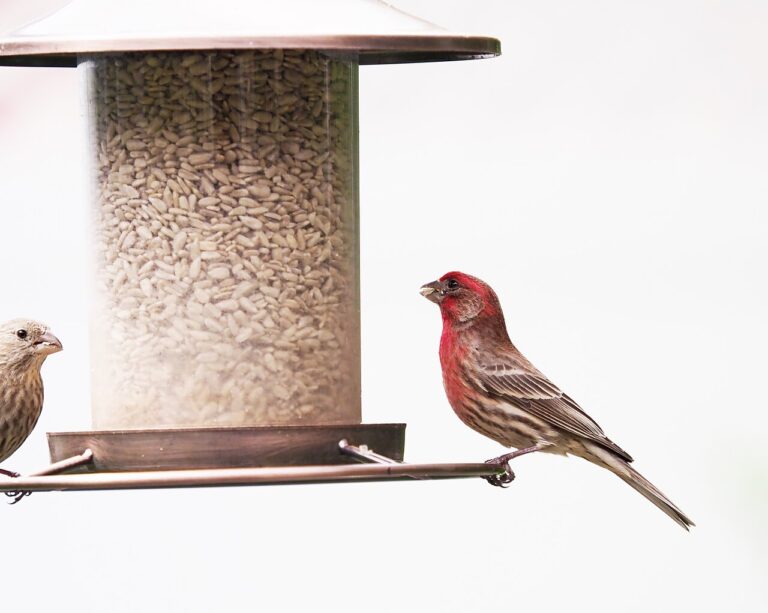
| Purple Finch | Not purple, raspberry red wash | Northern and eastern woodlands | 5 to 6 in |
Are There Really Purple Birds?
Yes, but far fewer than the common names suggest, and almost none of them owe their color to purple pigment. Birds produce most warm colors with carotenoids from their diet and most dark colors with melanin, and neither pathway yields violet. What looks purple is nearly always structural color, where microscopic layers inside the feather barbules cancel some wavelengths and reinforce others.
That distinction has practical consequences in the field. A pigment-based color, like the red of a cardinal, looks the same whether the bird is in shade or sun. A structural color changes with the angle between the sun, the bird, and your eye, so the same grackle can look flat black on an overcast morning and electric violet twenty minutes later.
The one broad exception among the world’s birds is the turaco family of Africa, which produces a genuine violet-blue pigment called turacoverdin along with a red pigment unique to the group. No North American species does anything comparable. If you are birding in the United States or Canada and something looks purple, you are seeing either the Purple Gallinule or a trick of light on dark feathers.
Purple Gallinule: The Most Purple Bird in North America
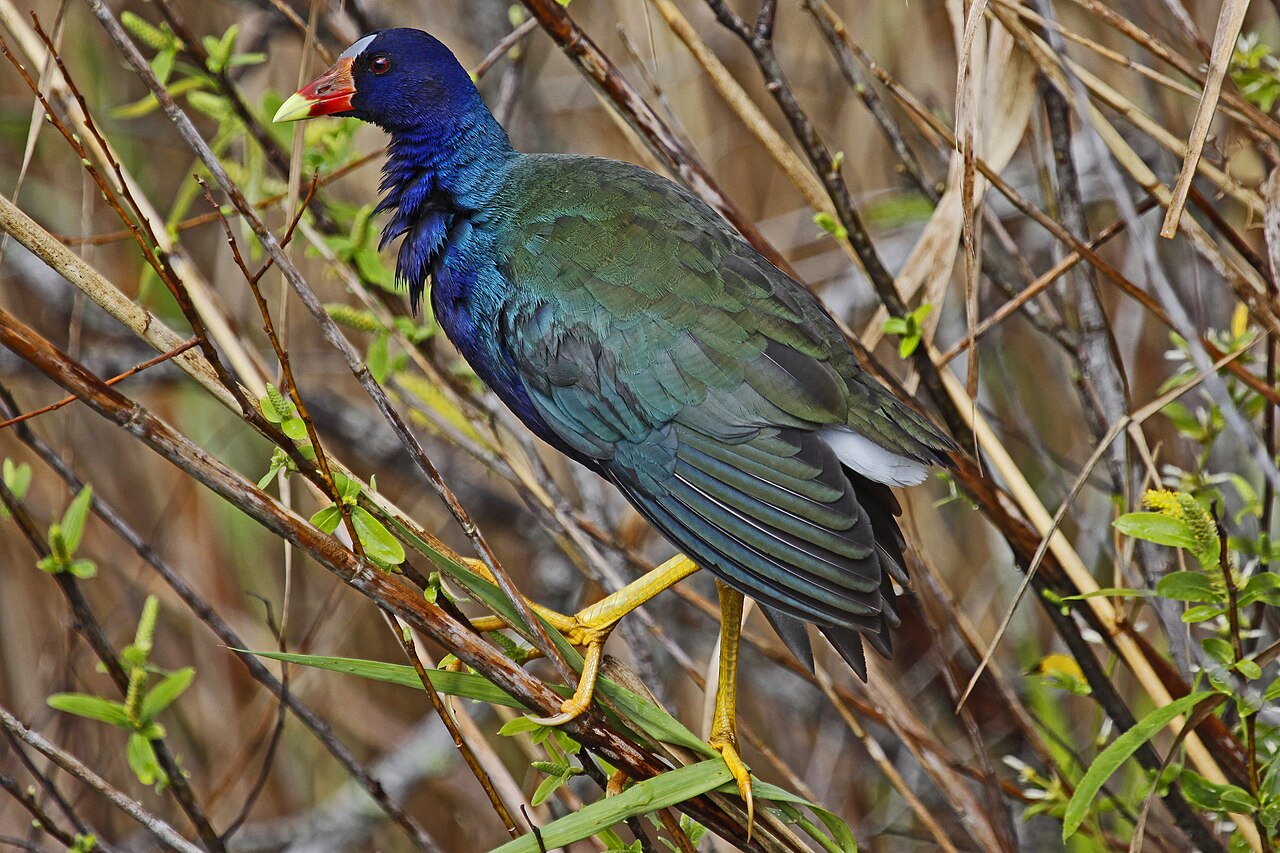
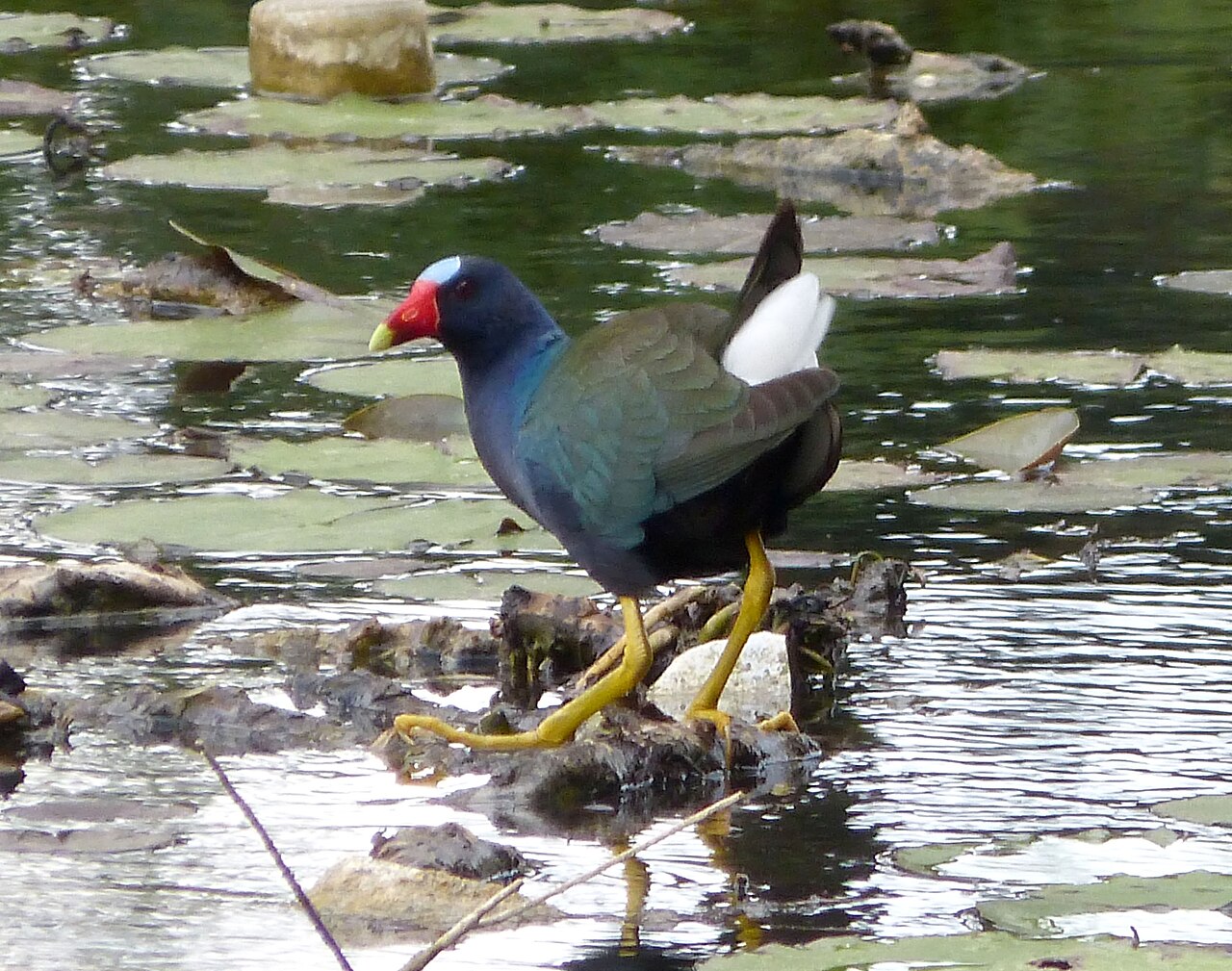
The Purple Gallinule is the species that earns the name without qualification. Adults have a deep violet head, neck, and underparts, a shining green back, a pale blue forehead shield, and a candy-red bill tipped in yellow. The legs are bright yellow and absurdly long, ending in toes that let the bird walk directly across floating vegetation.
Range is the main constraint. The species breeds in freshwater marshes across Florida, the Gulf Coast, and the coastal plain north to South Carolina, with scattered records well outside that band during migration overshoots. Look for it in shallow wetlands with heavy cover of lily pads, pickerelweed, or water hyacinth, usually walking rather than swimming.
Juveniles cause most of the confusion. A first-year Purple Gallinule is a buffy tan bird with no violet at all, which sends people down the wrong path entirely. The giveaways are the same oversized yellow feet, the same deliberate walk across floating leaves, and the pale blue shield beginning to show at the base of the bill.
Purple Martin: Glossy Blue Purple in Direct Light
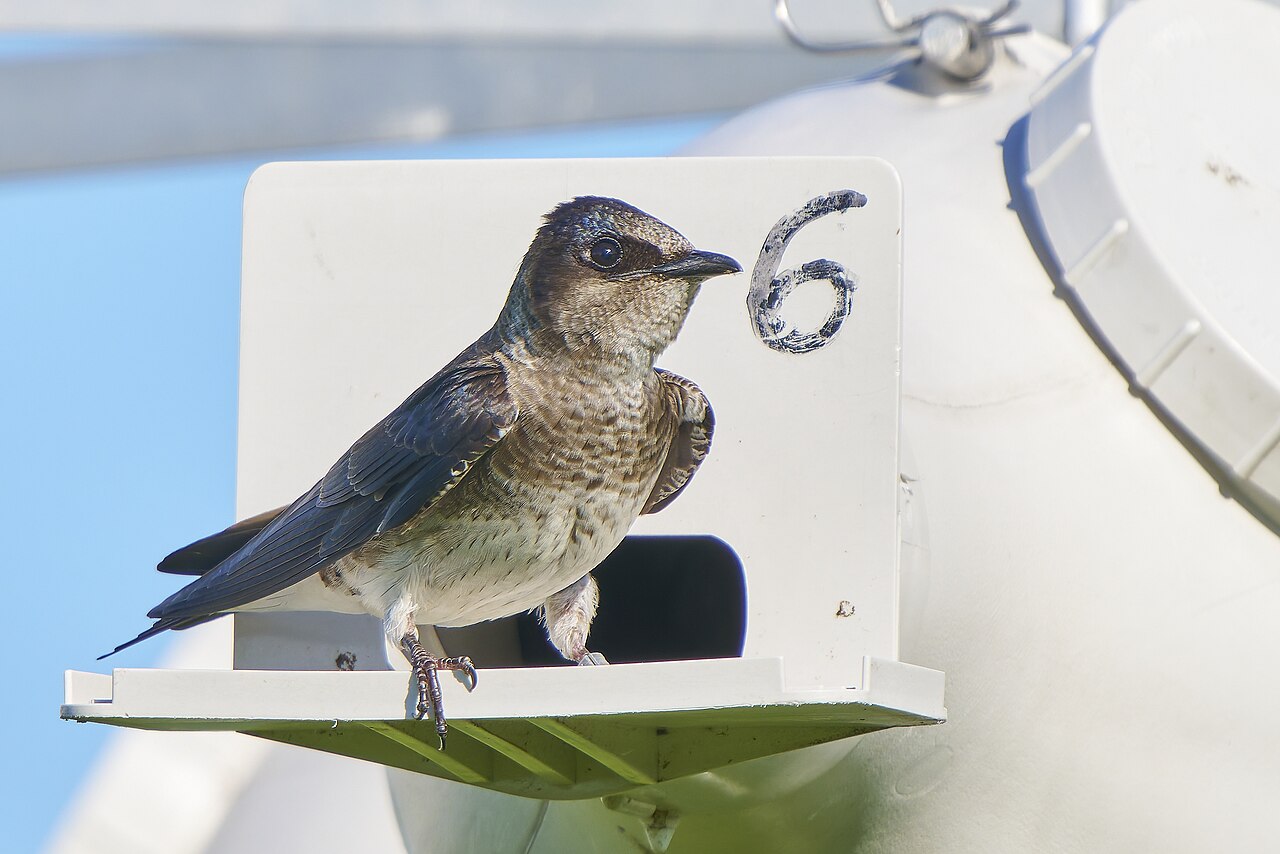
The Purple Martin is the largest swallow in North America, and adult males are the only ones that read purple. Their entire body is a uniform dark iridescent blue-purple with no pale underparts, which is unusual among swallows and makes a perched male distinctive at close range. Females and immatures are gray-bellied and show only a hint of gloss on the back.
Martins are also the most human-dependent birds on this list. East of the Rockies, the entire breeding population nests in gourds and multi-compartment houses put up by people, a relationship that goes back centuries to Indigenous communities who hung hollow gourds near their fields. Western populations still use natural cavities and saguaro holes.
The best way to see the purple is to catch a male in level morning light as he sits on a wire or house perch. In flight against a bright sky the bird almost always looks black. Colonies begin arriving in the Gulf states in late January and reach the northern edge of the range by May, so timing matters as much as location.
Common Grackle: A Purple Head Over a Bronze Body
The Common Grackle is the purple bird most people actually encounter, usually without recognizing it. In good light an adult male shows a glossy violet head and throat that transitions to bronze or greenish across the back and belly, with a long keel-shaped tail and startling pale yellow eyes. In poor light the whole bird reads as plain black.
Three regional forms exist and they differ in exactly this way. The Purple Grackle of the Atlantic coastal plain shows purple across the body rather than just the head, while the Bronzed Grackle of the interior and north has a bronze body with a purple head, and the Florida form falls between them. All three are the same species and interbreed where their ranges meet.
Grackles are loud, gregarious, and common in mowed lawns, farm fields, and shopping center parking lots. They walk rather than hop, which separates them instantly from blackbirds at a distance. If you want a guaranteed look at purple iridescence, this is the bird to study, because a flock of Common Grackles in low sun will show every angle of the effect within a minute.
Violet-green Swallow and the Western Sheen Birds
The Violet-green Swallow carries its purple on the rump and the sides of the tail base, which means the color flashes only when the bird banks away from you. The upperparts blend bronze-green on the back into violet toward the tail, and the face shows more white above and behind the eye than any other North American swallow. Underparts are clean white.
The species is a western bird of open woodland, mountain canyons, and cliff faces from Alaska south through California and the Rockies, and it nests readily in boxes at higher elevations. It often forages in mixed flocks with Tree Swallows, and separating the two at speed comes down to the white saddlebags that wrap onto the rump of the Violet-green.
Tree Swallows themselves deserve a mention, because in certain angles their steel-blue backs throw an unmistakable violet cast. So do European Starlings in fresh fall plumage, whose black feathers glow purple and green over a fine spray of white spots. Neither is a purple bird by name, and both are mistaken for one regularly.
Costa’s Hummingbird and the Purple Gorget Birds
Costa’s Hummingbird produces the most intense purple in North American birds, concentrated in the male’s gorget and crown. The elongated throat feathers flare outward like a drooping mustache, and when the male turns into the sun the whole head ignites in violet. Turn a few degrees off axis and the same feathers look sooty black.
This is a desert specialist of the Sonoran and Mojave, breeding early in the year to match the bloom of ocotillo, chuparosa, and desert lavender. Males display with a shrill high whistle delivered during a steep diving loop, which is often the first clue the bird is present at all. Females are plain gray-green with no purple whatsoever.
Two other hummingbirds join the purple category. Anna’s Hummingbird shows a rose-purple crown and gorget across the Pacific states, and the Black-chinned Hummingbird carries a narrow violet band below its black chin that only appears in perfect light. All three are structural, all three vanish at the wrong angle, and all three are worth a slow approach rather than a quick glance.
Purple Finch: The Bird That Broke the Name
The Purple Finch is not purple, and no lighting condition will make it so. Male Purple Finches are washed in raspberry or wine red across the head, breast, and back, an effect the ornithologist Roger Tory Peterson famously compared to a sparrow dipped in cranberry juice. The name traces back to an older, broader use of the word purple that covered deep reds.
The real identification problem is not the name but the House Finch, which overlaps in range and shares the same general shape and coloring with the Purple Finch. Purple Finches are stockier, show a notched tail, and carry their color evenly over the head and back rather than concentrated on the forehead and chest. Females are heavily streaked with a bold white eyebrow that House Finch females lack.
If you feed birds in the eastern or northern United States, both species may visit the same tube feeder within the same hour. Working through the House Finch versus Purple Finch comparison once will save years of second-guessing, and the female Purple Finch is worth studying separately because she looks nothing like the male.
Purple Honeycreeper and Tropical Purple Birds
Outside North America, genuine purple becomes far more common, and the Purple Honeycreeper of northern South America is the clearest example. Males are a saturated violet-purple over almost the entire body with black wings, a black mask, a curved black bill, and bright yellow legs that look almost artificial. They feed on nectar and small fruit in the canopy of humid lowland forest.
The Violet-backed Starling of sub-Saharan Africa takes the effect further, with males so brilliantly iridescent that the back looks metallic amethyst in sun and dull brown in shade. Females are plain brown and streaked, one of the most extreme differences between the sexes among songbirds. Neither species occurs in North America outside of aviaries.
Several tropical parrots, cotingas, and pigeons round out the global list. The Purplish Jay, Purple-throated Fruitcrow, and various Amazon parrots all carry violet in the name or the plumage. For a broader tour of what feather color can do, the wider survey of the most colorful birds covers the pigment and structure behind every hue.
Why Purple Feathers Are Structural, Not Pigmented
Feather barbules in iridescent birds contain stacked layers of keratin and melanin granules spaced at distances comparable to the wavelength of visible light. Light entering those layers reflects off each boundary, and the reflections either reinforce or cancel one another depending on spacing and angle. Purple appears when the structure reinforces both the short blue end and a trace of red at once.
Because the effect depends on geometry, it collapses the moment the geometry changes. Tilt the feather, move the sun, or step three paces to the left and the reinforced wavelength shifts, which is why grackles turn from purple to bronze to black as they walk across a lawn. Pigment-based color has no such dependency.
Structural color also degrades differently. Worn feathers lose the fine layer spacing, so late-summer birds often look duller than the same individuals in fresh plumage. Research summarized by the Cornell Lab of Ornithology at All About Birds documents how heavily molt timing influences perceived color in iridescent species.
Birds People Report as Purple That Are Not
Several species generate persistent purple reports without belonging on any purple list. European Starlings in winter plumage are the most frequent, followed by Brewer’s Blackbirds, whose males throw violet on the head and green on the body in the same way grackles do. Both are common enough that a purple sighting statistically favors them.
Rock Pigeons account for another share. The iridescent neck patch of a city pigeon runs through green, magenta, and violet depending on the angle, and on a bird standing in low sun the purple can dominate the entire throat. People often describe it as a purple-necked dove rather than recognizing the bird underneath.
Escaped cage birds fill in the rest. Budgerigars, lovebirds, and various conures appear in violet color mutations bred in captivity, and a loose one at a feeder produces a genuinely purple bird that no field guide will explain. If a purple bird is small, tame, and unbothered by close approach, captive origin is the first thing to consider, ahead of anything in the blue bird group.
Where and When to Find Purple Birds
Timing beats location for every species on this list except the Purple Gallinule. Iridescence needs direct low-angle sunlight, which means the first two hours after sunrise and the last two before sunset produce almost all good purple sightings. Midday overhead sun flattens the effect and overcast conditions eliminate it entirely.
For the Purple Gallinule, target Florida wetlands from March through August, with Everglades National Park, the Loxahatchee refuge, and Gulf Coast marsh boardwalks among the most reliable sites. For Purple Martins, find a managed colony and visit in the hour after sunrise when adults perch on the housing. For Costa’s Hummingbird, work desert washes in February and March during peak ocotillo bloom.
Position yourself with the sun behind you and slightly to one side. That geometry sends the reinforced wavelength straight back toward your eye, which is exactly the condition iridescence requires. Birders who reposition rather than zoom see purple on birds that everyone else logs as black.
What It Means When You See a Purple Bird
Purple has carried associations with royalty, spirituality, and transformation in many cultures, largely because Tyrian purple dye was historically so expensive that only rulers could afford it. Those associations attach easily to a bird that seems to change color as it moves, and violet sightings show up frequently in folk symbolism as markers of change or intuition.
There is no biological content to that reading, and the birds themselves are responding to entirely different pressures. Iridescent plumage in martins, grackles, and hummingbirds functions as a sexual signal, advertising feather condition and by extension health to potential mates. The color exists because females attend to it, not because it carries meaning for human observers.
Both readings can coexist without conflict. Noticing a Purple Gallinule stepping across lily pads or a grackle flaring violet on a lawn is worth the pause either way. The bird is doing physics, and the observer is free to make of it what they like.
Frequently Asked Questions
Is there any bird that is truly purple?
The Purple Gallinule comes closest in North America, with genuinely violet head, neck, and underparts visible in most lighting. Globally, the Purple Honeycreeper of South America and several turaco species carry real violet coloration. Almost every other so-called purple bird is showing iridescence rather than true purple plumage.
What kind of bird has purple feathers in my backyard?
In a typical yard, a purple-headed bird walking on the lawn is almost certainly a Common Grackle, and a glossy dark bird at a nest house is likely a male Purple Martin. European Starlings in winter also throw strong violet. Check the eye color, since the grackle’s pale yellow eye separates it from both immediately.
Why is the Purple Finch not purple?
The name dates to an era when English used purple loosely for deep reds as well as violets. Male Purple Finches are washed in raspberry or wine red, not violet, and no lighting condition changes that. The color comes from carotenoid pigments in the diet rather than from feather structure.
What bird is blue and purple at the same time?
Male Purple Martins show a blue-purple gloss that reads as either color depending on angle, and Violet-green Swallows blend green, blue, and violet across the back and rump. Tree Swallows and Barn Swallows also shift between blue and purple in low sun. All of these are iridescence rather than two separate pigments.
Are Purple Gallinules rare?
They are locally common within their range but that range is narrow, covering Florida, the Gulf Coast, and the southern Atlantic coastal plain. Outside those areas they are genuinely rare and usually represent overshooting migrants. Habitat loss in freshwater marshes has reduced numbers at the northern edge of the breeding range.
What does it mean when you see a purple bird?
Culturally, purple has long been tied to royalty, intuition, and transformation, so sightings often get read as signs of change. Biologically, the iridescence exists as a mating signal that advertises feather condition to potential mates. The two interpretations operate on completely separate levels and neither invalidates the other.