Colorful Birds
Colorful birds get their vivid feathers from two very different sources: pigments absorbed from their diet, and microscopic feather structures that bend light itself. Reds, oranges, and yellows almost always come from carotenoid pigments birds absorb by eating plants or plant-eating insects, while the blues and shimmering iridescence seen on species like the Blue Jay are created entirely by light scattering off nanoscale structures inside the feather, not by any blue pigment at all.
Across North American backyards, a handful of species account for most of the color people notice at feeders and in treetops, from the unmistakable red of the Northern Cardinal to the almost impossibly rainbow-hued Painted Bunting, each with its own story behind exactly how that color gets produced.
| Quick Reference | Detail |
|---|---|
| Red/Orange/Yellow Colors | Carotenoid pigments, absorbed through diet |
| Black/Brown Colors | Melanin pigments; also strengthen feathers |
| Blue/Iridescent Colors | Structural color from light-scattering nanostructures |
| Most Colorful US Species | Painted Bunting, often called North America’s most rainbow-colored bird |
| Typical Pattern | Males usually brighter than females |
| Attracting Them | Native plants, appropriate feeders, water sources |
What Makes a Bird Colorful? The Science Behind Feather Colors
According to the Cornell Lab of Ornithology, bird feather color comes from three main pigment groups, plus an entirely separate mechanism called structural color. Carotenoids, which birds can only get through their diet since they cannot produce them internally, create the brilliant reds of a Northern Cardinal and the sunny yellows of an American Goldfinch. Melanins produce blacks, browns, and grays, and also make feathers physically stronger and more wear-resistant than unpigmented ones, which is part of why the darkest wingtip feathers on many species tend to hold up best against everyday wear and tear.
Porphyrins are a rarer third pigment group responsible for unusual colors like the bright greens seen in turacos, and they can even fluoresce faintly under ultraviolet light invisible to human eyes but clearly visible to many birds themselves. Structural color works completely differently: it has nothing to do with pigment at all and instead comes from the physical arrangement of microscopic structures in the feather barbs, which scatter and reflect specific wavelengths of light, most commonly producing blues, violets, and the shifting, rainbow-like sheen called iridescence. Many species combine both mechanisms at once, layering a pigment beneath a structural element to create colors, like green, that neither system could produce entirely on its own.
Why Are Male Birds Usually More Colorful Than Females?
In most North American songbird species, males show noticeably brighter, bolder colors than females, a pattern driven largely by sexual selection: brighter plumage signals health, strong genetics, and successful foraging ability to potential mates, since producing vivid carotenoid coloring takes real nutritional investment. A washed-out or dull male, by contrast, may be silently advertising poor health or a weak diet to any female evaluating her options.
Females, meanwhile, often benefit from staying camouflaged, particularly since they do the bulk of nest incubation and sitting still on a nest in bright, eye-catching colors would attract far more predator attention. This is exactly why a female Scarlet Tanager looks like a fairly plain olive-yellow bird while the breeding male is a shocking, unmistakable red with jet-black wings.
Northern Cardinal: America’s Favorite Red Bird
The Northern Cardinal is arguably the most recognizable colorful bird in the eastern United States, with males showing an all-over brilliant red set off by a black face mask and a prominent crest. Females are more subdued, a soft tan or gray-brown with reddish tinges on the wings, tail, and crest, though both sexes share the same thick, seed-cracking bill. For a closely related question, see our guide to orange and black bird.
Unlike many colorful songbirds, cardinals do not migrate, making them a year-round backyard presence and a particularly striking sight against snow in winter. Their range has been steadily expanding northward for decades, a shift some researchers link partly to the spread of backyard bird feeders stocked with sunflower seeds, and many people who spot one wonder about the broader symbolism tied to seeing a cardinal, a topic that comes up constantly among backyard birders. Cardinals are far from the only backyard species carrying deep cultural symbolism either; exotic ornamental birds such as peafowl carry their own rich history, tied closely to the wider symbolism associated with peacocks across many cultures. For a closely related question, see our guide to birds with long beaks. For a closely related question, see our guide to blue and white bird.
Painted Bunting: North America’s Most Rainbow-Colored Bird
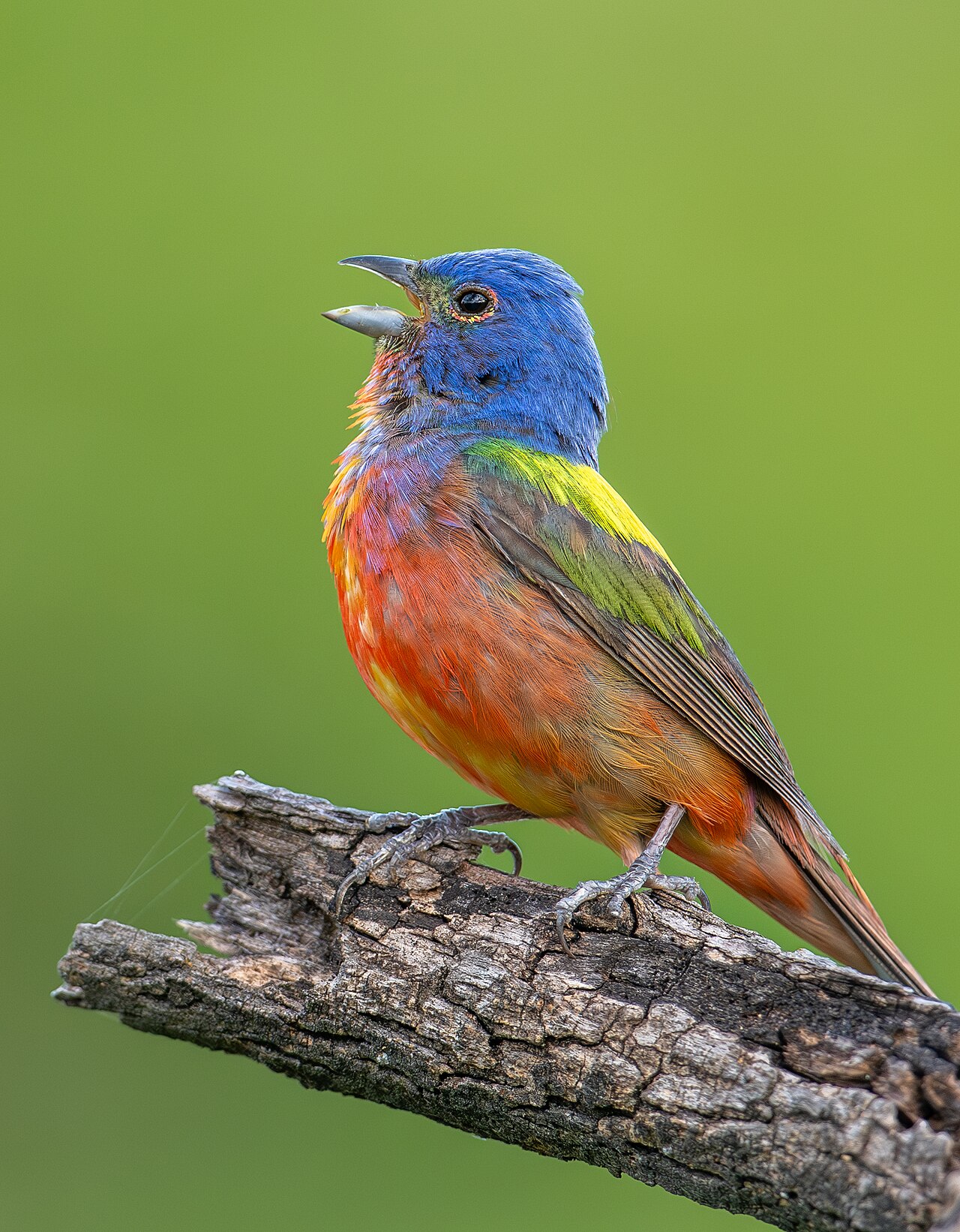
If any single species deserves the title of most colorful bird in North America, it is the Painted Bunting. Males display an almost cartoonishly vivid combination of a blue head, a bright green back, and a red throat, chest, and belly, a color combination that rivals even the ornamental brilliance of a golden pheasant kept in captivity, despite being a genuinely wild North American songbird.
Females and juveniles look completely different from the flashy males, showing an overall lemon-lime green that helps them stay far less conspicuous while nesting. Painted Buntings spend the breeding season across Texas, Oklahoma, Arkansas, Louisiana, and parts of Florida, and they do visit backyard feeders in that range, showing a particular fondness for white millet and mealworms.
Blue Jay and the Truth About “Blue” Feathers
The Blue Jay is one of the loudest and most conspicuous colorful birds of eastern backyards, instantly recognizable by its blue, white, and black plumage and bold crest. What surprises most people is that a Blue Jay’s feathers contain no blue pigment whatsoever; the underlying pigment is actually a dull brown.
The vivid blue appearance comes entirely from structural color, a physical effect where microscopic air pockets and keratin structures inside each feather barb scatter blue wavelengths of light back toward the viewer while absorbing other colors. This is easy to prove for yourself: hold a blue feather up so light passes through it rather than reflecting off it, and it will appear brown instead of blue, since the structural trick only works with reflected light.
Baltimore Oriole and American Goldfinch: Backyard Standouts
The Baltimore Oriole’s bold orange-and-black plumage is iconic enough to have lent its name to a Major League Baseball team, and the males’ fiery coloring makes them unmistakable as they forage in tall trees each summer across the eastern and north-central United States. Orioles are not seed eaters, so attracting them typically requires offering fresh orange halves, grape jelly, or nectar feeders rather than a standard seed mix, not unlike the specialized diets required by more exotic ornamental birds such as pheasants kept in aviaries.
The American Goldfinch offers a different kind of color payoff: breeding males turn a brilliant, almost highlighter-yellow with contrasting black wings and a small black cap, while females and winter males show a much duller olive-yellow. Goldfinches are reliable feeder visitors nearly everywhere in the United States and have a particular weakness for nyjer (thistle) seed and sunflower hearts.
Scarlet Tanager and Rose-breasted Grosbeak: Hidden Gems of the Treetops
The Scarlet Tanager spends much of its time high in the forest canopy, which is part of why this vivid red-bodied, black-winged bird is more often heard than seen despite being one of the most striking songbirds in the eastern United States. It breeds across the eastern states each summer before migrating to South America for winter, and it favors insects over seed, though it will occasionally take fruit or sugar water, a stark contrast to the far duller plumage typical of common blackbird species sharing the same woodland habitat.
The Rose-breasted Grosbeak pairs a bold black-and-white body with a dramatic triangular patch of rose-red across the chest, a striking look backed by a thick, oversized bill built for cracking seeds. Both species tend to favor mature woodlands over open lawns, so patient birders in wooded neighborhoods have a much better chance of spotting either one than someone watching a bare suburban feeder.
How to Attract Colorful Birds to Your Yard
Native, berry- and seed-producing plants do more heavy lifting than any single feeder, since they provide both natural food and the kind of cover many colorful species prefer over open lawn. Elderberry, buttonbush, and native flowering perennials are reliable draws for finches, tanagers, and orioles alike, and layering plants at different heights, from ground cover to canopy trees, gives the widest possible range of species a reason to stop.
Feeder choice matters just as much as placement: black oil sunflower seed and nyjer attract cardinals, goldfinches, and grosbeaks, while orioles and tanagers respond far better to fruit, jelly, or nectar feeders than to any seed mix. A shallow water source such as a birdbath or small fountain rounds things out, drawing in species that might otherwise pass a yard by, and avoiding broad-spectrum pesticides helps preserve the insect population that many colorful songbirds rely on to feed their young. Patience matters too, since it can take weeks or even a full season for word to spread among local birds that a new, reliable food source has shown up.
Related reading: Pink Bird.
Related reading: Yellow and Black Bird.
Related reading: Purple Bird.
Related reading: red bird not cardinal.
Frequently Asked Questions
Why are some birds so colorful?
Bird color comes from a combination of diet-derived pigments like carotenoids and melanins, plus structural color created by microscopic feather structures that scatter light, most often producing blues and iridescent sheens.
What is the most colorful bird in North America?
The Painted Bunting is widely considered the most colorful North American songbird, with males showing a striking combination of blue, green, and red plumage rarely matched by any other native species on the continent.
Why are female birds usually less colorful than males?
Duller female coloring typically provides better camouflage while incubating eggs and raising young, while brighter male coloring helps attract mates by signaling health and genetic quality.
What causes blue coloring in birds like blue jays?
Blue coloring comes from structural color rather than pigment. Microscopic structures in the feather scatter blue wavelengths of light back to the viewer, while the underlying pigment itself is actually a dull brown.
How can I attract colorful birds to my backyard?
Plant native, berry-producing shrubs, offer the right feeder type for the species you want (seed for cardinals and goldfinches, fruit or nectar for orioles), and add a water source such as a birdbath.
Do colorful birds migrate?
Some do and some don’t. Northern Cardinals stay year-round in much of their range, while species like the Painted Bunting, Scarlet Tanager, and Baltimore Oriole migrate substantial distances south into Mexico, Central America, or South America for the winter months.
Is a Painted Bunting rare?
It isn’t considered rare within its breeding range across the south-central and southeastern United States, but its striking looks and relatively limited range make it a genuine highlight for birders traveling from outside that area.