Birds with Yellow Breasts: 12 Common Species in North America with Identification (2026)
A yellow breast is one of the most attention-grabbing features in birds, bright, photogenic, and immediately diagnostic for many species. From the brilliant lemon-yellow of an American Goldfinch to the rich orange-yellow of an Eastern Meadowlark with its bold black ‘V,’ yellow-breasted birds span multiple families. This guide helps you identify the yellow-breasted bird you’ve spotted by combining the intensity and pattern of yellow, body markings (especially head pattern and back coloration), size, and habitat. Many warblers share yellow breasts but differ in other markings, careful observation of facial pattern and breast streaking is key.
The birds with yellow breasts in North America are the American Goldfinch, Eastern and Western Meadowlarks, Yellow Warbler, Common Yellowthroat, Western Tanager and Great Crested Flycatcher. A black V across the yellow chest means meadowlark and nothing else.
Quick Reference: 12 Birds with Yellow Breasts at a Glance
| Species | Size | Yellow Breast Pattern | Range |
|---|---|---|---|
| American Goldfinch | 5″ | All-yellow body incl. breast (summer male) | Continent-wide |
| Yellow Warbler | 5″ | Bright yellow + faint chestnut streaks | Continent-wide |
| Common Yellowthroat | 5″ | Bright yellow throat/breast + black mask | Continent-wide |
| Eastern Meadowlark | 9.5″ | Bright yellow + bold black V on chest | Eastern US fields |
| Western Meadowlark | 9.5″ | Bright yellow + black V (looks like Eastern) | Western US fields |
| Yellow-Breasted Chat | 7.5″ | Brilliant yellow breast + olive back | Continent-wide |
| Magnolia Warbler | 5″ | Yellow with bold black streaks | Eastern forests |
| Pine Warbler | 5.5″ | Olive-yellow breast + faint streaks | Eastern pine forests |
| Prothonotary Warbler | 5.5″ | Golden-yellow breast + olive back | Southeast swamps |
| Cape May Warbler | 5″ | Yellow + chestnut cheek + black streaks | Eastern boreal forests |
| Western Tanager (male) | 7.5″ | Bright yellow breast + red head + black wings | Western US |
| Wilson’s Warbler (male) | 4.5″ | Bright yellow + small black cap | Continent-wide |
Species Identification
American Goldfinch
The most familiar yellow-breasted bird at North American feeders. Summer male American Goldfinches have a brilliant lemon-yellow body (including breast) with jet-black wings, white wing bars, and a black cap on the forehead. In winter, both sexes turn dull olive-brown with paler yellow.
Range: Continent-wide year-round.
Habitat: Open fields, meadows, weedy areas, backyard feeders.
Key ID: Summer males unmistakable. Look for thick conical bill (seed-eater) + black wings with white bars.
Where to see: Nyjer (thistle) feeders. American Goldfinches are highly social, often in flocks.
Yellow Warbler
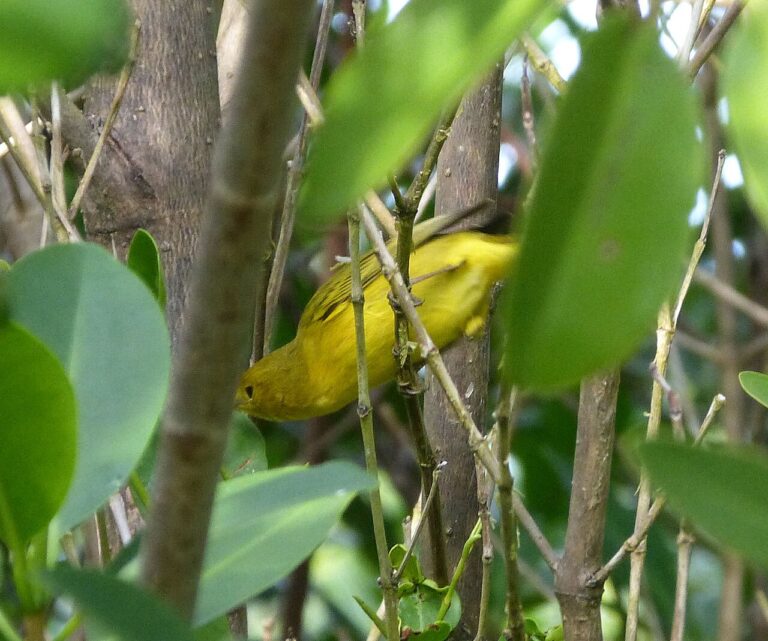
The most uniformly yellow songbird in North America, including the breast. Yellow Warblers are bright lemon-yellow all over, with subtle chestnut streaks on the breast (male). The entire body appears as just brilliant yellow from a distance.
Range: Continent-wide in summer. Migrates to Central/South America for winter.
Habitat: Wetlands, willow thickets, gardens with shrubs.
Key ID: Bright all-yellow body + thin pointed insect-catching bill + subtle chestnut breast streaks. No bold markings.
Where to see: Look near water and willow trees in summer. Rarely visits feeders.
Common Yellowthroat
A small, striking warbler. Male Common Yellowthroats have a bright yellow throat and breast, an olive back, and a distinctive black mask across the face. Females lack the black mask but have similar yellow throat/breast.
Range: Continent-wide in summer (most of North America).
Habitat: Marshes, wetlands, brushy fields.
Key ID: Yellow throat/breast + black mask (male only). Often skulks in dense vegetation.
Where to see: Listen for their ‘wichity-wichity-wichity’ song from dense brush.
Eastern Meadowlark
A grassland bird with the most distinctive yellow-breast pattern in North America. Eastern Meadowlarks have a brilliant yellow breast and belly with a bold black ‘V’ across the upper chest. The back is heavily streaked brown for camouflage.
Range: Eastern and central US year-round.
Habitat: Open grasslands, hayfields, pastures.
Key ID: Yellow breast + bold black V + brown-streaked back. Often perches on fenceposts singing.
Where to see: Grasslands and fields. Listen for their clear, flute-like ‘see-you-see-yer’ song.
Western Meadowlark
Nearly identical to Eastern Meadowlark in appearance, bright yellow breast with bold black V, brown-streaked back. The main differences are voice (Western has a more flute-like, gurgling song versus Eastern’s whistled song) and slight plumage differences only visible in good views.
Range: Western US year-round.
Habitat: Open grasslands, prairies, pastures.
Key ID: Same pattern as Eastern but range-based ID. Voice is the most reliable distinguisher.
Where to see: Western grasslands. Range overlaps Eastern Meadowlark in the central US.
Yellow-Breasted Chat
A large, robust songbird (formerly classified as a warbler, now in its own family). Yellow-Breasted Chats have a brilliant yellow breast and throat, olive-green back, white throat outline, and a distinctive face pattern with white eyebrows and ‘spectacles’ (white rings around the eyes).
Range: Continent-wide in summer.
Habitat: Dense brushy thickets, especially in early-successional habitat.
Key ID: Bright yellow breast + olive back + white spectacles around eyes. Bulkier and louder than warblers.
Where to see: Listen for their loud, varied song from dense brush. Hard to see, easy to hear.
Magnolia Warbler
Among the most striking warblers. Magnolia Warblers have a yellow breast with bold black streaks down the chest, a white belly band, olive-yellow back, and white wing bars. The combination of yellow + heavy black streaking is distinctive.
Range: Northeastern US and Canada in summer.
Habitat: Coniferous forests, especially young pine and spruce stands.
Key ID: Yellow breast + heavy black streaking + white belly band + white wing bars.
Where to see: Northern coniferous forests in summer. Often in lower portions of trees.
Pine Warbler
A subtle yellow-breasted warbler of pine forests. Pine Warblers have an olive-yellow breast with faint streaking, olive-yellow head, olive back, and white wing bars. The yellow is less intense than other warblers but consistently present.
Range: Eastern US, mostly in pine-dominated forests.
Habitat: Pine forests and mixed pine-oak forests.
Key ID: Olive-yellow overall + white wing bars + plain face. One of the few warblers that visits suet feeders.
Where to see: Pine forests in the East. Will visit suet feeders, especially in winter.
Prothonotary Warbler
The ‘swamp canary’ of the Southeast. Prothonotary Warblers have a brilliant golden-yellow head, breast, and underparts contrasted against olive-green wings and back. The yellow is more golden/orange than other yellow warblers.
Range: Southeastern US in summer.
Habitat: Wooded swamps, bottomland forests, areas with standing water.
Key ID: Brilliant golden-yellow head and breast + olive back. The most intensely yellow warbler.
Where to see: Southern swamps in summer. Cavity-nesting, will use nest boxes near water.
Cape May Warbler
A spectacular warbler. Male Cape May Warblers have a yellow breast with bold black streaks, distinctive chestnut cheek patches, yellow rump, and a yellow neck patch. Females are similar but duller.
Range: Eastern boreal forests in summer. Migration through eastern US.
Habitat: Spruce forests in summer.
Key ID: Yellow breast + chestnut cheek + black streaks. Specializes in spruce budworm, population fluctuates with caterpillar outbreaks.
Where to see: Migration in eastern US. Breeding in northern spruce forests.
Western Tanager (Male)
A spectacular western bird with a unique color combination. Male Western Tanagers have a bright yellow body INCLUDING the breast, jet-black wings with yellow/white wing bars, and a red-orange head.
Range: Western US in summer.
Habitat: Coniferous and mixed forests at all elevations.
Key ID: Yellow body + red head + black wings. Larger and bulkier than warblers (7.5 inches vs 5 inches).
Where to see: Western forests in summer. May visit fruit feeders (oranges, grape jelly) during migration.
Wilson’s Warbler (Male)
A small, bright warbler. Male Wilson’s Warblers have a brilliant yellow body and breast plus a distinctive small black cap on the head. Females lack the cap but are similarly yellow. The black cap is unique among yellow warblers.
Range: Continent-wide in summer.
Habitat: Riparian thickets, willow stands, wet woodlands.
Key ID: All-yellow body + small black cap (male only). Olive-green wings without prominent wing bars.
Where to see: Migration in spring/fall throughout the US. Breeding in northern wet thickets.
How to Attract Yellow-Breasted Birds to Your Yard
Different yellow-breasted birds respond to different attractants:
Goldfinches: Nyjer seed in finch socks or specialty thistle feeders. Often in flocks.
Warblers (Yellow, Common Yellowthroat, Magnolia, etc.): Most warblers don’t visit seed feeders. Attract them with native shrubs, water features, and pesticide-free yards.
Pine Warbler: One of few warblers that visits feeders. Offer suet, especially in winter.
Yellow-Rumped Warbler: Also visits suet feeders occasionally.
Western Tanagers: During migration, offer fresh orange halves and grape jelly in shallow dishes.
Meadowlarks: Don’t typically visit backyards. Need open grassland habitat. Plant native grasses if you have space.
Yellow-Breasted Chat: Doesn’t visit feeders. Provide dense thickets for cover.
Universal: A clean, fresh water source. Bird baths attract more yellow-breasted birds than any single feeder type. Insect-eaters need bug-friendly habitat.
What Bird Is Mistaken for a Goldfinch?
The Pine Siskin is the most frequent mix-up, especially at a nyjer feeder in winter. It is the same size and shape as a goldfinch but heavily streaked brown with only a thin yellow wash in the wings and tail. The two flock together, which is exactly why the confusion happens.
Beyond siskins, the Yellow Warbler causes trouble in spring, though it is uniformly yellow including the head and lacks the goldfinch’s black cap, black wings and white wingbars. Female House Finches with a yellow tinge, Lesser Goldfinches in the west, and the yellowish Wilson’s Warbler round out the list. The reliable goldfinch marks are the conical seed-eating bill, the black wings with clean white bars, and the deeply undulating flight with a call given on each bounce.
How to Tell a Meadowlark From Other Yellow Birds
A meadowlark is not easily confused with anything once seen well, because nothing else combines a bright yellow breast with a bold black V across the chest. The difficulty is that meadowlarks spend most of their time hidden in grass, and from behind they are cryptically streaked brown and disappear entirely.
Size helps: a meadowlark is robin-sized and chunky with a long straight bill and a short tail flashing white outer feathers in flight, nothing like a warbler or finch. Habitat helps more, since meadowlarks are birds of open grassland, pasture and roadside verges rather than of feeders or woodland edges. Eastern and Western Meadowlarks are nearly identical by sight and are best separated by song, the eastern a clear descending whistle, the western a richer bubbling warble. Audubon’s Eastern Meadowlark account covers the range overlap where both occur.
Frequently Asked Questions
What’s the brightest yellow-breasted bird?
The American Goldfinch (summer male) has the most brilliant lemon-yellow body and breast. The Prothonotary Warbler has the most golden-yellow color (more orange-yellow than lemon). Both are among the most striking yellow birds in North America.
What bird has a yellow breast and black V?
The Eastern Meadowlark (Eastern US) or Western Meadowlark (Western US). Both species have a bright yellow breast and belly with a bold black ‘V’ across the upper chest. They look nearly identical and are best distinguished by range and voice.
What yellow-breasted bird has a black mask?
The Common Yellowthroat male has a bright yellow throat/breast and a distinctive black mask across the face. The male Yellow Warbler does NOT have a mask, just plain yellow with faint chestnut streaks.
Do birds with yellow breasts visit feeders?
Some do. American Goldfinches visit nyjer feeders. Pine Warblers visit suet feeders. Yellow-Rumped Warblers occasionally visit suet. Western Tanagers may visit fruit feeders during migration. Most other yellow-breasted warblers don’t visit seed feeders, they’re insect-eaters.
What’s the difference between Yellow Warbler and Common Yellowthroat?
Yellow Warblers are uniformly yellow overall with no facial markings. Common Yellowthroats have a yellow throat/breast PLUS a black mask (males) and olive back/wings. Different habitats too, Yellow Warbler in willows and trees; Common Yellowthroat in marshes and dense brush.
Why do birds have yellow breasts?
Yellow color in birds comes from carotenoid pigments in their diet (from plants and insects). Brilliant yellow signals foraging ability and overall health, making yellow-breasted males attractive to females. Yellow is also relatively visible to other birds and is common in species needing to display.
What’s the largest bird with a yellow breast?
Eastern and Western Meadowlarks are the largest at about 9.5 inches. They’re songbirds despite being larger than most. Yellow-Breasted Chat is next at 7.5 inches. Western Tanager is 7.5 inches. Most yellow-breasted warblers are 5 inches or smaller.
Related reading: Backyard Birds with Yellow Bellies.