Red Birds: 12 Common Red Birds in North America with Identification (2026)
Spotting a red bird is one of the most striking moments in backyard birding. The intensity of red in a male Northern Cardinal, the brilliant scarlet of a tanager, or the raspberry wash on a House Finch immediately catches the eye. But ‘red bird’ isn’t a single species, over 12 distinct red birds occur regularly across North America, ranging from the ubiquitous Northern Cardinal to specialty species like the Pyrrhuloxia of the Southwest desert. This guide helps you identify the red bird you’ve spotted by combining color intensity, body size, geographic range, habitat preference, and the distinctive field marks that separate similar species.
Quick Reference: 12 Red Birds at a Glance
| Species | Size | Key ID Feature | Range |
|---|---|---|---|
| Northern Cardinal | 8.5″ | Crest + black mask + thick red bill | Eastern US, expanding |
| Scarlet Tanager | 7″ | Bright red body + black wings (male) | Eastern forests |
| Summer Tanager | 7.5″ | Uniformly red (no black wings) | Southern/SE US |
| Red-Headed Woodpecker | 9″ | All-red head + black/white body | Eastern/Central US |
| Pyrrhuloxia | 8.5″ | Gray body with red face/crest | Southwest desert |
| Vermilion Flycatcher | 6″ | Small brilliant red bird, black wings | SW US, Mexico |
| House Finch (male) | 5.5″ | Red wash on head/breast, streaky belly | Continent-wide |
| Cassin’s Finch (male) | 6.5″ | Red crown, pinkish wash | Western mountains |
| Purple Finch (male) | 6″ | Raspberry wash overall | Northern/Western US |
| Red Crossbill | 6″ | Brick-red, crossed bill tips | Coniferous forests |
| White-Winged Crossbill | 6.5″ | Pinkish-red, white wing bars | Northern conifer forests |
| Hepatic Tanager | 8″ | Brick-red, gray cheeks | SW mountains |
Species Identification
Northern Cardinal
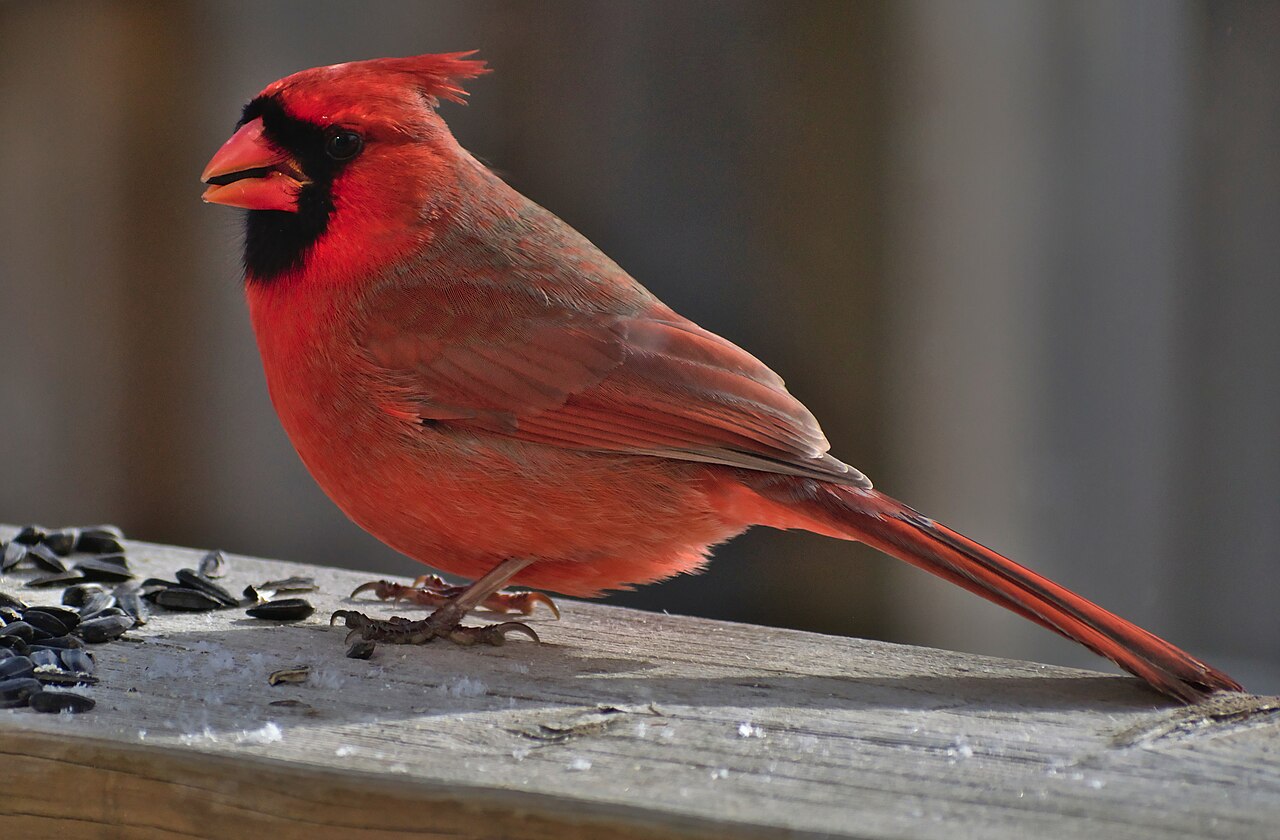
The Northern Cardinal is the most recognizable red bird in North America, and the official state bird of seven US states. The male is brilliant red overall with a distinctive pointed crest, a black mask around the face, and a thick orange-red bill. Females are warm tan-brown with red highlights on the wings, tail, and crest.
Range: Eastern and central US, expanding westward. Year-round resident (non-migratory).
Habitat: Backyards, woodland edges, parks, gardens with dense shrubs for nesting.
Key ID: Pointed crest separates from all other red birds. Thick conical bill. Black mask in male. Pairs often seen together (cardinals mate for life).
Where to see: Visit feeders with sunflower or safflower seed. Hopper and platform feeders preferred over tube feeders.
Scarlet Tanager
The Scarlet Tanager male in breeding plumage is the most intense red bird in North America, a brilliant scarlet body contrasted against jet-black wings and tail. The combination is unmistakable. Females and non-breeding males are yellow-olive overall.
Range: Eastern US forests in summer. Migrates to South America for winter.
Habitat: Mature deciduous forests, especially oak-hickory canopy.
Key ID: Scarlet body + solid black wings = breeding male Scarlet Tanager. No other North American bird has this exact combination.
Where to see: Forest canopy in summer. Listen for hoarse, robin-like song. Rarely visits backyard feeders but may visit if oranges or grape jelly are offered.
Summer Tanager
The Summer Tanager male is uniformly rose-red across the entire body, no black wings, no contrasting markings. The result is a strikingly red bird that can look almost glowing in good light. Females are mustard-yellow overall.
Range: Southern and southeastern US. Migrates to Central/South America for winter.
Habitat: Open woodlands, especially pine-oak forests in the Southeast.
Key ID: Solid red overall (no black wings = not Scarlet Tanager). Heavy pale bill. Often seen in tree canopy.
Where to see: Listen for their distinctive ‘pi-tuck’ call note. Specialist feeder on wasps and bees.
Red-Headed Woodpecker
The Red-Headed Woodpecker is unmistakable: a striking pattern of all-red head, snow-white body and underparts, and black wings with large white patches. Both sexes look identical. Juveniles have brown heads that turn red over their first year.
Range: Eastern and central US year-round, with some northward migration in summer.
Habitat: Open woodlands, parks, golf courses, anywhere with mature trees and open ground.
Key ID: All-red head (not just a red crown like other woodpeckers). Bold black-white-red color pattern visible from a distance.
Where to see: Look for them in dead trees or on tree trunks. They visit suet feeders and platform feeders for nuts and seeds.
Pyrrhuloxia
Often called the ‘desert cardinal,’ the Pyrrhuloxia looks like a Northern Cardinal that’s been bleached gray. The body is silvery-gray with reddish wash on the face, crest, breast center, wings, and tail. Bill is yellow (not red/orange like cardinals).
Range: Southwestern US (Arizona, New Mexico, southern Texas) and northern Mexico.
Habitat: Desert scrubland, mesquite thickets, dry washes.
Key ID: Gray body with red highlights and yellow bill distinguishes from Northern Cardinal.
Where to see: Visit cardinal-friendly feeders in their range. Sunflower and safflower seed work well.
Vermilion Flycatcher
A small brilliant red bird of the Southwest, the male Vermilion Flycatcher has a fiery red head, breast, and belly contrasted with chocolate-brown wings, back, and tail. The intensity rivals scarlet tanagers but in a much smaller package (sparrow-sized).
Range: Southwestern US and Mexico, expanding northward.
Habitat: Open areas near water, streams, ponds, riparian woodlands, golf courses.
Key ID: Small size (5-6 inches), brilliant red on head/underparts, brown wings/back. Often seen on exposed perches.
Where to see: Watch for them sallying out from low perches to catch flying insects. Not a feeder bird.
House Finch (Male)
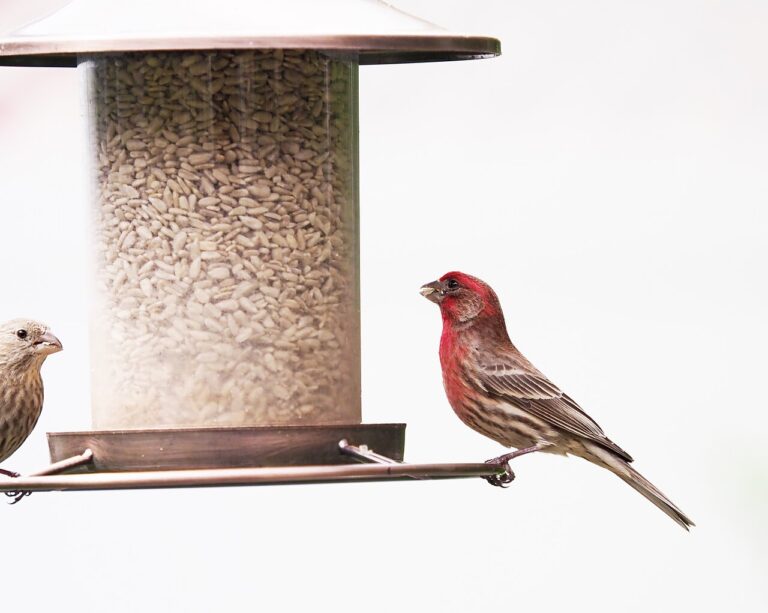
The most common red bird at North American feeders. Male House Finches have a red wash on the head, breast, and rump, with brown-streaked underparts. The red intensity varies dramatically, some males are intensely red, others orange or even yellow (color depends on diet).
Range: Continent-wide, year-round.
Habitat: Urban and suburban areas, parks, residential neighborhoods.
Key ID: Red on head/breast only (not whole body). Brown streaks on flanks and belly. Smaller than cardinals.
Where to see: Tube feeders with nyjer or sunflower seed. Often in small flocks. Females are streaky brown overall.
Cassin’s Finch (Male)
Western counterpart to the Purple Finch, male Cassin’s Finches have a distinct red crown patch contrasted with pinkish wash on the breast and a brown-streaked back. The red is more concentrated on top of the head than House Finch’s diffuse red.
Range: Western mountains, especially conifer forests.
Habitat: Pine and fir forests at higher elevations.
Key ID: Distinct red crown (peaked appearance). Cleaner underparts than House Finch.
Where to see: Mountain feeders in summer. Visits sunflower and nyjer feeders.
Purple Finch (Male)
Despite the name, Purple Finches are raspberry-red, not purple. The male has a wine-red wash covering the head, breast, back, and rump, like the bird was dipped in raspberry juice. Females are streaky brown with a strong face pattern.
Range: Northern US and Canada, with winter migration south.
Habitat: Coniferous and mixed forests, edges of woodlands.
Key ID: Raspberry wash overall (more extensive than House Finch). Strong face pattern in females (white eyebrow stripe).
Where to see: Winter feeders in the southern US. Sunflower and nyjer seeds.
Red Crossbill
An unusual specialist bird with a distinctive crossed bill (upper and lower mandibles cross at the tip) for extracting conifer seeds. Male Red Crossbills are brick-red overall with darker wings and tail. Females are yellow-olive.
Range: Coniferous forests across northern North America.
Habitat: Pine, spruce, and fir forests. Highly nomadic, follows conifer seed crops.
Key ID: Crossed bill (visible in good views). Brick-red color. Often in small flocks moving through conifers.
Where to see: Conifer forests where seed crops are abundant. May visit feeders in irruption years.
White-Winged Crossbill
Similar to Red Crossbill but with a distinctive feature: bold white wing bars. Male White-Winged Crossbills are pinkish-red overall (less intense than Red Crossbill) with black wings showing two prominent white bars.
Range: Northern coniferous forests, including Alaska and Canada. Irruptive in lower latitudes.
Habitat: Spruce, larch, and tamarack forests.
Key ID: White wing bars are the key feature. Pinkish-red color (vs brick-red in Red Crossbill).
Where to see: Far northern conifer forests. Like Red Crossbill, may irrupt south during seed crop failures.
Hepatic Tanager
A specialty of southwestern mountains. The male Hepatic Tanager is a darker, brick-red color with subtle gray cheeks and gray wash on the back. Less brilliant than Summer or Scarlet Tanagers.
Range: Southwestern US mountains (Arizona, New Mexico).
Habitat: Pine and pine-oak forests at higher elevations.
Key ID: Brick-red coloration (not bright red). Gray cheeks visible. Heavy dark bill.
Where to see: High-elevation forests in the Southwest. Listen for their robin-like song. Rarely visits backyard feeders.
How to Attract Red Birds to Your Yard
If you want to attract red birds, especially Northern Cardinals, the most common backyard red bird, focus on these strategies:
Offer sunflower seed (black oil sunflower), the universal cardinal favorite. Add safflower seed for variety.
Use hopper or platform feeders rather than tube feeders, cardinals need a perching surface for their larger bodies.
Plant native shrubs for nesting cover. Cardinals nest 3-10 feet off the ground in dense vegetation.
Provide water, bird baths attract cardinals consistently.
For finches (House, Purple, Cassin’s), offer nyjer seed in finch socks or specialty finch feeders.
For tanagers, offer fresh oranges cut in half, plus grape jelly in shallow dishes during spring migration.
Frequently Asked Questions
What’s the most common red bird in North America?
The Northern Cardinal is by far the most common red bird across most of North America. It’s the official state bird of seven US states. House Finches (male) are second-most common, especially at feeders.
Are all red birds male cardinals?
No. While male Northern Cardinals are the most common red bird, over 12 species of red or red-marked birds occur in North America. House Finches, tanagers, and woodpeckers all include red species.
What’s the difference between a Northern Cardinal and a House Finch?
Cardinals are larger (8.5 inches vs 5.5 inches), have a distinctive crest, a thick red-orange bill, and a black face mask. Male House Finches lack a crest, have brown-streaked underparts, and a smaller pale bill.
Why are male birds red while females are not?
Male birds use bright colors to attract mates and signal genetic fitness. Females are typically duller-colored for camouflage during nesting. Red coloration comes from carotenoids in their diet.
What red bird has a black face mask?
The Northern Cardinal male is the most likely red bird with a black face mask. The mask surrounds the bill and extends into the throat.
Do red birds visit backyard feeders?
Yes, Northern Cardinals, House Finches, Purple Finches, Red-Headed Woodpeckers, and Pyrrhuloxia all visit backyard feeders regularly. Tanagers may visit for oranges and grape jelly during migration.
Are red birds rare?
No, Northern Cardinals and House Finches are extremely common. Some red bird species are localized (Pyrrhuloxia in the Southwest) but not rare in their range.
Related reading: Orange Birds.
Related reading: Birds with Red Heads.
Related reading: Red Wasp.
Related reading: Red Wasp.
Related reading: Red Wasp.
Related reading: Red Wasp.
Related reading: Red Wasp.
Related reading: Red Wasp.
Related reading: Red Bird Meaning.