Golden Pheasant: Appearance, Diet & Care Guide
The golden pheasant is one of the most vividly colored birds in the world, instantly recognizable by the male’s golden crest, fan-like orange cape, and scarlet underparts, while females wear a much plainer mottled brown that keeps them camouflaged on the nest. Native to the mountain forests of western China, golden pheasants have been kept in captivity for centuries and now live as introduced, self-sustaining populations in parts of the United Kingdom and elsewhere. This guide covers what a golden pheasant looks like, where it lives, what it eats, and what it takes to keep one successfully.
| Trait | Detail |
|---|---|
| Scientific name | Chrysolophus pictus |
| Native range | Mountain forests of western/central China |
| Length | Males 90 to 105 cm (incl. tail); females 60 to 80 cm |
| Diet | Seeds, berries, grain, shoots, occasional insects |
| Lifespan | 5 to 6 years wild; 15 to 20 years in captivity |
| Conservation status | Least Concern (IUCN), population decreasing |
What Does a Golden Pheasant Look Like?
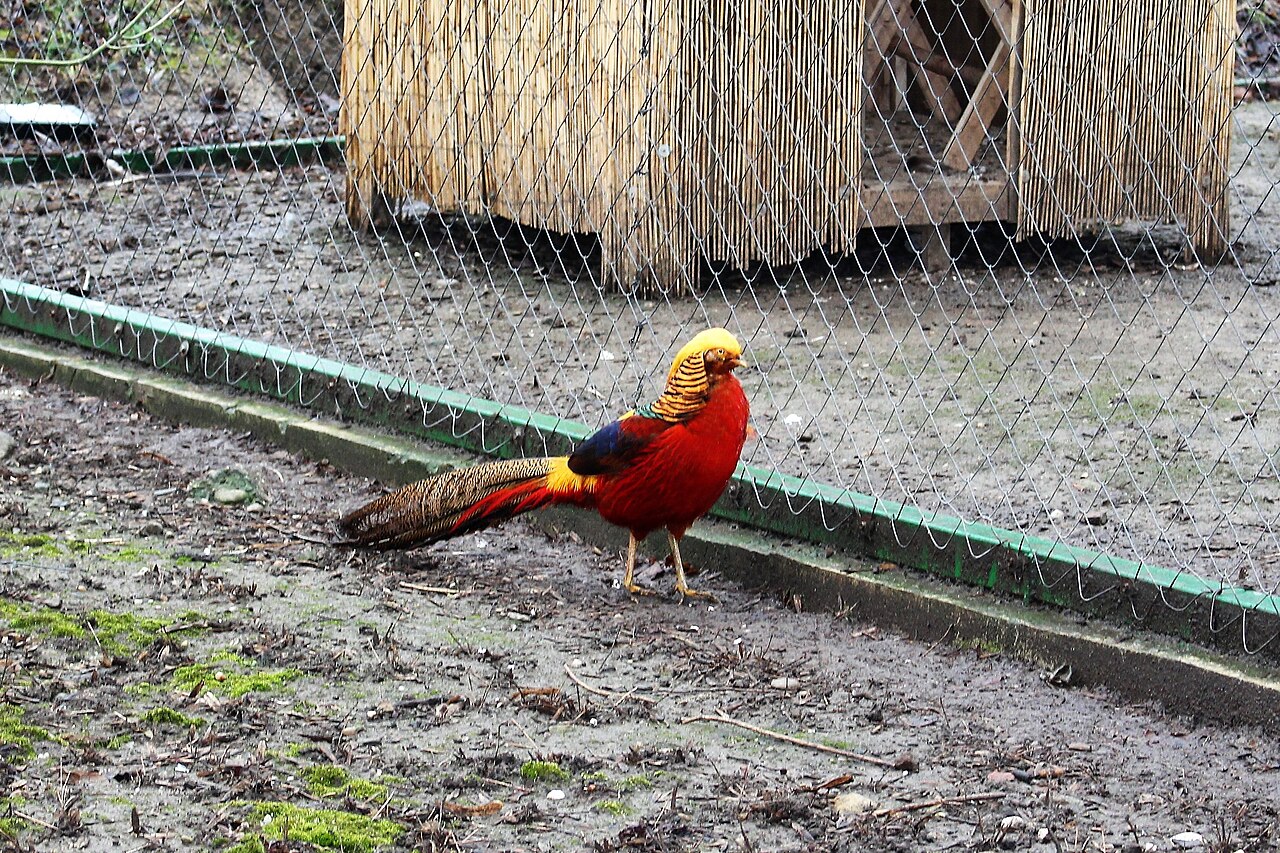
The male golden pheasant is almost unmistakable: a golden-yellow crest tipped in red flows down the back of the neck, framed by an orange and black striped cape that he can raise to cover most of his face during courtship display, leaving only a bright yellow eye visible. His underparts are deep scarlet, the upper back is green, wings show a mix of blue and red, and the long tail, making up roughly two-thirds of his total length, is black with cinnamon spotting. Females are almost the opposite: a dull, mottled brown overall with dark barring, a much shorter tail, and no bright coloring at all, an adaptation that keeps an incubating hen nearly invisible against the forest floor. Both sexes share bright yellow legs and bills, which can help confirm identification even when lighting makes other colors hard to judge.
Golden pheasants share the same basic pheasant-family courtship strategy as peacocks; see our guide to peacock feathers for the science and symbolism behind that kind of elaborate male plumage.
Where Do Golden Pheasants Live?
In their native range, golden pheasants inhabit dense, shadowy conifer and mixed forests in the mountains of western and central China, favoring areas with sparse undergrowth that still offer heavy overhead cover. That preference for shade is not incidental: prolonged direct sunlight can visibly fade the male’s intense coloration, so the dim forest canopy actually helps preserve the plumage that makes the species so recognizable. Beyond China, feral, self-sustaining populations exist in parts of the United Kingdom and have been introduced in limited numbers elsewhere, while captive birds are kept in aviaries worldwide, including private collections across the United States dating back to the 1700s.
What Do Golden Pheasants Eat?
Golden pheasants are ground foragers, scratching through leaf litter much like a chicken in search of seeds, berries, grain, and the tender shoots and leaves of forest plants, occasionally supplementing this plant-heavy diet with insects and spiders when the opportunity arises. In winter, wild flocks often move closer to the edges of human settlements, feeding heavily on wheat leaves and any available grain. Captive golden pheasants do best on a high-quality game bird feed supplemented with fresh fruit, vegetables, and occasional live insects, plus a source of grit to aid digestion, since ground-foraging birds like this rely on grit in the gizzard to break down tougher plant material.
Golden Pheasant Behavior and Courtship
Despite their spectacular appearance, golden pheasants are shy, secretive birds that spend most of the year alone or in small groups, making them surprisingly difficult to actually spot in the wild given how bright the males are. They are poor, clumsy fliers, capable only of short, fast bursts usually used to escape a threat or reach a roosting branch, and they much prefer running to flying, foraging on the ground during the day and roosting high in trees at night for safety from ground predators. During the spring breeding season, males perform an elaborate courtship display, spreading the orange cape fully over the face and circling the female while producing a distinctive metallic call, and a single dominant male may mate with several females, an arrangement that can turn a harem of hens toward one male even though the species is often described as forming pairs.
Are Golden Pheasants Endangered?
The golden pheasant is currently listed as Least Concern by the IUCN, reflecting its still-substantial wild population and broad range, though that overall status masks a real downward trend. Habitat loss from deforestation and logging, hunting for food, and ongoing capture for the pet and aviary trade are all putting pressure on native Chinese populations specifically, even as introduced populations elsewhere remain stable or expand. This is a useful reminder that a “Least Concern” label describes the species globally and does not mean every regional population is doing equally well.
Golden Pheasants as Pets and Aviary Birds
Golden pheasants are among the most popular pheasant species kept in captivity, prized for their combination of dazzling appearance, cold hardiness, and relatively manageable care requirements compared with more delicate exotic birds. A breeding pair or trio typically needs at least 20 square feet of enclosure space per bird, with netting over the top since golden pheasants are prone to flying out, and fencing set roughly 20 inches into the ground to prevent digging out underneath. Golden pheasants should never be housed with or near chickens, since chickens can carry diseases they are largely immune to but that can be fatal to a pheasant, and should also be kept apart from grouse, which have a tendency to bite off a pheasant’s upper beak. With patient handling starting from a young age, golden pheasants can become reasonably tame, though enthusiasts are quick to note that “easy to tame” usually means someone who has spent considerable time with hand-raised birds and plenty of peanut bribes, similar to the patience required when learning to attract wild birds to a backyard, and worth comparing against the space and predator-proofing needs covered in guides to other pheasant species kept in aviaries.
Golden Pheasant Molt and Seasonal Color Changes
A male golden pheasant’s spectacular plumage is not permanent year-round. After the breeding season ends, males molt out of their brightest feathers and take on a duller, more subdued appearance closer to the female’s coloring until the next breeding cycle approaches. This seasonal shift means a golden pheasant spotted outside of spring may look noticeably less impressive than the classic images most people associate with the species, which can occasionally confuse first-time keepers into thinking a bird is unwell or the wrong species entirely when it is simply between molts.
Golden Pheasant vs Lady Amherst’s Pheasant
The golden pheasant’s closest living relative is the Lady Amherst’s pheasant (Chrysolophus amherstiae), the only other member of the same genus, and the two are both known as “ruffed” pheasants for the fan-like cape males display during courtship. Lady Amherst’s pheasant shows a white and black barred body with a much longer, more slender tail compared to the golden pheasant’s cinnamon-spotted tail, and its cape is white and black rather than orange and black. Because the two species can and do hybridize readily in captivity, breeders trying to maintain pure bloodlines of either species must keep enclosures carefully separated, and buyers seeking a “pure” golden pheasant should ask for documented, unrelated parentage rather than taking a seller’s word alone, much as breeders of raptors and other specialty birds rely on verified lineage records.
Golden Pheasant Predators and Threats
In the wild, golden pheasants face a wide range of predators, including foxes, martens, and birds of prey such as eagles and hawks, with young and inexperienced birds facing the highest risk. Camouflage does the heavy lifting for females and juveniles, while adult males rely more on secretive behavior and a fast escape flight when spotted, since their bright plumage offers no protective advantage once discovered. Survival odds in the wild are genuinely harsh: roughly two-thirds of golden pheasants do not survive their first six to ten weeks of life, and only a small percentage reach three years old, which is part of why the species evolved to combine reasonably large clutches with rapid early growth rather than relying on adult longevity alone. Zoological institutions such as the Smithsonian’s National Zoo and various accredited zoos document similar juvenile mortality patterns across many ground-nesting game birds, not just golden pheasants.
Cultural Significance of the Golden Pheasant
In China, the golden pheasant carries deep symbolic weight as a sign of good luck and prosperity, and legend connects the bird to the mythical phoenix as an ancestor figure representing auspiciousness. This cultural prominence, combined with the male’s genuinely striking plumage, is a major reason the species was one of the earliest pheasants deliberately transported west, with historical records placing golden pheasants in aviculture in the American colonies as early as 1740, and some accounts suggesting George Washington kept them at Mount Vernon. For anyone building a backyard interested in other visually striking or symbolically significant birds, species like hawks and owls carry their own rich cultural histories in North America.
Related reading: Albino Peacock.
Related reading: Emu vs Ostrich.
Related reading: Emu Egg.
Related reading: Baby Flamingo.
Related reading: Quetzal.
Frequently Asked Questions
What does a golden pheasant look like?
Males have a golden crest tipped in red, an orange and black cape, scarlet underparts, a green back, and a long black tail spotted with cinnamon. Females are dull mottled brown all over, which camouflages them while nesting.
Where do golden pheasants live?
Golden pheasants are native to dense mountain forests in western and central China, favoring conifer and mixed woodland with sparse undergrowth. Feral populations also exist in parts of the United Kingdom, alongside captive birds kept worldwide.
What do golden pheasants eat?
They forage on the ground for seeds, berries, grain, and tender plant shoots, occasionally eating insects and spiders. Captive birds are typically fed game bird feed supplemented with fresh produce, insects, and grit.
Are golden pheasants endangered?
No, they are classified as Least Concern by the IUCN due to a substantial overall population, though native populations in China are declining from habitat loss, hunting, and capture for the pet trade.
Can golden pheasants fly?
Only in short, fast bursts, usually to escape danger or reach a roost. They are primarily ground-dwelling birds that prefer running and spend most of the day foraging on the forest floor.
Do golden pheasants make good pets?
They can, especially for experienced bird keepers, since they are hardy and cold-tolerant, but they need spacious netted enclosures, protection from chicken diseases, and patience to tame. They are not low-maintenance for a beginner.
How long do golden pheasants live?
In the wild, golden pheasants typically live 5 to 6 years, but with proper captive care they commonly reach 15 years, and 20 years is not unheard of.