Woodpecker Sounds: Drumming, Calls, and House Noise
Woodpeckers make two entirely different kinds of sound: drumming, which is a rapid burst of blows on a resonant surface used as a signal in place of song, and vocal calls including sharp piks, rattling whinnies, laughing kek-kek-kek series, and harsh screams. The hammering people hear at dawn on a gutter or chimney cap is drumming, not feeding, and each species has a recognisable drum pattern.
That distinction is the key to everything else. Feeding taps are irregular and quiet, excavation is a slow steady chiselling, and drumming is a fast even roll delivered in short bursts and repeated. A bird hammering on metal is not damaging the house and is not looking for insects in it; it is advertising a territory in the loudest way available. This guide covers each sound, species by species identification, and what to do about house drumming.
Woodpeckers drum in rapid even bursts as a territorial signal, and drumming replaces song. They also give sharp pik calls, rattling whinnies, laughing kek series, and screams depending on species. Drumming on metal is a signal, not feeding damage, and it peaks in spring. Feeding taps are irregular; excavation is slow and steady.
| Sound | Meaning or Species |
|---|---|
| Fast even burst, repeated | Drumming; territory and mate attraction |
| Irregular quiet tapping | Feeding, searching bark |
| Slow steady chiselling | Excavating a nest or roost cavity |
| Descending whinny | Downy woodpecker |
| Sharp peek, no whinny | Hairy woodpecker |
| Rolling churr | Red-bellied woodpecker |
| Loud laughing kek-kek-kek | Pileated woodpecker or flicker |
Why Do Woodpeckers Drum?
Drumming is communication, and it does the job that song does for other birds. Woodpeckers do not sing, so they announce territory ownership and attract mates by hammering rapidly on the most resonant object they can find, and both sexes drum. It is entirely separate from feeding.
The choice of surface follows from that. A bird wants maximum volume, so it selects dead resonant limbs, hollow trunks, and around houses, metal gutters, downspouts, flashing, chimney caps, satellite dishes, and TV aerials. A metal chimney cap is acoustically superior to any tree, which is exactly why birds pick it.
Drumming peaks in late winter and spring, from roughly February through May depending on latitude, and drops sharply once pairs are established and nesting. A bird drumming on a house in March will usually stop by June with no intervention at all. The types of woodpeckers guide covers the species involved.
How Do You Tell Drumming From Feeding?
Rhythm and duration. Drumming is a fast, even, machine-like roll lasting about half a second to two seconds, delivered in discrete bursts with pauses between them, and repeated in the same spot over and over. It is loud and deliberately so.
Feeding taps are irregular, softer, and unhurried, with the bird moving as it works and pausing to probe. There is no rhythm to them, and they usually come from bark, dead branches, and rotting wood rather than from metal or siding.
Excavation is different again: slow, steady, forceful chiselling in one place, often with visible chips flying and a growing hole. That is the sound that indicates actual damage to wood siding, and it means the bird is either building a cavity or working into an insect infestation in the wall. The response differs completely from the response to drumming.
How Do You Identify Woodpeckers by Sound?
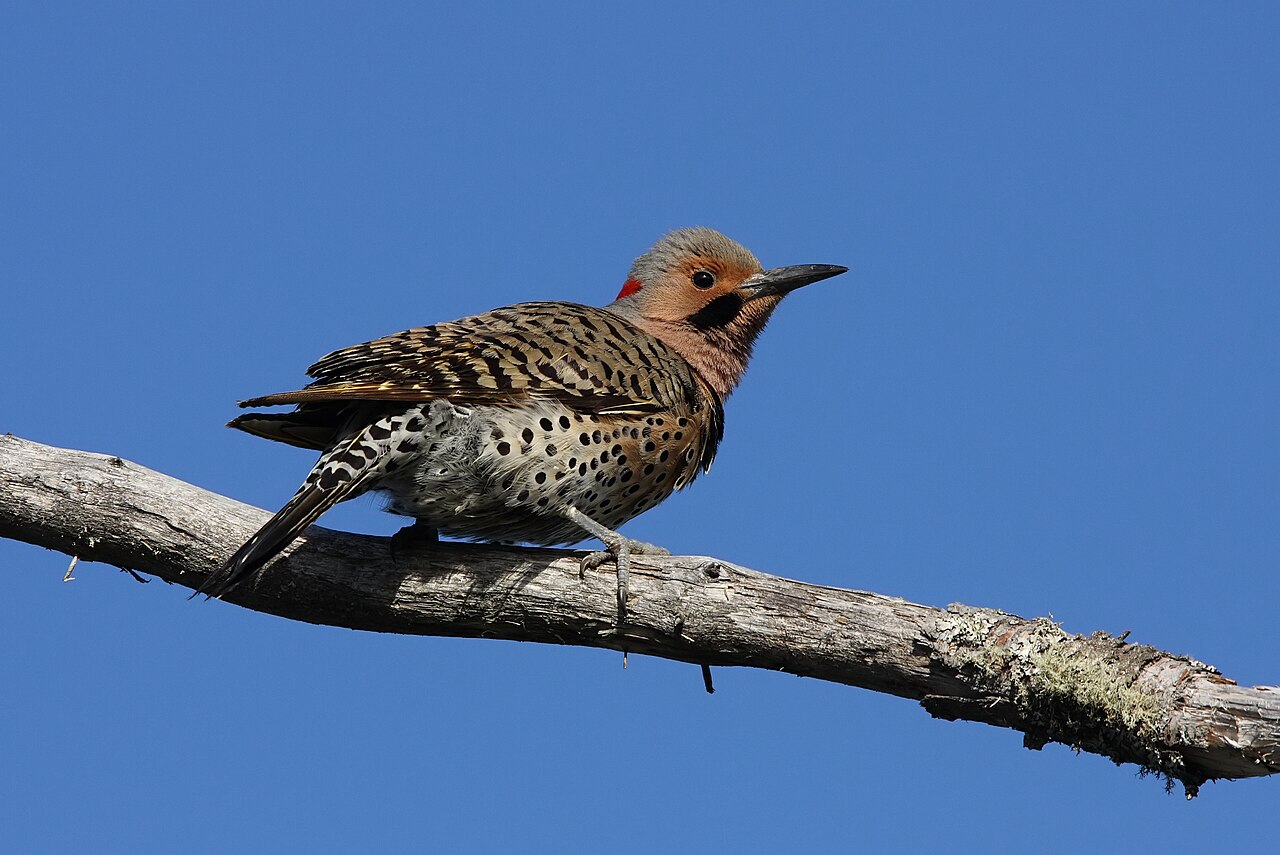
Calls separate the common species more reliably than drums do. Downy woodpeckers give a soft pik and a descending whinny that falls in pitch; hairy woodpeckers give a sharper, louder peek and a rattle that stays level in pitch rather than descending. That pairing is the classic identification problem in eastern North America.
Red-bellied woodpeckers give a rolling churr or kwirr, low and rich, plus a sharper cha-cha-cha in agitation. Northern flickers give a loud sustained wick-wick-wick-wick series that can run for several seconds, plus a sharp single kleer and a soft wicka-wicka exchanged between pairs.
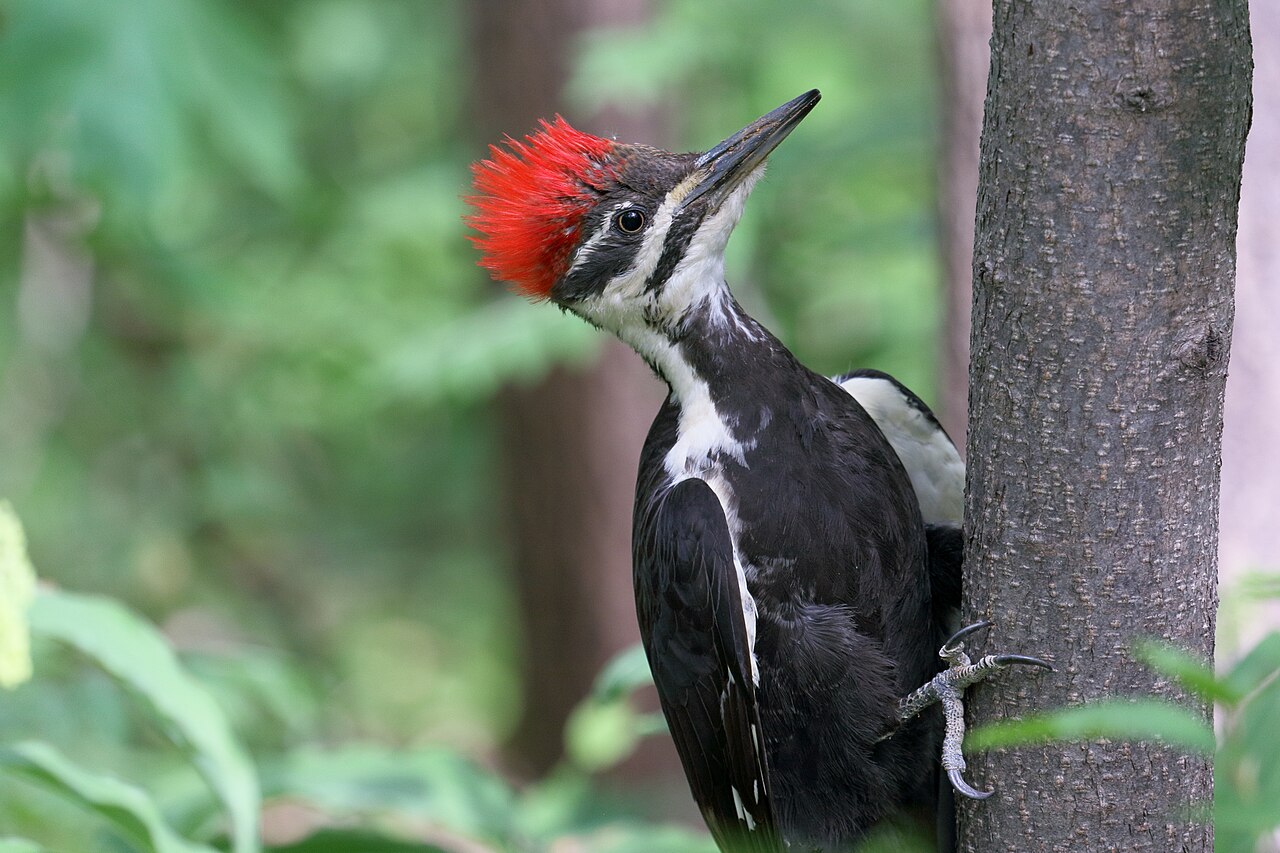
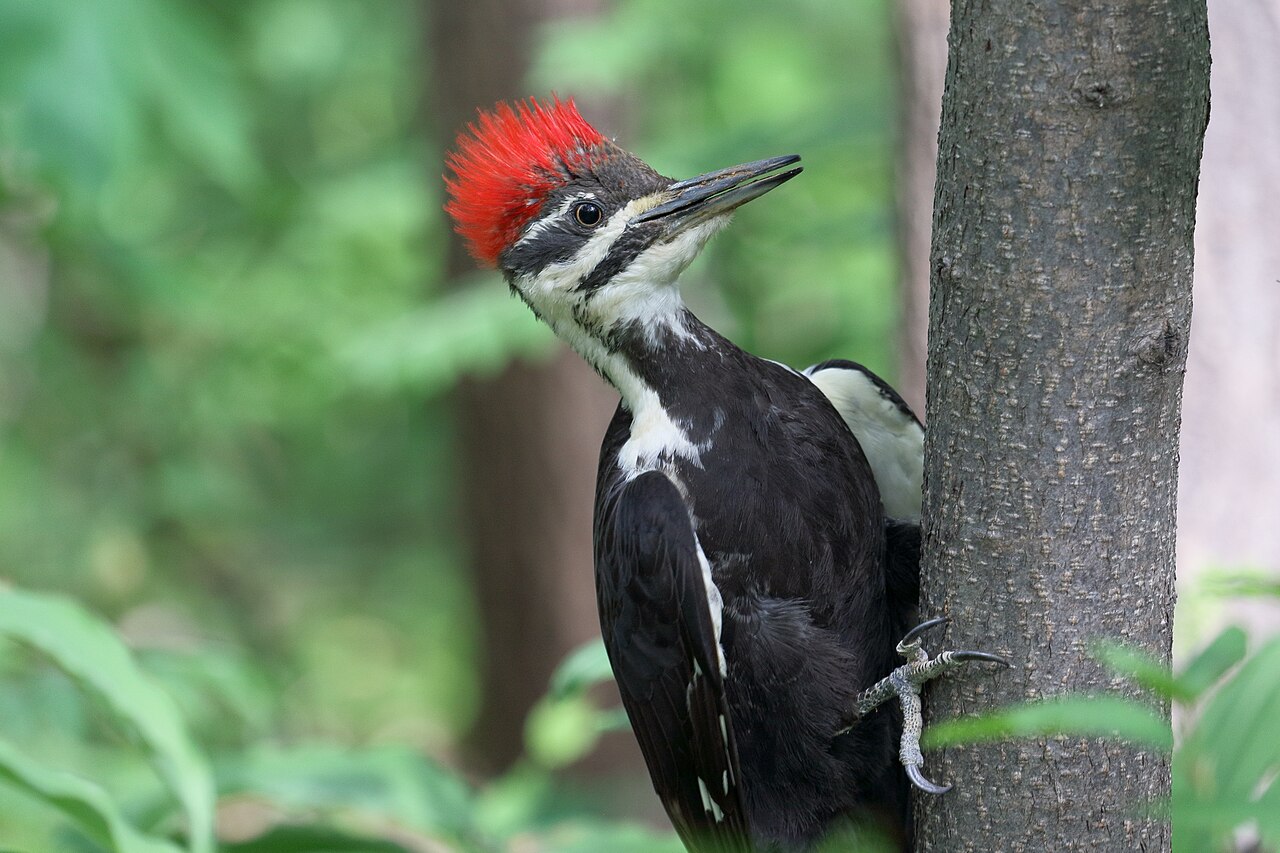
Pileated woodpeckers give a loud, irregular, laughing kek-kek-kek that carries a long way through forest, often rising and falling, and their drum is slow, deep, and trails off at the end. Red-headed woodpeckers give a harsh tchur, and sapsuckers a nasal mewing cat-like call. The downy vs hairy woodpecker guide covers the hardest pair in detail.
Can You Tell Species by Drum Pattern?
Often, with practice. Drums differ in speed, length, and whether they hold an even tempo or slow at the end. Downy woodpecker drums are short and relatively slow with distinguishable individual beats; hairy woodpecker drums are faster and blur into a single burst.
Pileated woodpecker drums are deep, powerful, and slow enough to count, and they characteristically trail off in speed and volume at the end, which is the most recognisable drum in eastern woodland. Yellow-bellied sapsuckers are the outlier: their drum is irregular, starting fast and breaking into a stuttering, arrhythmic pattern that sounds like Morse code and is unmistakable once learned.
Red-bellied woodpecker drums are short, even, and about a second long. Northern flickers drum in long even rolls. Reference recordings make this practical to learn, and the Cornell Lab of Ornithology (allaboutbirds.org) hosts drum and call libraries for every North American species.
What Sounds Do Woodpeckers Make on My House?
Three different things, and the fix depends on which one it is. Drumming on metal or resonant siding is a signal, does no structural damage, and stops when the breeding season ends. Excavation into wood siding, leaving a growing hole, is either nest building or a bird working into insects behind the boards.
The insect explanation matters more than most people expect. Woodpeckers working repeatedly on one section of wood siding are often finding carpenter bees, carpenter ants, or beetle larvae in it, and treating the insect problem removes the reason for the damage. Cedar and redwood siding and unpainted wood are the most affected.
Nest or roost holes are round, clean, and usually one to two inches across depending on species, often in soffits, fascia, or thick siding. Because woodpeckers are protected under the Migratory Bird Treaty Act, an active nest cannot legally be removed or destroyed, and the practical route is deterrence before nesting or exclusion afterward. The guide to what woodpeckers eat covers what they are actually finding.
What Noise Do Woodpeckers Hate?
Nothing reliably, and sound-based deterrents are the weakest option available. Ultrasonic devices do not work, distress-call playback produces short-term habituation at best, and general noise makers are ignored within days. Woodpeckers are habituation specialists by nature.
Visual deterrents work better, and movement is the key element. Reflective streamers, mylar tape, and old CDs hung so they twist and flash near the drumming site are the most consistently effective cheap option, and lightweight netting hung a few inches off the wall physically prevents access. Plastic owls and hawk silhouettes are ignored within a week unless moved regularly.
The most durable fixes are physical. Damping the resonant surface, covering the affected area with hardware cloth or metal sheeting, replacing damaged siding with a less attractive material, and dealing with any insect infestation all address the reason rather than the symptom. Extension programmes such as Cornell and the University of Nebraska (unl.edu) publish tested deterrent rankings.
What Does It Mean if You Hear a Woodpecker?
Practically, it means territory establishment if it is spring drumming, and a resident bird if it is calls through the year. Drumming heard in February is one of the earliest signs of the breeding season starting, often weeks before any songbird begins singing.
Symbolically, woodpeckers are read as messages about persistence, opportunity, rhythm, and paying attention to a signal, drawn directly from the drumming and from the methodical way the birds work a tree. Several Native American traditions associate woodpecker drumming with communication and, in some cases, with prophecy or warning.
Weather folklore attaches to them too, with a woodpecker drumming or calling loudly taken in some traditions as a sign of coming rain. There is no evidence for it, though drumming does increase on still mornings when sound carries, which may be where the association started. The woodpecker spiritual meaning guide covers the symbolism in depth.
What Bird Is Mistaken for a Woodpecker?
Nuthatches are the most frequent, because they work trunks and branches and tap at bark, and the white-breasted nuthatch’s nasal yank-yank call is often reported as a woodpecker. Nuthatches move headfirst downward, which no woodpecker does, and that alone settles it.
Brown creepers spiral up trunks and are quiet enough to be missed entirely, and their high thin call is nothing like a woodpecker’s. Northern flickers cause confusion in the other direction: they are true woodpeckers but spend most of their time on the ground eating ants, so people report them as an unfamiliar brown bird.
Sound-wise, the hammering that gets attributed to woodpeckers is sometimes something else altogether. Squirrels working nuts against a gutter, tree branches on siding in wind, and carpenter bees drilling into fascia all produce tapping, and carpenter bee activity in particular often coexists with woodpecker damage because the bees are what the bird is after.
How Do Woodpeckers Not Get Concussed?
Several adaptations together, and the popular shock-absorber explanation turns out to be wrong. A woodpecker strikes at up to twenty times a second with decelerations many times what would concuss a human, and for decades the skull was described as a spongy shock absorber that cushioned the brain.
Research published in 2022 overturned that. High-speed analysis showed the head behaves as a stiff hammer rather than a cushion, and any shock absorption would reduce pecking efficiency, which is the opposite of what a woodpecker needs. The head, neck, and beak move essentially as one rigid unit.
What actually protects the brain is size and geometry. A woodpecker brain is very small and light, so the force acting on it is correspondingly small, and it is packed tightly against the skull with a large flat contact area that spreads the load. The hyoid bone wrapping around the skull, the third eyelid closing at impact, and the alignment of the strike all contribute. The pileated woodpecker guide covers the species that hits hardest.
Frequently Asked Questions
Why do woodpeckers drum?
To announce territory and attract mates. Woodpeckers do not sing, so drumming does the job song does for other birds, and both sexes drum. It has nothing to do with feeding.
How do you tell drumming from feeding?
Drumming is a fast even burst of half a second to two seconds, repeated in the same spot and deliberately loud. Feeding taps are irregular and quiet, and excavation is slow steady chiselling in one place.
How do you identify woodpeckers by sound?
By call. Downy gives a soft pik and a descending whinny, hairy a sharper peek and a level rattle, red-bellied a rolling churr, flicker a long wick-wick-wick, and pileated a loud laughing kek series.
Why is a woodpecker pecking my house?
Either drumming on a resonant surface as a signal, excavating a nest cavity, or working into carpenter bees, ants, or beetle larvae in the siding. Repeated damage in one spot usually means insects.
What noise do woodpeckers hate?
None reliably. Ultrasonic devices and noise makers fail within days. Moving reflective streamers, netting hung off the wall, and damping the resonant surface work far better than any sound deterrent.
What time of year do woodpeckers peck on houses?
Drumming peaks from February through May, and most house drumming stops on its own by June. Cavity excavation and insect-driven damage can happen at any time of year.
How do woodpeckers avoid brain damage?
Not by shock absorption, which research in 2022 disproved. Their brains are small and light, tightly packed against the skull over a large contact area, and the head acts as a stiff hammer rather than a cushion.

Similar Posts
Types of Grosbeaks: A Complete Guide
The main types of grosbeaks are the rose-breasted, black-headed, blue, evening, and pine grosbeaks. Learn to identify grosbeak species and how to attract them.
Seagull Sounds: The Long Call and Every Other Noise
The seagull long call signals territory and identity, and mates recognise each other by voice. Every call decoded, plus why gulls scream at 4am in summer.
Birds That Eat Snakes: 12 Snake-Hunting Species
From roadrunners that kill rattlesnakes to hawks, owls, herons, and guinea fowl, meet the birds that eat snakes and learn how they strike without getting bitten.
Backyard Birds of North Carolina: 15 Common Species (2026 Identification Guide)
Identify 15 common backyard birds of North Carolina — Northern Cardinal, Carolina Wren, Carolina Chickadee, Eastern Bluebird. Photos, ranges, attract tips.
Barn Owl Sounds: The Screech and Other Calls Explained
Barn Owl sounds are eerie screeches, hisses, and snores rather than hoots. Here is what each Barn Owl call means, why they inspired ghost legends, and when you will hear them.
Birds That Look Like Hawks: Identification Guide
Birds that look like hawks include falcons, owls, vultures, and the osprey. Learn which birds are mistaken for hawks and how to tell true hawks apart.