Sandhill Crane Sounds: The Rattle Call and Every Other Note
The sandhill crane makes a loud rolling bugle usually described as a rattle, a low trumpeting garooo-a-a-a that carries over 2 miles and sounds unlike any other North American bird. The tone comes from an unusually long windpipe that coils inside the breastbone, adding roughly 30 inches of extra tubing and giving the call its deep resonant quality. People hearing it for the first time consistently describe it as prehistoric, which is fitting for a bird lineage with fossils reaching back millions of years.
Beyond that signature rattle, sandhill cranes produce a purr for close contact, a guard call for alarm, a synchronised unison call given by mated pairs, and a thin peeping whistle from colts. Learning which is which tells you a surprising amount about what a group of cranes is doing without needing to see them.
| Sound | Meaning |
|---|---|
| Rattle bugle | Contact in flight and on the ground |
| Unison call | Pair bond and territory, male and female together |
| Guard call | Alarm, single sharp note |
| Purr | Close contact, feeding groups, adult to colt |
| Colt peep | Young begging or lost |
| Audible range | Over 2 miles in open country |
| Windpipe length | About 4 ft, coiled in the sternum |
What a Sandhill Crane Sounds Like
The core sound is a hard rolling rattle with a trumpet underneath it. Transcriptions vary because no spelling captures it well, but garooo-a-a-a and kar-r-r-o-o-o both get at the two-part structure: a sharp attack followed by a rolling, slightly wavering decay. The note lasts around a second and is usually repeated.
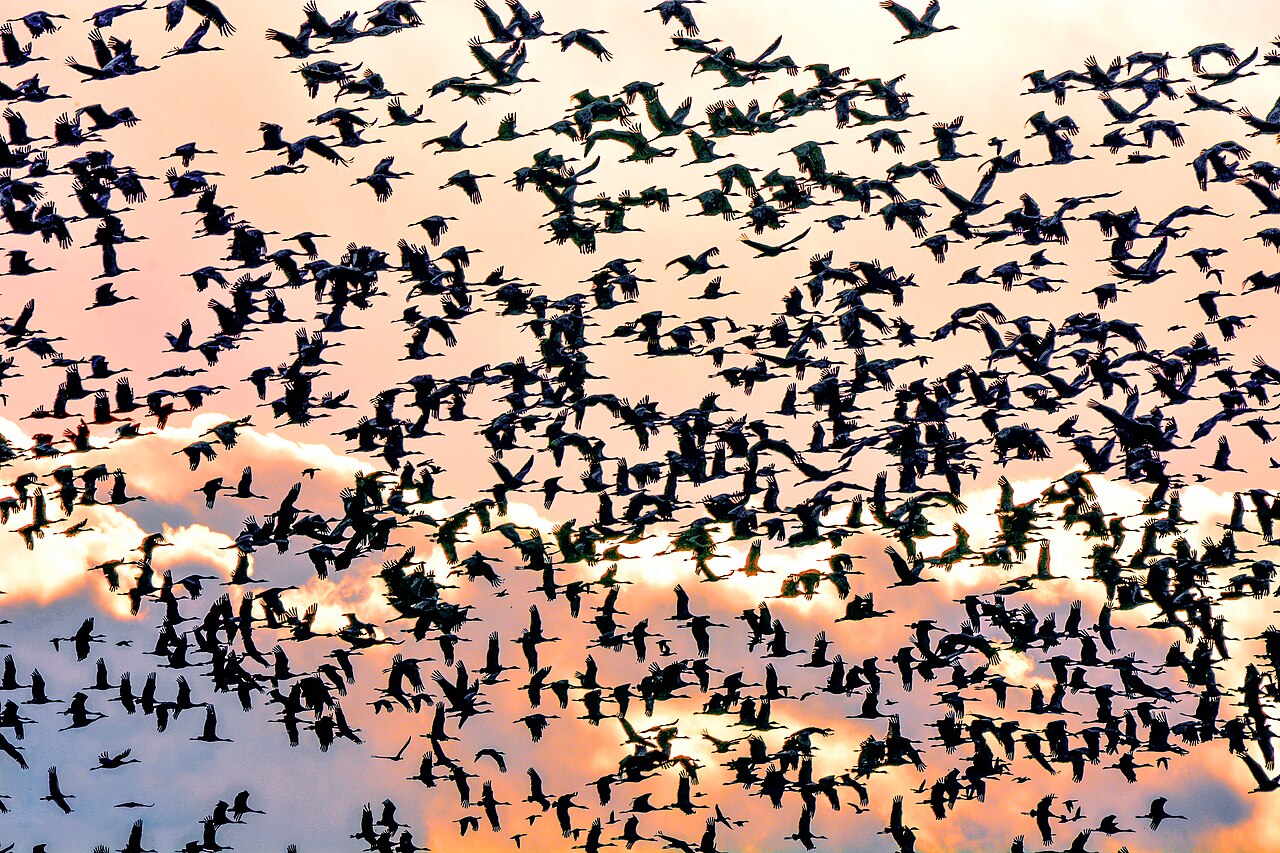
Volume is what people remember. A single crane calling from half a mile away is unmistakably loud, and a migrating flock of several thousand produces a continuous wall of sound audible long before the birds come into view. Along the Platte River in Nebraska, where hundreds of thousands stage each spring, the sound is the main attraction rather than the sight. The Cornell Lab of Ornithology describes the rolling rattle as audible more than 2 miles away.
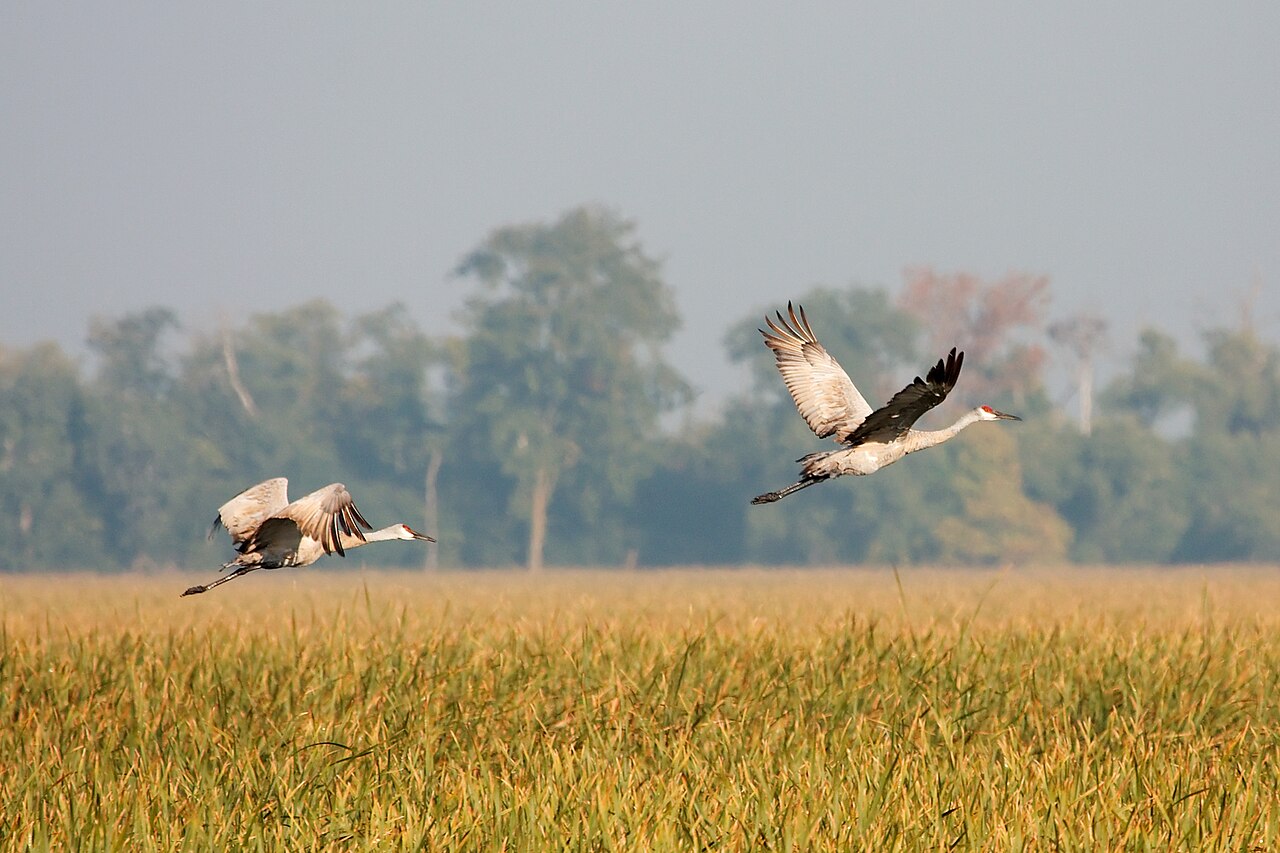
Frequency sits low for a bird of this size, in the range that carries well across open ground and through mist. Cranes call heavily in flight, which is why the sound so often arrives from an empty-looking sky before anyone spots the flock. Our guide to types of cranes covers how the species compares with the other cranes of the world.
Why the Call Carries So Far
The anatomy is the reason. A sandhill crane’s trachea is roughly 4 feet long, and rather than running straight it coils within a hollow chamber in the sternum before reaching the lungs. That coiled extension acts like the tubing of a brass instrument, lowering the fundamental frequency and adding harmonic richness the bird could not otherwise produce.
Low frequency sound travels further than high frequency sound because it loses less energy to absorption and scatters less around obstacles. A crane call that starts loud and starts low reaches distances that a similarly loud but higher-pitched call could not. Over open prairie and marsh the practical range exceeds 2 miles.
The same adaptation appears in whooping cranes, trumpeter swans, and several other large birds, and in each case it evolved independently for the same reason: these are birds that need to stay in contact across open landscapes and in flocks spread over long distances. The sternal coiling is visible in any crane skeleton and is one of the more striking pieces of avian anatomy.
The Unison Call
The unison call is the most structured sandhill crane vocalization and the one worth learning to recognise. A mated pair stands close together, throws the head back, and calls in a coordinated duet, with the female typically producing two or three higher notes for each single lower note from the male.
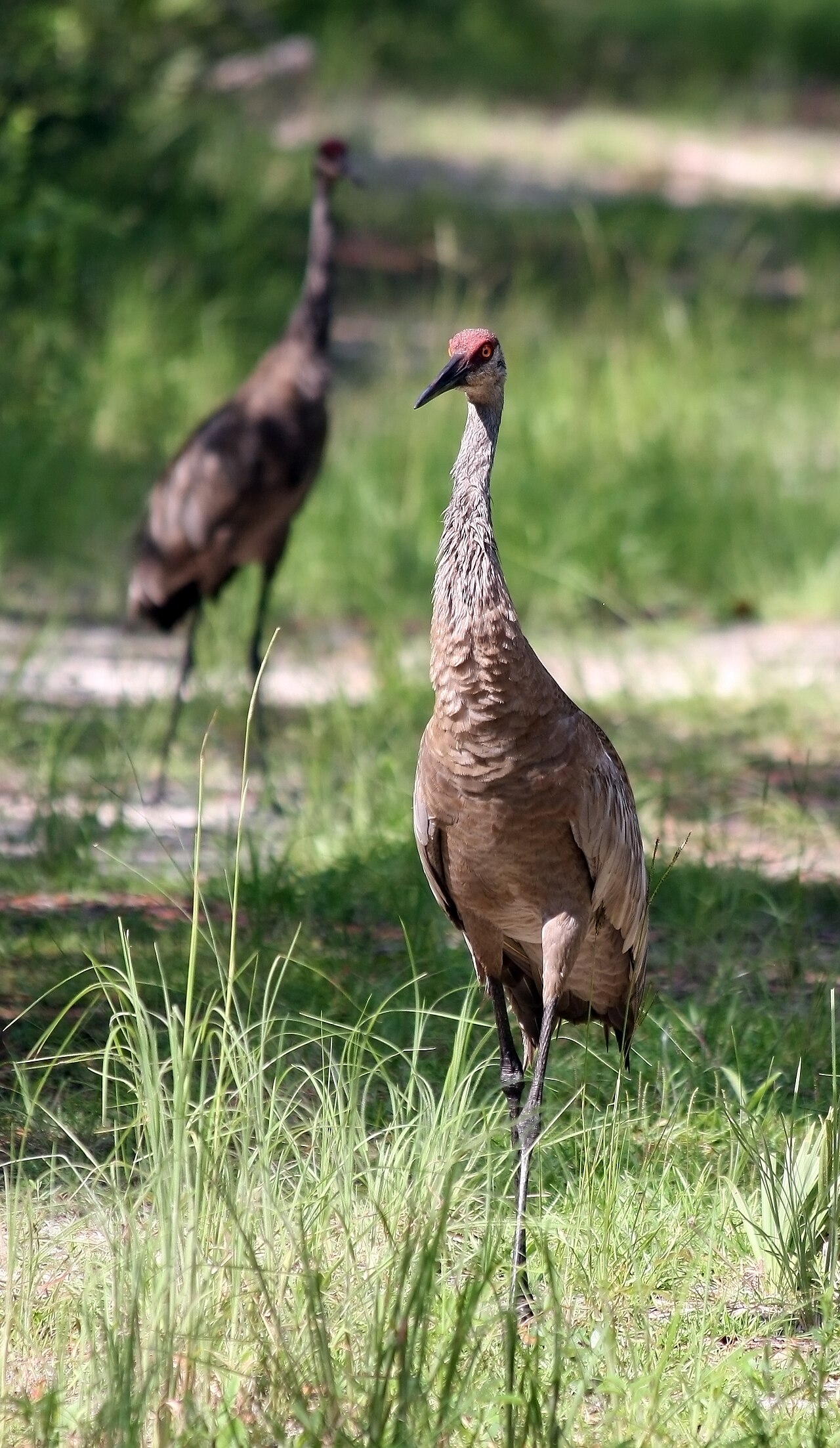
Function is dual. The call reinforces the pair bond and it advertises territory occupancy to neighbouring pairs, and it occurs most intensively during the breeding season when both matter most. Pairs frequently posture through it, with wings partly raised and the red crown skin flushing brighter.
Because the sexes differ in the call, the unison call is one of the few reliable ways to sex sandhill cranes, which are otherwise essentially identical in plumage. Males are slightly larger on average, but the difference is not usable in the field. The call is, once you have heard the rhythm a few times.
Guard Calls and Purrs
The guard call is a single loud sharp note given when a crane detects a threat, and it triggers immediate alertness across the whole group. Birds stop feeding, straighten up, and orient toward whatever prompted it. If the threat closes, the group flushes, usually calling continuously as it goes.
Purring sits at the opposite end. It is a low soft rolling sound, quiet enough to be audible only within perhaps 30 m, and it passes constantly between birds in a relaxed feeding flock. Parents purr to colts almost continuously while foraging, and it appears to function as a reassurance and location signal.
The contrast is diagnostically useful. A field of cranes purring is a calm, undisturbed flock, and hearing it means you can stay where you are without pushing the birds. Our guide to great horned owl sounds covers a night caller frequently heard from the same wetland edges. Guard calls followed by silence mean the birds have detected something and are watching. This is the same alarm and contact split that shows up across many social birds, as our guide to turkey sounds describes for another large ground-feeding species.
Sandhill Crane Colts and Their Calls
Young sandhill cranes are called colts, one of the few bird young with a distinctly non-avian name, apparently referencing their long legs and tendency to run. They hatch precocial, covered in cinnamon down, and follow the parents within a day.
Colt calls are thin high peeps that sound nothing like an adult, and they are used for begging and for contact when separated. The voice changes gradually over the first year as the trachea lengthens and begins to coil, so a bird in its first autumn produces a cracked intermediate version of the adult rattle that sounds distinctly unfinished.
Families stay together through the first migration and typically separate on the breeding grounds the following spring. During autumn migration a family group of three, two adults and one colt, is a common sight, and the colt’s different voice within the group is often audible.
Sandhill Crane Sounds at Night
Cranes call at night, particularly during migration and at roost sites. They roost standing in shallow water on sandbars and river flats, which protects them from mammalian predators, and a large roost produces near-continuous low calling through the night as birds shift position and maintain contact.
Migration itself often happens at night for at least part of a journey, and cranes call while flying. A rolling rattle from a dark sky in late autumn or early spring is a migrating flock passing overhead, and it is one of the more memorable sounds in North American natural history.
Sudden loud calling from a night roost usually means a disturbance, most often a coyote or a person approaching the water’s edge. The whole roost can lift at once, and the noise of several thousand cranes flushing in darkness is startling enough that it is worth keeping well back from known roosts after dusk.
When Sandhill Cranes Are Most Vocal
Two peaks dominate. Spring migration, roughly February through April, produces the highest concentration of sound as birds stage in enormous numbers along the Platte River and other stopover sites. The Nebraska staging alone involves hundreds of thousands of birds in a narrow window.
The breeding season is the second peak but for different reasons. Calling shifts from flock contact to unison calls and territorial advertisement between pairs, so the volume drops while the structure becomes more elaborate. Non-breeding subadults form loose flocks and continue to give contact rattles.
Autumn migration, roughly September through November, brings a third and slightly quieter peak. Florida and parts of the Gulf Coast host resident non-migratory populations that call year round, which is why residents there hear cranes in months when most of the continent does not.
Weather shifts the timing more than the calendar does. A warm spell in late winter can move the Platte River peak forward by a week or more, and a late cold snap can hold birds south of their usual staging grounds. Anyone planning a trip around the migration should track conditions rather than fixed dates, since the window at any single site is only a few weeks wide.
What Else Sounds Like a Sandhill Crane
Very little, which is what makes the call so useful. Great blue herons produce a harsh croaking squawk that is shorter, rougher, and lacks the rolling quality, and they call far less often. Canada geese honk in a clearly two-note pattern at a higher pitch with none of the rattle.
Whooping cranes are the closest genuine match and share the coiled trachea, producing a similar bugle at a slightly higher and more piercing pitch. The ranges overlap only in a narrow corridor and whooping cranes number in the hundreds, so hearing one is a genuinely notable event rather than a likely identification.
The most common misidentification runs the other way: people hearing sandhill cranes for the first time frequently attribute the sound to something mechanical, to geese, or to an unidentified large animal. Once heard knowingly it is not confusable. Our guides to loon sounds and owl sounds cover the other two calls most often reported as unidentifiable, and crane symbolism covers the cultural weight the bird carries.
Frequently Asked Questions
What noises do sandhill cranes make?
The main sound is a loud rolling rattle or bugle, often written as garooo-a-a-a, that carries over 2 miles. They also give a coordinated unison call between mated pairs, a sharp single guard call for alarm, a soft purr for close contact, and colts produce thin high peeps.
Why is a sandhill crane’s call so loud?
Their windpipe is about 4 feet long and coils inside a chamber in the breastbone, working like the tubing of a brass instrument. This lowers the pitch and adds resonance, and low-frequency sound travels much further across open ground than higher-pitched calls do.
What does it mean when sandhill cranes make noise?
It depends on the call. A rolling rattle is general contact, in flight or on the ground. A coordinated duet from two birds standing together is a pair unison call marking territory. A single sharp note is alarm. Soft purring means a relaxed, undisturbed group.
What time of year do sandhill cranes call most?
Spring migration, roughly February through April, is the loudest period, when hundreds of thousands stage along the Platte River in Nebraska. Autumn migration from September through November is a second peak. Florida’s resident population calls year round.
Why do sandhill cranes call at night?
They roost standing in shallow water and maintain contact through the night, producing near-continuous low calling at large roosts. They also migrate at night and call while flying. Sudden loud calling from a night roost usually indicates a disturbance such as an approaching coyote.
What is a baby sandhill crane called?
A colt, a term borrowed from horses and apparently referring to their long legs and running. Colts hatch covered in cinnamon down and follow the parents within a day. Their calls are thin high peeps that gradually change to the adult rattle over the first year.
What is a group of sandhill cranes called?
A group in flight is often called a herd, and other collective terms include a sedge, a siege, and a construction. In practical usage among birders and biologists, flock and herd are the terms actually used, with the more elaborate names coming from medieval venery lists.