Types of Cranes: A Complete Guide
North America has two types of cranes: the abundant sandhill crane and the rare, endangered whooping crane, which is the tallest bird on the continent. These majestic, long-legged birds are famous for their bugling calls, their spectacular dances, and their lifelong pair bonds. This guide covers how many types of cranes there are, the two North American species, how to tell them apart, where they live, and how cranes differ from herons.
| Crane | Key Features |
|---|---|
| Sandhill Crane | Gray, red crown, very common |
| Whooping Crane | White, black wingtips, rare |
How Many Types of Cranes Are There?
North America is home to two species of cranes: the sandhill crane and the whooping crane. Worldwide there are fifteen crane species, but only these two occur naturally in North America, with the occasional common crane appearing as a rare visitor from Eurasia. The sandhill crane is by far the more common and widespread, a tall gray bird found across much of the continent, while the whooping crane is one of the rarest birds in the world, a large white crane that was brought back from the edge of extinction through intensive conservation. Cranes are among the tallest flying birds, with long legs, long necks, and a stately bearing, and they are known for their loud, resonant, bugling calls, their elaborate courtship dances, and their strong, lifelong pair bonds. They fly with their necks fully outstretched, a key distinction from herons. Understanding these two species is the key to knowing North American cranes, magnificent birds that share wetlands with those in our guide to types of herons.
The Two North American Cranes
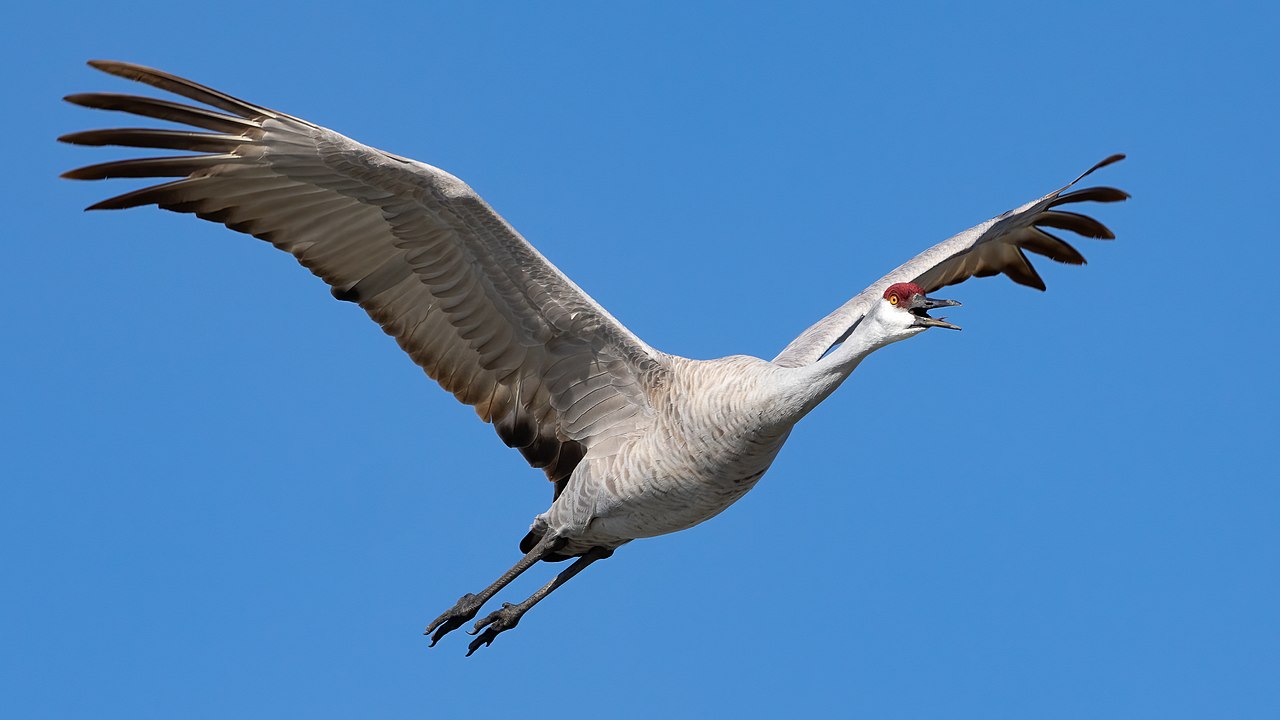
Each of the two North American cranes has its own distinctive features. The sandhill crane is the common crane of the continent, a tall gray bird, sometimes stained rusty from preening with iron-rich mud, with a bare red crown and a tuft of feathers over the rump often called a bustle. Sandhill cranes gather in huge flocks during migration, one of the great wildlife spectacles, and their loud, rolling, bugling calls carry for great distances. The whooping crane is the tallest bird in North America, standing around five feet, a striking white crane with black wingtips and a red crown. Once reduced to only a handful of individuals, the whooping crane has slowly recovered through dedicated conservation, though it remains endangered and rare. Both cranes are known for their spectacular dancing, leaping, and bowing displays, which strengthen pair bonds, and for mating for life, as explored in our guide to birds that mate for life.
How to Tell Cranes Apart
Telling the two North American cranes apart is straightforward, focusing mainly on color and size. The sandhill crane is gray, sometimes with rusty staining, while the whooping crane is white with black wingtips, so color alone usually distinguishes them. Size is another clue, since the whooping crane is taller, standing around five feet, making it the tallest bird on the continent, while the sandhill crane, though large, is somewhat shorter. Both have a patch of red on the crown. Given how rare the whooping crane is, a tall gray crane you encounter is almost certainly a sandhill crane, while a large white crane with black wingtips, most likely seen in specific protected areas or reintroduction sites, would be a whooping crane. It is also worth distinguishing cranes from the somewhat similar great blue heron, which is blue-gray but flies with its neck folded rather than outstretched. By using color, size, and flight posture, you can readily identify North American cranes, as explored in our guide to types of white birds.
Where Cranes Live
Cranes live in open wetlands, marshes, prairies, and fields across parts of North America, favoring areas with shallow water and open ground. The sandhill crane breeds in marshes, bogs, wet meadows, and prairies across the northern United States, Canada, and Alaska, as well as in some scattered southern populations, and it migrates in large numbers, gathering at famous stopover sites like the Platte River in Nebraska, where hundreds of thousands congregate. In winter, sandhill cranes move to fields, wetlands, and grasslands in the southern United States and Mexico. The whooping crane, being rare, is restricted to a few areas, most notably breeding in a remote part of Canada and wintering on the Texas Gulf Coast, along with reintroduced populations in other regions. Cranes generally need open landscapes with wetlands for roosting and fields for feeding, and they often forage for grains, invertebrates, and plants. Because sandhill cranes gather in such spectacular numbers, their migration is a highlight for birders, as detailed in our guide to crane symbolism.
Cranes vs Herons
Cranes are often confused with herons, since both are tall, long-legged birds, but they differ in several important ways. The most useful distinction is flight posture: cranes fly with their necks fully outstretched, while herons and egrets fly with their necks folded back in an S-shape, so a tall bird flying with its neck extended is likely a crane. Cranes also tend to be found in open fields and prairies as well as wetlands, often in flocks, whereas many herons are more solitary and closely tied to water edges. In terms of behavior, cranes are famous for their elaborate dancing displays and loud bugling calls, and they feed largely on the ground on grains and other foods, while herons typically hunt fish and other prey by standing or stalking in shallow water. Cranes and herons also belong to entirely different bird families, despite their superficial similarity. Understanding these differences in flight, habitat, behavior, and family helps distinguish cranes from herons, as explored in our guide to types of herons.
The Sandhill Crane Migration Spectacle
The sandhill crane is worth special attention for one of nature’s greatest wildlife spectacles. According to the Cornell Lab of Ornithology, sandhill cranes gather by the hundreds of thousands during migration, and cranes fly with their necks outstretched. Each spring, on the Platte River in Nebraska, an enormous concentration of sandhill cranes stops to rest and feed on their northward journey, one of the largest gatherings of cranes anywhere and a bucket-list event for birdwatchers. The birds roost in the shallow river at night and feed in surrounding fields by day, filling the air with their rolling, bugling calls. This staging is a critical part of their migration, allowing the cranes to build up energy reserves before continuing north to their breeding grounds. Similar, smaller gatherings occur at other sites as well. Witnessing tens of thousands of cranes rising from a river at dawn is an unforgettable experience, showcasing the grandeur of these birds, as explored in our guide to crane symbolism.
The Whooping Crane’s Fight for Survival
The whooping crane represents one of the most dramatic conservation stories in North America. This magnificent white crane, the tallest bird on the continent, declined catastrophically due to hunting and habitat loss until, by the 1940s, only about fifteen birds remained in the wild, bringing the species to the very brink of extinction. Through decades of intensive and dedicated conservation, including habitat protection, captive breeding, and creative reintroduction efforts, the whooping crane has slowly increased in number, though it remains one of the rarest birds in the world and is still endangered. The main wild population breeds in a remote area of Canada and winters on the Texas Gulf Coast, and additional reintroduced populations have been established elsewhere. Each whooping crane is precious to the species’ survival. The ongoing recovery of the whooping crane illustrates both the fragility of endangered species and the difference that determined conservation can make, a powerful story among the birds in our guide to birds that mate for life.
Frequently Asked Questions
How many types of cranes are there in North America?
North America has two crane species: the common sandhill crane and the rare, endangered whooping crane. Worldwide there are fifteen crane species.
What is the most common crane?
The sandhill crane is by far the most common and widespread crane in North America, a tall gray bird that gathers in huge flocks during migration.
What is the tallest bird in North America?
The whooping crane is the tallest bird in North America, standing around five feet. It is a rare, endangered white crane with black wingtips and a red crown.
How do you tell cranes apart?
Use color. The common sandhill crane is gray, while the rare whooping crane is white with black wingtips. The whooping crane is also taller.
What is the difference between a crane and a heron?
Cranes fly with their necks outstretched, while herons fly with necks folded in an S-shape. Cranes also favor fields and prairies and belong to a different family.
Do cranes mate for life?
Yes, cranes form strong, lifelong pair bonds and are famous for their elaborate dancing displays, which help strengthen the bond between mated pairs.
Where do cranes live?
Sandhill cranes live in marshes, prairies, and fields across the north and migrate south for winter, while whooping cranes are restricted to a few protected areas.