Baby Garter Snake: ID, Safety, and the Copperhead Test
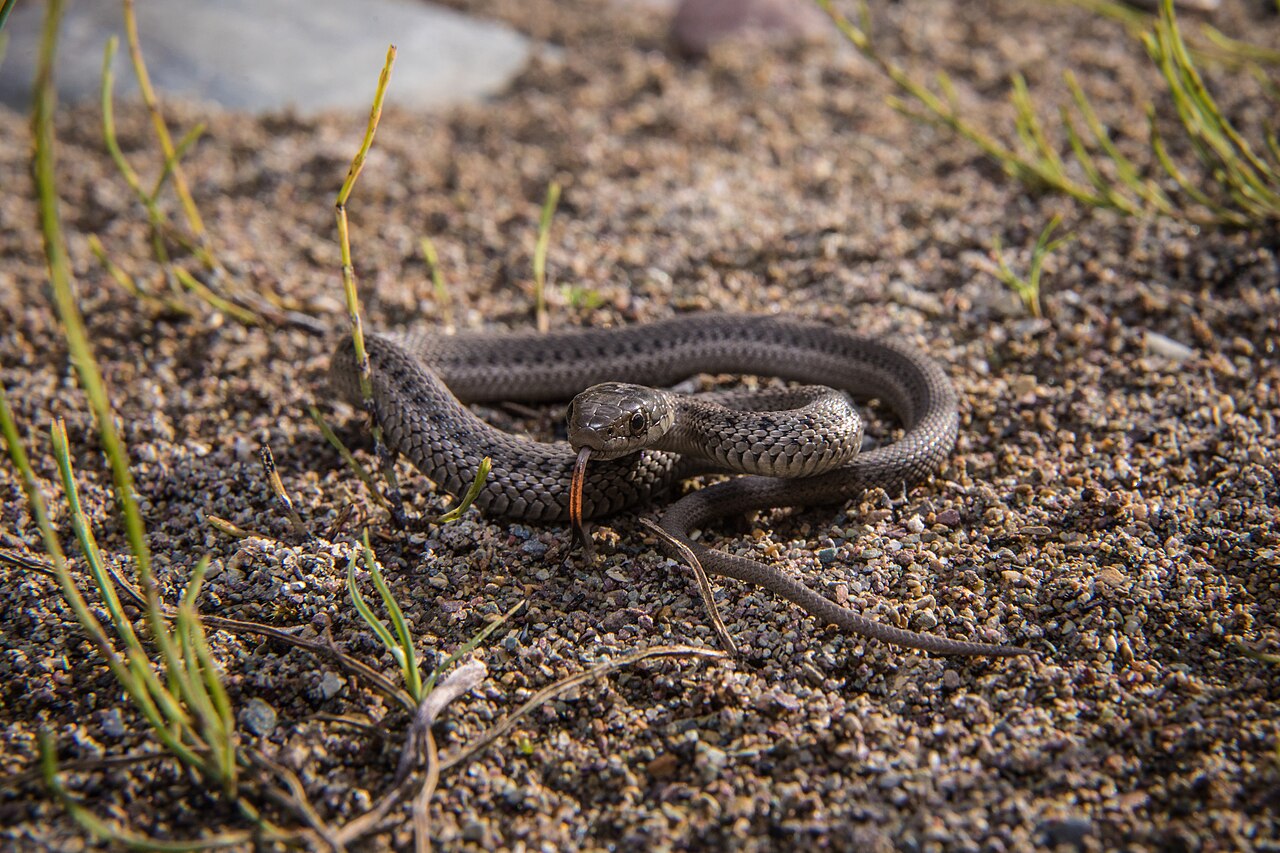
A baby garter snake is 5 to 9 inches long at birth, pencil-thin, and marked with the same three pale stripes running the length of the body that identify the adult. They are completely harmless to people, they are born live rather than hatched from eggs, and they receive no parental care at all. Finding several at once in late summer is normal, because a single female gives birth to 10 to 40 young in one litter.
The identification that actually matters is baby garter snake against baby copperhead, since that is the mistake that gets harmless snakes killed. A garter snake has stripes running lengthwise, round pupils, and no facial pit. A copperhead has hourglass crossbands running side to side, vertical pupils, a bright yellow tail tip as a juvenile, and a heat-sensing pit between eye and nostril. Stripes versus crossbands settles it in one look.
| Feature | Baby Garter Snake |
|---|---|
| Length at birth | 5 to 9 inches |
| Birth type | Live birth, not eggs |
| Litter size | 10 to 40, occasionally more |
| Pattern | Three pale lengthwise stripes |
| Pupils | Round |
| Venom | None dangerous to humans |
| Birth season | Late July through September |
What a Baby Garter Snake Looks Like
Newborn garter snakes are miniature adults. The body is slender, roughly the diameter of a pencil, and the head is only marginally wider than the neck. The defining feature is the striping: one pale stripe down the centre of the back and one along each side, usually yellow, cream, or greenish, set against a darker olive, brown, grey, or near-black ground colour.
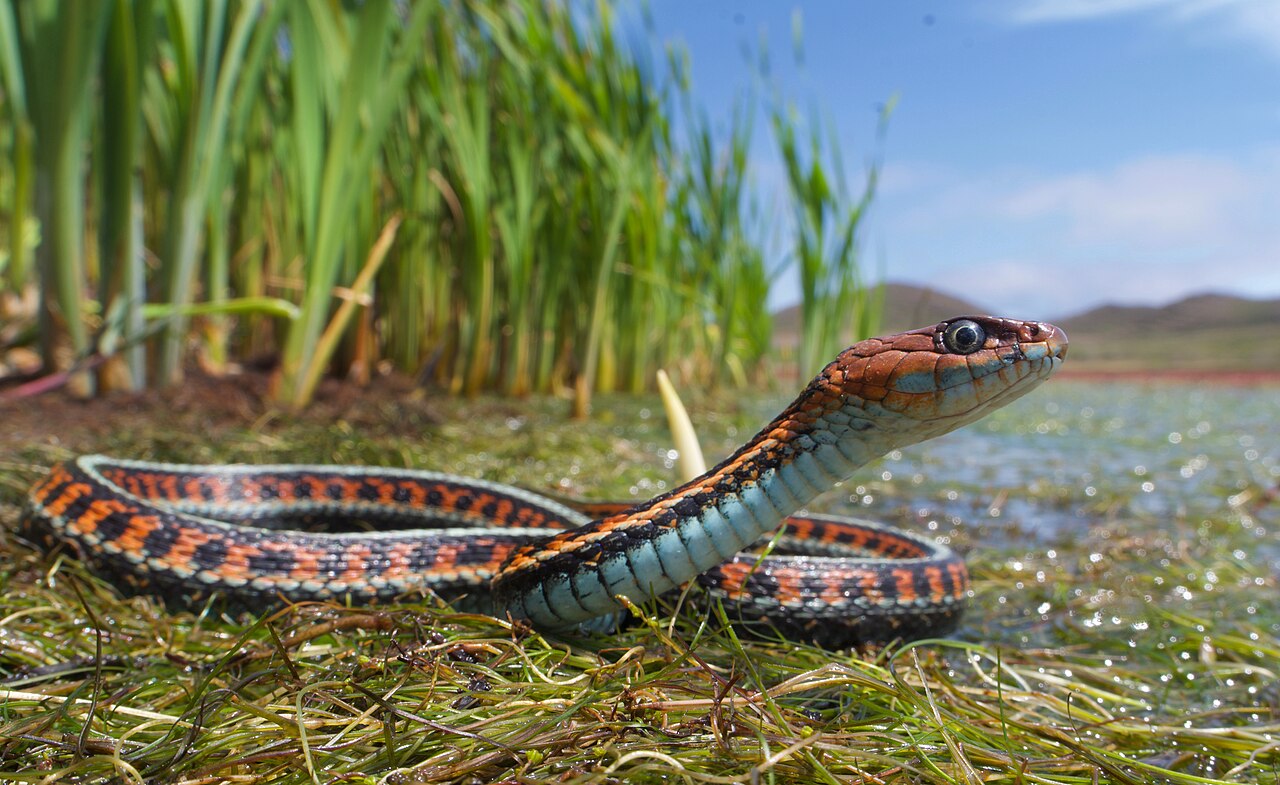
Between the stripes many individuals show a checkerboard of dark squares, which can make the pattern look busier than the clean three-stripe description suggests. The common garter snake, Thamnophis sirtalis, is the most widespread species and shows enormous regional colour variation, so a baby garter snake in Oregon can look quite different from one in Ohio while sharing the same stripe layout.
The eyes are proportionally large, the pupils are round, and there is no pit between the eye and the nostril. Those three head features separate garter snakes from every pit viper in North America and are visible in any decent photograph. For the broader picture across species, our guide to the baby snake covers what young snakes of many kinds look like.
Baby Garter Snake vs Baby Copperhead
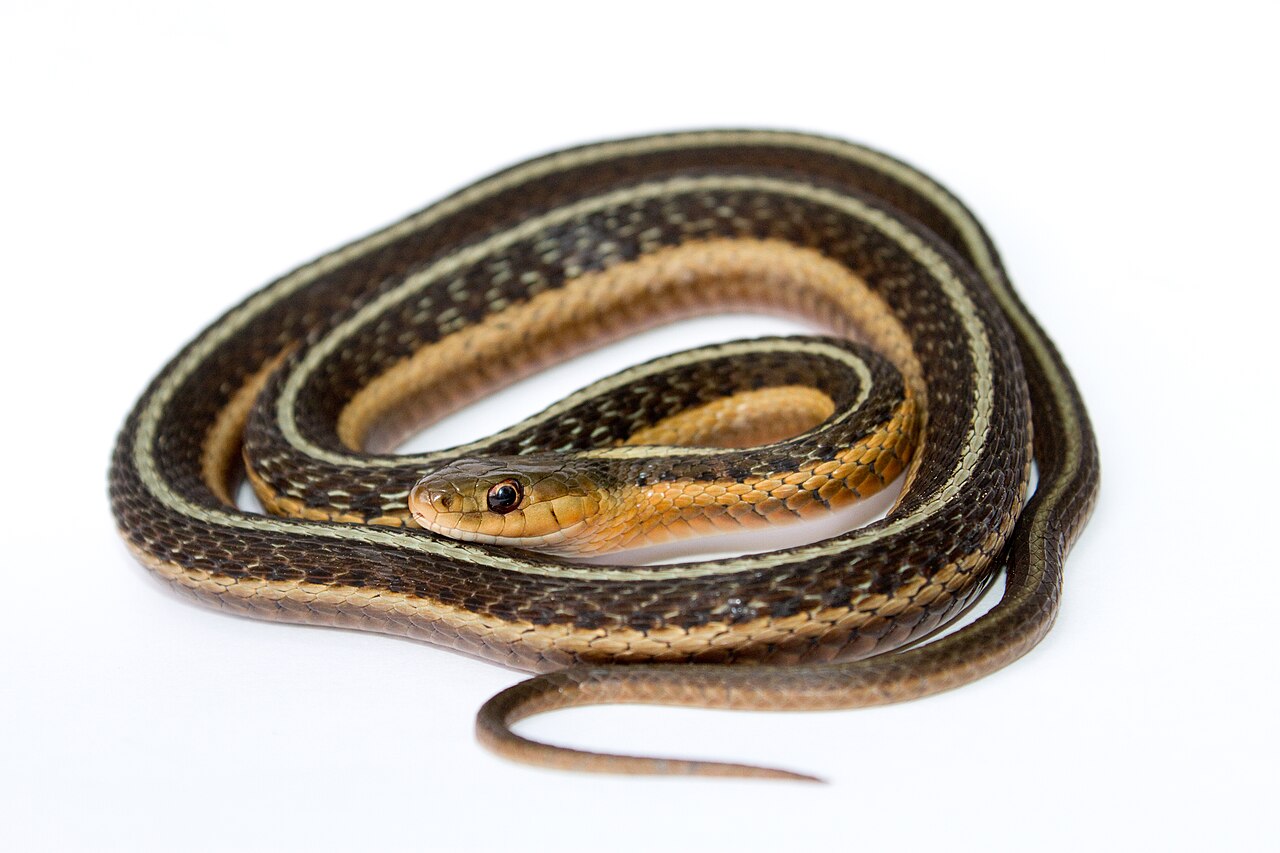
This is the comparison worth memorising, and it comes down to pattern direction. Garter snake markings run lengthwise along the body as continuous stripes. Copperhead markings run crosswise as distinct hourglass or saddle-shaped bands, wider at the sides and pinched at the spine. No garter snake has crossbands and no copperhead has lengthwise stripes.
Juvenile copperheads carry a second unmistakable mark: a bright sulphur-yellow or greenish tail tip, used to lure frogs and lizards within striking range. It is present for roughly the first year and is not subtle. A small snake with a vivid yellow tail is a pit viper, most likely a copperhead or a cottonmouth, and should be left alone.
Head shape gets cited constantly and is the least reliable of the marks, because garter snakes flatten the head into a broad triangle when threatened and look convincingly viper-like doing it. Rely on pattern direction and tail tip instead. Our guides to the baby copperhead and the baby cottonmouth cover both venomous look-alikes in detail.
Are Baby Garter Snakes Dangerous?
No. Garter snakes are not dangerous to people at any age. They were long described as entirely non-venomous, and the current understanding is more precise: they produce a mild neurotoxic saliva in enlarged rear teeth that helps subdue amphibians and worms. It is not delivered by fangs and it has no meaningful effect on humans. The University of Georgia Savannah River Ecology Laboratory describes garter snakes as harmless to people and among the most frequently encountered snakes in North American yards.
A bite from a baby garter snake barely breaks the skin. The realistic outcome is a scratch, mild local irritation, and possibly slight swelling in a person with sensitive skin. Normal wound cleaning is the whole treatment. Documented cases of anything beyond that involve prolonged chewing bites from large adults and are exceptionally rare.
The defensive behaviours are more noticeable than the bite. A handled garter snake will thrash, flatten its head and body, and discharge musk from glands near the vent, a strongly unpleasant-smelling fluid that is entirely harmless but takes real effort to wash off. Most will also void the contents of the cloaca. None of this poses any risk.
Where Baby Garter Snakes Come From
Garter snakes are viviparous, giving birth to live young rather than laying eggs. This is unusual among North American snakes and gives them a real advantage in cool climates, since the female can move into sunlight to raise her body temperature and speed development rather than relying on ambient soil temperature at a fixed nest.
Mating occurs in spring shortly after emergence from hibernation, and the young are born from late July into September after a gestation of roughly 2 to 3 months. Litter size runs 10 to 40 for common garter snakes, with exceptional litters exceeding 80. Females in better condition produce larger litters.
Newborns disperse within hours and receive no care whatsoever. This is why people find several small snakes in one area of a yard in August: they are littermates that have not yet spread out. It is not an infestation and it does not mean a nest is present, since garter snakes do not build nests. That same viviparity is shared by our subject in the baby rattlesnake guide, which is worth knowing since both appear at the same time of year.
What Baby Garter Snakes Eat
Newborns eat earthworms, slugs, small amphibians, and insect larvae, taking whatever they can physically swallow. Earthworms are the staple across most of the range, and the young are effective hunters from the first day using scent trailing rather than sight.
Garter snakes are among the few predators that eat toads and newts, tolerating skin toxins that kill most other animals. In parts of the Pacific Northwest an evolutionary arms race with the rough-skinned newt has produced garter snake populations resistant to tetrodotoxin at doses that would kill a person many times over, a system documented in detail by researchers at Utah State University. Newborns inherit that resistance.
Feeding frequency is high because growth is fast. A young garter snake may double in length within its first year given good conditions, and it needs to eat every few days through the active season. This is also why gardens with healthy worm and slug populations attract them, and why they are genuinely useful animals to have around.
Should You Worry About Garter Snakes in the Yard?
Garter snakes are among the most beneficial animals a yard can host. They eat slugs, worms, grubs, and small rodents, they are harmless to people and pets, and they are prey for hawks, owls, herons, and foxes, meaning their presence indicates a functioning local food web rather than a problem.
What attracts them is cover and food. Rock piles, woodpiles, dense ground cover, sheet mulch, and board piles all provide the sheltered basking and hiding spots they need, and a moist garden with a healthy invertebrate population supplies the diet. Removing cover is the only reliable way to reduce numbers, and it is rarely worth doing.
Repellents marketed for snakes, including sulphur, mothballs, and various essential oil products, have no reliable evidence behind them and mothballs are both ineffective and illegal to use that way in the United States. If a garter snake gets indoors, the correct response is to open a door and guide it out with a broom or lift it into a container. Our guide to the ringneck snake covers another small harmless species that turns up in the same situations.
What Snakes Are Mistaken for Garter Snakes?
Ribbon snakes are the closest look-alike and are in the same genus. They are more slender, have a proportionally longer tail, and carry cleaner, brighter stripes with an unmarked area between them, but the distinction is subtle enough that even experienced observers hedge. Both are harmless, so a misidentification carries no risk.
Brown snakes and redbelly snakes are frequently confused with young garter snakes because of their similar small size, but their striping is faint or absent and the redbelly shows an unmistakable orange to red underside. Young rat snakes are sometimes mistaken for garter snakes too, though they carry blotches rather than stripes.
The dangerous confusion runs the other way. Small copperheads, cottonmouths, and rattlesnakes get killed as garter snakes and, far more often, harmless garter snakes get killed as copperheads. Checking for lengthwise stripes takes one second and resolves it. Our guide to the baby rat snake covers another commonly misjudged juvenile.
When Baby Garter Snakes Appear
Births concentrate in late July through September, so the last third of summer is when small garter snakes suddenly seem to be everywhere. That impression is accurate: an entire cohort emerges within a few weeks across a whole region, and it disperses over the following month.
Adults emerge from hibernation in early spring, often March or April depending on latitude, and garter snakes are famous for communal hibernation. In parts of Manitoba tens of thousands overwinter together in limestone sinkholes, producing one of the largest gatherings of snakes anywhere in the world when they emerge.
Newborns must find suitable overwintering shelter before their first winter, and this is the highest-mortality period of their lives. Small body size means less energy reserve and less tolerance for freezing, and first-year survival is low. Leaving a rock pile or an undisturbed woodpile in a corner of the yard is a meaningful contribution if you want them around.
Frequently Asked Questions
Are baby garter snakes harmless?
Yes. Garter snakes pose no danger to people at any age. They produce a mild saliva toxin that helps subdue amphibians and worms, delivered by enlarged rear teeth rather than fangs, and it has no meaningful effect on humans. A bite from a newborn barely breaks the skin.
How do you identify a baby garter snake?
Look for three pale stripes running lengthwise along a dark body, a slender pencil-thin build, a head barely wider than the neck, round pupils, and no facial pit. Length at birth is 5 to 9 inches. Lengthwise stripes are the key mark, since no venomous North American snake has them.
What is the difference between a baby garter snake and a baby copperhead?
Pattern direction. Garter snakes have stripes running lengthwise, copperheads have hourglass crossbands running side to side. Juvenile copperheads also have a bright yellow tail tip, vertical pupils, and a heat-sensing pit between eye and nostril. Head shape is unreliable because garter snakes flatten their heads when threatened.
Do garter snakes lay eggs?
No. Garter snakes give birth to live young, typically 10 to 40 per litter, from late July through September after a gestation of about 2 to 3 months. Live birth lets the female raise her body temperature by basking, which is a real advantage in cool climates.
Why are there so many baby garter snakes in my yard?
They are almost certainly littermates. A single female produces 10 to 40 young at once and they disperse over the following weeks, so finding several small snakes together in August is normal. Garter snakes do not build nests, so there is nothing to remove.
What attracts garter snakes to your yard?
Cover and food. Rock piles, woodpiles, dense ground cover, and boards give them basking and hiding spots, and a garden with healthy earthworm, slug, and amphibian populations supplies the diet. Removing cover is the only reliable way to reduce numbers, and most gardeners are better off keeping them.
What month do garter snakes come out?
Adults emerge from hibernation in March or April depending on latitude, with mating following almost immediately. Young are born from late July into September, which is why small garter snakes seem to appear suddenly in late summer. Activity drops off with the first hard frosts.