Ring Neck Snake: Identification, Venom Facts and Habits
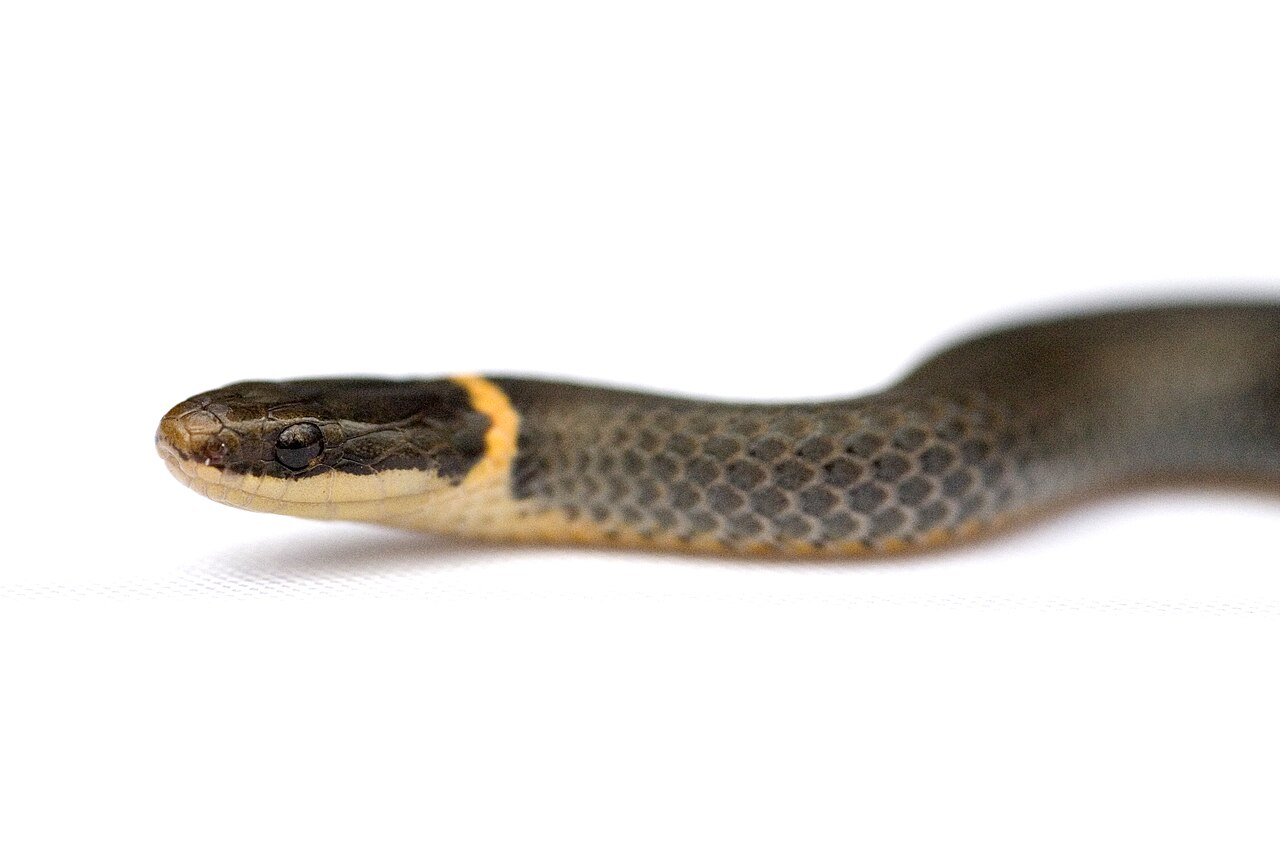
A ring neck snake is a small, slender, harmless snake identified by a bright yellow, cream, or orange collar just behind its head and a matching yellow-to-red belly. Most adults measure only 10 to 15 inches long, about the length of a pencil and roughly as thick as a shoelace. Ring neck snakes are rear-fanged and produce a mild saliva that subdues earthworms and salamanders, but they cannot meaningfully harm a person. They are among the most commonly encountered snakes in North American gardens, yet most people never see one because they spend their days hidden under rocks, logs, and mulch.
These snakes turn up in flowerbeds, under patio stones, and inside window wells across most of the eastern United States, the Pacific Coast, and parts of Mexico. Their combination of tiny size, glossy dark back, and vivid neck ring makes them one of the easiest snakes in the country to identify with confidence once you know what to look for.
| Feature | Ring Neck Snake Details |
|---|---|
| Scientific name | Diadophis punctatus |
| Typical adult length | 10 to 15 in (25 to 38 cm); rarely over 18 in |
| Key field mark | Yellow, cream, or orange ring behind the head |
| Belly color | Yellow, orange, or red, often with black spots |
| Danger to humans | None; rear-fanged but harmless |
| Main prey | Earthworms, slugs, salamanders, small lizards |
| Activity | Nocturnal and secretive, hides by day |
How to Identify a Ring Neck Snake
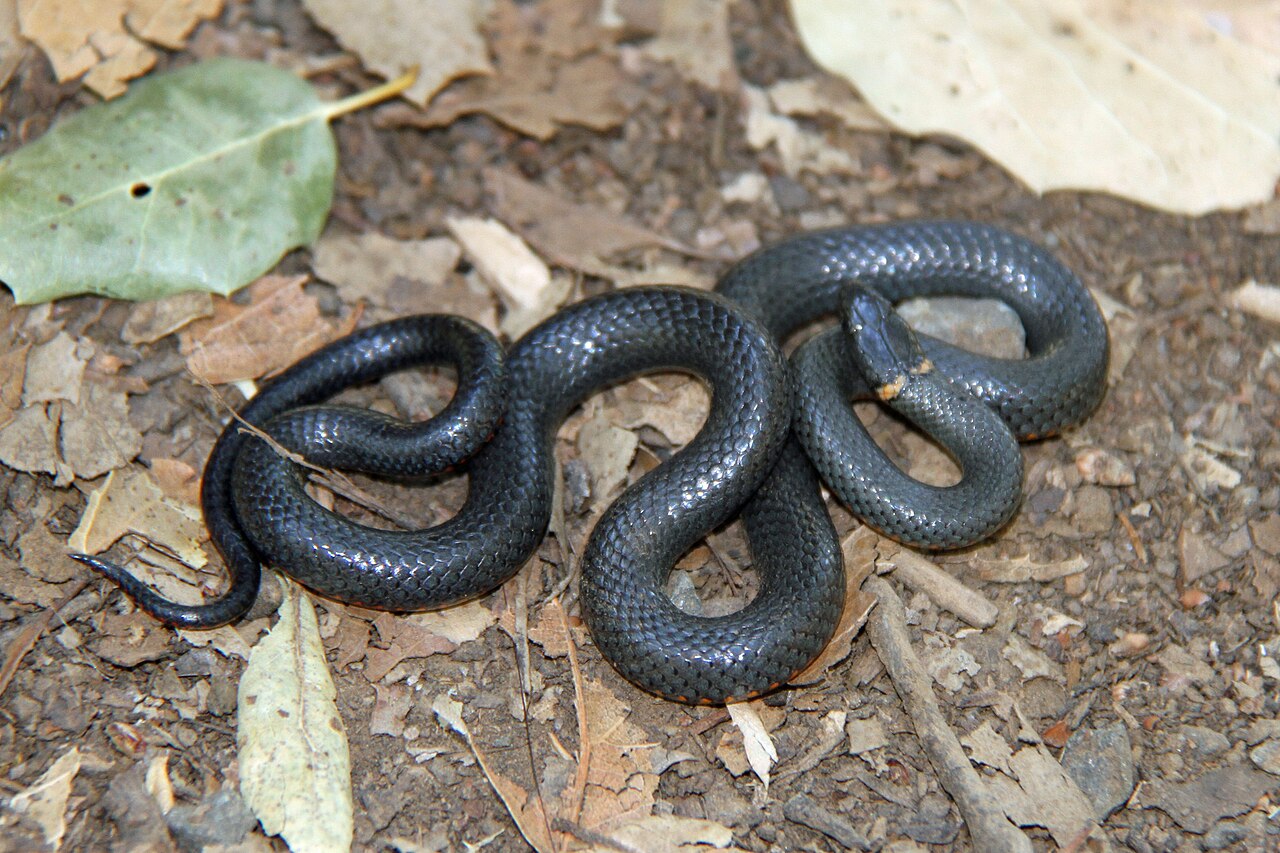
The neck ring is the field mark that settles the identification almost every time. It sits one to three scale rows behind the head and runs completely around the neck in most populations, appearing as a clean yellow, cream, or orange band against a much darker body. The contrast is striking because the back is uniformly glossy and unmarked, ranging from slate gray through olive and bluish-black to true black. There is no blotching, banding, or striping anywhere else on the dorsal surface, which immediately separates this species from young rat snakes, milk snakes, and garter snakes that all carry patterns down the length of the body.
Size is the second confirming clue. Adults usually reach 10 to 15 inches, and the largest individuals rarely exceed 18 inches, according to the Savannah River Ecology Laboratory herpetology program at the University of Georgia (srelherp.uga.edu). A snake that is pencil-thin, shorter than a ruler, and carries a bright collar is almost certainly a ring neck. The head is small and barely wider than the neck, giving the animal a blunt, almost featureless profile, and the scales are smooth rather than keeled, which produces a distinctly polished, wet-looking sheen even on a dry animal.
Flip the perspective and the belly seals the case. Where the back is dark and plain, the underside is vivid: lemon yellow at the head end, often warming to orange and then coral red toward the tail. Many individuals carry a scattering of small black half-moons or dots running down the center of the belly. That two-tone design, drab above and brilliant below, is the anatomical basis for the species’ famous defensive display, and it is unlike anything else you will find in a North American yard at this size.
Are Ring Neck Snakes Poisonous or Venomous?
Ring neck snakes are not poisonous, and for practical purposes they are not dangerous. The distinction matters: poisonous means harmful when eaten, venomous means capable of injecting a toxin. Ring necks are neither in any way that affects people. They belong to the family Dipsadidae, a group often labeled “harmlessly venomous” in state herpetological references such as the Kansas Herpetofaunal Atlas maintained by Fort Hays State University, because they carry enlarged rear teeth and a Duvernoy’s gland behind the eye that produces a weak secretion.
That secretion exists to slow down earthworms and salamanders, not to defend against predators. To deliver it, the snake has to work prey backward into the rear of its mouth and chew, which is not something it can do to a finger. Ring neck snakes almost never attempt to bite even when handled, and their mouths are too small to close around most human skin. Researchers at Kansas State University describe the worst realistic outcome as comparable to a sweat bee sting, and even that requires the animal to manage a sustained chewing bite that it rarely attempts.
The practical guidance is simple. There is no medical emergency associated with this species, no antivenom, and no reason to kill one found in a garden. If a ring neck does manage to break skin during rough handling, wash the area with soap and water and watch it as you would any minor scratch, since the risk is ordinary bacterial contamination rather than venom. The far better approach is not to handle them at all: these are delicate snakes that stress easily and can be injured by even gentle restraint.
Where Ring Neck Snakes Live
The range of Diadophis punctatus is enormous, covering most of the eastern United States, a broad band through the central states, the Pacific Coast from Washington into California, southeastern Canada, and pockets of central Mexico. Few North American snakes are distributed this widely. That breadth explains why the species turns up in search results tied to so many individual states, from Florida and North Carolina to Missouri, Oklahoma, Kansas, and Virginia. In most of those places it is common without being conspicuous.
Habitat preferences shift by region. Northern and western populations favor open woodlands, rocky hillsides, woodland edges, and debris piles, often in suburban settings where stone walls and landscape timbers create the crevices they need. Southern populations lean toward wetter ground: damp forests, swamp margins, and riparian corridors. Across the range, the constant requirement is moisture plus cover, because a snake this small dehydrates quickly and has no defense against a hawk in the open.
Around houses, that translates into predictable hiding spots. Ring neck snakes concentrate under flat rocks, landscape fabric, mulch beds, boards, discarded plywood, compost piles, and the flagstones of a patio. They are strongly nocturnal, foraging after dark and retreating before dawn, so a homeowner who lifts a paving stone in the middle of the afternoon is far more likely to find one than someone who walks the yard at dusk. They also tolerate each other unusually well for snakes, and dozens of individuals have been recorded sharing a single hibernation site.
Ring Neck Snake Subspecies and Regional Differences
Herpetologists recognize roughly twelve to fourteen subspecies of ring neck snake, and the differences between them are the reason regional descriptions sometimes seem to contradict each other. The clearest split for anyone east of the Mississippi is between the northern and southern forms. The northern ring neck snake carries a uniform, unspotted belly, usually plain orange or yellow, and a complete neck ring. The southern ring neck snake carries a bolder belly, bright yellow to orange with a row of prominent black half-moons down the middle, and its neck ring is sometimes narrowed or broken.
West of that divide, the prairie ring neck snake dominates the central states. The University of Nebraska herpetology program (herpneb.unl.edu) describes it as olive green, brown, or greenish-gray above with a red, orange, or yellow belly and a total length of roughly 9.8 to 16.5 inches. Farther west, the Pacific ring neck snake and the northwestern ring neck snake occupy the coastal states, and the regal ring neck snake of the Southwest is the giant of the group, occasionally reaching 15 to 18 inches. The Key ring neck snake, restricted to the Florida Keys, is the most geographically limited of all.
For a homeowner, none of these distinctions change the practical answer, because every subspecies is equally harmless and behaves the same way. They matter mainly when you are trying to match a photograph to a field guide and the belly pattern in your yard does not look like the one in the book. If you are working through identifications of other small dark snakes in the same habitat, a side-by-side comparison with a milk snake or a juvenile rat snake is usually the fastest way to rule out lookalikes.
What Ring Neck Snakes Eat
Earthworms are the backbone of the ring neck snake diet almost everywhere the species occurs. A snake that tops out at 15 inches and weighs a few grams is limited to soft-bodied prey it can swallow whole, and worms fit that requirement perfectly while being abundant in exactly the damp, cover-rich soil these snakes prefer. Slugs make up a second reliable staple, and in some populations they rival earthworms in importance.
Beyond invertebrates, ring neck snakes take small salamanders, and in the Southeast this becomes a defining feature of their ecology. Red-backed salamanders and other woodland species living under the same logs are regularly eaten. Small lizards and even the young of other snake species round out the menu where they are available. The mild rear-fanged secretion matters here: a salamander is a comparatively powerful meal for a snake this small, and the combination of chewing envenomation and loose body coils gives the ring neck enough control to swallow prey that would otherwise escape.
Regional variation is substantial. Western populations lean more heavily on lizards and other snakes, while eastern populations lean toward worms and amphibians. This flexibility explains why the species thrives in suburbs, since a mulched garden bed produces earthworms in quantities no natural woodland floor can match. Homeowners who want to understand what other small predators are working the same ground can compare the ring neck’s menu against the broader picture in our guide to what lizards eat.
The Belly Roll Defense Display
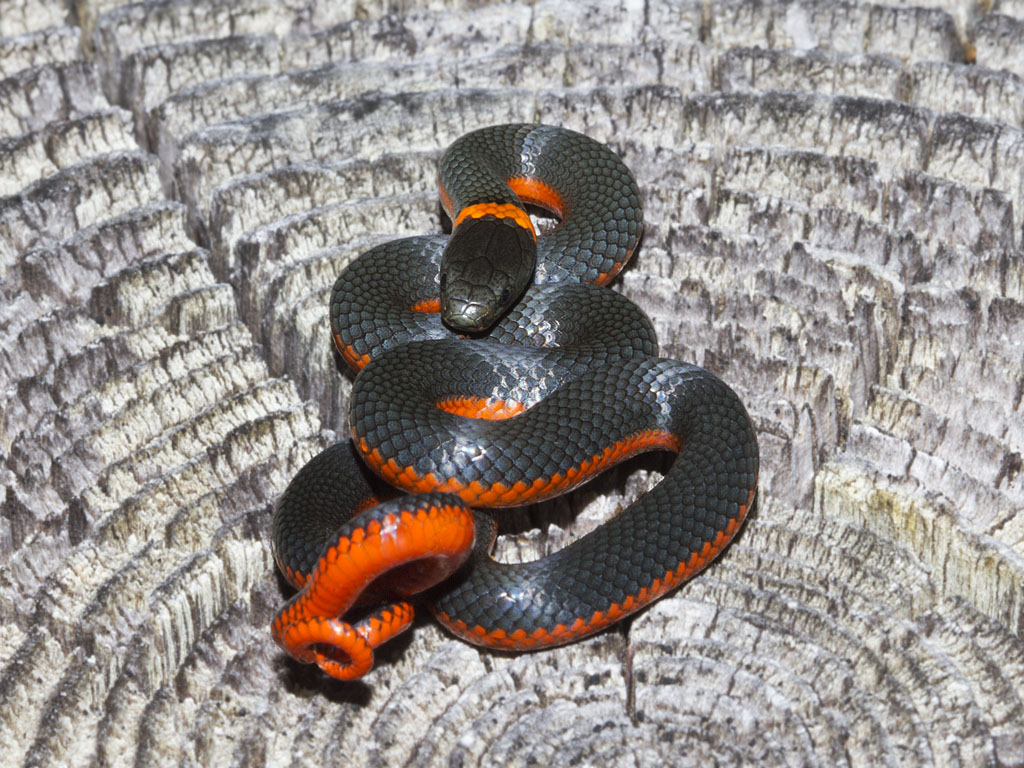
The ring neck snake has one of the most memorable defensive behaviors of any small North American reptile. When it feels cornered and cannot escape, it does not strike. Instead it coils the last few inches of its tail into a tight corkscrew and flips it upward, exposing the brilliant red-orange underside like a warning flag while keeping the head tucked down and hidden beneath the body. Some individuals go further and go limp, playing dead with the mouth open.
This display works on the same principle as the coloring of a poison dart frog. The snake is advertising, falsely, that it is dangerous to eat. A bird or small mammal that has learned to associate flashes of red and orange with a bad experience will hesitate, and hesitation is all a slow-moving 12-inch snake needs to slip back under a rock. The drab back keeps the animal invisible while it forages; the bright belly is held in reserve as a bluff for emergencies.
Ring Neck Snake Eggs and Life Cycle
Ring neck snakes lay eggs rather than giving birth to live young. Breeding typically happens in spring, with mating in some populations recorded as early as late March, and the female deposits her clutch in early to midsummer. The University of Nebraska herpetology program reports one to two clutches per female per year, each containing 2 to 10 eggs, which is a very small output compared with larger colubrids that may lay two dozen at once.
Nest sites are chosen for constant moisture and stable temperature: rotting logs, the interior of decaying stumps, the loose soil under a flat rock, or the crumbling mortar of an old stone wall. Communal nesting has been documented, with several females depositing eggs in the same cavity. The eggs are elongated, white, and roughly an inch long, and they hatch after about seven to eight weeks. Hatchlings emerge in late summer or early fall at roughly 3 to 4 inches long, already carrying the complete adult pattern in miniature, ring included.
Young ring necks grow slowly and reach breeding age at around two to three years. In the wild they may live a decade or more, which is remarkable for an animal this small, and reflects how effectively the secretive lifestyle protects them. Anyone who finds a very small snake in late summer and is not sure whether it is a hatchling ring neck or the young of a larger species will find the size-and-marking comparisons in our guide to baby snakes useful for narrowing it down.
Ring Neck Snakes in Your Yard
A ring neck snake in the garden is a net benefit and needs no management. These snakes consume slugs, which are among the most destructive pests in a vegetable bed, and they present no risk to children, dogs, or cats. A dog that mouths one will not be envenomated in any meaningful sense, though the snake will almost certainly be killed, which is the more likely bad outcome of the encounter.
If you want fewer of them near the foundation, the lever is habitat rather than removal. Ring necks need damp cover, so reducing the depth of mulch against the house, removing stacked boards and unused flagstones, and clearing leaf litter from window wells will make the immediate perimeter less attractive. Leaving a brush pile or rock stack at the back of the property gives them somewhere better to be. Glue traps and rodent bait stations kill ring neck snakes indiscriminately and should be kept out of garden beds for that reason.
Distinguishing a ring neck from the larger snakes that also use suburban yards is worth doing once, properly. The species most often confused with it at a glance are the shiny dark juveniles of common yard snakes; a look at the king snake and the hognose snake covers the two most frequent misidentifications. If you are working from droppings rather than a sighting, our guide to snake poop explains what the scat of a small snake looks like and how it differs from that of lizards and rodents.
Frequently Asked Questions
Are ring neck snakes poisonous to dogs?
No. Ring neck snakes are not poisonous to dogs, cats, or people. They carry a mild rear-fanged secretion used on earthworms and salamanders, but they cannot deliver it effectively to a mammal, and their mouths are too small to bite most pets. A dog that picks one up is far more likely to kill the snake than to be harmed by it. Contact a veterinarian only if your dog shows swelling or distress, which would point to a different species.
How big do ring neck snakes get?
Most adults measure 10 to 15 inches, and individuals over 18 inches are unusual. The regal ring neck snake of the Southwest is the largest subspecies and can reach roughly 15 to 18 inches. Hatchlings emerge at about 3 to 4 inches. A snake noticeably thicker than a pencil is almost certainly a different species.
What do ring neck snakes eat?
Earthworms and slugs form the bulk of the diet across most of the range. They also take small salamanders, small lizards, and occasionally the young of other snakes. Diet varies by region, with western populations eating more lizards and eastern populations eating more worms and amphibians.
What does it mean when a ring neck snake curls its tail?
That is a defensive bluff. The snake corkscrews its tail to flash the bright red-orange underside while hiding its head, signaling to a predator that it might be toxic. Some individuals also play dead with the mouth open. It is a sign the animal feels threatened, not a sign it is about to strike.
Where do ring neck snakes lay their eggs?
Females deposit 2 to 10 eggs in early to midsummer inside rotting logs, decaying stumps, loose soil beneath flat rocks, or old stone walls. Several females sometimes share one nest site. The eggs hatch after roughly seven to eight weeks, producing young in late summer or early fall.
Are ring neck snakes good to have in the garden?
Yes. They eat slugs and other soft-bodied garden pests, pose no threat to people or pets, and require nothing from a homeowner. Leaving a rock pile or brush stack at the edge of the property gives them habitat away from the foundation if you would rather not encounter them near the house.
Can you keep a ring neck snake as a pet?
They are a poor choice. Ring neck snakes are small, stress-prone, and specialized feeders that often refuse anything except live earthworms and salamanders, which makes them difficult to maintain long term. Many wild-caught individuals stop eating in captivity. Observing them in the yard is far more rewarding, and several states restrict collecting native reptiles.