Strawberry Poison Dart Frog: How Toxic It Really Is
The strawberry poison dart frog (Oophaga pumilio) is a thumbnail sized Central American frog that carries enough alkaloid toxin in its skin to make a predator violently ill, but not enough to kill a healthy adult human. It is the small red frog with blue legs that shows up on rainforest posters, and it is one of the most variable animals in the Americas: in the Bocas del Toro archipelago of Panama alone, populations range from blood red to green, yellow, orange, white, and near black.
Two things make this species worth a closer look than its more famous relatives. First, its poison is borrowed, not manufactured, which is why captive bred strawberry dart frogs are completely harmless. Second, the female carries each tadpole up a tree individually and then feeds it her own unfertilized eggs for weeks, a level of parental care almost unheard of in amphibians.
The strawberry poison dart frog is a 0.7 to 1 in (17 to 24 mm) frog of Central American lowland rainforest. Wild frogs carry pumiliotoxins absorbed from mites and ants, strong enough to cause pain, swelling, and cardiac effects but not usually lethal to humans. Captive bred frogs are nontoxic because the diet that supplies the poison is missing.
| Quick Facts | Strawberry Poison Dart Frog |
|---|---|
| Scientific name | Oophaga pumilio, formerly Dendrobates pumilio |
| Adult size | 0.7 to 1 in (17 to 24 mm), about the size of a fingernail |
| Range | Nicaragua, Costa Rica, and Panama, lowland Caribbean slope |
| Color morphs | Around 15 to 30 described, concentrated in Bocas del Toro |
| Diet | Mites, ants, springtails, tiny insects |
| Lifespan | 3 to 5 years wild, 8 to 12 years in captivity |
| Toxicity | Pumiliotoxins, painful and dangerous, rarely fatal to humans |
What Is the Strawberry Poison Dart Frog?
It is a member of the family Dendrobatidae, the poison dart frogs, and one of the smallest species people keep or photograph. Adults reach 0.7 to 1 in (17 to 24 mm), so a full grown frog sits comfortably on a thumbnail. The classic form, from the Caribbean lowlands of Costa Rica and Nicaragua, has a brilliant red or orange body with dark blue or purple hind legs, which is where the nickname blue jeans frog comes from.
The genus name Oophaga means egg eater and refers to the tadpole diet, not the adult diet. That single trait separates this frog from the Dendrobates species most keepers start with, and it is the reason breeding Oophaga pumilio is considered an advanced project rather than a first one.
Unlike most frogs you encounter in a North American backyard, this one is active in daylight. Bright color plus daytime activity is the standard signal of a chemically defended animal, the same logic that runs through the whole poison dart frog family. A frog that can afford to be seen is advertising that eating it is a mistake.
How Poisonous Are Strawberry Poison Dart Frogs?
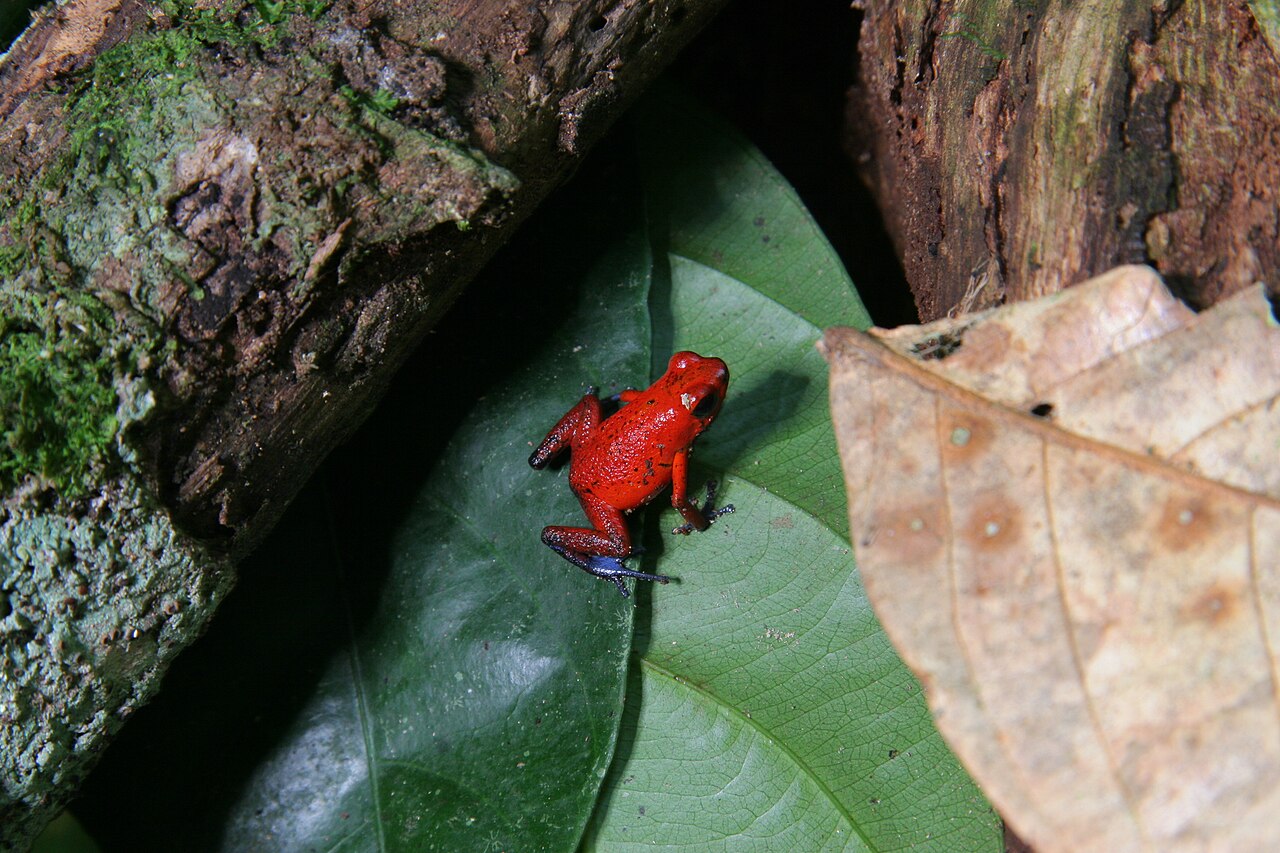
Wild strawberry poison dart frogs carry a cocktail of lipophilic alkaloids, mainly pumiliotoxins and allopumiliotoxins, concentrated in glands across the skin. These compounds interfere with sodium and calcium channels in nerve and muscle tissue. In a small predator the result is rapid: burning pain, muscle spasm, cardiac arrhythmia, and often death.
For a human the dose matters. A single frog carries roughly a few hundred micrograms of alkaloid spread across its entire skin surface, far less than the amount a golden poison frog (Phyllobates terribilis) carries and far less than a lethal dose by skin contact. Documented human effects from handling come down to burning, numbness, and swelling where the toxin met broken skin, plus nausea if it reached the mouth.
The important qualifier is that toxicity varies enormously between populations. Frogs from different Bocas del Toro islands carry different alkaloid profiles at different strengths, because the local supply of toxic mites and ants differs. There is no single number for how poisonous this species is, which is exactly why the safe assumption is that any wild individual is dangerous.
Can I Touch a Strawberry Poison Dart Frog?
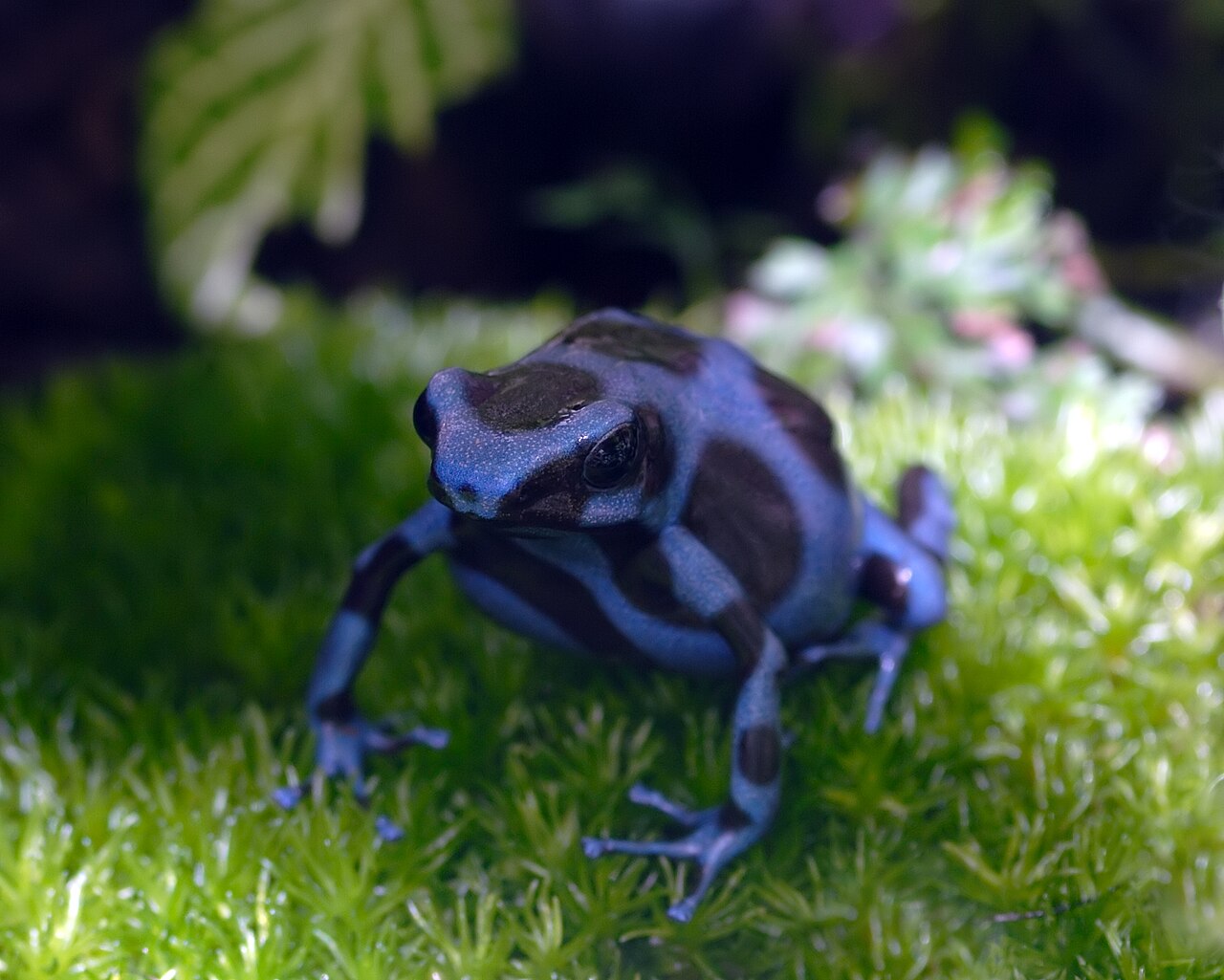
Do not touch a wild strawberry poison dart frog. The toxins are not absorbed efficiently through thick, intact palm skin, so a brief accidental contact usually causes nothing worse than tingling, but a cut, a hangnail, or a hand that later rubs an eye changes that calculation completely. The consequences run from hours of burning pain to genuine cardiac symptoms.
What happens if a human touches a dart frog is also a question with a second victim. The frog loses skin mucus, absorbs salts and oils from your hand through skin it breathes with, and can die from handling that looked entirely gentle. Field researchers who must handle them use powder free nitrile gloves and change them between animals.
The answer flips for captive bred frogs, and that is covered below. Even then, handling is limited to what a transfer between enclosures requires, with clean wet gloves, because the risk to the frog does not disappear.
Why Are They Not All Red? The Bocas del Toro Morphs
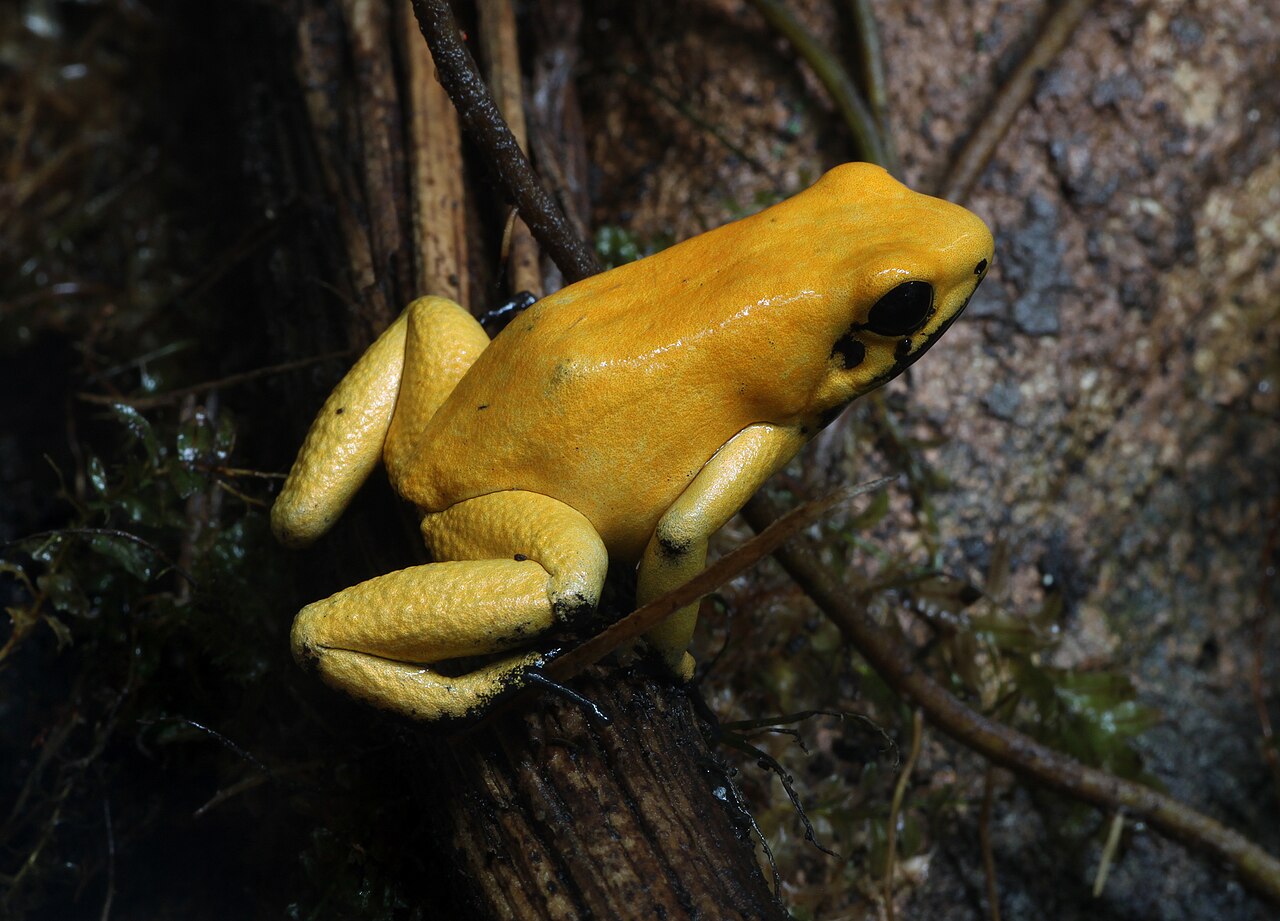
Across the mainland range the frog is usually red with blue legs. In the Bocas del Toro archipelago off western Panama, a cluster of islands separated for only a few thousand years, the species has split into a set of strikingly different local forms. Populations there include solid green, bright yellow, orange, white with black speckles, pale blue, and a nearly black form, often only a few miles apart.
This diversity is a favorite case study in rapid evolution. Female preference appears to drive much of it: females tend to prefer males of their own local color, which reinforces differences faster than geography alone would. Predator learning pushes in the same direction, since a bird that learns one warning pattern on one island has no reason to generalize it.
For identification this means color is nearly useless on its own. A green frog from Isla Bastimentos and a red frog from Costa Rica are the same species, while a similarly green frog from South America is likely a completely different genus. Shape, size, range, and the granular skin texture do the identifying work that color cannot.
Where Strawberry Poison Dart Frogs Live
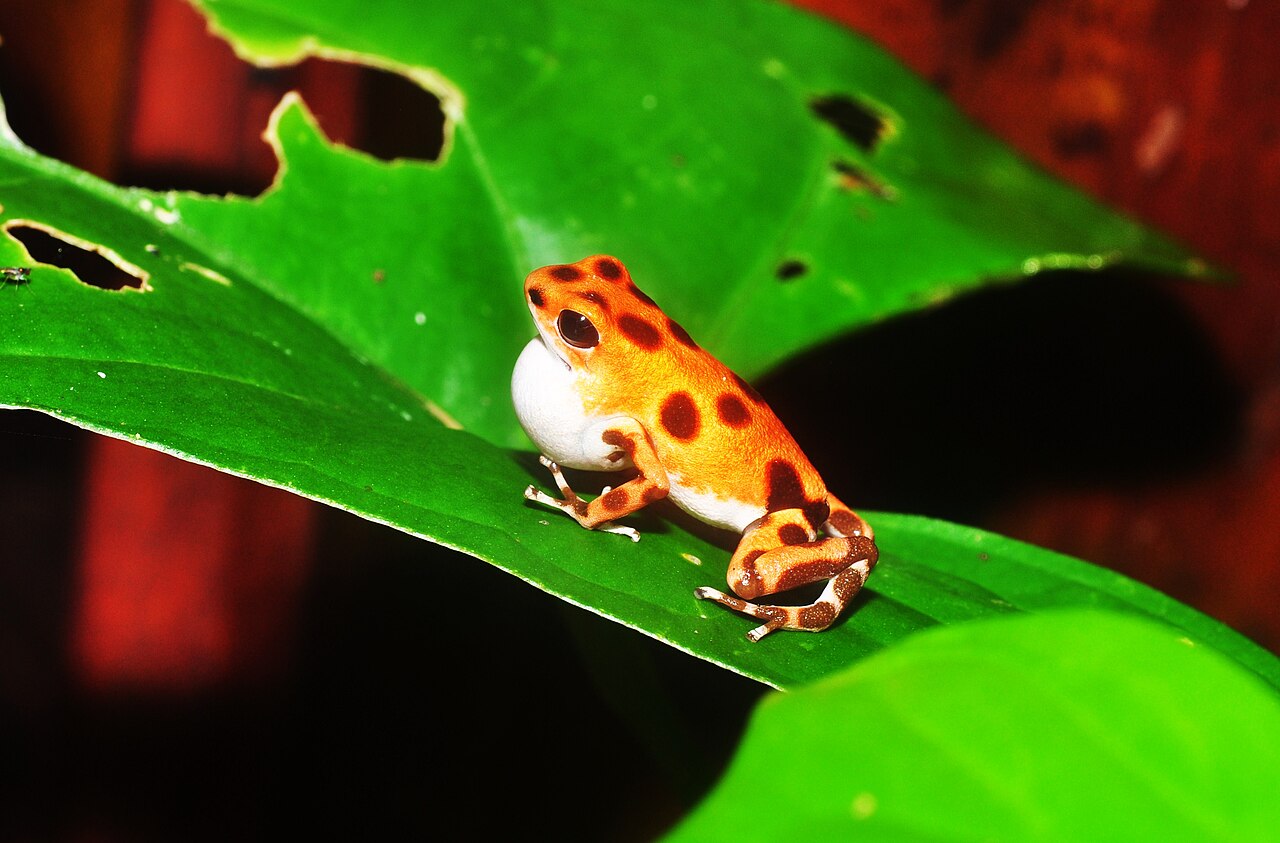
The species occupies humid lowland rainforest on the Caribbean slope from southeastern Nicaragua through Costa Rica to northwestern Panama, generally below 3,000 ft (900 m). Within that forest it lives on the ground and in the leaf litter, climbing into the canopy mainly to use bromeliads as nurseries.
Bromeliads are the hinge of the whole life cycle. Each plant holds a small pool of water in the axils of its leaves, and those pools are where tadpoles develop. A forest without epiphytes cannot support the species regardless of how many adult frogs are released into it, which is why secondary growth and plantation edges hold far fewer frogs than intact forest.
Males are strongly territorial and call from elevated perches, a thin insect like buzz repeated for hours. Densities in good habitat can reach several thousand frogs per acre, making this one of the most abundant vertebrates in Central American lowland forest even though a visitor may walk past dozens without seeing one.
What They Eat and Why the Diet Makes the Poison
Adults eat mites, ants, springtails, and other tiny arthropods, taking hundreds of prey items per day because each is so small. Oribatid mites and formicine ants dominate the diet, and those two groups are not random choices: they are the source of the alkaloids the frog sequesters.
The frog does not synthesize its poison. It absorbs alkaloids from prey, moves them across the gut, and concentrates them in specialized granular glands in the skin, a process called dietary sequestration. Feed the same frog fruit flies and crickets for a generation and the skin chemistry goes blank.
That mechanism explains the sharp difference between wild and captive animals, and it also explains regional differences in potency. A population living in litter rich in toxic mites is dangerous; one a few miles away with different soil fauna is measurably less so. The Smithsonian Institution maintains detailed species accounts on dart frog chemistry and care, available at si.edu.
Tadpole Care: The Frog That Feeds Its Young Eggs
Breeding begins on the forest floor. The female lays a small clutch of 3 to 5 eggs in leaf litter, the male fertilizes them and returns regularly to moisten them with water carried in his cloaca. When the tadpoles hatch after about a week, the female takes over completely.
She backs into the clutch, lets a single tadpole wriggle onto her back, and carries it up a tree to a bromeliad pool, depositing it alone. Then she repeats the trip for the next tadpole, to a different pool. Each tadpole gets its own nursery because they are cannibalistic and would eat each other in shared water.
For the next six to eight weeks the mother visits each pool every few days and deposits unfertilized eggs for the tadpole to eat. These eggs are the tadpole’s only food, and they also transfer the first alkaloids, meaning young frogs leave the pool already chemically defended. The investment is enormous by amphibian standards and closer to what a bird does than what a Pacman frog or any other sit and wait amphibian does.
What Animal Eats a Poison Dart Frog?
Very few animals do, and the best documented is a snake. Species in the genus Erythrolamprus, formerly Leimadophis, are resistant to dart frog alkaloids and prey on them regularly, which makes the snake the answer to what animal is immune to poison dart frogs. Resistance in these snakes comes from modified sodium channels that the toxins cannot bind effectively.
Beyond that, large spiders and some arthropods take juveniles, and a few birds have been observed sampling and rejecting adults. Tadpoles in bromeliad pools face damselfly larvae and other tadpoles. The overwhelming majority of adult mortality comes from desiccation, disease, and the snake, not from general predation.
What kills poison dart frogs at population scale is different again: habitat conversion, the chytrid fungus Batrachochytrium dendrobatidis, and collection for the pet trade. Bright warning color protects an individual frog well and protects a species not at all.
Can You Have a Strawberry Dart Frog as a Pet?
Yes, and captive bred Oophaga pumilio are legal and available in the United States, but this is not a beginner frog. Expect to pay 150 to 400 USD per animal depending on morph, considerably more than the 40 to 90 USD range for common Dendrobates species. Imports are restricted, so verify captive bred provenance in writing.
The setup is a tightly sealed, heavily planted vivarium of at least 18 by 18 by 18 in (45 cm cube) for a pair, with live bromeliads, a drainage layer, 80 to 100 percent humidity, and temperatures held between 72 and 80 F (22 to 27 C). Food is a permanent culture of flightless fruit flies and springtails dusted with vitamin and mineral supplement, which means you are maintaining live insect cultures every week for the life of the animal.
Captive bred frogs are not poisonous, because the mites and ants that supply the alkaloids are absent from the diet. They remain display animals rather than handling animals. Anyone who wants a frog to interact with is better served by a hardier species such as the strawberry Pacman frog or a common tree frog like the American green tree frog.
Conservation Status and Threats
The IUCN lists Oophaga pumilio as Least Concern because the species remains abundant across a broad range, but that assessment hides real local risk. Individual Bocas del Toro island morphs occupy a few square miles each, and several are targeted by collectors precisely because they are rare and visually distinctive.
Deforestation for cattle pasture and banana plantations removes the epiphytes the life cycle depends on. Chytrid fungus has swept Central American amphibians hard, though lowland species have generally fared better than montane ones. Climate driven drying of bromeliad pools is an emerging pressure that directly attacks the nursery stage.
The practical conservation lever for a hobbyist is simple: buy captive bred only, and never buy a frog described by island locality without documentation. Wild collection of a morph confined to one island is the single fastest way to lose it. The transparency of a glass frog and the chemistry of this one are both products of intact lowland forest, and both disappear with it.
Related reading: Blue Poison Dart Frog.
Related reading: Poison Dart Frog Adaptations.
Related reading: Poison Dart Frog Habitat.
Related reading: Poison Dart Frog Colors.
Related reading: Poison Dart Frog Diet.
Frequently Asked Questions
What’s the deadliest poison dart frog?
The golden poison frog (Phyllobates terribilis) of western Colombia. A single wild adult carries around 1 mg of batrachotoxin, enough to kill several adult humans, and it is the only dart frog genuinely used to poison blowgun darts. The strawberry poison dart frog is far weaker by comparison.
What happens if a human touches a dart frog?
With a wild strawberry poison dart frog and intact skin, usually tingling or brief burning. With a cut, the toxin enters the bloodstream and can cause intense pain, numbness, swelling, and in rare cases cardiac symptoms. Wash immediately with soap and water, avoid touching your face, and seek care if symptoms go beyond local irritation.
Can I touch my pet poison dart frog?
Captive bred frogs are not poisonous, so there is no toxin risk to you. There is still risk to the frog: its skin absorbs oils, soaps, and salts and is its breathing surface. Handle only when necessary, using clean wet nitrile gloves, and never as routine interaction.
How much does a strawberry poison dart frog cost?
Between 150 and 400 USD for a captive bred animal in the United States, with rare Bocas del Toro morphs reaching higher. A complete planted vivarium with drainage, misting, lighting, and live food cultures typically adds 300 to 600 USD before the frog arrives.
How long do strawberry poison dart frogs live?
Three to five years in the wild, where desiccation, disease, and snake predation take a steady toll. In a stable captive vivarium they commonly reach 8 to 12 years, and well kept individuals have exceeded that. Females continue breeding for most of their adult lives.
Are captive bred strawberry dart frogs still poisonous?
No. The alkaloids come entirely from wild prey, mainly oribatid mites and formicine ants, and are stored rather than produced. A frog raised on fruit flies and springtails never accumulates them. Frogs caught in the wild lose potency over months in captivity as the stored supply depletes.