Blue Poison Dart Frog: How Poisonous It Is and How to Keep One
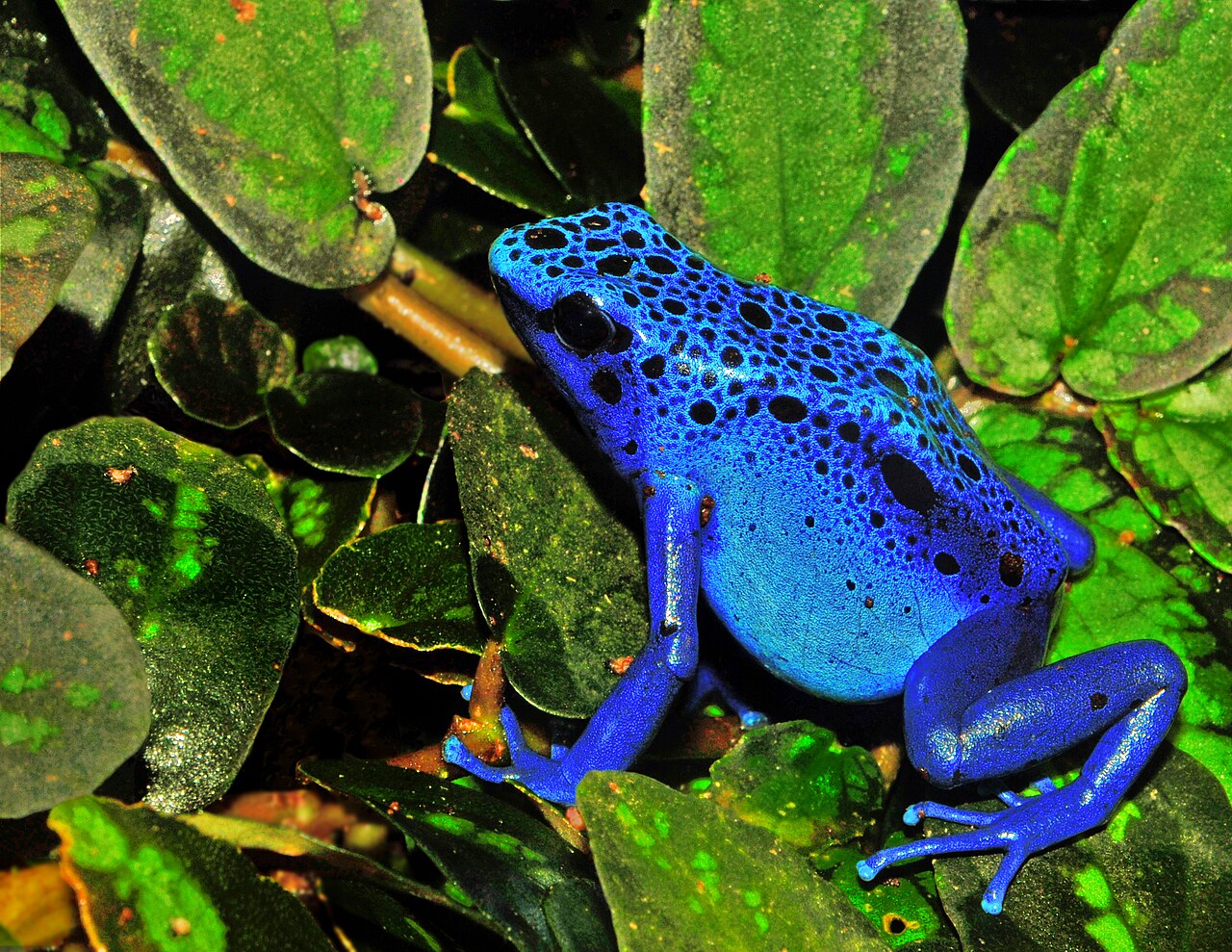
The blue poison dart frog (Dendrobates tinctorius “azureus”) is a cobalt blue, black spotted frog from a handful of isolated forest islands in southern Suriname, and despite the name it cannot kill a person. Wild frogs carry skin alkaloids strong enough to sicken a predator, but this species was never used to tip blowgun darts, and captive bred animals carry no toxin.
It is the frog most people picture when they hear dart frog: electric blue, active in daylight, small enough to sit on a quarter. It is also the most common dart frog in zoos and collections, so the gap between its reputation and its real risk is unusually wide.
The blue poison dart frog grows to 1.2 to 1.8 in (3 to 4.5 cm) and lives in Suriname’s Sipaliwini savanna forest islands. Wild frogs carry pumiliotoxins that cause pain and swelling but are not lethal to humans. Captive bred frogs are nontoxic, because the poison comes from wild ants and mites rather than from the frog itself.
| Quick Facts | Blue Poison Dart Frog |
|---|---|
| Scientific name | Dendrobates tinctorius “azureus” |
| Adult size | 1.2 to 1.8 in (3 to 4.5 cm), females larger |
| Range | Sipaliwini savanna forest islands, southern Suriname |
| Lifespan | 4 to 6 years wild, 10 to 15 in captivity |
| Toxicity | Pumiliotoxins in wild frogs, none in captive bred |
| Price | 60 to 150 USD captive bred in the US |
What Is the Blue Poison Dart Frog?
It is a color form of Dendrobates tinctorius, the dyeing poison frog, long treated as its own species under the name Dendrobates azureus and still sold that way. Genetic work placed it inside tinctorius. Every population lives in relict forest patches ringed by open savanna, cut off from each other for roughly 10,000 years.
Adults reach 1.2 to 1.8 in (3 to 4.5 cm), larger than most Central American species people picture when they hear poison dart frog. The body is deep sky to cobalt blue with darker limbs, and the black spots are unique to each individual, which researchers use like fingerprints. At rest the frog sits hunched, and it walks in short deliberate steps rather than jumping like a blue tree frog.
How Poisonous Is It, and Can You Touch One?
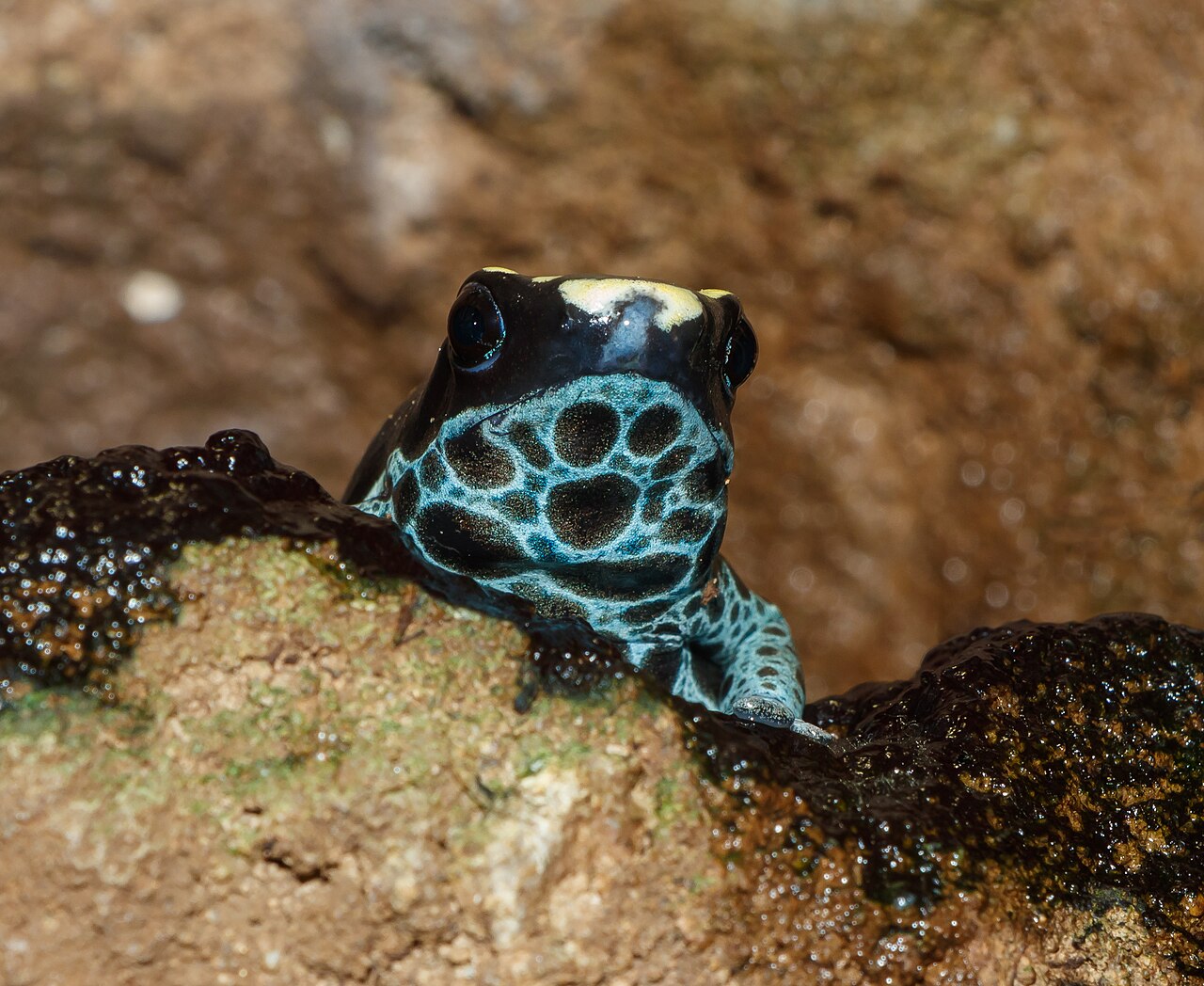
Wild blue poison dart frogs secrete pumiliotoxins from granular skin glands. These alkaloids disrupt sodium and calcium channels in nerve and muscle, so a predator that mouths one gets burning pain, cramping, and often heart arrhythmia. Against a human the dose falls far short of lethal: a whole frog carries a fraction of a milligram, and a human can survive a poison dart frog of this species without difficulty.
You should still not touch a wild one. Toxin entering through a cut or reaching the eyes causes real pain and swelling, and there is no antidote, only supportive care. Touching a blue poison dart frog also harms the frog, whose permeable skin absorbs hand oils and soap residue and doubles as its breathing surface. Captive bred frogs are chemically blank and pose no toxin risk at all.
Where It Lives and What It Eats
The entire wild range covers a few square miles of forest fragments along creeks in the Sipaliwini savanna of southern Suriname. Each patch is humid gallery forest with deep leaf litter, mossy boulders, and constant shade, an island of rainforest inside open grassland.
Frogs stay near water and forage by day through litter for ants, termites, mites, springtails, and small beetles. Ants and oribatid mites matter most, because they supply the alkaloids the frog stores, which is why captive animals lose their poison. Males call a soft trill and hold small territories, and the male carries hatched tadpoles on his back to bromeliad pools or tree holes, where they develop for 10 to 12 weeks.
Can I Keep a Dart Frog as a Pet?
Blue poison dart frogs are one of the better first dart frogs, and captive bred animals run 60 to 150 USD in the United States. A pair needs a sealed, planted vivarium of at least 18 by 18 by 18 in (45 cm cube), humidity near 80 percent, 72 to 80 F (22 to 27 C), a drainage layer, and deep leaf litter with a resident springtail culture.
Food is flightless fruit flies dusted with calcium and vitamin A supplement every two or three days, plus whatever micro fauna the tank produces. Vitamin A deficiency is the most common cause of death in captive dart frogs, so supplement rotation is not optional. They are display animals, not handling animals, and live 10 to 15 years. Anyone drawn mainly to the color might prefer a hardier blue tailed skink, and the same warning coloration logic shows up in the blue morpho butterfly.
Conservation and Where to See One
The IUCN assesses Dendrobates tinctorius as Least Concern across its wide Guianan range, but the azureus populations occupy a tiny fragmented area and cannot absorb collection pressure. Suriname restricts export, so wild caught animals are effectively absent from legal US trade. The real threats are fire pushing in from the savanna, drying creeks, and chytrid fungus.
Zoos have bred the species reliably for decades, so almost every blue frog in the hobby traces to captive lines many generations deep. Most large US amphibian houses keep them, often alongside species such as the glass frog, and their daytime activity makes them one of the few amphibians reliably visible to visitors. Species profiles are published by the Smithsonian at si.edu.
Related reading: Strawberry Poison Dart Frog.
Frequently Asked Questions
How long does a blue poison dart frog live?
Four to six years in the wild, where predation and drying habitat take a toll. In a stable vivarium with correct humidity and supplemented food, 10 to 15 years is normal and some pass 20, making them one of the longest lived amphibians in the hobby.
What is the deadliest frog on Earth?
The golden poison frog (Phyllobates terribilis) of the Colombian Pacific coast. A single wild adult carries roughly 1 mg of batrachotoxin, theoretically enough to kill several adults, and it is the only frog genuinely used to poison blowgun darts. The blue poison dart frog is not in that category.
Can a human survive a poison dart frog?
Yes, for this species. Contact with a wild blue poison dart frog causes burning, numbness, and swelling, worse if toxin enters a cut, but not death. There are no confirmed human fatalities from Dendrobates species. Wash immediately, keep hands away from eyes and mouth, and seek care if symptoms spread.
How much does a poison dart frog cost?
Captive bred blue poison dart frogs run 60 to 150 USD each, and common green and black or yellow banded species start near 40 USD. The vivarium, misting system, lighting, and live food cultures usually cost more than the frogs themselves.