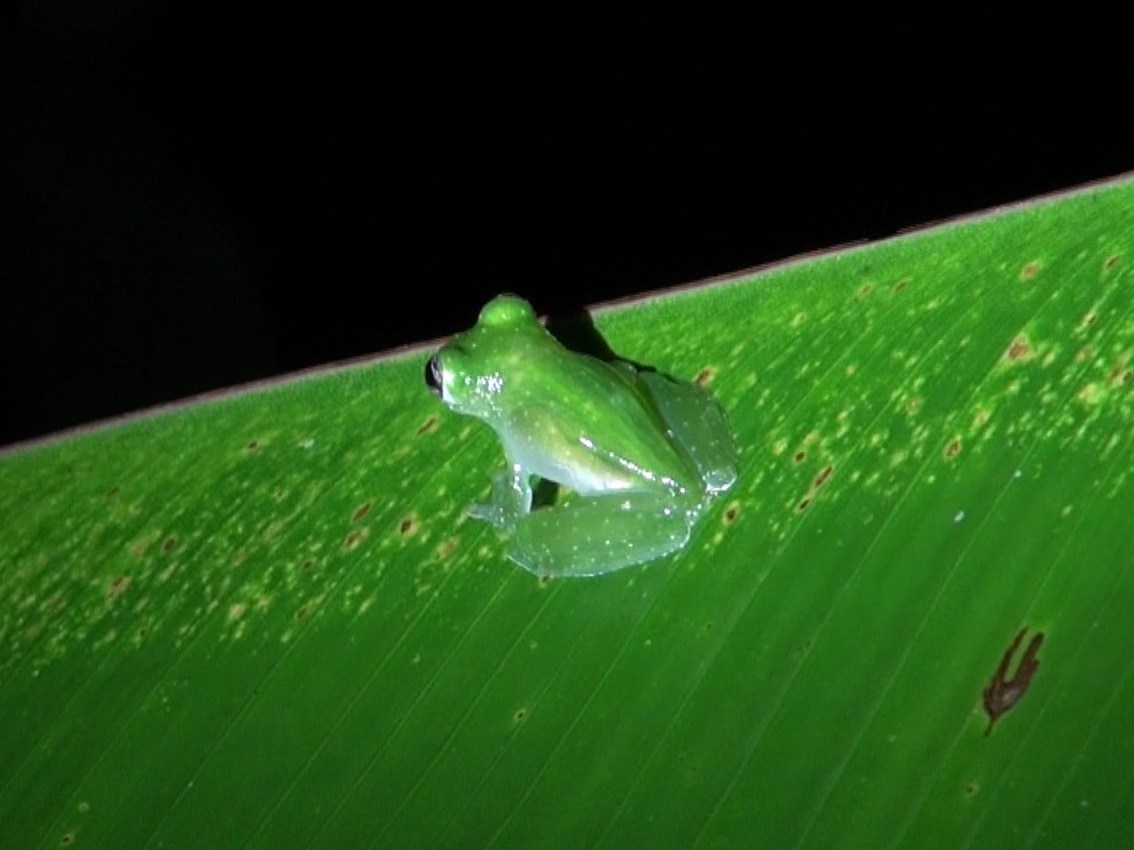
Glass Frog: Why You Can See Its Heart Beating
A glass frog is a small tree frog from the family Centrolenidae whose belly skin is so clear that you can watch the heart beat through it. Roughly 160 species live in the wet forests of Central and South America, and nearly all of them spend their nights on leaves hanging over running water.
From above the animal is unremarkable: lime green, thumbnail sized, easy to walk past. Turn one over and the trick is obvious. The underside carries almost no pigment, so the liver, the intestines and the pulsing heart sit in plain view.
Glass frogs are about 160 species of small Central and South American tree frogs with transparent belly skin that exposes the heart, liver and intestines. Most adults measure 0.8 to 1.2 in (20 to 30 mm), breed on streamside leaves, are neither venomous nor poisonous, and make poor beginner pets.
| Quick fact | Detail |
|---|---|
| Family | Centrolenidae, about 160 described species |
| Adult size | 0.8 to 1.2 in (20 to 30 mm); largest near 3 in (75 mm) |
| Range | Southern Mexico to Bolivia, Amazon basin, Guiana Shield |
| Habitat | Leaves overhanging fast, clear streams |
| Diet | Small flies, ants, spiders, moths |
| Danger to people | None. No venom, no significant skin toxins |
| Captive price | Roughly 100 to 400 USD, captive-bred |
What Is a Glass Frog?
A glass frog is any member of Centrolenidae, a family of small nocturnal tree frogs restricted to the American tropics. The best known species is the reticulated glass frog, Hyalinobatrachium valerioi, whose spotted green back mimics its own egg clutch. Most adults fit on a US quarter at 0.8 to 1.2 in (20 to 30 mm), and the giant of the family, Centrolene geckoideum, still only reaches about 3 in (75 mm). Seen from above they are uniform lime to olive green, often flecked with yellow. In several species the bones glow pale green under a flashlight, and the eggs of a gravid female are visible without anyone touching her.
Why Can You See Through a Glass Frog?
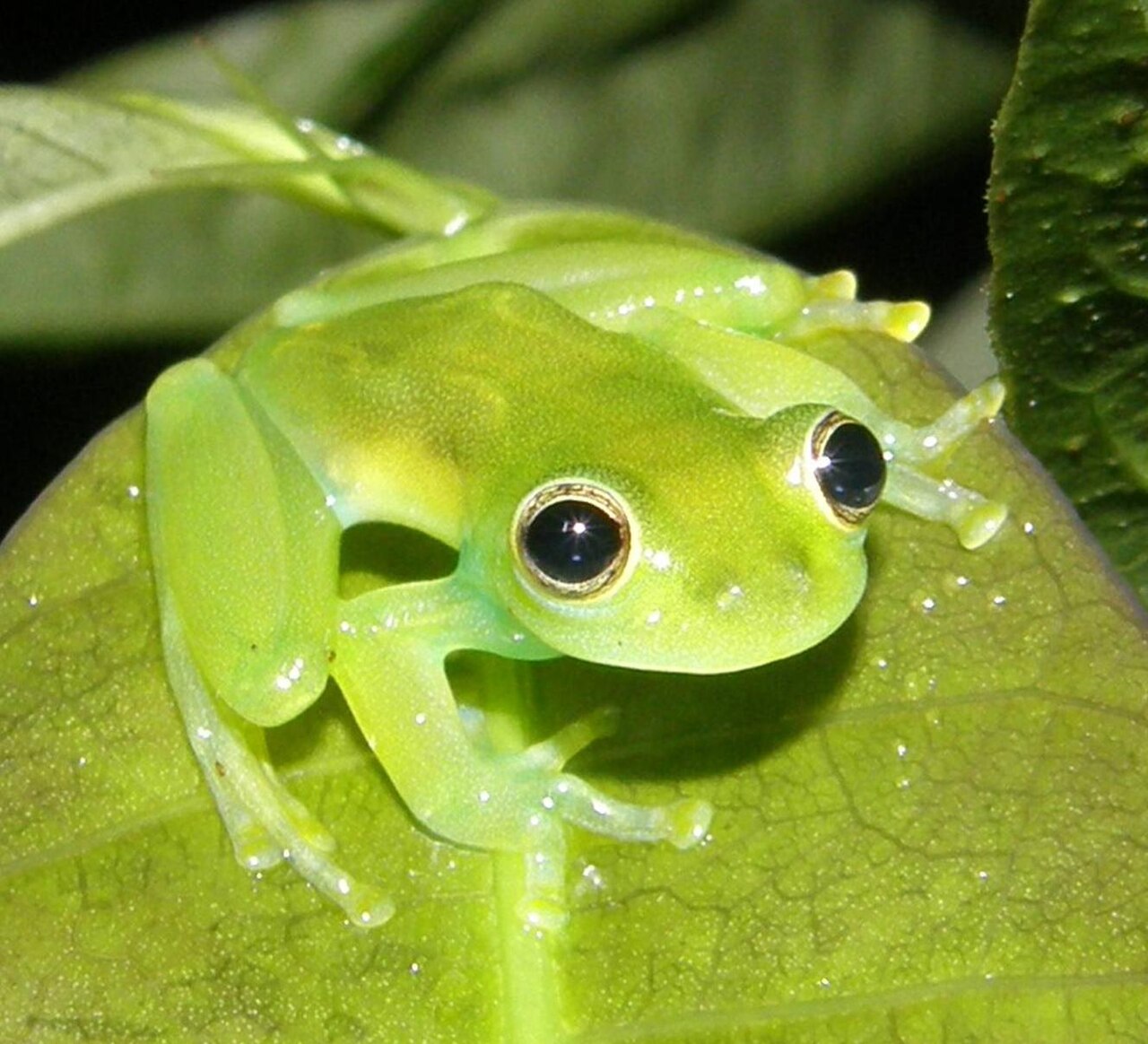
Blood is what normally stops an animal from being see-through, and glass frogs get around it by hiding theirs. A 2022 study of the northern glass frog, Hyalinobatrachium fleischmanni, found that sleeping frogs pack most of their red blood cells into the liver, which is wrapped in reflective guanine crystals. The animal becomes 34 to 61 percent more transparent while it rests, then releases the cells again when it wakes.
The payoff is camouflage of an unusual kind. A transparent frog does not match the leaf, it softens its own outline, so the edge where frog stops and leaf begins never resolves for a passing bird.
Where Glass Frogs Live and What They Eat
The family runs from southern Mexico through Central America and down the Andes into Bolivia, with a second concentration in the Amazon basin. Species occupy lowland rainforest at sea level up to cloud forest above 7,500 ft (2,300 m), but nearly all need the same thing: vegetation leaning over a clear, fast stream, because the stream is where the tadpoles end up.
Adults hunt small arthropods at night, mostly flies, ants, springtails and moths taken off leaf surfaces. Males call from leaf undersides, a short high peep repeated for hours, nothing like the calls of common North American frogs.
Is Glass Frog Venomous, or Poisonous to Touch?
No glass frog is venomous. Venom needs a delivery system such as a fang or spine, and frogs have neither. The useful question is whether the skin is poisonous, and there too the answer is reassuring: glass frogs carry only mild secretions that deter some invertebrates and do nothing to a human hand. They are nowhere near the toxin-loaded dart frogs of the same forests. No glass frog has ever been recorded harming a person. Wash your hands anyway, because the real risk runs the other direction: bacteria travel from frog to person far more easily than any toxin does.
Can You Touch a Glass Frog?
You can, and you should not. Amphibian skin is a breathing and drinking organ, and a glass frog weighs less than a paperclip, so sunscreen, lotion, soap residue and salt on human fingers go straight into an animal with no margin. Handling also spreads the amphibian chytrid fungus between individuals and sites, which is the biggest killer of tropical frogs alive today. Keepers who maintain them move animals with a cup, and only when an enclosure has to be cleaned. That hands-off rule is why glass frogs suit display keepers, not people who want a frog that tolerates contact the way a White’s tree frog does.
How Rare Is a Glass Frog, and How Much Is a Glass Frog Worth?
As a family, glass frogs are not rare. Individual species often are, because many are confined to a single valley or ridge, and a large share of Centrolenidae is listed as threatened or data deficient by the IUCN. Chytrid, stream siltation and cloud forest clearance hit them hard. All glass frogs went on CITES Appendix II in 2023, so international trade now needs permits. The Smithsonian’s National Zoo and Conservation Biology Institute runs one of the long-standing captive programs for Central American amphibians. On the US market, captive-bred Hyalinobatrachium valerioi runs 100 to 400 USD per frog. Wild-caught imports are cheaper and worth refusing.
Related reading: Glass Frog Habitat.
Frequently Asked Questions
What is the lifespan of a glass frog?
Published captive records for Hyalinobatrachium species run about 10 to 14 years. Wild lifespan has not been measured for any glass frog, so the figures of 5 or more years you will see quoted are inferences from body size and breeding behavior, not from marked animals followed over time.
Is a glass frog a good pet?
Only for experienced keepers. They need moving water, 70 to 80 percent humidity, cool nights, live plants and a steady supply of flightless fruit flies and springtails. They cannot be handled, they hide all day, and a lapse in misting or ventilation kills them in days rather than weeks.
What is the deadliest frog on Earth?
The golden poison frog, Phyllobates terribilis, of western Colombia. One wild adult carries enough batrachotoxin to kill several people, and there is no antidote. Captive-bred individuals raised on fruit flies lose the toxicity entirely, because they never get the alkaloid precursors that wild prey supplies.
Can I own a glass frog legally in the US?
In most states yes, provided the animal was legally imported or captive-bred. The CITES Appendix II listing controls international movement rather than private ownership, but a seller should still be able to show paperwork. Check state and city exotic animal rules first, since a few restrict amphibians outright.
What is the friendliest pet frog?
White’s tree frog earns that reputation: calm, slow moving, tolerant of brief handling and often waiting at the glass. Pacman frogs are hardy but bite, and dart frogs are display animals only. Among any group of frogs kept in captivity, friendly means tolerant, never affectionate.