Black Fuzzy Caterpillar: ID by Color and Which Ones Sting
A black fuzzy caterpillar is most often a woolly bear, a giant leopard moth larva, or a tussock moth caterpillar, and the colors mixed in with the black tell you which. Black with a rust-brown band means a banded woolly bear. Solid black showing red between the segments when curled means a giant leopard moth. Black and white tufts with long black pencils means a hickory tussock moth, and that one is worth not touching.
Most black fuzzy caterpillars are harmless to handle, but a few cause genuine skin reactions, and the difference is not obvious from a distance. This guide sorts them by the color combination you actually see, covers which ones sting or irritate, explains what they turn into, and answers the winter folklore question that brings most people here in autumn.
| What You See | Likely Species |
|---|---|
| Black ends, rust-brown middle band | Banded woolly bear, harmless |
| Solid black, red bands when curled | Giant leopard moth, harmless |
| Black and white tufts, long black pencils | Hickory tussock moth, can irritate |
| Black with orange or yellow tufts | Tussock moth species, can irritate |
| Dense black with yellow spines | Buck or io moth larva, stings |
| Black with white speckles and branched spines | Spiny elm caterpillar, harmless |
Start With the Second Color
Black alone identifies almost nothing, because a great many caterpillars are predominantly black. What narrows it down is whatever else is present: a band, tufts, spines, speckling, or the color that shows when the animal curls up.
Texture is the second axis. Soft dense bristles that look like fur point toward the tiger moth group, which includes the woolly bears. Distinct tufts arranged in clumps along the back, often with longer hair pencils projecting forward and backward, point toward tussock moths. Stiff branched spines that look like miniature trees point toward brush-footed butterfly larvae.
Host plant narrows it further, since caterpillars are usually found on what they eat. Our guides to the fuzzy caterpillar and the black caterpillar approach the same identification problem from the other two directions, by hairiness and by color across all textures.
Black With a Brown Band: The Woolly Bear
This is the most searched combination and the answer is the banded woolly bear, larva of the Isabella tiger moth. It reaches about 2 in, with black at both ends and a rust-brown to reddish band across the middle, covered in dense stiff bristles.
It is completely harmless. There is no venom and no stinging spine, the bristles are physical defense against birds and parasitic wasps, and children handle them every autumn without incident. Sensitive individuals occasionally get brief mild irritation from the bristles, which washing and adhesive tape resolve.
The band width folklore is wrong and worth addressing directly, since it is why many people search in the first place. A wide rust band does not predict a mild winter. Band width reflects the caterpillar’s age and how good the previous growing season was, and caterpillars collected from one field on one afternoon show different bands. Our guide to the woolly bear caterpillar covers the origin of the myth and the biology behind it.
Solid Black With Red Bands: Giant Leopard Moth
A jet black caterpillar with stiff glossy bristles that reveals brilliant red or orange bands between its segments when it curls into a ball is a giant leopard moth larva. It reaches about 2 in and the red is invisible until the animal rolls up, which is why people describe it as solid black.
It is harmless. The bristles are stiff but not venomous, and the defense is curling and being unpleasant to swallow rather than any chemical delivery. It feeds on a wide range of broadleaf plants including dandelion, plantain, violets, and cherry. For a closely related question, see our guide to red and black caterpillar.
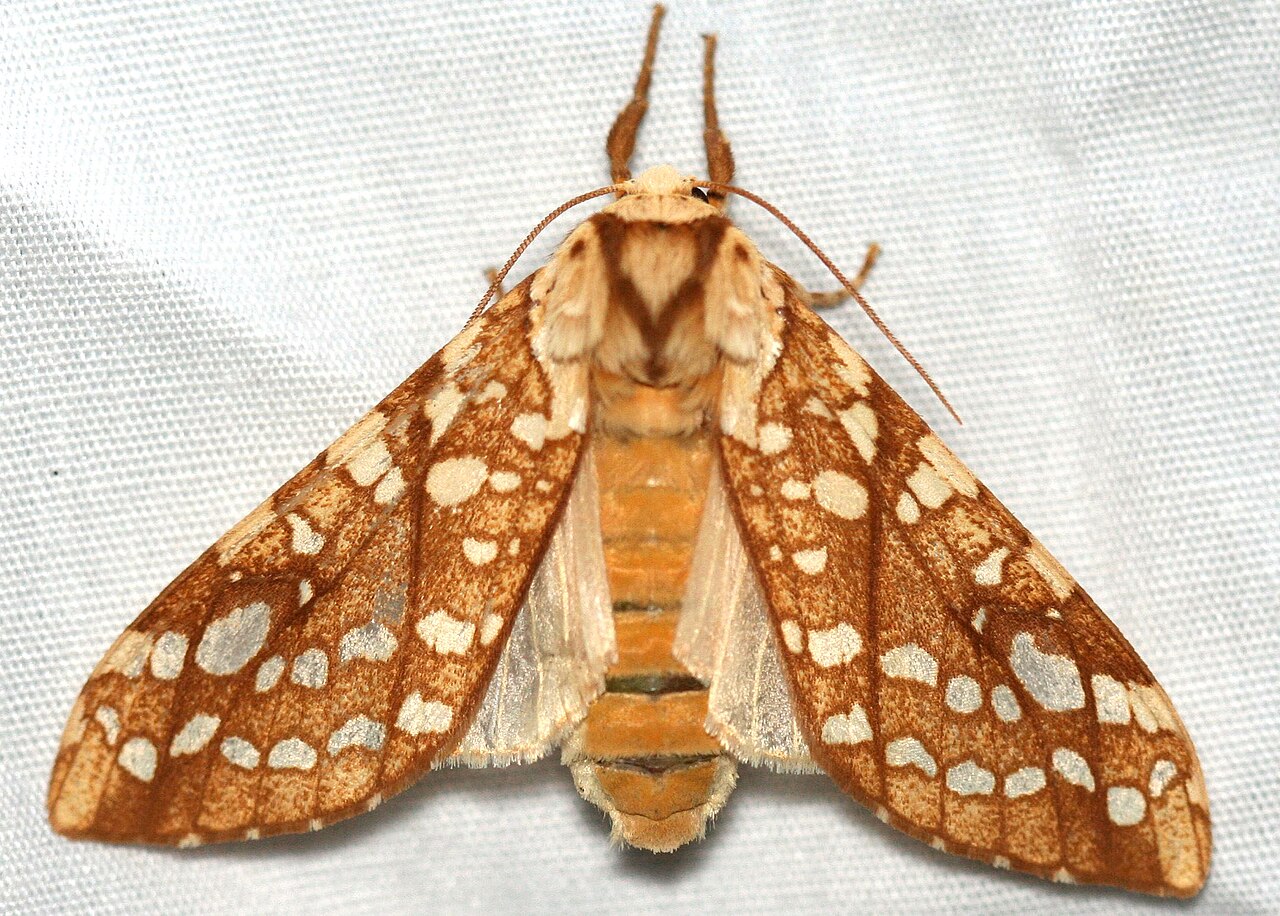
The adult is unrecognizable next to the larva, a striking white moth up to 3 in across patterned with black rings and spots and carrying an iridescent blue and orange abdomen. Like the woolly bear, this species overwinters as a caterpillar, which is why both turn up crossing pavement in autumn and on warm winter days.
Black and White Tufts: Tussock Moths
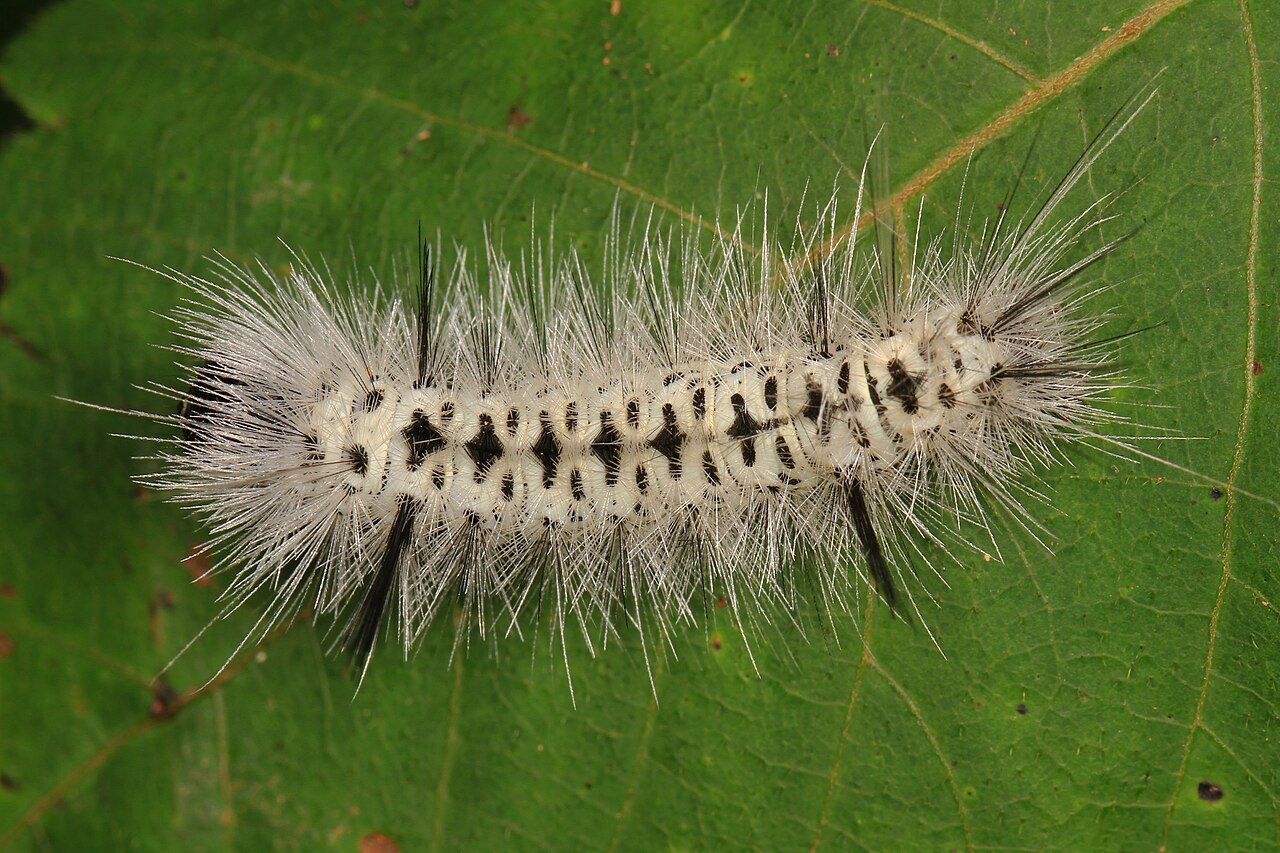
This is the group to be careful with. Hickory tussock moth caterpillars are white to pale grey with a row of black tufts down the back and long black hair pencils projecting from each end, and they are common across the eastern United States and Canada in late summer.
They cause contact dermatitis in a substantial number of people. The hairs break off in skin and produce itching, redness, and a rash that can last several days, and reactions vary from mild to genuinely uncomfortable. Schools in affected regions issue warnings about them most autumns.
Related species share the pattern and the problem. White-marked tussock moth larvae have four dense white or cream tufts on the back, red spots, and black pencils, and the spongy moth caterpillar is dark and hairy with paired blue and red dots, causing similar reactions during outbreak years. None of these is dangerous in a medical emergency sense, but none should be handled bare-handed either.
Black With Orange or Yellow
Black and orange fuzzy caterpillars generate substantial search traffic and cover several species. Some tussock moth larvae carry orange tufts alongside black ones, and the giant leopard moth reads as black and orange when curled.
Yellow woolly bears are a separate species entirely, the larva of the Virginian tiger moth, and they range from pale yellow through cream to orange rather than being banded. They are harmless, though their hairs irritate somewhat more readily than banded woolly bear bristles.
The combination that genuinely warrants caution is dense black with prominent yellow or orange spines rather than soft hairs. Buck moth and io moth caterpillars carry branched hollow spines connected to venom glands, and contact produces immediate burning pain rather than delayed itching. Spines versus hairs is the distinction that matters, and it is visible up close: spines are stiff, branched, and sparse, while hairs are soft, dense, and numerous.
Which Ones Actually Sting
Very few, and they are identifiable. The genuinely venomous caterpillars in North America are the puss caterpillar, the saddleback, the io moth, the buck moth, the hag moth, and a small number of relatives, all of which have hollow spines connected to venom glands.
The reaction is immediate and unmistakable. A sting produces burning pain within seconds, often described as worse than a wasp sting, along with swelling and sometimes a grid-shaped mark matching the spine pattern. The puss caterpillar in particular causes severe pain that can radiate up the limb and occasionally causes systemic symptoms requiring medical attention.
By contrast, tussock moth and woolly bear reactions are delayed, itchy rather than painful, and confined to the contact area. If you have been stung, remove embedded spines with adhesive tape pressed on and lifted away, wash with soap and water, apply a cold compress and hydrocortisone, and contact poison control at 1-800-222-1222 in the United States if pain is severe or symptoms extend beyond the skin.
Black Fuzzy Caterpillars That Are Not Fuzzy
Two common finds get described as fuzzy and are not. The spiny elm caterpillar is black with fine white speckling, red-orange spots, and prominent branched black spines, feeding in groups on elm and willow, and it does not sting despite the formidable appearance. It becomes the mourning cloak butterfly.
Black swallowtail caterpillars in their early stages are black with a white saddle and small spiny projections, mimicking bird droppings. They change completely to smooth green with black bands as they grow, and they feed on parsley, dill, fennel, and carrot tops.
Sawfly larvae round out the confusion. They look like caterpillars, feed in dense synchronized groups, and rear back in unison when disturbed, but they are wasp relatives with six or more pairs of fleshy prolegs rather than the five or fewer that true caterpillars have. That distinction matters because Bacillus thuringiensis, the standard organic caterpillar control, has no effect on them.
What They Turn Into
None of these becomes a butterfly, with the exception of the spiny elm caterpillar and the swallowtail mentioned above. The fuzzy black caterpillars are moth larvae, and the adults are generally far less conspicuous than the caterpillars that produce them.
Banded woolly bears become Isabella tiger moths, dull yellowish-orange insects with small black dots that almost nobody recognizes despite knowing the caterpillar well. Giant leopard moth caterpillars become large striking white moths with black rings. Tussock moth larvae become small grey or brown moths, and in several species the females are flightless with reduced wings.
Timing varies by group. Woolly bears and giant leopard moths overwinter as caterpillars and pupate in spring, while tussock moths overwinter as eggs or pupae, which is why the caterpillars appear at different times of year. Our guides to the imperial moth and the white moth cover adults from the same broad family.
What to Do When You Find One
Leave it alone, in almost every case. Caterpillars are the single most important food source for nesting songbirds, with a chickadee pair needing thousands to raise one brood, and the fuzzy black species cause no meaningful plant damage in a garden.
If one is crossing pavement in autumn, it is looking for an overwintering site and moving it to leaf litter in the direction it was heading genuinely helps. Do not put it back on a plant, since a wandering caterpillar in late season has finished feeding.
If you must handle one, use a leaf or a stick rather than fingers, which costs nothing and removes the identification question entirely. Wash afterward regardless, and if a rash develops, adhesive tape lifts embedded hairs and hydrocortisone handles the itching. Leaving leaf litter and standing stems through winter protects the ones sheltering in your yard, which is the single most useful thing a property can do for them, and the same applies to the species in our guide to the monarch caterpillar.
Related reading: Black and Orange Caterpillar.
Frequently Asked Questions
What is a black and brown fuzzy caterpillar?
A banded woolly bear, larva of the Isabella tiger moth, with black at both ends and a rust-brown band across the middle. It is completely harmless and reaches about 2 in. The band width does not predict winter weather, contrary to the folklore.
What is a solid black fuzzy caterpillar?
Usually a giant leopard moth larva, jet black with stiff glossy bristles that reveals bright red bands between the segments when it curls into a defensive ball. It is harmless and becomes a large white moth patterned with black rings.
Do black fuzzy caterpillars sting?
Most do not. Woolly bears and giant leopard moth larvae are harmless, while tussock moth caterpillars cause delayed itchy contact dermatitis in many people. The genuinely venomous species, including buck and io moth larvae, have stiff branched spines rather than soft dense hairs and cause immediate burning pain.
What is the black and white fuzzy caterpillar with long hairs?
Most likely a hickory tussock moth caterpillar, white to pale grey with black tufts down the back and long black hair pencils at each end. It causes contact dermatitis in a substantial number of people and should not be handled bare-handed.
What should I do if I get a rash from a caterpillar?
Press adhesive tape on the area and lift it away to remove embedded hairs, wash with soap and water, and apply a cold compress with 1 percent hydrocortisone. Contact poison control at 1-800-222-1222 if pain is severe or symptoms spread beyond the contact area.
Does a black woolly bear mean a hard winter?
No. A very narrow rust band, which makes the caterpillar look nearly all black, indicates a young caterpillar that has not molted many times, usually because the feeding season was short or dry. It says nothing about the winter ahead.
How do I tell a caterpillar from a sawfly larva?
Count the fleshy prolegs on the abdomen. Caterpillars have five pairs or fewer, sawfly larvae six or more. Sawflies also feed in dense groups and rear back in unison when disturbed, and Bacillus thuringiensis has no effect on them.