Black Caterpillar: Identification Guide by Markings
A black caterpillar in a North American yard is most likely a giant leopard moth larva, a black swallowtail caterpillar, a spiny elm caterpillar, or one of several tiger moth larvae. Nearly all of them are harmless to handle, and the ones worth avoiding are identifiable by their spines rather than by their color.
Black is a common caterpillar color precisely because it does several jobs at once: it absorbs heat, it warns predators when paired with red or orange, and on a leaf it can read as a bird dropping. This guide sorts black caterpillars by the markings that accompany the black, since that is what actually identifies them, and covers which ones sting, what they turn into, and what to do when you find one.
| Caterpillar | Key Feature |
|---|---|
| Giant leopard moth | Jet black bristles, red bands visible when curled |
| Black swallowtail (young) | Black with a white saddle, mimics bird droppings |
| Spiny elm caterpillar | Black with white flecks, red spots, branched spines |
| Eastern tent caterpillar | Black with a white stripe down the back |
| Spongy moth | Dark with paired blue and red dots |
| Sawfly larvae | Not a caterpillar, feeds in dense groups |
Most black caterpillars in North American yards are one of a few species: the giant leopard moth caterpillar (bristly black with red bands), the black swallowtail (smooth black with yellow dots), the spiny elm caterpillar (black with red spots and spines) or the mourning cloak. Fuzzy black caterpillars are usually harmless; the spiny ones can cause mild skin irritation.
What Black Caterpillar Did You See?
Look past the black at what accompanies it. A uniformly black fuzzy caterpillar is a different animal from a black caterpillar with a white stripe, which is different again from a black one with branched spines and red spots. The secondary markings carry nearly all the identifying information.
Then check the texture. Dense soft-looking bristles point to the tiger moth group, which includes the woolly bears. Stiff branched spines that look like miniature trees point to the brush-footed butterflies. A smooth body with no projections points to swallowtails or sphinx moths.
Finally note the host plant, since caterpillars are usually found on what they eat. Parsley, dill, and carrot tops mean a swallowtail. Elm and willow mean a spiny elm caterpillar. Cherry and apple in spring mean tent caterpillars. Our guide to the fuzzy caterpillar handles identification by hairiness, which is the other axis people search on.
Black Caterpillars With Red or Orange Bands
The giant leopard moth caterpillar is the classic all-black species and the one most people mean. It reaches about 2 in, is covered in stiff glossy black bristles, and appears entirely black until it curls into a defensive ball, at which point brilliant red or orange bands between the body segments become visible.
It is completely harmless. The bristles are stiff but not venomous, and the caterpillar’s defense is to curl up and rely on being unpleasant to swallow. It feeds on a wide range of broadleaf plants including dandelion, plantain, violets, and cherry, and it overwinters as a caterpillar, which is why they turn up crossing pavement in autumn and again on warm winter days.
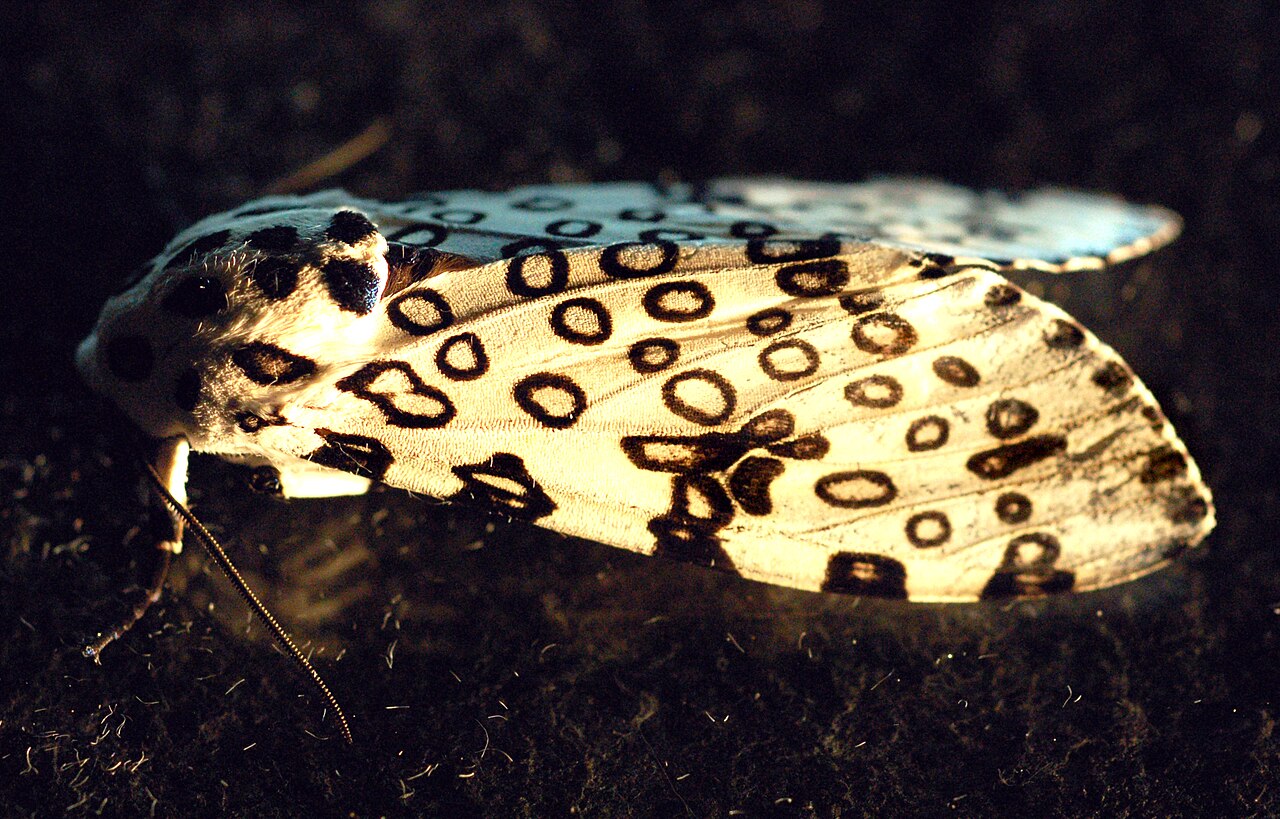
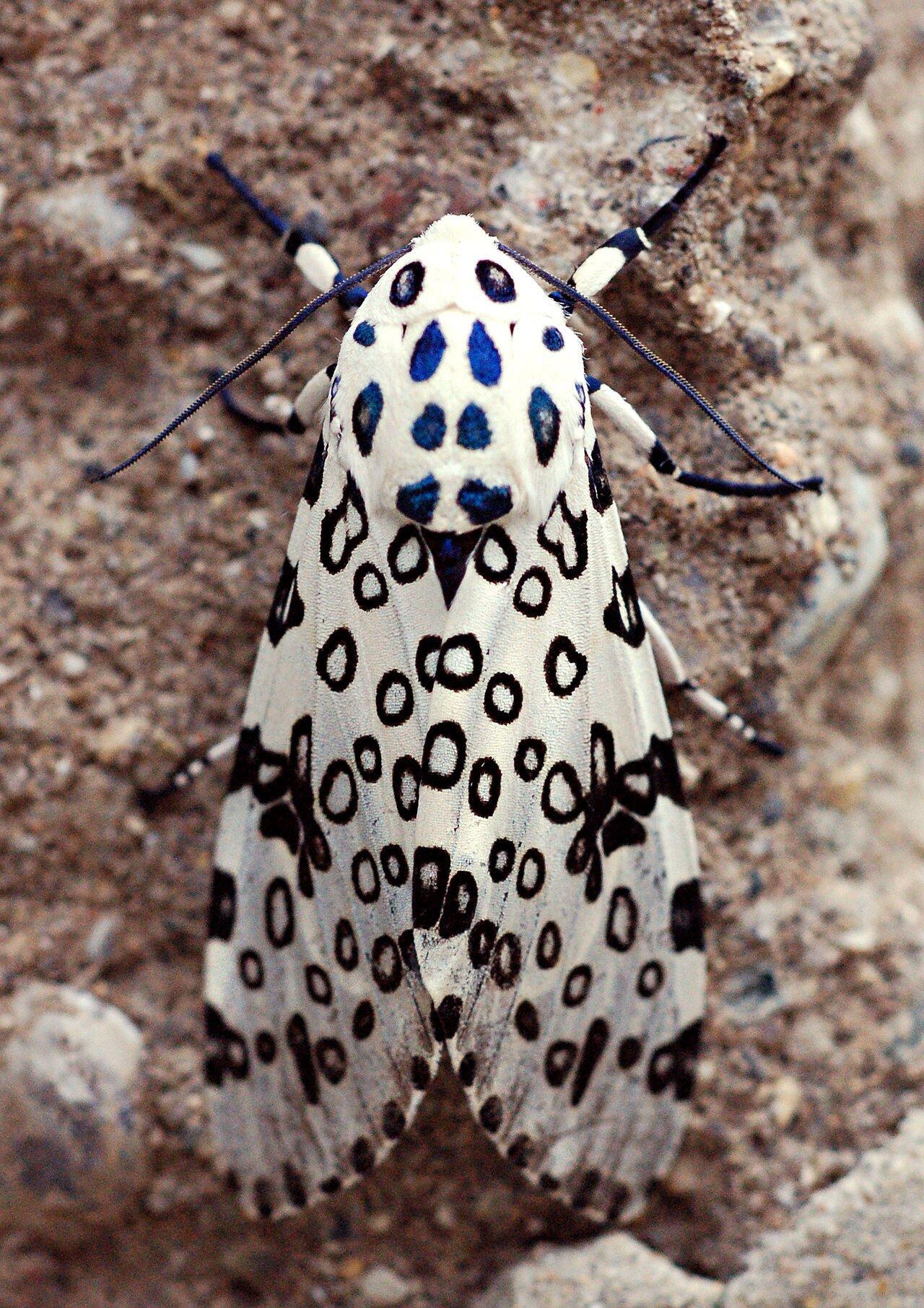
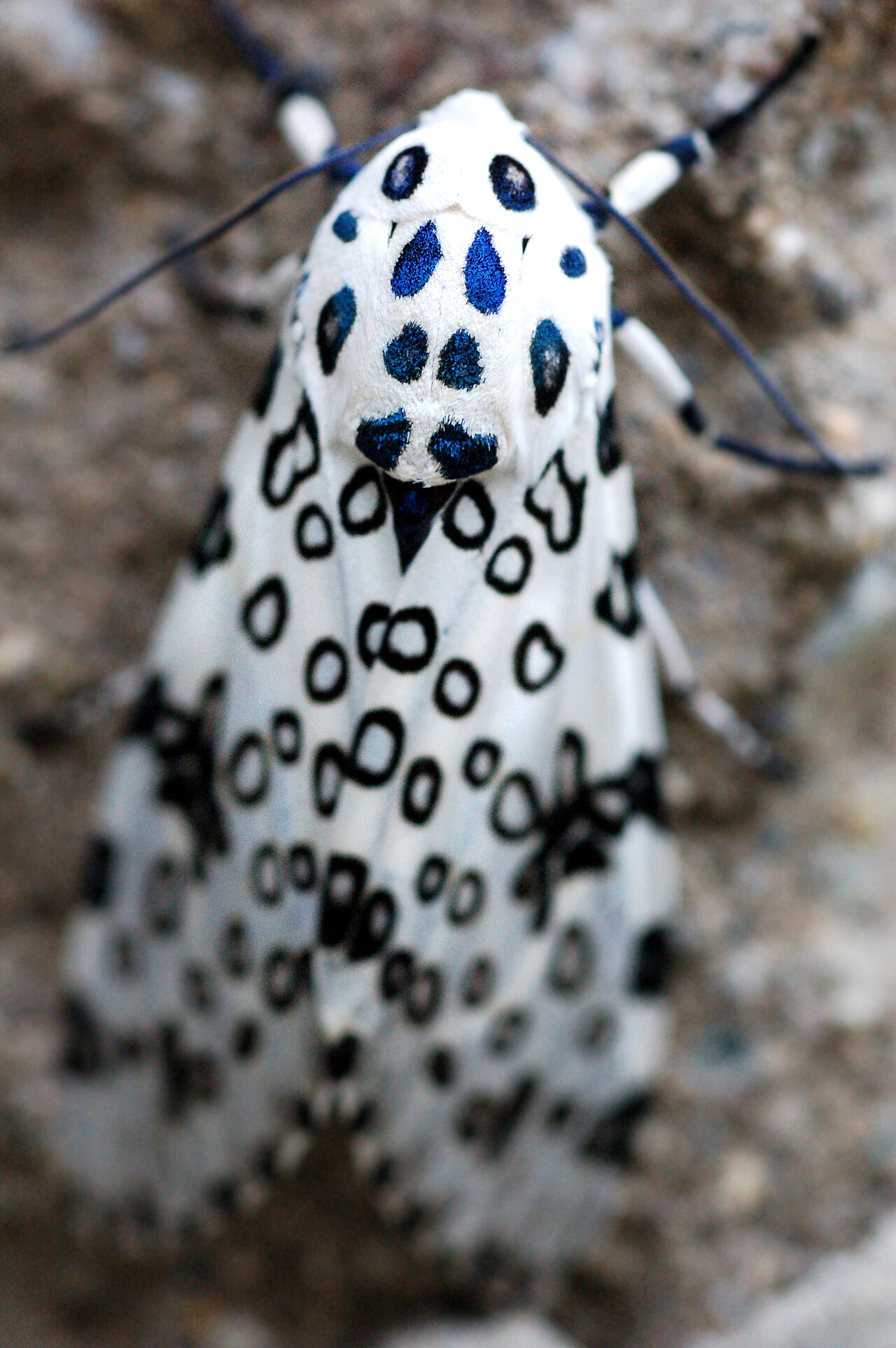
The adult is worth knowing because it looks nothing like the larva. The giant leopard moth is a striking white moth with a wingspan up to 3 in, patterned with black rings and spots and carrying an iridescent blue and orange abdomen. Dark banded woolly bears with very narrow rust bands can also look nearly black, which our guide to the woolly bear caterpillar sorts out.
Black Caterpillars With Spines
The spiny elm caterpillar is black with fine white speckling, a row of red-orange spots down the back, and prominent branched black spines. It reaches about 2 in and feeds in groups on elm, willow, hackberry, and poplar, sometimes defoliating individual branches. For a closely related question, see our guide to red and black caterpillar.
Despite its formidable appearance it does not sting. The spines are mechanical defense and cause at most mild irritation. It becomes the mourning cloak butterfly, a dark maroon insect with cream wing borders that is among the longest-lived butterflies in North America, overwintering as an adult and often flying on the first warm days of spring before any flowers open.
Genuinely stinging spiny caterpillars exist and are worth recognizing. The saddleback, io moth, buck moth, and puss caterpillar have hollow spines connected to venom glands, and contact causes immediate burning pain, swelling, and occasionally systemic symptoms. None of them is predominantly black, but the general rule applies: do not handle unfamiliar spiny caterpillars bare-handed, and contact poison control at 1-800-222-1222 in the United States if a sting causes more than local pain.
Smooth Black Caterpillars
Young black swallowtail caterpillars are black with a white band across the middle and small spiny protrusions, and the resemblance to a bird dropping is deliberate. Predators that hunt by sight skip over them entirely, which is one of the more elegant defenses in the insect world.
They change completely as they grow. Later instars become smooth green with black bands and yellow dots, looking like a different species, and they feed on parsley, dill, fennel, carrot tops, and Queen Anne’s lace. Gardeners who find them on herbs often want them gone, but leaving a few plants for them is the price of having swallowtails in the yard.
Both stages carry a hidden defense. When threatened, a swallowtail caterpillar everts a fleshy orange forked organ behind its head called an osmeterium and releases a sharp citrus-like smell that deters ants and small predators. It is harmless to people and startling the first time you see it. The adults are among the butterflies covered in our guides to the blue butterfly and the purple butterfly.
Black Caterpillars With Stripes or Dots
Eastern tent caterpillars are black with a distinct white stripe down the back, blue and orange markings along the sides, and fine hairs. They appear in spring on cherry, apple, and crabapple, and they build the conspicuous silk tents in branch forks that get blamed on webworms.
Their tents are the identifying feature and the timing separates them from fall webworms, which build at branch tips in late summer instead. Neither typically threatens an established tree, and both are heavily controlled by parasitic wasps and birds, so insecticide usually costs more than it saves.
Spongy moth caterpillars, formerly called gypsy moths, are dark and hairy with five pairs of blue dots followed by six pairs of red dots down the back, which is a diagnostic pattern once seen. They are a serious invasive defoliator across the northeastern United States, capable of stripping entire forests in outbreak years, and their hairs cause allergic skin reactions in a substantial minority of people. Suspected sightings in newly infested areas should be reported to a state agriculture department.
Tiny Black Caterpillars in Groups
Small dark larvae feeding shoulder to shoulder in dense groups on a single leaf or branch are often not caterpillars at all. Sawfly larvae look convincingly caterpillar-like but are the larvae of wasp relatives, and they can be distinguished by counting the fleshy prolegs on the abdomen: caterpillars have five pairs or fewer, sawfly larvae have six or more.
The distinction matters for control. Sawfly larvae are not caterpillars, so products based on Bacillus thuringiensis, the standard organic caterpillar control, have no effect on them whatsoever. Many gardeners spend a season wondering why the treatment failed.
Sawfly larvae also rear back in unison when disturbed, lifting their tail ends in a synchronized S shape that caterpillars do not do. They feed on roses, pines, birch, and many other plants, and small infestations can be knocked off with a hose or removed by hand since they do not sting.
Are Black Caterpillars Poisonous?
Most are not. Color is unrelated to whether a caterpillar can sting, and the black species people encounter most often, including giant leopard moth larvae, spiny elm caterpillars, swallowtail larvae, and tent caterpillars, are all safe to handle.
The reaction people occasionally report is contact irritation from hairs rather than venom. Spongy moth caterpillars are the notable case, since their hairs cause an itchy rash in many people during outbreak years, and tiger moth larvae including woolly bears can produce mild irritation in sensitive individuals. Washing with soap and lifting embedded hairs with tape resolves it.
The genuinely venomous North American caterpillars are a short list: the puss caterpillar, saddleback, io moth, buck moth, hag moth, and a few relatives. All have specialized hollow spines rather than soft hairs, and all cause immediate significant pain rather than delayed itching. Since none of them is mainly black, the practical rule remains simple: look, photograph, do not handle unfamiliar caterpillars with your bare hands.
What to Do With a Black Caterpillar
Usually leave it. Caterpillars are the single most important food source for nesting songbirds, with a pair of chickadees requiring several thousand to raise one brood, and a yard with no caterpillars cannot support breeding birds. The overwhelming majority of species cause no meaningful plant damage.
Where a caterpillar is genuinely damaging something you care about, hand removal works for small numbers and Bacillus thuringiensis works for larger ones on true caterpillars, applied selectively to the affected plants only. Broad-spectrum insecticide is the wrong tool, since it kills the parasitic wasps and predatory insects that regulate populations and reliably makes the next outbreak worse.
If you find one crossing pavement in autumn, it is looking for an overwintering site and moving it to leaf litter in the direction it was heading is a small kindness. Leaving leaf litter and standing stems through winter protects the ones already sheltering there, and it costs nothing except the appearance of a tidy yard. Adults from these larvae include the moths in our guide to the white moth and the butterflies in our guide to the orange butterfly.
Related reading: Black Bumble Bee.
Related reading: Black and Orange Caterpillar.
Black Caterpillars That Are Not Fuzzy
A smooth black caterpillar with no visible hairs narrows the list considerably, because most of the familiar black caterpillars are bristly. The common smooth ones in North American yards are early-stage black swallowtails, which are black with a white saddle and look like bird droppings, and later-stage black swallowtails, which are green with black bands and yellow dots.
Two more are worth knowing. Sawfly larvae are not caterpillars at all but look like them, appearing as glossy black grubs feeding in groups on the edges of leaves, usually on roses, pines or fruit trees. Dark forms of the cabbage looper and various cutworms are smooth, dull black to gray, and are found at the base of plants or just under the soil rather than out on the foliage.
The absence of hair is also a rough safety signal. The caterpillars capable of causing skin irritation are the ones with stiff spines or clustered bristles, so a genuinely smooth black caterpillar is almost always safe to handle. The Smithsonian’s moth information sheet covers how larval appearance shifts between molts, which is why the same species can look smooth one week and patterned the next.
Frequently Asked Questions
What is a completely black fuzzy caterpillar?
Most often a giant leopard moth caterpillar, which reaches about 2 in with stiff glossy black bristles and reveals red or orange bands between the segments when it curls up. It is harmless, and it becomes a large white moth patterned with black rings.
Are black caterpillars poisonous?
Nearly all are safe to handle, and color has nothing to do with whether a caterpillar stings. Spongy moth larvae cause an itchy rash in many people during outbreaks, and some tiger moth hairs irritate sensitive skin. Genuinely venomous species such as the puss caterpillar and saddleback are not predominantly black.
What black caterpillar has white stripes?
Eastern tent caterpillars are black with a white stripe down the back and blue and orange side markings, and they build silk tents in branch forks on cherry and apple in spring. They are harmless to handle and rarely threaten an established tree.
What is a black caterpillar with spines and red spots?
A spiny elm caterpillar, which feeds in groups on elm, willow, and hackberry and becomes the mourning cloak butterfly. The branched spines look dangerous but do not sting, causing at most mild irritation.
What black caterpillars eat parsley and dill?
Black swallowtail caterpillars. Young ones are black with a white saddle and mimic bird droppings, then change to smooth green with black bands and yellow dots as they grow. They evert an orange forked organ that smells of citrus when threatened, which is harmless.
Why are tiny black larvae feeding in a tight group?
They are probably sawfly larvae rather than caterpillars. Count the fleshy prolegs: caterpillars have five pairs or fewer, sawflies have six or more. Sawflies also rear back in unison when disturbed, and Bacillus thuringiensis has no effect on them.
Should I remove black caterpillars from my garden?
Usually not. Caterpillars are the primary food for nesting songbirds and most cause no meaningful damage. For genuine problems, hand removal or targeted Bacillus thuringiensis on affected plants works, while broad-spectrum insecticide kills the parasitic wasps that control outbreaks and makes the next one worse.