Purple Butterfly: Identification & Species Guide
True purple pigment is genuinely rare among butterflies, so most “purple butterflies” get their color from structural iridescence, microscopic wing scales that refract light into shifting violet, indigo, or amethyst tones rather than a fixed purple pigment. This guide covers how to identify the purple butterflies most likely seen in North America, why their color works so differently from a simple pigment, and what they eat, since several species have surprisingly unglamorous feeding habits for such striking insects.
| Species | Range | Key ID feature |
|---|---|---|
| Red-spotted purple | Widespread in southeastern US | Dark wings with iridescent blue-purple sheen, no tails |
| White admiral | Northern US, Canada, Alaska | Same species as red-spotted purple; white-banded form |
| Florida purplewing | Southeastern US, Texas | 1-2 inch wingspan, dark purple margins, white forewing dots |
| Pipevine swallowtail | Central America, American Southeast | 4 inch wingspan, teal spots, orange hindwing spikes |
| Purple emperor | Central/southern England (not North America) | Blue-purple sheen, white bands, orange hindwing ring |
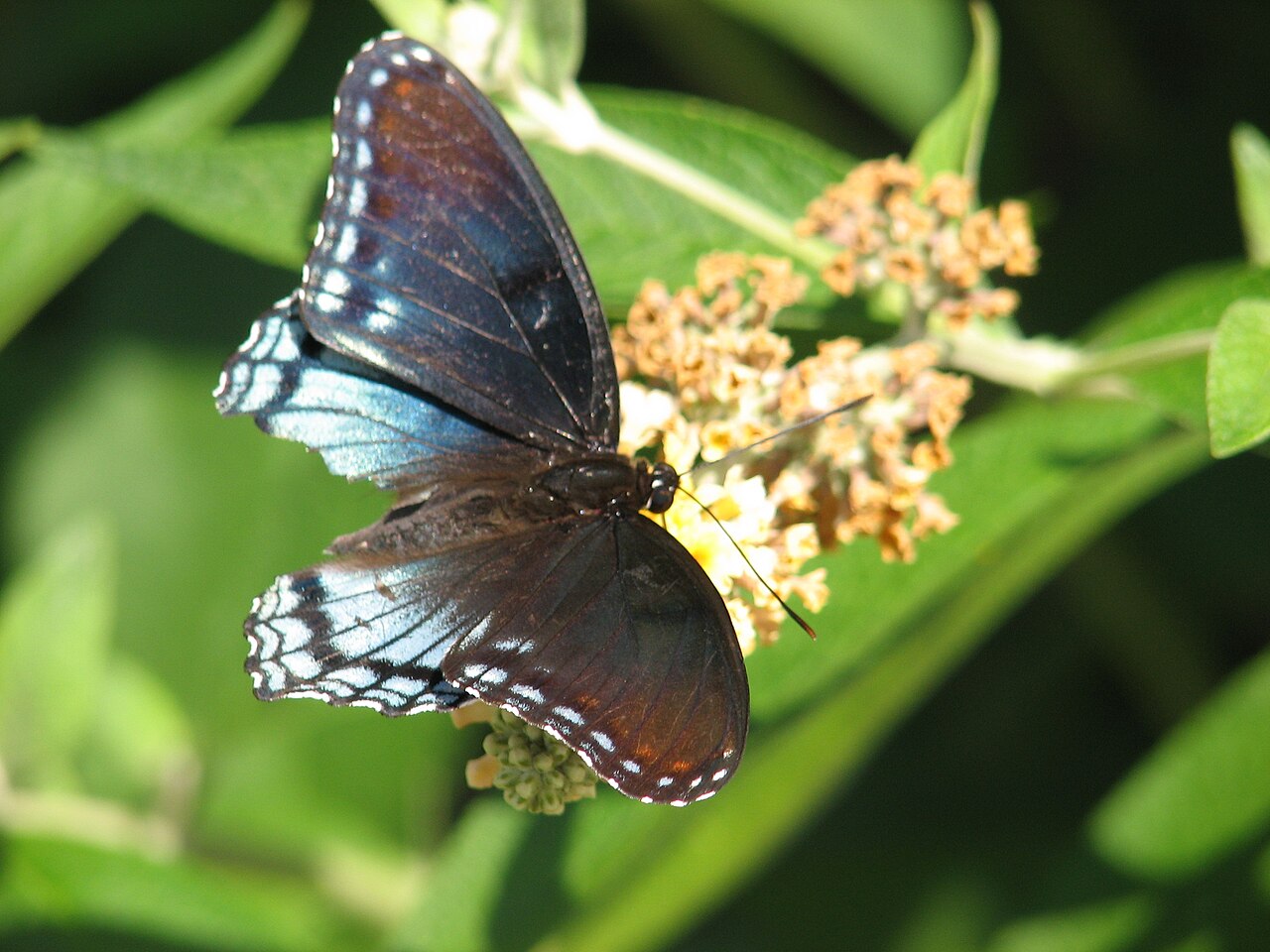
Almost no butterfly makes purple pigment. The violet in a Red-Spotted Purple comes from structural color, microscopic wing scales that bend light into purple. That is why the shade shifts as the wing angles, and why a purple butterfly can look plain brown or black from the side.
Why Purple Butterflies Are So Rare
Genuine purple pigment is essentially absent in the insect world, which is part of why purple butterflies stand out so dramatically compared with common yellows, oranges, and browns. Instead, the purple, violet, and indigo colors seen on butterfly wings almost always come from structural coloration: specialized, layered scales on the wing surface bend and scatter light in ways that produce an iridescent purple sheen rather than a true, stable pigment. This is why the same butterfly’s wings can look distinctly purple in bright direct sunlight and appear far duller, even brownish or black, in shade, since the iridescent effect depends heavily on the angle and intensity of light hitting the wing.
How to Identify the Red-Spotted Purple
The red-spotted purple is the butterfly most commonly reported as a “purple butterfly” in the eastern and southeastern United States. Its wings are a dark, almost black base with a striking iridescent blue-to-purple sheen, most visible from certain angles, and it notably lacks the tails found on many other swallowtail-family look-alikes. According to Birds & Blooms, this species has a northern counterpart called the white admiral, which is the same species (Limenitis arthippus) expressing a different regional wing pattern with bold white banding instead of the solid dark purple sheen, a striking example of how one species can look like two entirely different butterflies depending on where it lives.
Purple Butterfly Wingspan and Size
Size varies considerably across purple butterfly species, from smaller species like the Florida purplewing at just 1 to 2 inches across, to considerably larger species like the pipevine swallowtail, which can reach a 4 inch wingspan. This size range matters for field identification, since a quick wingspan estimate combined with the presence or absence of tails on the hindwings can help narrow down a likely species before examining finer details like spot patterns or exact color, which are often harder to judge accurately from a distance or in poor light.
What Do Purple Butterflies Eat?
Adult purple butterflies overwhelmingly feed on flower nectar, the same primary food source used by most butterfly species, making nectar-rich flowering plants just as valuable for attracting purple butterflies as they are for pollinator gardens generally. What surprises many people is that several purple species supplement or even prefer decidedly less glamorous food sources: the red-spotted purple and related species frequently feed on decaying fruit, tree sap, and mud puddles for minerals, while species like the Purple Emperor in Europe are documented favoring decaying animal matter, dung, and even urine over flower nectar, a behavior called mud-puddling and carrion-feeding that provides sodium and other minerals nectar cannot supply.
Purple Butterfly Caterpillar Host Plants
Unlike the adult’s nectar-focused diet, purple butterfly caterpillars are typically far more selective, relying on specific host plants that provide the nutrition and, in some cases, the chemical defenses the species needs. The red-spotted purple’s caterpillars favor cottonwoods, willows, and wild cherry trees rather than the milkweed associated with monarchs, which means a garden built around milkweed alone will not necessarily attract this species. Other purple butterflies depend on plants like passionflower, oak, or willow, and identifying the correct host plant is often the single most useful step for anyone hoping to attract a specific purple butterfly species to a yard rather than simply hoping one passes through.
Purple Butterflies vs Other Purple-Winged Insects
Not every purple-winged flying insect spotted in a garden is a butterfly. Certain moths display similar iridescent purple sheens, and some wasps and other insects can show purple or violet tints under the right light, which occasionally leads to misidentification. The clearest distinguishing feature remains behavior and antenna shape: butterflies fly during the day and have thin, club-tipped antennae, while most purple-toned moths are nocturnal with feathery or thread-like antennae, a distinction more reliable than color alone, especially since the same insect can look strikingly different depending on lighting, much like how a red wasp can appear to shift color in different light despite having no true color variation.
Habitat and Range of Purple Butterflies
Purple butterflies as a group favor forested habitats, particularly broadleaved woodlands and areas near tropical or heavily wooded, damp environments, which explains why they are comparatively uncommon in open grassland or desert habitats compared with many other butterfly families. In North America, species like the red-spotted purple and Florida purplewing are found across the southeastern United States, with the red-spotted purple’s range extending as far as Texas and Kansas, while its northern counterpart, the white admiral, replaces it across Canada, Alaska, and the northern states. Globally, some of the most striking purple species, including the true Purple Emperor, are restricted to specific regions like central and southern England rather than occurring in North America at all.
Best Time of Year to See Purple Butterflies
Timing varies by species and region, but most North American purple butterflies are most active during the warmer months, typically from late spring through late summer, when host plants are in leaf and nectar sources are abundant. Species overwintering as pupae or in other dormant life stages tend to emerge as adults once temperatures reliably stay warm, so a single warm early-spring day is not a reliable predictor of activity the way a sustained stretch of warm weather is. Checking local butterfly society reports or citizen-science sighting databases for a specific region is generally more reliable than a fixed calendar date, since emergence timing shifts meaningfully with a given year’s weather patterns.
Cultural and Symbolic Meaning of Purple Butterflies
Beyond their rarity in nature, purple butterflies carry symbolic weight in several cultures, often associated with mystery, elegance, transformation, and spiritual significance, themes that echo the broader folklore surrounding owls and other visually or behaviorally distinctive animals. In Japan, certain purple-toned butterfly species hold national symbolic importance, reflecting a broader pattern in which unusually colored or rare wildlife often accumulates cultural meaning well beyond its ecological role, not unlike the rich symbolic traditions built around hawks and other visually striking predators.
Purple Butterfly Life Cycle
Like all butterflies, purple species undergo complete metamorphosis through egg, caterpillar, chrysalis, and adult stages, with the specific timing varying by species and climate. University entomology extension programs commonly note that host-plant availability is the single biggest factor determining where a given purple butterfly species can complete its life cycle, since a caterpillar that hatches without access to its specific host plant nearby has little chance of surviving to adulthood regardless of how ideal the adult nectar sources are in the same area. This is why simply seeing adult purple butterflies passing through an area does not guarantee the species is actually breeding there.
How to Attract Purple Butterflies to Your Yard
Because purple butterflies depend so heavily on specific host plants for their caterpillar stage, attracting them requires more targeted planting than a generic butterfly garden. Planting known host species like willow, wild cherry, or cottonwood alongside nectar-rich adult food sources gives a yard a realistic chance of supporting the full life cycle rather than only passing adult visitors. Leaving some rotting fruit or a small, shaded mud patch can also help, since several purple species are drawn to exactly these unglamorous resources for minerals that flowers alone cannot provide, a detail most conventional pollinator garden advice overlooks entirely, alongside the value of leaving a nearby insect-friendly patch of unmown grass or leaf litter for overwintering pupae.
Related reading: Red Wasp.
Related reading: Red Wasp.
Related reading: Red Wasp.
Related reading: Potato Bug.
Related reading: Potato Bug.
Related reading: Potato Bug.
Related reading: Potato Bug.
Related reading: Potato Bug.
Related reading: Potato Bug.
Related reading: Potato Bug.
Related reading: Potato Bug.
Related reading: Red Wasp.
Related reading: Blue Butterfly.
Related reading: Orange Butterfly.
Related reading: Green Butterfly.
Related reading: Black and White Butterfly.
Related reading: Yellow and Black Butterfly.
Related reading: Swallowtail Butterfly.
Related reading: Giant Swallowtail Butterfly.
Related reading: White Butterfly.
Related reading: Yellow Butterfly.
Related reading: Painted Lady Butterfly.
Related reading: Moth vs Butterfly.
Related reading: Red-Spotted Purple Butterfly.
Related reading: Monarch Butterfly.
Related reading: Monarch Butterfly Meaning.
Related reading: Purple Emperor Butterfly.
Related reading: Buckeye Butterfly.
Purple Butterfly or Blue Butterfly? How to Tell Them Apart
Check the wing from two angles before you decide on a color. Structural color changes with viewing angle, so a butterfly that reads purple head-on often reads blue from the side and dull brown from behind. A pigment-based color, such as the orange of a monarch, stays the same from every angle.
In practice that means most reports of a purple butterfly in North America are a Red-Spotted Purple seen in good light, and most reports of a blue butterfly are the same insect seen at a different angle. Size helps too: the Red-Spotted Purple has a wingspan of roughly 3 to 3.5 inches, while the small blues such as the eastern tailed-blue barely reach an inch.
The Smithsonian’s overview of butterfly wing color and structure sets out the difference between pigmentary and structural coloration, which is the whole reason purple is so slippery to pin down in the field.
Frequently Asked Questions
Why don’t butterflies have true purple pigment?
True purple pigment is extremely rare in insects. Most purple coloring on butterfly wings comes from structural iridescence, where microscopic wing scales refract light into a shifting violet or purple sheen rather than a fixed pigment.
What is the most common purple butterfly in North America?
The red-spotted purple is the species most commonly identified as a purple butterfly in the eastern and southeastern US, recognized by its dark wings with an iridescent blue-purple sheen and no tails.
What do purple butterflies eat?
Adult purple butterflies mainly feed on flower nectar, but many also feed on decaying fruit, tree sap, and mud for minerals. Some species, like the Purple Emperor, even prefer dung and carrion over nectar.
What plants do purple butterfly caterpillars eat?
Caterpillar host plants vary by species. The red-spotted purple’s caterpillars favor cottonwood, willow, and wild cherry trees rather than milkweed, so attracting them requires different plantings than a monarch garden.
Is the white admiral the same as the red-spotted purple?
Yes, they are the same species (Limenitis arthippus) with two regional forms. The red-spotted purple form is found in the southeastern US, while the white admiral form with bold white banding occurs across Canada, Alaska, and the northern states.
Why do some purple butterflies feed on dung or rotting fruit?
This behavior, called mud-puddling or carrion-feeding, provides sodium and other minerals that flower nectar does not supply. Species like the Purple Emperor are documented favoring these sources over nectar.
How can I attract purple butterflies to my garden?
Plant known caterpillar host plants like willow, wild cherry, or cottonwood alongside nectar-rich flowers for adults, and consider leaving a small patch of rotting fruit or damp mud, which several species seek out for minerals.
Field guides and citizen-science photo databases have made purple butterfly identification considerably more accessible than it once was, letting anyone compare a photographed specimen against confirmed regional sightings rather than relying solely on printed range maps that may not reflect a species’ actual current distribution.