Animals That Look Like Beavers: Muskrat, Nutria, Otter and 6 More
If an animal looks like a beaver but something about it seems off, the answer is almost always a muskrat. Muskrats share the same ponds, the same brown fur, and the same habit of swimming with just the head showing, and they are far more common than beavers across most of the United States. Nutria, river otters, groundhogs, and a handful of other mammals account for nearly all the remaining mix-ups.
The single most reliable way to tell them apart is the tail. A beaver drags a wide, flat, scaly paddle behind it, a muskrat has a thin tail flattened side to side, and a nutria has a round tail like a rat. Size, teeth color, and how the animal swims settle the rest. This guide covers the nine animals most often mistaken for beavers, what separates each one, and what the tracks and sign in your yard are actually telling you.
The animal most often mistaken for a beaver is the muskrat. Check the tail first: beavers have a wide flat paddle, muskrats have a thin tail flattened vertically, and nutria have a round rat-like tail. Beavers reach 35 to 50 lbs, muskrats only 2 to 4 lbs, and nutria fall in between at 15 to 20 lbs.
| Animal | Adult weight | Tail | Quick tell |
|---|---|---|---|
| American beaver | 35 to 50 lbs | Wide, flat, scaly paddle | Fells trees, builds dams and lodges |
| Muskrat | 2 to 4 lbs | Thin, flattened side to side | Tail whips side to side when swimming |
| Nutria | 15 to 20 lbs | Round and hairless, like a rat | Bright orange front teeth, white muzzle |
| River otter | 11 to 30 lbs | Thick, tapered, furred | Porpoises and dives, long slender body |
| Groundhog | 5 to 12 lbs | Short and bushy | On land only, digs burrows in lawns |
| Mountain beaver | 2 to 3 lbs | Almost no tail at all | Pacific Northwest forests, not aquatic |
| Capybara | 75 to 145 lbs | No visible tail | Not wild in the US outside Florida escapees |
What Animal Is Mistaken for a Beaver Most Often?
The muskrat (Ondatra zibethicus) is the animal mistaken for a beaver more than all others combined. Both are semi-aquatic rodents with dense brown fur, both swim with only the top of the head and back visible, and both are active at dawn and dusk. From 50 ft away on a pond, the silhouettes look nearly identical.
Size is the first correction most people need. An adult beaver weighs 35 to 50 lbs and can reach 3 ft long before the tail, while a muskrat tops out around 4 lbs and 10 to 14 in of body. If the animal looks small enough to pick up with one hand, it is not a beaver. Distance across water makes this surprisingly hard to judge, which is why the tail matters more than the overall impression.
Nutria run a distant second, and in the Gulf states and the Pacific Northwest they may actually be the more likely sighting. Beyond those three, confusion drops off quickly: otters move too differently, and groundhogs are never in the water.
Is It a Beaver or a Muskrat?
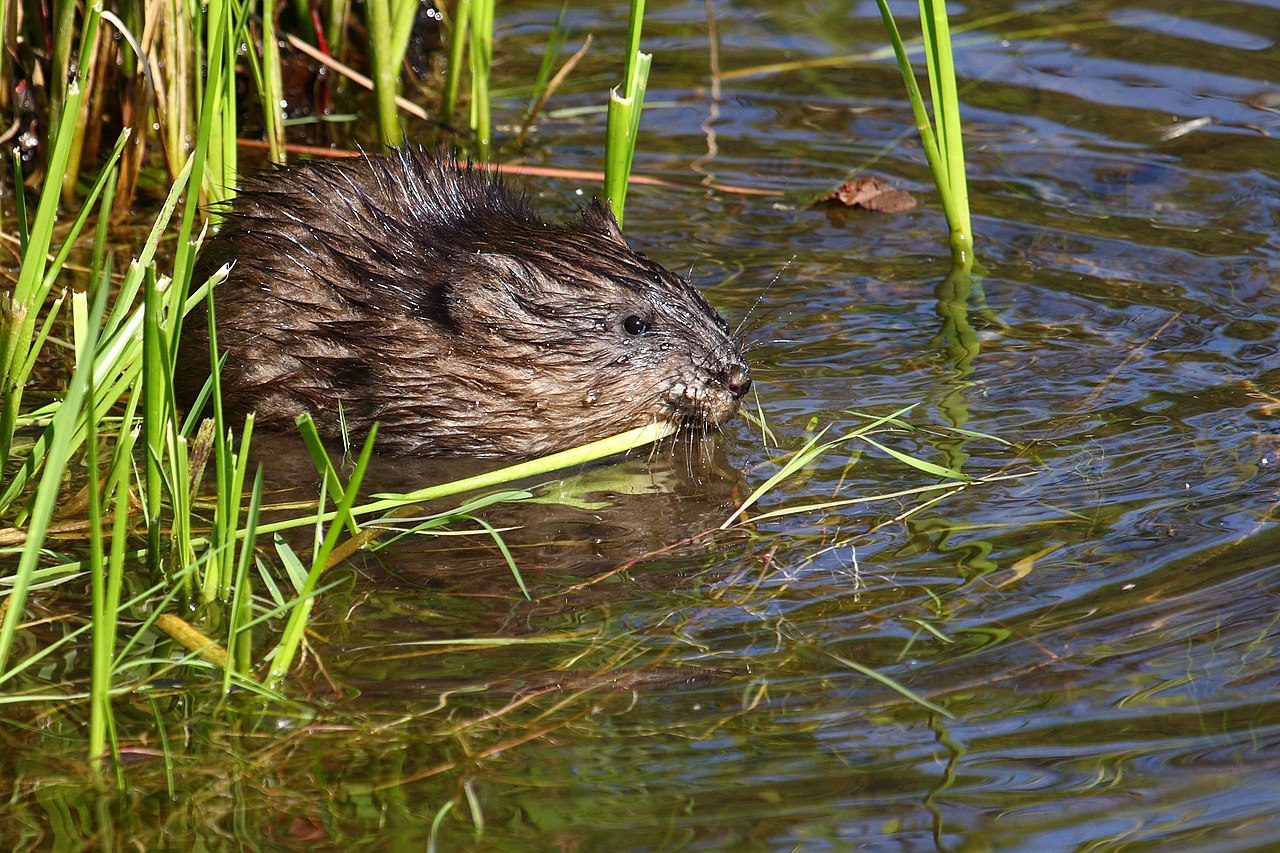
Watch the tail as the animal swims. A beaver’s tail stays below the surface and leaves a broad wake, and when the animal is alarmed it slaps the water with a crack you can hear across a pond. A muskrat sculls with its tail, which whips side to side like a thin rudder and is often visible just at or above the waterline.
The profile in the water differs too. Beavers ride low and wide, showing a broad flat back. Muskrats ride higher and narrower, often with a visible V-wake from a much smaller body. A muskrat also tends to swim with more of its back exposed, which makes it look like it is sitting on the water rather than in it.
The strongest evidence is not the animal at all. Beavers fell trees, leaving pointed stumps and stripped branches, and they build dams and dome-shaped lodges of sticks and mud. Muskrats build push-ups of cattails and mud or dig bank burrows, and they never cut a tree. If there are gnawed stumps, you have beavers.
Nutria vs Beaver: The Orange Teeth Giveaway
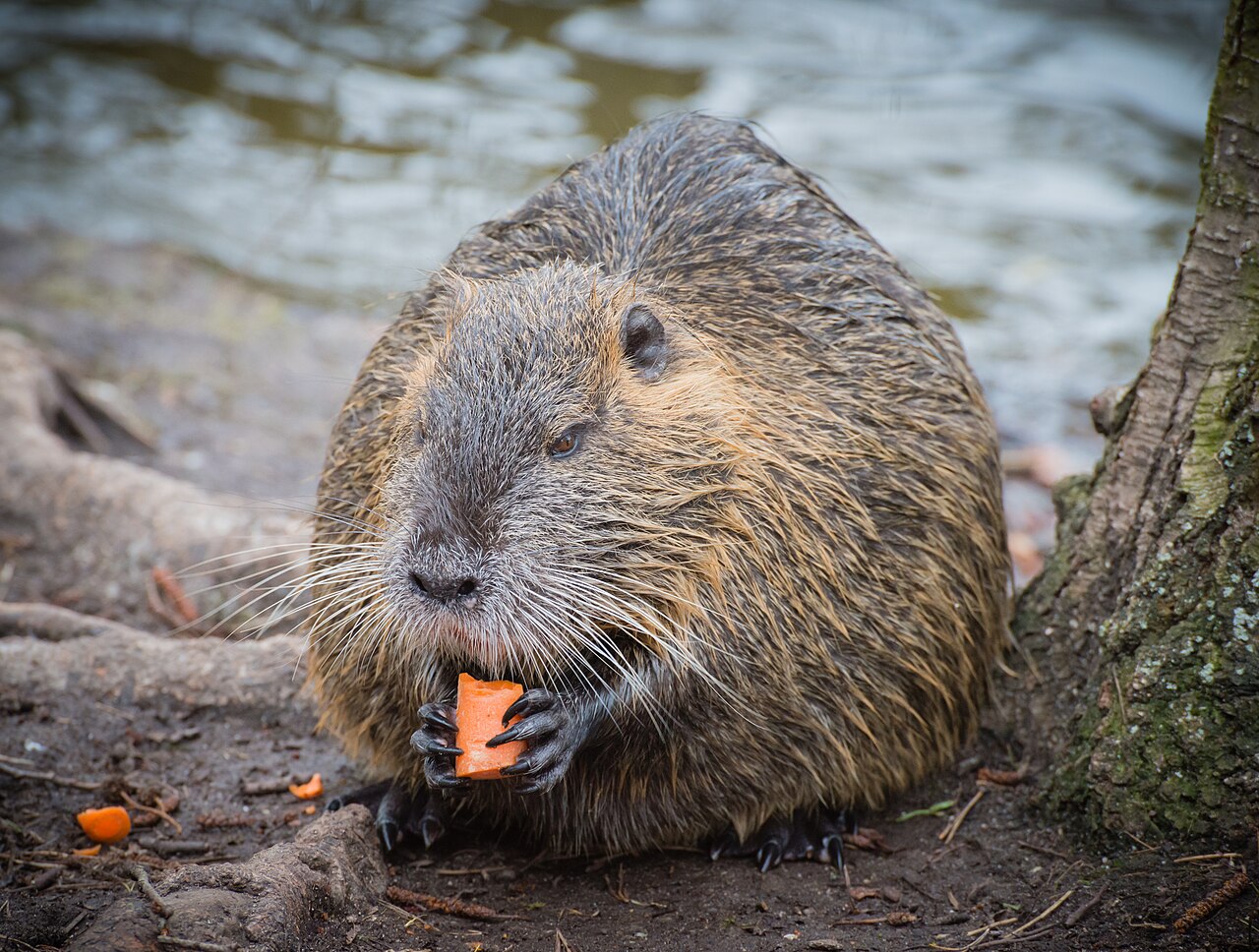
Nutria (Myocastor coypus) are South American rodents introduced to the United States for the fur trade and now established across the Gulf Coast, the Atlantic seaboard, and parts of the Pacific Northwest. At 15 to 20 lbs they sit between a muskrat and a beaver in size, which is exactly the wrong size for easy identification.
Two features settle it instantly. Nutria have bright orange to yellow-orange front incisors that are visible even at a distance when the animal is feeding, and a white or pale patch on the muzzle around the nose and lips. Beavers have orange incisors as well, but they are a deeper, duller shade and the muzzle is uniformly dark.
The tail is the other giveaway. A nutria tail is round in cross-section, nearly hairless, and looks unmistakably like a rat tail trailing behind a much larger animal. Nutria are also destructive in a different way from beavers: they eat the roots of marsh plants and cause bank collapse rather than damming streams, which is why federal and state agencies treat them as an invasive species rather than a nuisance native.
Did I See an Otter or a Muskrat?

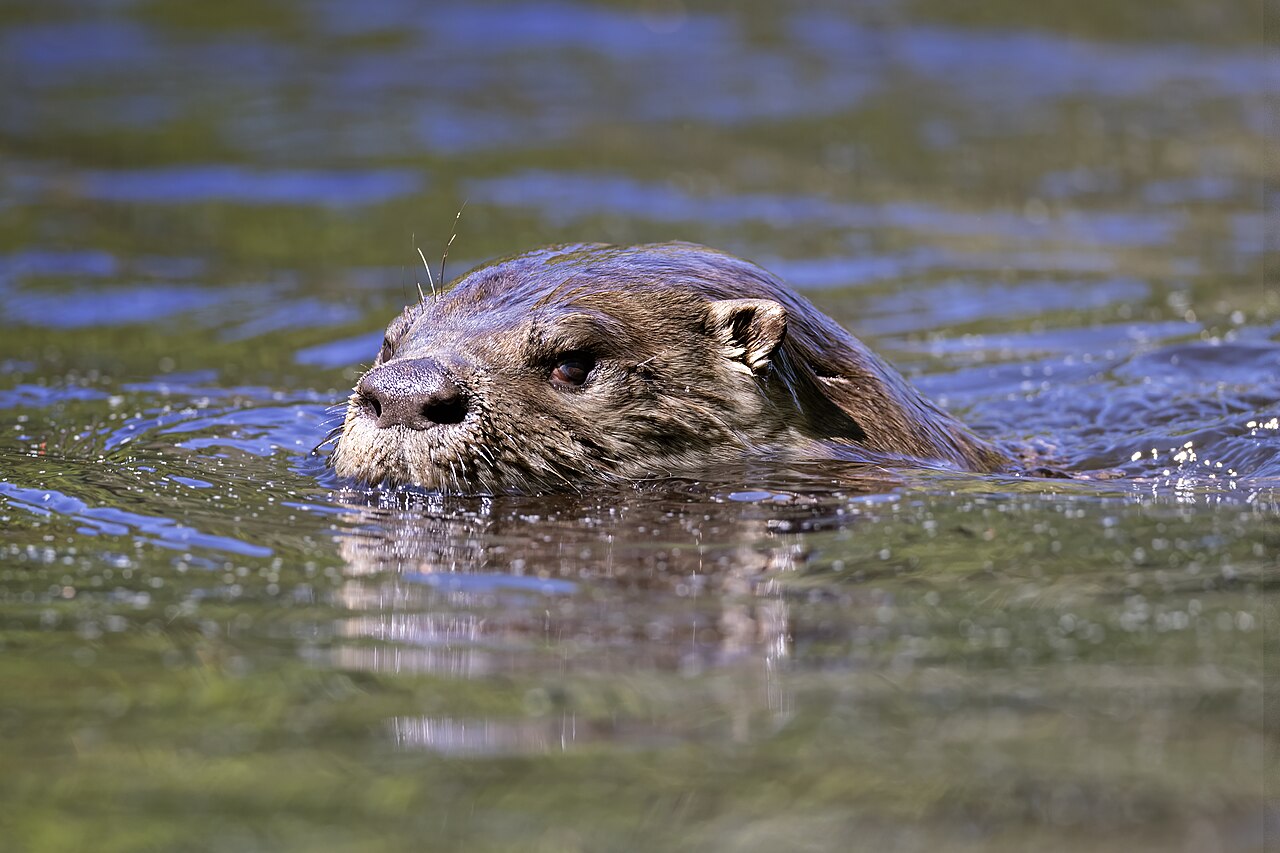
Movement separates otters from everything else on this list. North American river otters (Lontra canadensis) porpoise through the water, arching and diving repeatedly, and they frequently travel in family groups. Beavers and muskrats swim in a steady line and dive once, cleanly, without the rolling motion.
Body shape confirms it. An otter is long, slender, and muscular, with a thick tapered tail that is furred along its whole length, and a head that looks small and flattened against the body. Muskrats look compact and blunt, with a rounded head and a visible gap between head and shoulders when swimming.
Otters are also loud and conspicuous. They chirp, chuckle, and snort, haul out on logs and banks to eat fish in plain view, and leave scat full of fish scales and crayfish shells at latrine sites. A silent animal that submerges and does not reappear for a minute is far more likely a beaver. For another pair that trips people up for the same reason, see our guide to animals that look like ferrets.
Groundhog: The Beaver Without a Tail
The question “what animal looks like a beaver without a tail” almost always resolves to a groundhog (Marmota monax), also called a woodchuck. Groundhogs are stocky brown rodents of 5 to 12 lbs with the same general build and face as a beaver, and from behind on a lawn the resemblance is strong.
The short bushy tail is the obvious difference, but location is a faster filter. Groundhogs are land animals that dig extensive burrow systems in fields, under sheds, and along fence lines. They can swim if they must, but you will not find one working a pond edge the way a beaver does. If the animal was standing upright on its hind legs to look around, it was a groundhog or a marmot, not a beaver.
Groundhog burrows have a main entrance with a conspicuous mound of excavated soil and several hidden escape holes without mounds. That burrow signature is diagnostic and nothing else on this list produces it. Confusion with other yard mammals is common enough that we cover it separately in our guide to animals that look like raccoons.
Mountain Beaver: A Look-Alike That Is Not a Beaver
The mountain beaver (Aplodontia rufa) has the name but almost nothing else. It is a small, tailless, burrowing rodent of 2 to 3 lbs restricted to the damp forests of the Pacific Northwest and northern California, and it is the most primitive living rodent in North America rather than a relative of the beaver.
Mountain beavers do clip vegetation and small saplings with beaver-like cuts, which is where the confusion starts, and their burrow entrances near streams can look like bank dens. The animal itself resembles a tailless muskrat or a very large vole, with small eyes and short rounded ears. It is rarely seen because it is nocturnal and spends most of its life underground.
Capybara: The Beaver Look-Alike That Starts With C
Capybaras (Hydrochoerus hydrochaeris) are the world’s largest rodents at 75 to 145 lbs, and they are the answer people are reaching for when they search for an animal that looks like a beaver but bigger, or one that starts with the letter C. They are native to South America and look like an oversized guinea pig with a blocky head and no visible tail.
In the United States, wild capybaras exist only as a small escaped population in parts of Florida, plus occasional escapees from private collections elsewhere. A capybara sighting in Ohio or Oregon is a zoo animal or a pet, not a wild population. The absence of a tail is the clearest separation from a beaver.
Marmots, Mink and Three More Mix-Ups
Yellow-bellied marmots and hoary marmots (Marmota flaviventris and Marmota caligata) are western relatives of the groundhog, bulky and brown, and they are regularly reported as beavers by hikers who see them near alpine ponds. The short bushy tail and the habit of whistling an alarm call rule out a beaver immediately.
American mink (Neogale vison) are dark, sleek, and semi-aquatic, and they are mistaken for small otters more often than for beavers. At 1.5 to 3 lbs they are much smaller than anything else swimming in a pond, and the fur is a uniform dark chocolate brown that looks almost black when wet.
Two more account for most of the rest. Beaver kits swimming alone are routinely reported as muskrats, since a young beaver can be muskrat-sized through its first summer, and Norway rats swimming across water at dusk are reported as muskrats for the same reason. Juveniles are the hardest category in any identification problem, which is also true for the birds in our guide to birds that look like blue jays.
Tracks and Sign That Settle the Question
Tracks are the most reliable identification you can get without seeing the animal clearly. A beaver hind foot leaves a webbed print 5 to 7 in long with five toes, often partly erased by the tail drag, and the front prints are much smaller and hand-like. Nothing else in a North American wetland leaves a webbed print that size.
Muskrat tracks are the same shape in miniature, with hind prints around 2 to 3 in and a thin tail line between them rather than a broad smear. Nutria hind tracks fall between the two at 3 to 5 in, webbed on four of five toes, with a round tail drag. Otter tracks are rounder, show five webbed toes front and back, and come with slides on muddy or snowy banks.
Sound helps at dusk. A beaver tail slap is a loud flat crack that carries several hundred feet and is unmistakable once you have heard it. Nutria make a low pig-like grunt, otters chirp and chuckle, and muskrats are almost silent apart from a squeak when fighting.
What Looks Like a Beaver in My Yard?
If the animal is in a yard with no pond, stream, or ditch within a few hundred feet, it is almost certainly a groundhog. Beavers do not travel far from water and do not forage on lawns. Nutria and muskrats stay within a short distance of the waterline as well.
If there is water on or near the property, work through the tail and the sign. Chewed shrubs and small trees with 45 degree cuts point to beaver. Clipped marsh plants, a mud push-up, or holes in the bank at the waterline point to muskrat. Burrows in the bank with a lot of loose soil and orange-toothed animals feeding at the edge point to nutria.
Damage patterns are the practical reason to care. Beavers flood land and take down valuable trees, nutria undermine banks and levees, and groundhogs compromise foundations and equipment with their tunnels. The response and the agency you call are different for each, so identification is the first step rather than a curiosity. The same identification-first logic applies to the waterbirds in our guide to animals that look like ducks.
Is It Bad to Have a Muskrat in Your Yard? Are They Aggressive?
Muskrats are not aggressive toward people. They avoid humans, flee into water when approached, and will only bite if cornered, handled, or trapped. A muskrat in a backyard pond is a nuisance question rather than a safety question for anyone who does not try to pick it up.
The real costs are structural. Muskrats burrow into pond banks, dams, and earthen levees, and a heavily used bank can slump or leak. They also eat ornamental aquatic plants and can clear a small pond of cattails and lilies in a season. Those are reasons to exclude them with riprap or hardware cloth along the bank, not reasons to panic.
Disease risk exists but is low. Muskrats can carry tularemia and leptospirosis, both transmitted through contact with contaminated water or an infected carcass rather than through casual proximity. Standard advice from the U.S. Fish and Wildlife Service and state wildlife agencies is to avoid handling wild rodents and to report animals behaving abnormally. For more on telling similar species apart at a glance, see our guide to animals that look like deer.
Frequently Asked Questions
What animal is mistaken for a beaver?
The muskrat is mistaken for a beaver most often, followed by the nutria. All three are brown semi-aquatic rodents that swim with the head above water. The tail separates them: flat and paddle-shaped on a beaver, thin and vertically flattened on a muskrat, and round and hairless on a nutria.
What are some animals similar to beavers?
Muskrats, nutria, river otters, groundhogs, marmots, mountain beavers, mink, and capybaras all get reported as beavers. Only muskrats and nutria are genuinely similar in build and habitat. Otters move differently, groundhogs and marmots live on land, and capybaras are not wild in the United States outside a small Florida population.
What looks like a beaver in my yard?
With no water nearby, it is almost certainly a groundhog, which is similar in color and build but has a short bushy tail and digs burrows with mounded soil. With a pond or stream on the property, check for pointed tree stumps, which mean beaver, or bank holes and clipped marsh plants, which mean muskrat.
Is it a beaver or muskrat?
Compare size and tail. A beaver weighs 35 to 50 lbs and drags a wide flat paddle, while a muskrat weighs 2 to 4 lbs and sculls with a thin whip-like tail. If trees have been cut with pointed 45 degree stumps, it is a beaver, because muskrats never fell trees.
Is a muskrat aggressive?
Muskrats are not aggressive toward humans and retreat into water when approached. They bite only when cornered, handled, or caught in a trap. The practical problem with muskrats is bank burrowing that can weaken pond edges and earthen dams, not any threat to people or pets.
What can be mistaken for an otter?
Mink and muskrats are the usual confusion with otters. Mink are much smaller at 1.5 to 3 lbs with dark, almost black wet fur, and muskrats are blunt and compact rather than long. An otter porpoises through the water, travels in family groups, and is noisy, while the other two are quiet and swim in a straight line.