Bugs That Look Like Ducks: 6 Lookalikes and How to Tell Them Apart
No insect actually looks like a duck, but a handful of them borrow one duck feature convincingly enough to stop people mid step: a long bill, a cocked tail, a paddling swim or a blunt head with a forward horn. Bugs that look like ducks almost always turn out to be one of five groups, and four of them are harmless to handle.
The quick way to sort them is to ask which duck part you are seeing. A bill means a weevil, a tail means a planthopper nymph, a head horn means a treehopper, and a duck that paddles across your pool means a water bug, the only group on this list that bites.
Bugs that look like ducks are usually snout weevils, whose long curved rostrum reads as a bill, or planthopper nymphs, whose white wax filaments stick up like tail feathers. Treehoppers add a duck shaped head horn, and backswimmers paddle like one. Only the backswimmer bites, and never seriously.
Which Bugs Look Like Ducks, and Are Any of Them Dangerous?
Take the safety question first. Of the insects that get called duck bugs, only the backswimmers (Notonecta species) can hurt you, and only if you pick one up. Their bite is a defensive jab that stings sharply for a few minutes with no lasting effect, which earned them the nickname water bee. Nothing here stings, and nothing here is venomous in a medical sense.
Weevils, planthoppers and treehoppers have no bite at all, since all three feed on plants with mouthparts built for sap or seeds. They are garden insects, not house insects. If you are chasing something indoors instead, the likelier candidates are covered under roach lookalikes and silverfish lookalikes.
Snout Weevils: The Long Bill Lookalike
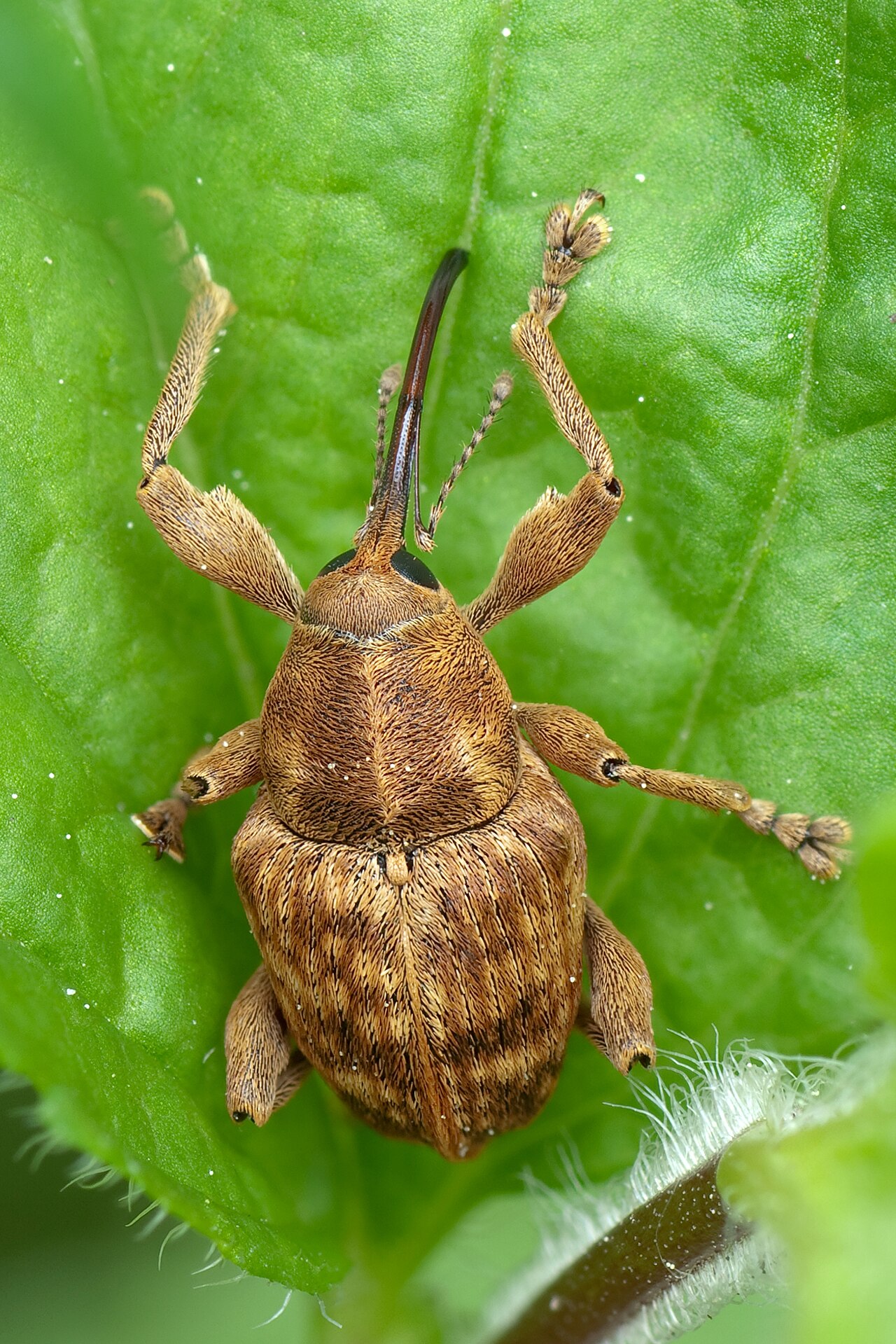
Acorn and nut weevils (Curculio species) are the closest thing to a duck billed insect in North America. The female carries a slender, curved rostrum as long as her whole body, which she uses to drill into a green acorn and lay an egg inside. Bodies run about 0.2 to 0.4 in (5 to 10 mm), colors are tan, brown or mottled gray, and they turn up on oaks and hickories across the eastern and central states in late summer.
The rose curculio (Merhynchites bicolor) gives the same profile in bright red with a black bill, about 0.25 in (6 mm), and shows up on rose buds through the northern and western states. Both are harmless to people. Guides from university programs such as University of Kentucky Entomology treat them as orchard and ornamental pests, nothing more.
Planthopper Nymphs: Wax Tails That Read as Tail Feathers

The duck tail belongs to planthopper nymphs. Young Acanalonia conica and citrus flatid planthoppers (Metcalfa pruinosa) produce long white waxy filaments from the rear of the abdomen and hold them upright in a fan, so a 0.15 in (4 mm) insect on a stem looks like a tiny white tailed duck sitting on water. Disturb one and it jumps, leaving the wax behind.
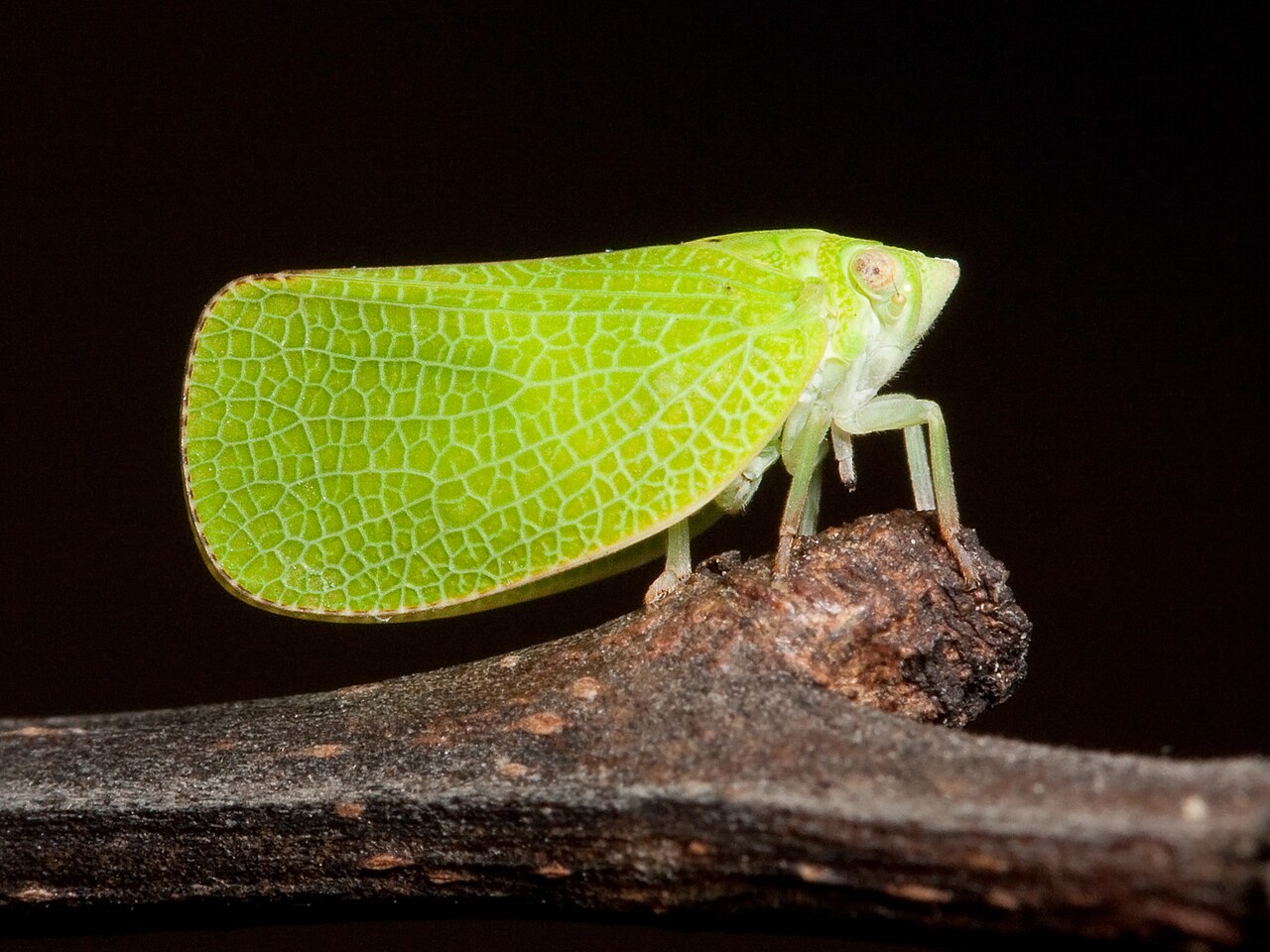
Adults lose the illusion. Acanalonia conica matures into a bright green, cone headed, wedge shaped insect about 0.3 in (8 mm) long, common east of the Rockies on weeds, shrubs and grapevines. Neither species bites, and neither does meaningful damage outside of nurseries.
Treehoppers: A Forward Horn Shaped Like a Duck’s Head
Treehoppers carry an enlarged pronotum that extends over the head, and in several North American species it points forward into a shape that reads as a bill. The widefooted treehopper (Campylenchia latipes) is the common one, a drab brown insect of about 0.3 in (8 mm) found on goldenrod and other herbaceous plants through the eastern and central states.
The two marked treehopper (Enchenopa binotata) adds two yellow spots and a steeper horn, often in groups on redbud, viburnum and black locust. They feed on sap, cannot bite, and are easiest to find by following ants, which tend the honeydew. Treehoppers are a good reminder that odd insect shapes are usually camouflage, the same trick behind caterpillars that mimic snakes.
Backswimmers and Water Boatmen: Bugs That Paddle Like Ducks
In a pool or stock tank, the duck impression is behavioral. Backswimmers (Notonecta) row with long hair fringed hind legs held out like oars, surface to breathe, then dive, all at 0.4 to 0.6 in (10 to 15 mm). They swim upside down, which no duck does, and they are predators that will bite a hand that grabs them.
Water boatmen (family Corixidae) look nearly identical but swim right side up, eat algae and detritus, and do not bite. Both arrive by flight within days of a new water feature, so finding them says the water is standing, not that the water is contaminated.
Duck Lice, Duck Flies and the Duck Test
Two groups are named after ducks instead of merely resembling them. Chewing lice such as Holomenopon leucoxanthum live on waterfowl, and people who keep or handle ducks sometimes find them crawling on their arms afterward. They are host specific and die within a day or two off the bird, so they cannot infest a person or a house. Duck fly is an angling name for non biting midges in the family Chironomidae, which hatch in clouds over water in spring.
As for the phrase itself: when something looks like a duck and quacks like a duck, the duck test says call it a duck. It works for politics, which is what it was coined for, and it fails for insects, where a bill shaped mouthpart and a wax tail evolved in animals that are not remotely related. Birds, meanwhile, treat all of these as food, as the appetites behind stink bug eating birds and wasp eating animals show.
| Insect | Duck feature | Size | Where | Bites? |
|---|---|---|---|---|
| Acorn weevil (Curculio) | Long curved bill | 0.2 to 0.4 in | Oaks, eastern and central US | No |
| Rose curculio | Black bill, red body | 0.25 in | Roses, northern and western US | No |
| Planthopper nymph | Upright white wax tail | 0.15 in | Weeds and shrubs, most states | No |
| Widefooted treehopper | Forward head horn | 0.3 in | Goldenrod, eastern and central US | No |
| Backswimmer (Notonecta) | Paddling swim, oar legs | 0.4 to 0.6 in | Pools, ponds, tanks | Yes, stings briefly |
| Water boatman | Paddling swim, right side up | 0.3 to 0.5 in | Pools, ponds, tanks | No |
Frequently Asked Questions
When it looks like a duck and quacks like a duck, what does that mean?
The duck test means you can identify something by its obvious traits instead of waiting for proof. It entered American usage in the 1940s as a political argument and is now general slang. For actual identification it is unreliable, because unrelated insects evolve duck like bills and tails independently through convergent evolution.
Do all ducks quack, and which gender of duck quacks?
No. Among mallard type ducks, which includes most domestic breeds, only the female gives the loud quack. Drakes make a quieter, raspier two note call. Many other species never quack at all: wood ducks whistle and squeal, and whistling ducks are named for the sound they make in flight.
What is a female duck called?
A female duck is a hen, a male is a drake, and a young bird is a duckling. In older hunting usage you will also see duck used specifically for the female and drake for the male of the same species, which is why a field guide may label plates as drake and duck rather than male and female.
Are ducks good pets?
Ducks are good backyard livestock and poor house pets. They need daily access to water, produce a large amount of wet waste, cannot be reliably housebroken, and do badly alone, so three birds is a practical minimum. Given a yard, a pond or tub and a predator proof house, they are hardy, long lived and productive layers.
What is the natural enemy of a duck?
Ducks are eaten by almost everything that can reach them. On land the main predators are foxes, coyotes, raccoons, mink and domestic dogs; from the air, great horned owls, eagles and large hawks; in the water, snapping turtles and large fish take ducklings. Nests lose more eggs to raccoons and skunks than to anything else.