Pink Spider Identification: 6 Real Species and the Lookalikes
Pink spiders are real, but almost none of them are entirely pink, and the pink ones you are most likely to find in the United States are crab spiders sitting on flowers. True all over pink bodies belong to a handful of species, most of them outside North America, and a surprising share of “pink spider” sightings turn out to be mites, spiderlings or a molted skin rather than an adult spider.
This guide works through the species that actually show pink in the US, the ones sold in the pet trade, and the lookalikes that fool people most often. Because the first question is always safety, that one comes first: none of the pink spiders on this page is medically dangerous to people.
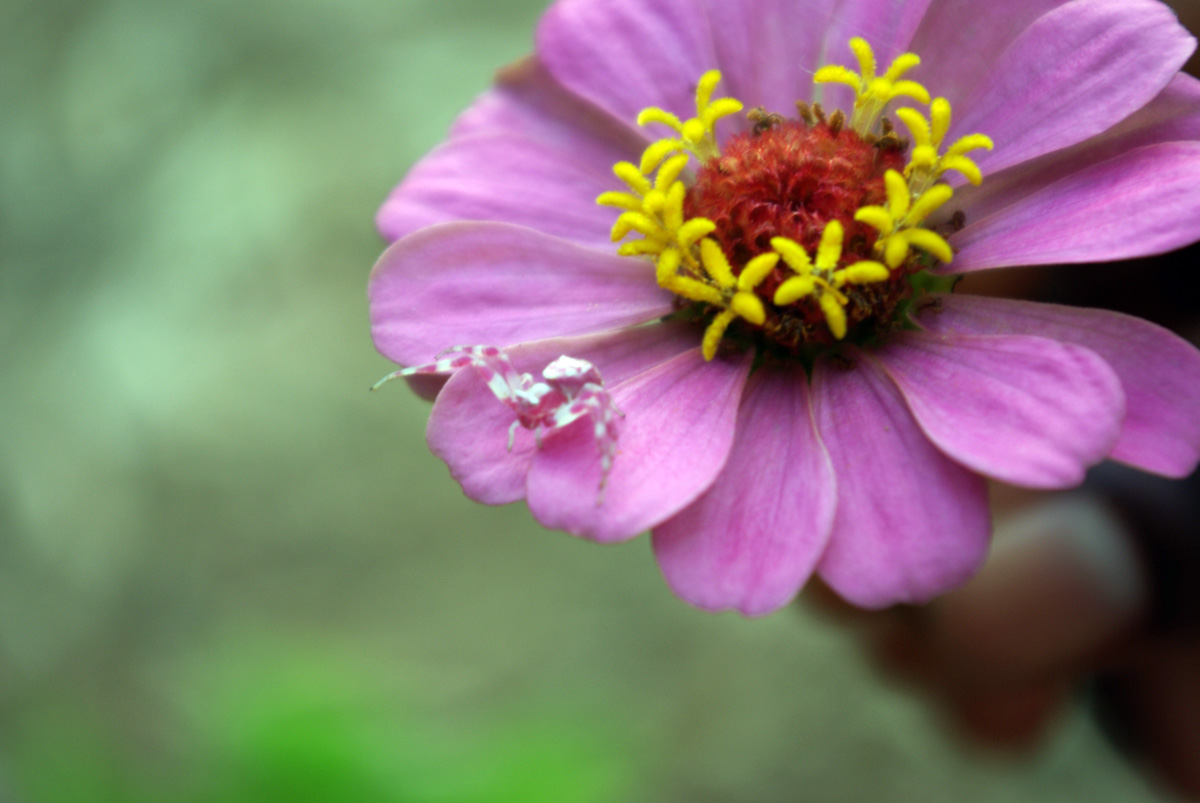
Yes, pink spiders exist. In the United States the pink ones are usually crab spiders such as the goldenrod crab spider (Misumena vatia), which carries pink stripes on a white body, or the Hawaiian happy face spider with pink markings. None of them is dangerous. A tiny pink dot moving on a windowsill is far more likely to be a mite than a spider.
| What people call pink | What it usually is | Size | Where |
|---|---|---|---|
| Pink spider on a flower | Goldenrod or whitebanded crab spider | 1/8 to 3/8 in (4 to 10 mm) | Nationwide, meadows |
| Tiny pink dot indoors | Spider mite or clover mite | Under 1/32 in (under 1 mm) | Windows, sills |
| Pink spider with a smiley | Hawaiian happy face spider | 1/5 in (5 mm) | Hawaii only |
| Pink and black jumper | Red backed jumping spider | 1/4 to 1/2 in (6 to 13 mm) | Western US |
| Large fuzzy pink spider | Pinktoe or rose hair tarantula | 4 to 5 in leg span | Pet trade only |
| Pink cluster in a web | Spiderlings or an egg sac | Under 1/16 in each | Corners, foliage |
Does a Pink Spider Exist?
A pink spider does exist, and there are several, but the color almost never covers the whole animal. In spiders, pink comes from pigments in the cuticle and from bile pigments visible through a translucent abdomen, which is why pink usually appears as stripes, patches or a wash over a pale base rather than as a uniform coat.
The clearest genuinely pink species on earth is Thomisus onustus, a Eurasian and North African crab spider whose females are often rose pink from end to end. It does not live in the Americas. In the US, pink is a variable color form inside otherwise white, yellow or brown species.
Image searches make this worse. Most of the top results for pink spiders are clothing, Halloween decorations, plant photos and comic book characters, which is why identification by picture search routinely fails for this color. The reliable route is body shape and leg arrangement, the same approach that works for the yellow spiders people find in the same flower heads.
Are Pink Spiders Venomous or Dangerous?
Every spider with fangs produces venom, but no pink spider in the United States is dangerous to people. Crab spiders have small fangs and cannot usually break adult skin, and bites are rare because the spider’s defense is to drop off the flower rather than fight.
Jumping spiders will bite if pinned against skin. The result is a pinprick and a small red mark that fades in a day, comparable to a nettle sting. Tarantulas sold as pets have larger fangs and a mechanically painful bite, but the venom of Avicularia and Grammostola species is mild; the real nuisance is urticating hairs that the spider kicks off its abdomen, which itch for days and are genuinely hazardous in the eyes.
The two spiders in North America that warrant real caution, widows and recluses, are never pink. If the animal is brown with a violin mark or black with a red hourglass, you are looking at something else, and our comparison of the brown recluse against common house spiders covers how to tell those apart.
Goldenrod Crab Spider (Misumena vatia)
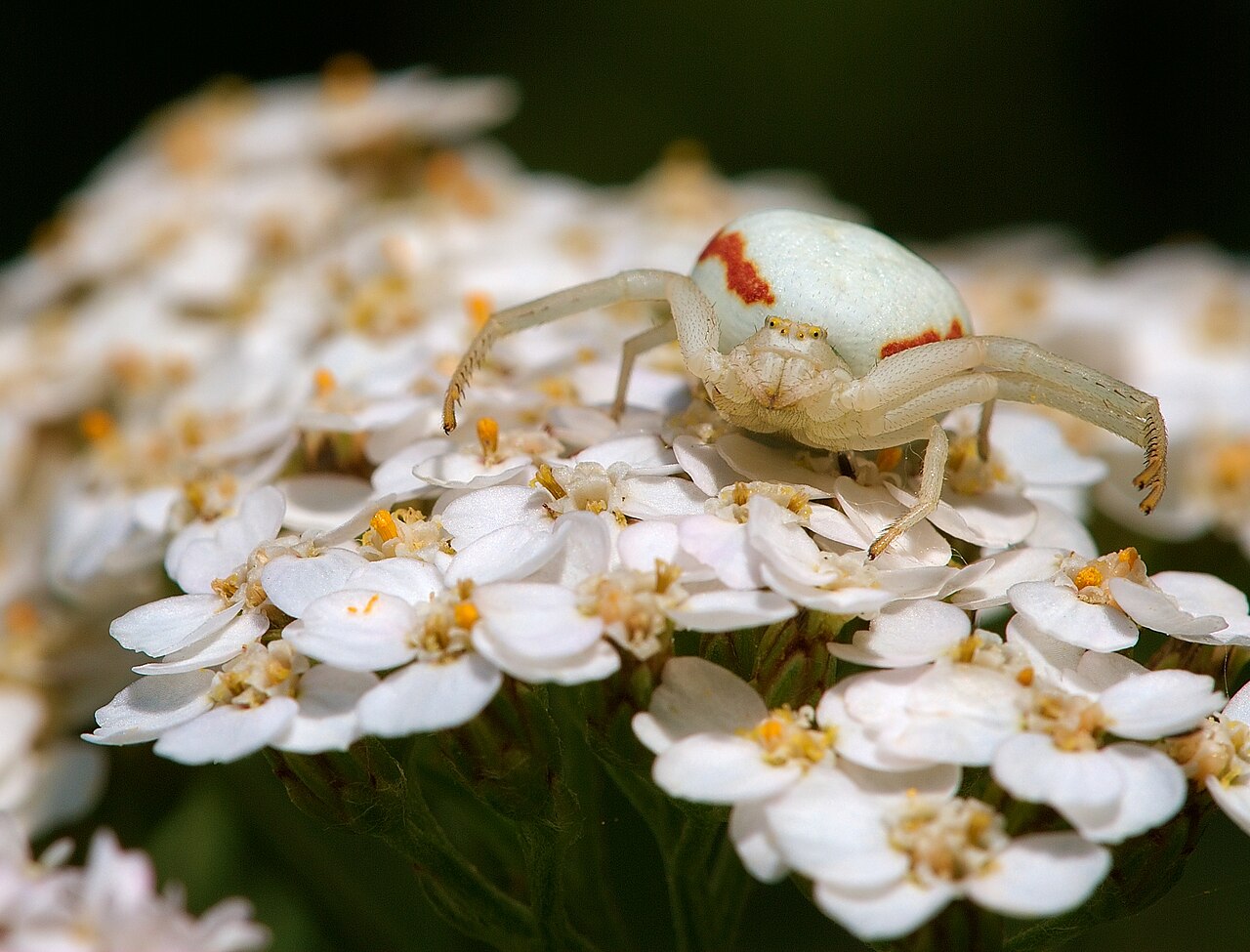
This is the pink spider most Americans actually meet. Adult females are 1/4 to 3/8 inch (6 to 10 mm), bright white or yellow, with two broad red to pink stripes running down each side of the abdomen, and front legs much longer than the back pairs, held open like crab claws.
They sit motionless in goldenrod, daisies, milkweed and asters and ambush bees, flies and butterflies far larger than themselves. They build no web at all. Males are tiny by comparison, around 1/8 inch (3 to 4 mm), dark legged and with a pale abdomen, and they are often overlooked entirely.
The species is found across most of North America and Europe. The pink striping is strongest on mature females, which is why the same species looks plain white one week and pink striped the next. Like all crab spiders they are strictly predatory, taking the same insect prey covered in our piece on what spiders eat.
Whitebanded Crab Spider (Misumenoides formosipes)

The whitebanded crab spider is the close relative that confuses identification. Females run 1/4 inch (5 to 11 mm) and carry a distinct white ridge across the face between the eyes, which is the one reliable separator from Misumena vatia.
Body color varies from white to bright yellow, and some individuals carry pink or reddish markings on the abdomen sides. It is common in old fields and roadside flowers from the East Coast through the Midwest and into the Southwest.
Both species are worth looking for in the same flower head because they compete for the same perches. If you find one crab spider in a stand of goldenrod, there are usually several within a few feet, including the black and yellow garden spiders strung between the stems nearby.
Hawaiian Happy Face Spider (Theridion grallator)
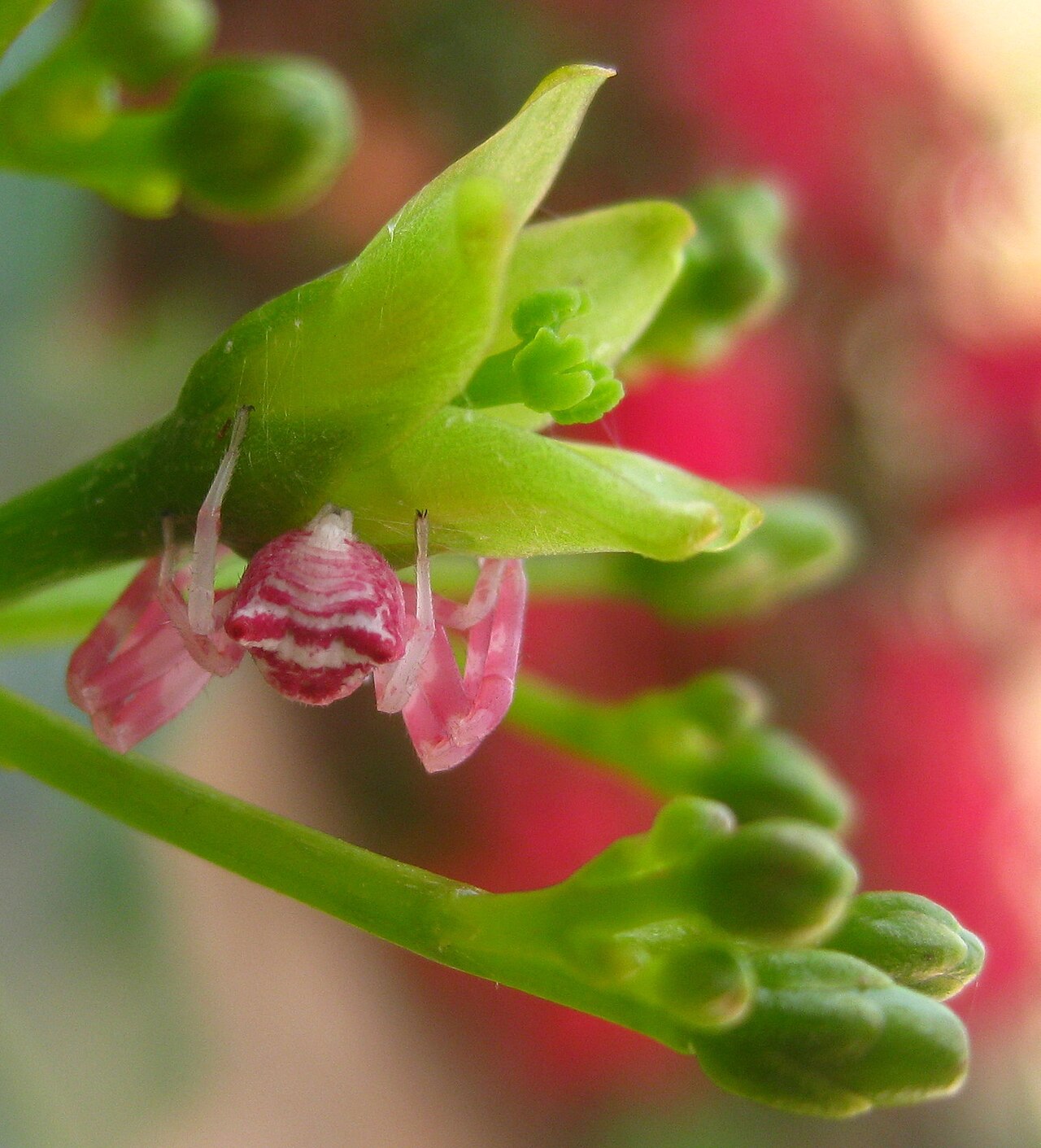
This is the most strikingly pink patterned spider in the United States, and it lives only in Hawaii. Adults are about 1/5 inch (5 mm) with a translucent pale yellow abdomen marked with red, pink and black blotches that in some individuals form a pattern resembling a grinning face.
The pattern is genetically variable and differs island to island, so plain, spotted, striped and smiling morphs all occur in the same population. The spider hangs under the leaves of native wet forest plants and builds a small sheet web, hunting flies and springtails.
It is harmless and increasingly scarce as native forest shrinks, and it is a favorite subject of evolutionary research precisely because the color polymorphism is so visible. Hawaii has unusual pink wildlife more generally, from these spiders to the island birds covered in our look at the pink birds of North America.
Red Backed Jumping Spider (Phidippus johnsoni)
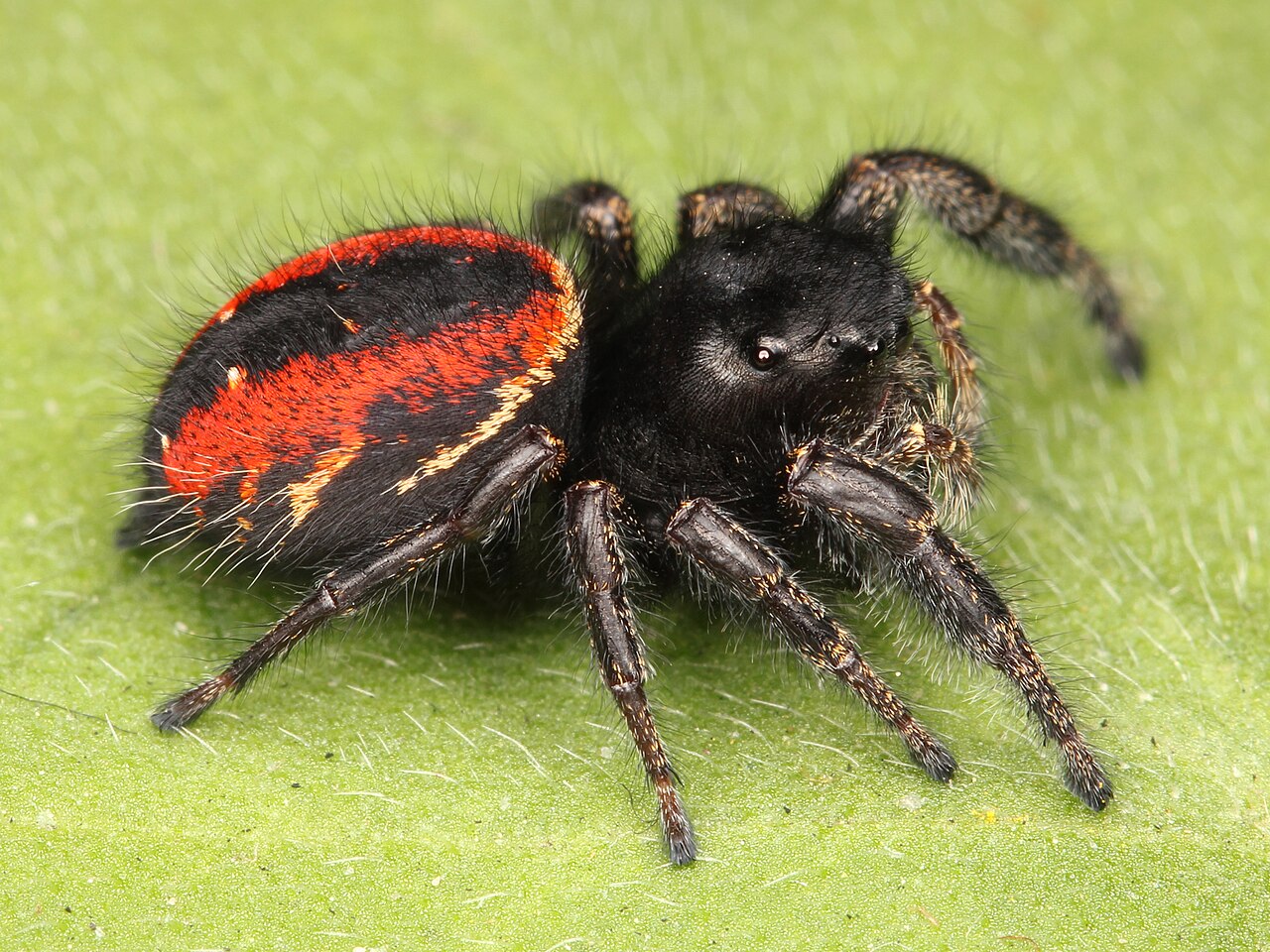
The red backed jumping spider is routinely reported as a pink spider, because in strong light the abdomen reads as rose rather than brick red. Adults are 1/4 to 1/2 inch (6 to 13 mm), stocky and hairy, with a black cephalothorax, iridescent green chelicerae and a plain red to pinkish abdomen; females add a black central stripe.
It is common in the western United States from British Columbia to Baja, in grassland, scrub and suburban gardens, and it is active by day. Jumping spiders hunt by sight, stalking prey and pouncing, and they build silk retreats under stones and bark rather than webs.
These are the spiders most likely to look back at you, and they are also the easiest to photograph. If the animal is sitting on a wall watching your hand move, it is a jumper, and our profile of the bold jumping spider covers the family’s behavior in detail.
Pink Crab Spider (Thomisus onustus): Not a US Species
The species behind most genuinely pink spider photographs online is Thomisus onustus, sometimes called the pink crab spider or pink flower crab spider. Females reach about 1/4 to 3/8 inch (7 to 10 mm), with a squat angular abdomen that widens toward the rear and two raised turrets carrying the outer eyes.
Females occur in rose pink, white, yellow and occasionally lilac, and they match the flower they are hunting on. The range covers southern and central Europe, North Africa, the Middle East and parts of Asia, so a US sighting is a misidentification or an image misfiled.
If a photograph of a plainly pink crab spider is labeled as American, check the source. Stock libraries mislabel this species constantly, which is a large part of why people believe pink spiders cannot be found in the United States at all.
Pinktoe and Rose Hair Tarantulas in the Pet Trade
Large pink spiders in photographs are usually pet tarantulas. The pinktoe tarantula, Avicularia avicularia, is a tree dwelling South American species with a dark metallic body and bright pink tips on each foot, reaching a leg span of 4 to 5 inches (10 to 13 cm). Spiderlings reverse the pattern with pink bodies and dark feet.
The Chilean rose tarantula, Grammostola rosea, is the other common one, a ground dwelling species with a rose to copper sheen over brown, also around 4 to 5 inches (10 to 13 cm) and known for living 15 to 20 years as a female. Neither species occurs in the wild in the US.
Both kick urticating hairs when stressed. For keepers, the practical rule is to wash hands after any enclosure work and never handle a spider over a hard floor, since a fall of even a few feet can rupture the abdomen.
Tiny Pink Spider in the House: Usually a Mite
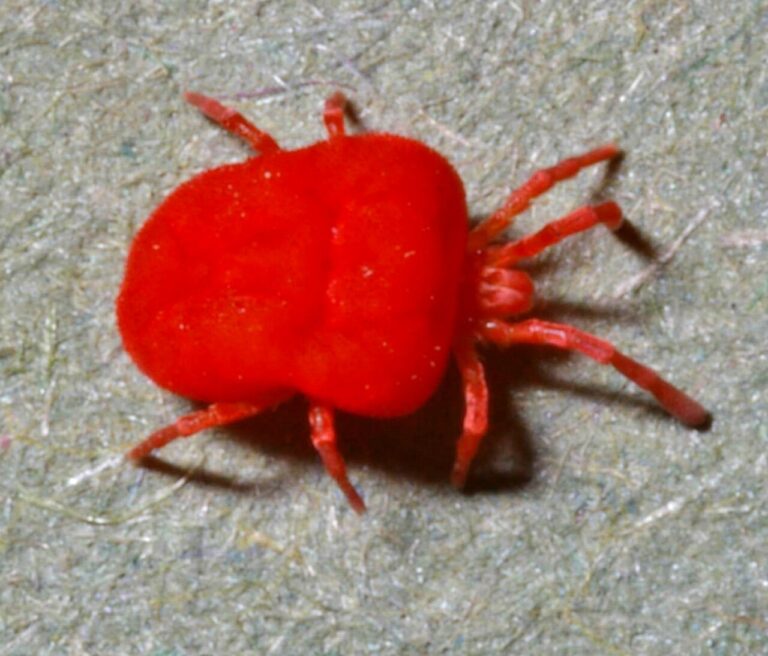
A pink or red speck the size of a grain of pollen crawling on a windowsill, a bathtub or a sunlit wall is almost certainly a mite rather than a spider. Clover mites (Bryobia praetiosa) are rust red with very long front legs, and two spotted spider mites (Tetranychus urticae) go orange to pinkish red in their overwintering form.
The quickest separator is the body: a spider has two obvious body sections joined by a narrow waist, while a mite is a single rounded blob. Mites also have eight legs, which is why “it has eight legs so it is a spider” fails here.
Neither mite bites people. Clover mites stain surfaces red when crushed, so vacuum rather than wipe, and both arrive from grass or houseplants pressed against the building. Wash plants and seal window frames rather than spraying the room.
Pink Spiderlings, Egg Sacs and Molted Skins
A pink cluster in a web corner is usually a brood. Freshly hatched spiderlings of many species are pale pink or orange because the cuticle has not hardened and the gut contents show through, and they darken over the following days as they molt.
Egg sacs add to the confusion. Some orb weaver and cobweb spider sacs are pink or salmon colored silk, and a sac with a dead female beside it is a common autumn find. A freshly molted spider of any species is pale and often pinkish for an hour or two before it colors up.
If the pink thing has not moved in a day, it is a sac or a shed skin. Hold a sheet of white paper behind it: shed skins are hollow, split along the side, and the legs stay curled in a fixed position, while a live pale spider will right itself when the paper touches the web.
Do Spiders Change Color?
Yes, some do, and the crab spiders on this page are the textbook case. Misumena vatia females can shift between white and yellow over several days by moving a liquid yellow pigment into or out of the outer cell layer of the cuticle, matching the flower they hunt from; white to yellow takes 10 to 25 days, and the reverse is faster.
That slow pigment change does not produce pink on demand. The pink and red striping on the abdomen is a fixed pattern, not an adaptive color, and it varies between individuals rather than within one spider’s lifetime.
Other color change in spiders is mostly about molting, hydration and reflectance. Many abdomens look brighter after a large meal and duller when the spider is dehydrated, and the Smithsonian’s National Museum of Natural History arachnid collections are a good starting point for comparing documented color forms against a field photograph.
How to Identify a Pink Spider Step by Step
Work through four questions in order: does it have a narrow waist, how long are the front legs relative to the back, does it sit in a web or on a surface, and how big is the body excluding legs. Those four answers place almost every pink report into one of the categories below.
| Character | Crab spider | Jumping spider | Mite |
|---|---|---|---|
| Waist | Narrow, visible | Narrow, visible | None, single blob |
| Front legs | Much longer, held open | Equal to others | Longest pair forward |
| Eyes | Eight small, in two rows | Two large forward facing | Not visible |
| Web | None | Silk retreat only | Fine webbing on plants |
| Movement | Sideways, slow | Short jumps, watches you | Steady crawl |
| Body length | 1/8 to 3/8 in | 1/4 to 1/2 in | Under 1/32 in |
Report an unusual sighting with a location and a scale object, because pink color forms in US species are genuinely under documented. Spiders with high contrast markings, such as the black spiders with white spots, are far better recorded than the pale and pink morphs of the same families.
Frequently Asked Questions
Does a pink spider exist, and are there pink spider species in the US?
Yes. Genuinely pink species include the Eurasian Thomisus onustus and some color forms of American crab spiders. In the US, pink appears as stripes on the goldenrod crab spider, as markings on the Hawaiian happy face spider, and as a rose cast on the red backed jumping spider.
Do spiders change color?
Some do. Goldenrod crab spiders shift between white and yellow over 10 to 25 days by moving pigment within the cuticle to match their flower. Pink and red abdomen stripes are fixed patterns and do not change. Most other apparent color change in spiders is molting, feeding or hydration.
Are pink spider lilies poisonous?
Yes, but they are plants, not spiders. Pink spider lilies in the genus Lycoris contain lycorine and related alkaloids throughout the bulb and foliage, and ingestion causes vomiting and diarrhea in people, dogs and cats. The name refers to the long spidery flower stamens.
Why shouldn’t I squish a wolf spider?
A female wolf spider carries dozens of spiderlings on her back in late summer, and crushing her scatters live young across the floor. Wolf spiders also eat large numbers of household pests. Trapping one under a glass and carrying it outside takes about the same effort and leaves nothing behind.
What is a tiny pink spider in my house?
Under about 1/32 inch it is nearly always a clover mite or a spider mite, both of which are rust red to pinkish and have no waist between body sections. If the body clearly has two parts joined by a thin stalk, it is a spiderling, usually pale because it has recently hatched or molted.
Is a pink crab spider dangerous to people or pets?
No. Crab spiders have fangs too small to penetrate adult human skin reliably, no medically significant venom, and no defensive aggression; their response to being approached is to drop from the flower. A cat or dog that eats one may salivate briefly but is not at risk.