Jumping Spider: Identification & Facts Guide
Jumping spiders (family Salticidae) are small, fuzzy, harmless spiders instantly recognizable by their compact bodies, large forward-facing eyes, and unmistakably curious habit of turning to track movement, including a person’s finger, with genuine interest. This guide covers how to identify a jumping spider, why their vision is considered the best of any spider, whether they are dangerous, and how they differ from the web-building spiders most people picture by default.
| Trait | Detail |
|---|---|
| Family | Salticidae (largest spider family, ~6,000+ species) |
| Size | 1/8 to 3/4 inch (4-18mm) |
| Eyes | 8 total; 2 large front-facing, 6 smaller for wide-angle detection |
| Hunting style | Active stalk-and-pounce, no web used to trap prey |
| Venomous to humans? | Mild venom; not dangerous, comparable to a mosquito bite |
How to Identify a Jumping Spider
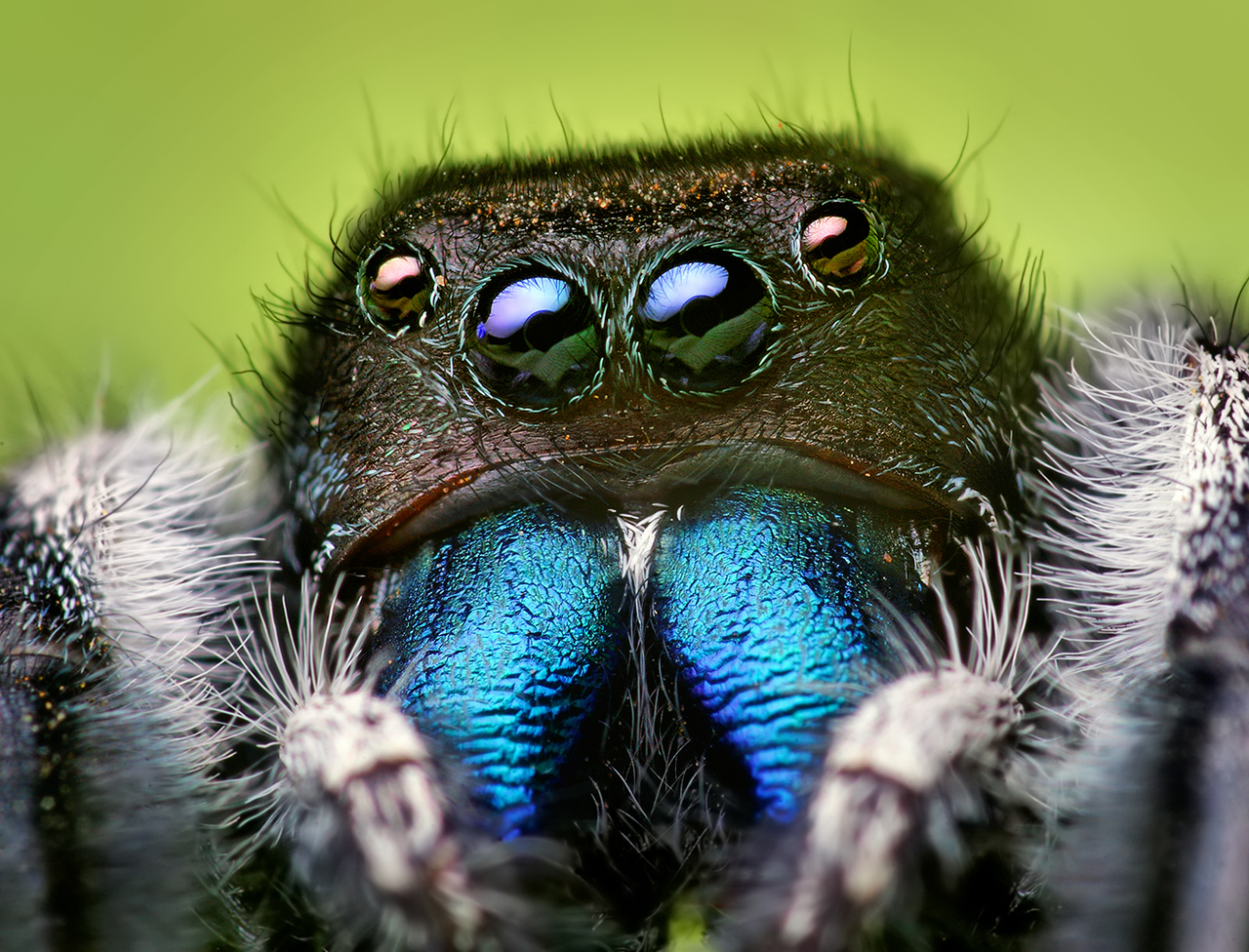
Jumping spiders have a distinctly compact, stocky body with a square-fronted, unusually tall cephalothorax, short but powerful legs, especially the front pair, and a rounded, often patterned abdomen. Coloration varies widely across the roughly 6,000 known species, ranging from dull black, brown, and gray to individuals with strikingly bright metallic blue or green accents, but nearly all share the same basic silhouette and the family’s signature large front eyes. Common species people encounter include the bold jumping spider (Phidippus audax), black with distinctive white spots and metallic green mouthparts, and the zebra jumping spider (Salticus scenicus), recognizable by bold black-and-white stripes and frequently found on walls and windowsills.
Why Jumping Spiders Have Such Remarkable Vision
Jumping spiders possess the best vision of any spider family, built around a genuinely sophisticated eight-eye system. Two large, front-facing principal eyes provide detailed, high-resolution, essentially binocular vision used to judge distance and identify potential prey, predators, or mates with real precision, while the remaining six smaller eyes, positioned along the sides and top of the cephalothorax, provide near 360-degree motion detection. When a side eye picks up movement, the spider physically rotates its entire body to bring the target into the sharper, forward-facing principal eyes, the same behavior responsible for a jumping spider appearing to deliberately track a finger moved across a window or tilt its body to keep an observer in view.
How Jumping Spiders Hunt Without a Web
Unlike orb weavers and many other common spider families, jumping spiders do not build webs to trap prey; instead, they are active, visual hunters that stalk potential prey using their exceptional eyesight before pouncing with remarkable precision from a distance of several body lengths away. This leaping ability comes from hydraulic pressure rather than muscular leg extension: jumping spiders rapidly increase blood pressure within their legs to extend them forcefully, propelling a jump that can cover up to 50 times their own body length. They still produce silk, though it is used for a dragline safety tether while jumping, to construct protective silk retreats for molting and egg-laying, and to wrap prey after a successful capture rather than to build any kind of prey-trapping web structure.
Are Jumping Spiders Dangerous to Humans?
No, jumping spiders pose no meaningful danger to people. They are non-aggressive by nature and will typically flee or leap away rather than confront a person, biting only as a last resort if directly handled, cornered, or pressed against skin. Their venom, while technically present since virtually all spiders produce some venom to subdue prey, is mild enough in jumping spiders that a bite typically causes no more than brief, localized irritation comparable to an ordinary mosquito bite, with no documented risk of serious medical complications in a healthy person.
Do Jumping Spiders Bite Children or Pets?
Jumping spiders are not considered a meaningful risk to children, infants, or household pets. Their small size, genuinely mild venom, and strongly non-aggressive temperament make a serious incident extremely unlikely even with direct contact; a curious child who touches or briefly holds a jumping spider will typically find that the spider’s instinctive response is to attempt escape rather than bite defensively. For cats and dogs, jumping spiders present essentially no threat at all, and any incidental contact between a pet and a jumping spider is exceedingly unlikely to cause any lasting harm. For a closely related question, see our guide to black and yellow caterpillar. For a closely related question, see our guide to green caterpillar. For a closely related question, see our guide to praying mantis eggs.
Jumping Spider Courtship Displays
Male jumping spiders of many species perform elaborate visual courtship displays, waving brightly colored legs, vibrating their bodies, and dancing in patterns specifically evolved to be noticed by a female’s exceptional eyesight, since visual communication matters far more for this family than it does for most other spiders that rely primarily on vibration or chemical cues. Peacock spiders, a strikingly colorful jumping spider genus native to Australia, take this to an extreme with elaborate, fan-like abdominal flaps and genuinely intricate dance routines that have made them a viral sensation in nature documentaries and online videos alike.
Are Jumping Spiders Beneficial to Have Around?
Yes, genuinely so. As active, visually-driven predators, jumping spiders help control populations of common household and garden insects, including flies, mosquitoes, and ants, making them a beneficial presence both indoors and outdoors from a pest-management perspective. Because they do not build the kind of visible, sprawling webs that many people specifically try to remove, jumping spiders are frequently the spider species pest control professionals recommend simply leaving alone rather than treating, reserving genuine concern and intervention for confirmed dangerous species like larger web-building spiders or medically significant venomous spiders instead, according to pest management guidance from university entomology extension programs.
Jumping Spider Colors and Species Diversity
With over 6,000 described species, jumping spiders show remarkable diversity in color and pattern, from the dull earth tones most people picture to genuinely vivid, iridescent species displaying metallic blues, greens, and even peacock-like courtship displays in some Australian species. This sheer diversity, the largest of any spider family by species count, means new jumping spider species continue to be documented regularly, and identification down to the exact species level, as opposed to simply recognizing the family, often requires close examination of eye arrangement and body markings that go well beyond general coloring alone.
Where Do Jumping Spiders Live?
Jumping spiders are found across an enormous range of habitats worldwide and represent the largest spider family by species count, thriving in gardens, tall grasses, dense vegetation, and underneath loose bark outdoors. They are diurnal, active and hunting during daylight hours, and are frequently seen in sunny, well-lit spots both outside and, when they wander in accidentally on clothing, packages, or potted plants, occasionally indoors near windows where insects gather. Unlike species that deliberately seek out indoor shelter, jumping spiders generally end up inside by accident rather than actively colonizing homes as habitat.
Jumping Spider Lifespan and Reproduction
Most jumping spider species live around one year in the wild, completing their entire life cycle from egg to adult within that relatively short window depending on species and environmental conditions. Females construct small, silk-lined nests, often tucked into protected spots like curled leaves, bark crevices, or the underside of stones, where they lay and guard their eggs until the spiderlings hatch and disperse to begin hunting independently. This short but genuinely active lifespan is part of why jumping spiders are so frequently encountered actively hunting during the day, since nearly their entire adult life is spent foraging and hunting rather than the more sedentary, ambush-based existence typical of many web-building spider species.
Jumping Spider vs Wolf Spider: Key Differences
Jumping spiders and wolf spiders are frequently confused, both being active ground or surface hunters rather than web-builders, but a few clear differences separate them. Jumping spiders are generally smaller and more visually compact, with the family’s signature oversized front eyes clearly visible even to a casual observer, while wolf spiders are typically larger, more robust, and have a flatter, less distinctly “square” head shape. Behavior offers another clue: jumping spiders move in short, deliberate, jerky bursts and pause frequently to visually track movement, while wolf spiders tend to move more continuously and rely more heavily on vibration sensing than the sharp, direct visual tracking jumping spiders are famous for, a sensory difference not unlike how a visually alert lizard relies on sight while many other reptiles depend more heavily on scent and vibration, or how other backyard arthropods rely on entirely different sensory strategies to navigate and hunt, alongside completely unrelated hunting styles seen in ambush predators like the rat snake, or the venomous defense of a bullet ant.
Related reading: Banana Spider.
Related reading: Jumping Spider Enclosure.
Related reading: Baby Jumping Spider.
Related reading: Yellow Caterpillar.
Frequently Asked Questions
Are jumping spiders dangerous?
No, they pose no meaningful danger to humans. They are non-aggressive, will typically flee rather than bite, and their mild venom causes no more than brief, localized irritation comparable to a mosquito bite if a bite does occur.
Why do jumping spiders seem to watch and follow movement?
Jumping spiders have exceptional vision with two large front eyes for detailed sight and six smaller eyes for near-360-degree motion detection. When they detect movement, they rotate their body to track it with their sharper front eyes.
Do jumping spiders build webs?
No, they don’t build webs to trap prey. Instead they actively stalk and pounce on prey using their excellent vision. They do use silk for safety draglines while jumping and for protective retreats.
How far can jumping spiders jump?
Jumping spiders can leap up to 50 times their own body length, achieved through hydraulic pressure that rapidly extends their legs rather than muscular force alone.
Are jumping spiders dangerous to cats or dogs?
No, jumping spiders present essentially no threat to pets. Their small size and mild venom make any incidental contact with a cat or dog extremely unlikely to cause harm.
What is the most common jumping spider found in homes?
The bold jumping spider (Phidippus audax), black with white spots and metallic green mouthparts, and the zebra jumping spider, with black-and-white stripes, are among the most commonly encountered species.
Should I remove a jumping spider I find in my house?
Not necessarily. Jumping spiders are beneficial predators that help control flies, mosquitoes, and ants, and pose no danger. Many pest control professionals recommend simply leaving them alone.
Whether encountered on a windowsill or in a garden, a jumping spider genuinely rewards a closer, patient look rather than an instinctive urge to remove or avoid it entirely.
Their combination of harmlessness, genuine ecological value, and unusually expressive behavior makes jumping spiders one of the more approachable spiders even for people who otherwise feel uneasy around arachnids in general, arguably more so than a startled different types of small pets or the far more intimidating-looking large ground beetle.