What Do Jumping Spiders Eat? Diet, Hunting, and Feeding
Jumping spiders eat live insects, and they catch them by hunting rather than by building webs. The everyday diet is flies, mosquitoes, gnats, small moths, aphids, crickets, caterpillars, and other spiders, all taken by stalking and pouncing. A jumping spider will happily take prey up to its own body size and sometimes larger, subduing it with venom that is potent against insects and harmless to people.
What makes the group remarkable is not the menu but the method. These are visual predators with the sharpest eyesight of any spider, they plan routes around obstacles, and one species has largely given up meat altogether in favor of plant material. This guide covers what wild jumping spiders eat, how they hunt, what to feed a pet one, how often they need food, and how long they survive without it.
| Quick Facts | Jumping Spider Diet |
|---|---|
| Main prey | Flies, gnats, moths, crickets, aphids, other spiders |
| Hunting method | Active stalking and pouncing, no capture web |
| Jump distance | Up to 4 to 6 times body length |
| Prey size | Up to their own body size, sometimes larger |
| Feeding frequency | Every 2 to 3 days for adults |
| Danger to humans | None, venom is not medically significant |
What Do Jumping Spiders Eat in the Wild?
The core diet is small flying and crawling insects. Houseflies and fruit flies are staples, along with mosquitoes, gnats, small moths, leafhoppers, aphids, and juvenile crickets. Jumping spiders are generalists and will take nearly anything they can overpower, which is why they turn up on window sills, fence posts, and garden foliage where insects concentrate.
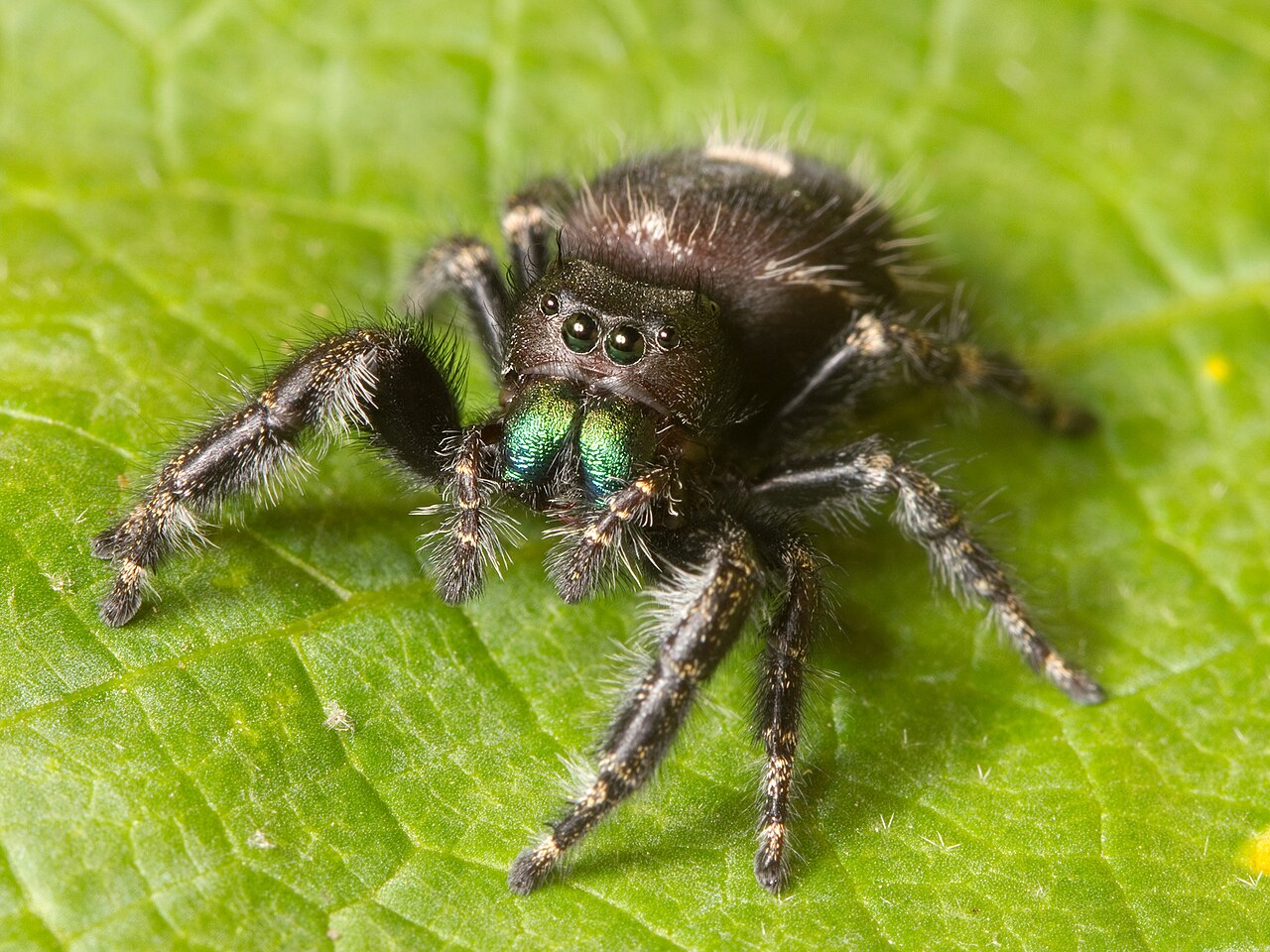
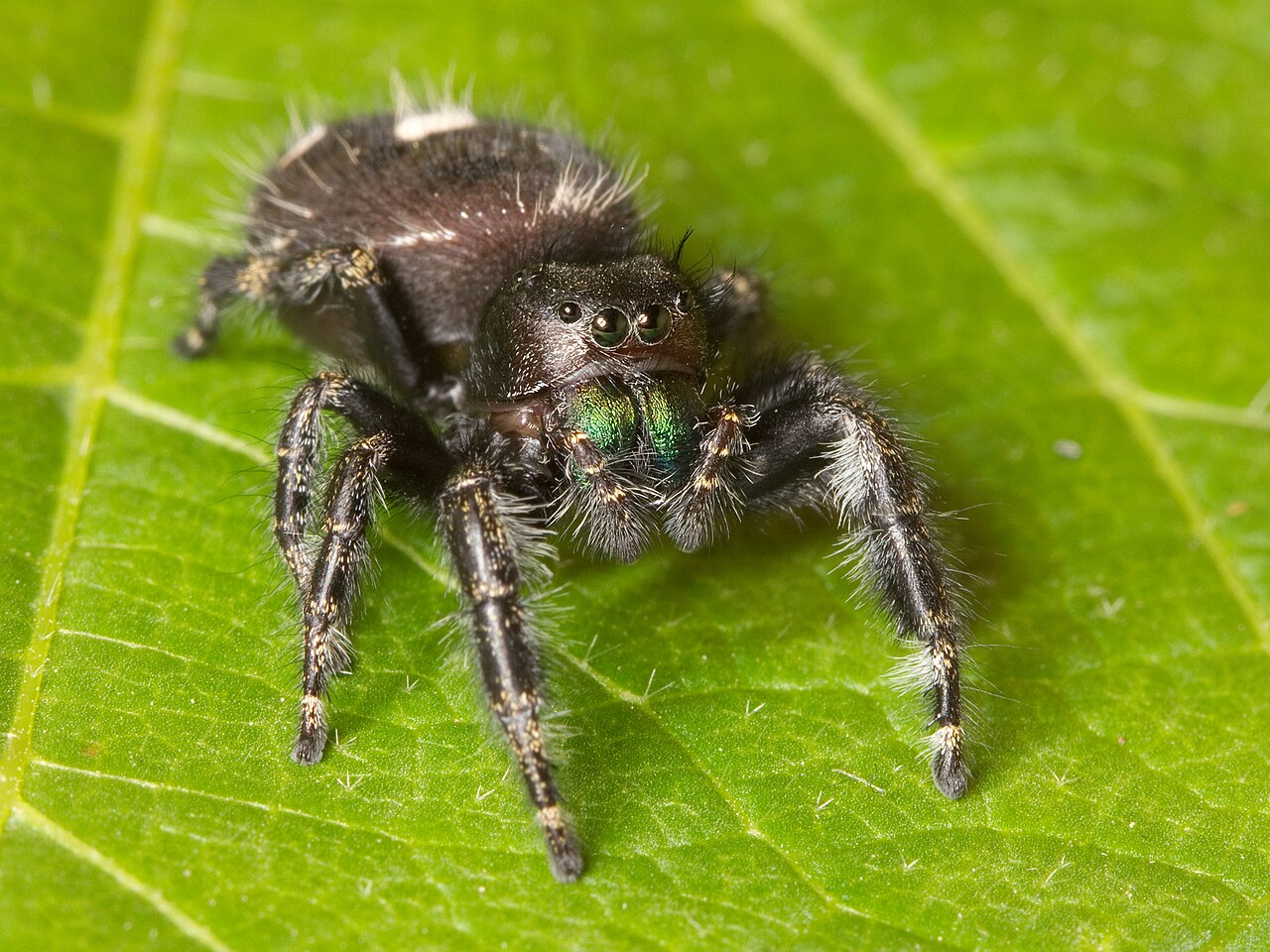
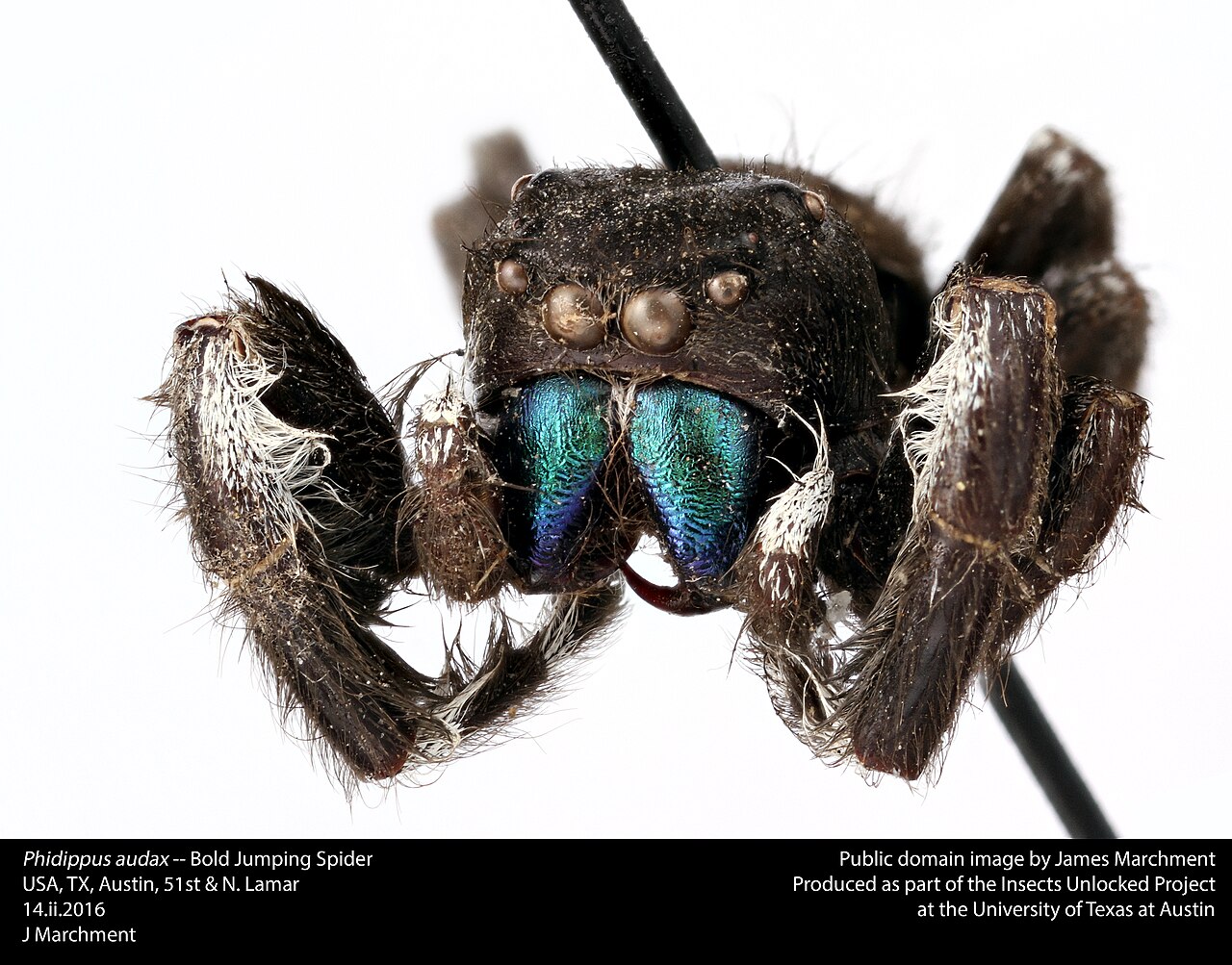
Prey size scales with the spider. The bold jumping spider (Phidippus audax), one of the most common North American species at about 0.5 in, regularly takes prey its own length and occasionally larger, including grasshoppers and caterpillars that outweigh it. The kill comes from venom injected through the fangs, which immobilizes an insect within seconds.
Feeding itself is external. Spiders cannot swallow solid food, so the spider injects digestive enzymes into the prey, waits while the tissue liquefies, then draws out the contents, leaving a hollow husk behind. That is why you sometimes find intact-looking insect shells near a spider’s retreat rather than fragments. The insects at the base of this food chain are covered in our guide to what crickets eat.
How Jumping Spiders Hunt Without a Web
Jumping spiders build silk retreats for molting, resting, and egg-laying, but they never build a capture web. Instead they hunt like small cats, spotting prey at a distance, creeping closer in a series of pauses and advances, then launching from a crouch when they close within range.
The jump itself is hydraulic rather than muscular. Spiders have no extensor muscles in their legs, so they extend them by rapidly increasing internal blood pressure, effectively pumping the legs straight. That system launches the spider 4 to 6 times its body length, and some species manage considerably more.
Every jump comes with a safety line. Before launching, the spider anchors a dragline of silk to the surface, which arrests a missed jump and lets it climb back. High-speed video also shows the dragline being used to control body orientation in mid-air, so the spider lands feet first on target rather than tumbling.
Eyes Built for Hunting
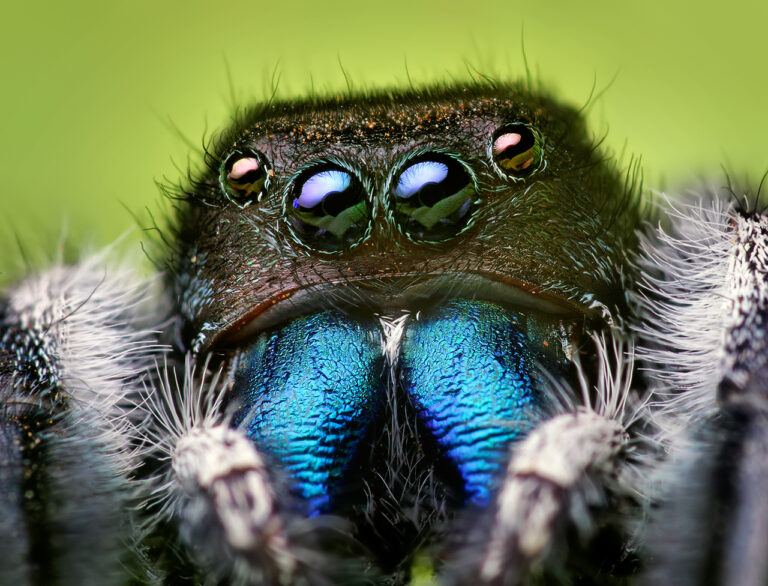
Jumping spiders have eight eyes arranged in rows, and the two enormous forward-facing ones, called the anterior median eyes, give them the highest visual acuity known in any spider and among the best of any animal their size. Those eyes work like telephoto lenses, with a long focal length and a narrow field of view.
The retinas behind them move. Muscles swivel the retina to scan across a scene while the lens stays fixed, which is how a spider with a narrow field of view builds a detailed picture of what is in front of it. The surrounding smaller eyes handle motion detection across a nearly 360 degree field and trigger the head turn that brings the main eyes to bear.
Color vision comes with it. Several species see into the ultraviolet, and some have evolved a filter that adds green sensitivity, giving them genuine color discrimination that they use in courtship displays as well as hunting. Combined with an ability to judge distance from a single eye using image defocus, this visual system is what allows accurate pouncing, and it is a large part of why jumping spiders behave so differently from the web builders covered in our guide to the grass spider.
Do Jumping Spiders Eat Other Spiders?
Regularly. Other spiders are a normal part of the diet, including web builders caught on their own webs and other jumping spiders. Cannibalism happens too, particularly between adults of different sizes and occasionally after mating, which is one reason pet keepers house them individually.
The genus Portia takes this to an extreme that has made it famous in behavioral research. These spiders specialize in hunting web-building spiders, and they do it by plucking the web with their legs to produce vibrations that mimic a trapped insect or a courting male. When the resident spider approaches, Portia attacks.
What makes Portia striking is the flexibility. Individuals trial different vibration patterns when the first attempt fails, effectively searching for the signal that works on that particular resident. They also take detours that require moving out of sight of the prey for extended periods, which implies holding a route in mind. For an animal with a brain smaller than a pinhead, that is a genuinely surprising level of problem solving.
The Vegetarian Jumping Spider
One species breaks the pattern entirely. Bagheera kiplingi, a jumping spider of Central America, gets the large majority of its diet from plant material rather than prey, making it the closest thing to a herbivorous spider known to science.
It lives on acacia trees and feeds on Beltian bodies, the protein and fat rich structures the tree produces at the tips of its leaflets to feed the ants that defend it. The spider steals them, which means it spends its life evading the patrolling ants rather than hunting insects.
The exception proves the rule about spider digestion. Because Bagheera kiplingi eats solid plant tissue, it has to process food differently from a spider that liquefies prey, and its digestive physiology reflects that. It also still takes ant larvae and nectar opportunistically, so the diet is overwhelmingly rather than strictly vegetarian.
What Do Baby Jumping Spiders Eat?
Spiderlings emerge from the egg sac at a fraction of a millimeter and need correspondingly tiny prey. In the wild they take springtails, mites, aphids, thrips, fungus gnats, and the smallest flies they can find, and they hunt using the same stalk-and-pounce method as adults from the start.
Immediately after hatching they do not eat at all. Spiderlings live off the remaining yolk for their first days and remain in or near the egg sac until they molt once, after which they disperse and begin hunting independently. Some species disperse by ballooning, releasing silk threads that catch the wind.
Growth happens in steps. Each molt increases size by a noticeable increment, and prey size increases along with it, so a spiderling that started on springtails is taking fruit flies within weeks. Most species reach adulthood in several months to a year depending on temperature and food supply, and adults typically live about a year.
What to Feed a Pet Jumping Spider
Flightless fruit flies are the staple, and Drosophila hydei is the standard choice because it is larger than the common melanogaster and suits an adult spider. For spiderlings, melanogaster or springtails are the right size. Both cultures are easy to maintain and cheap, which matters given how often the spider eats.
Small crickets, house flies, mealworm beetle larvae in small sizes, waxworms, and green bottle fly larvae all work as variety for larger species such as Phidippus regius. The rule is that prey should be no longer than the spider’s body, and softer prey is preferable, since a hard-shelled beetle can injure a spider during the struggle.
Two things to avoid. Never feed wild-caught insects from anywhere that may have been treated with pesticide, since residues kill spiders readily. And do not offer prey that can fight back effectively, including ants, which bite and spray formic acid, and anything much larger than the spider. Gut-loading feeder insects for a day before offering them passes better nutrition on to the spider, and our guide to the jumping spider enclosure covers the housing side.
How Often Do Jumping Spiders Eat?
Adults do well on a feeding every 2 to 3 days, typically one appropriately sized prey item at a time. Spiderlings eat more frequently, often daily or every other day, because they are growing fast and their reserves are small relative to their metabolism.
Appetite drops before a molt. A spider preparing to molt seals itself into a silk retreat, refuses food for several days to over a week depending on size, and should not be disturbed. Offering food during this period is pointless and the uneaten prey can stress or even injure a freshly molted spider whose cuticle is still soft.
They tolerate hunger better than thirst. A healthy adult can survive one to two weeks without food and longer at cool temperatures, but dehydration kills much faster, so a water source matters more than a strict feeding schedule. A light misting every day or two provides droplets they drink from, and an abdomen that looks shrunken or wrinkled signals dehydration before it signals hunger.
Do Jumping Spiders Bite People?
Very rarely, and the result is trivial. Jumping spiders are not aggressive toward humans, they flee rather than confront, and a bite typically happens only when one is pressed against skin or trapped in clothing. The venom is calibrated for insects and is not medically significant to people.
A bite feels like a pinprick and produces mild local redness, swelling, and itching that resolves within a day or two. Wash the area with soap and water and monitor it for ordinary infection. Anyone with a genuine allergic response, which is uncommon, should seek medical care as with any insect or spider bite.
Their behavior around people is closer to curiosity than defense, and the visual system is why. A jumping spider that turns to look at you and holds position is assessing whether you are prey, predator, or irrelevant, and the answer is almost always the third. They are among the most useful predators in a garden, taking substantial numbers of flies, aphids, and other pests, which is a good argument for moving one outside rather than killing it. Our guide to the jumping spider covers identification across the common species, and the banana spider guide handles a much larger relative people often worry about.
Related reading: what do spiders eat.
Frequently Asked Questions
What do jumping spiders eat?
Live insects, primarily flies, gnats, mosquitoes, small moths, aphids, crickets, caterpillars, and other spiders. They hunt by stalking and pouncing rather than building capture webs, and they can take prey up to their own body size or larger.
Do jumping spiders build webs to catch prey?
No. They build silk retreats for molting, resting, and egg-laying, but never capture webs. They hunt actively, creeping toward prey and launching from a crouch using hydraulic leg extension, always anchoring a dragline of silk before the jump.
What do you feed a pet jumping spider?
Flightless fruit flies are the staple, with Drosophila hydei for adults and the smaller melanogaster or springtails for spiderlings. Small crickets and soft fly larvae work for larger species. Never feed wild-caught insects that may carry pesticide residue, and avoid ants and anything longer than the spider’s body.
How often do jumping spiders need to eat?
Adults every 2 to 3 days, spiderlings daily or every other day. Appetite stops before a molt, when the spider seals itself in a retreat and should be left alone for several days to a week. Water matters more than strict feeding, so mist lightly every day or two.
How long can a jumping spider go without food?
A healthy adult can survive one to two weeks without food, longer at cool temperatures. Dehydration is far more dangerous than hunger. A shrunken or wrinkled abdomen indicates dehydration and needs a water source rather than more prey.
Do jumping spiders eat other spiders?
Yes, regularly, including web builders and other jumping spiders. The genus Portia specializes in it, plucking webs to mimic trapped insects and luring the resident spider out, and adjusting the vibration pattern when the first attempt fails.
Are there vegetarian spiders?
Almost none, but Bagheera kiplingi, a Central American jumping spider, gets most of its diet from Beltian bodies, the protein-rich structures acacia trees produce to feed defending ants. It is the closest thing to a herbivorous spider known, though it still takes ant larvae and nectar opportunistically.