Banana Spider: Identification, Size, and Bite Facts
The banana spider you find strung across a garden path in the southeastern United States is almost always the golden silk orb-weaver, a large but harmless spider named for its yellow body and the golden sheen of its web. Despite its intimidating size, this banana spider cannot seriously hurt you. Its bite is comparable to a bee sting, and it has no interest in people. The confusion starts because at least three very different spiders share the name, including one genuinely dangerous species from South America.
This guide explains exactly what a banana spider is, how to recognize one, how big it gets, whether it bites, where it lives, and how it differs from the Joro spider that is spreading across the same region. You will also learn where the deadly reputation comes from and why it does not apply to the spider in your yard.
| Feature | Detail |
|---|---|
| Common name | Banana spider, golden silk orb-weaver, writing spider (locally) |
| Scientific name | Trichonephila clavipes (formerly Nephila clavipes) |
| Family | Araneidae (orb-weavers) |
| Female size | Body 1 to 1.5 in, leg span up to 3 in |
| Male size | About 0.2 in, roughly one tenth of the female |
| Range | Florida, Georgia, the Carolinas, Texas, Louisiana, Alabama |
| Danger to humans | Very low, mild bite only if handled roughly |
What Is a Banana Spider?
The name banana spider is used for at least three unrelated spiders, which is the main reason the species causes so much anxiety. In the United States, the banana spider almost always means the golden silk orb-weaver, Trichonephila clavipes. This is a big, long-legged orb-weaver with a yellowish, elongated body that hangs head-down in a large golden web. It is common across the humid Southeast and is completely harmless to people.
The second spider called a banana spider is Cupiennius, a group of large but medically harmless hunting spiders from Central and South America that occasionally arrive in fruit shipments. The third, and the source of the fearsome reputation, is Phoneutria, the Brazilian wandering spider, which is genuinely venomous. Only Phoneutria is dangerous, and it does not live in the United States.
Because these spiders look broadly similar to someone who is startled, the harmless orb-weaver in your garden often inherits fears that belong to a spider thousands of miles away. Much like the potato bug name, which covers several unrelated insects, the banana spider label spans very different animals, and in a US backyard the answer is nearly always the harmless golden silk orb-weaver.
What Does a Banana Spider Look Like?
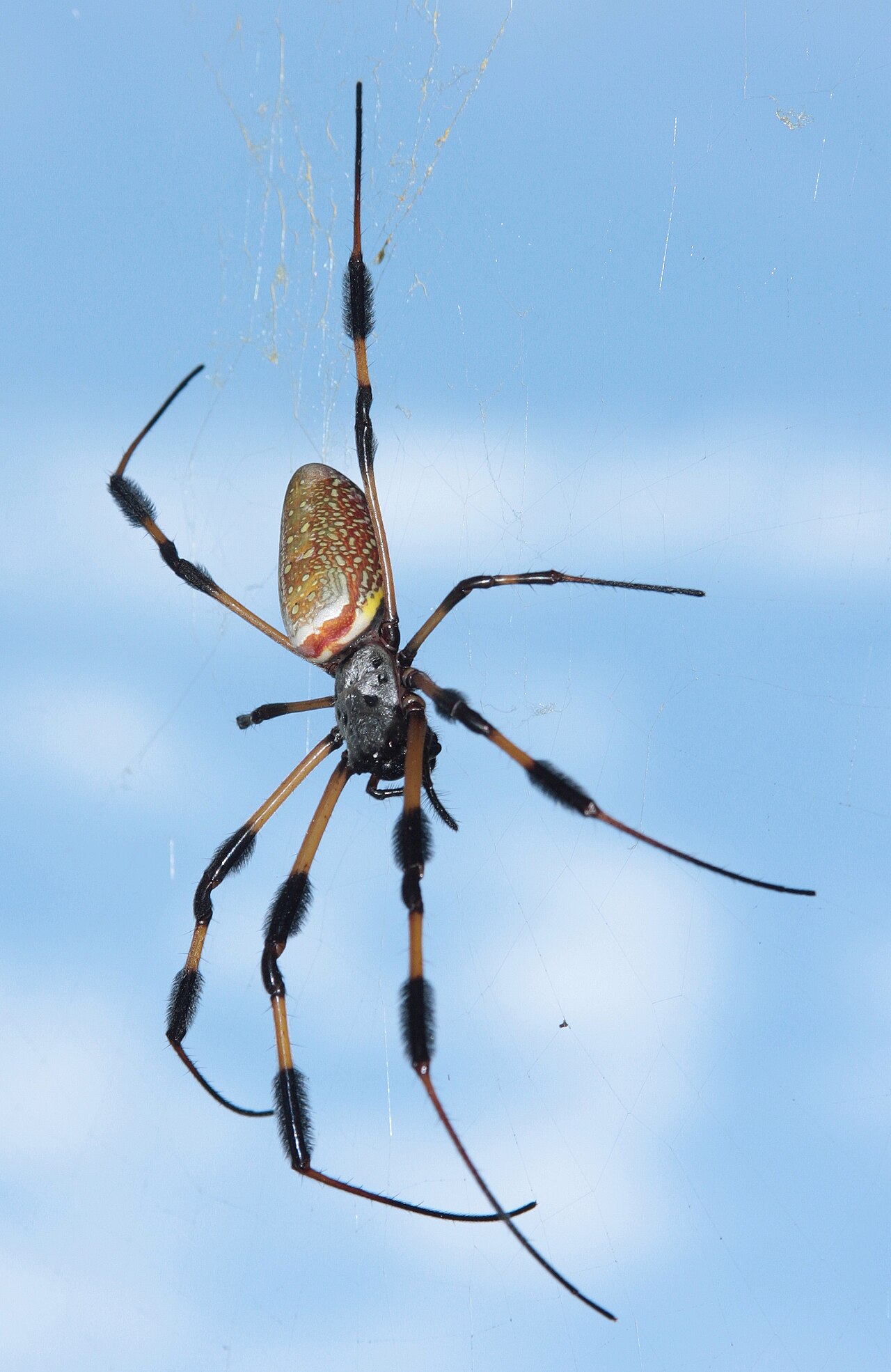
A female golden silk orb-weaver is unmistakable once you know the details. She has a long, cylindrical abdomen that is silvery to yellow-brown, often with small pale spots and a slightly bumpy front edge. Her legs are long, dark, and banded, with distinctive feathery tufts of hair on several leg segments that look like tiny brushes. These leg tufts are one of the most reliable identification marks.
The overall color impression is gold and dark brown, which blends with dappled light in the shrubs and forest edges where these spiders build. Seen from below, hanging in the center of the web, the female shows a patterned underside that helps distinguish her from other large orb-weavers. Males are so small and plain that most people never notice them sharing the female’s web.
Size alone often gives the species away. A large female with a leg span the width of a human palm, sitting in a faintly golden web at head height along a trail, is almost certainly a banana spider. If you want to confirm an identification, the University of Florida entomology extension publishes clear reference photos of Trichonephila clavipes for the region.
How Big Do Banana Spiders Get?
Banana spiders show one of the most extreme size differences between the sexes of any North American spider. A full grown female has a body around 1 to 1.5 inches long, and with her legs extended she can span up to 3 inches, which is what makes people stop in their tracks. She is one of the largest non-tarantula spiders you will encounter in the eastern United States.
The male is a different story. He measures only about 0.2 inches, roughly one tenth the length of the female and a tiny fraction of her weight. Several small males often live at the edge of a single female’s web, waiting for a chance to mate while she does the hunting. This is why photos of a banana spider almost always show the large female.
Size increases through the warm months as the female molts and grows, reaching her maximum in late summer and early fall. A giant banana spider spotted in September is simply a mature female at the end of her growing season, not a separate species or an unusual mutant. Her impressive dimensions are normal for a healthy adult.
The Golden Silk Web
The banana spider builds one of the strongest and most striking webs in North America. The silk has a warm golden color that is visible in direct sunlight, which is the origin of the name golden silk orb-weaver. The main orb can be several feet across, and it is often anchored by a complex scaffold of support lines that make the whole structure larger than the visible spiral.
This silk is remarkably tough. Researchers have studied golden orb-weaver silk for its tensile strength, which rivals some synthetic fibers by weight, and the webs are strong enough to catch large flying insects and occasionally small birds by accident. Walking face first into one is startling but harmless, and the spider will retreat rather than approach you.
Because the webs are rebuilt frequently and placed across open flight paths for insects, they often end up spanning garden paths, porches, and gaps between shrubs. Insect-eating birds sometimes benefit from the same insect traffic the spider targets, which is one reason a yard that attracts insect-eating birds tends to be rich in orb-weavers too.
Where Do Banana Spiders Live?
Golden silk orb-weavers are creatures of warm, humid climates. In the United States they are concentrated in the Southeast, and searches for banana spider Florida, banana spider Georgia, banana spider Texas, banana spider South Carolina, banana spider Louisiana, and banana spider Alabama all point to the same species. Florida is the heartland of the population, where the spiders are active for much of the year.
Within their range they favor forest edges, citrus groves, swampy woodland, and shaded gardens where flying insects are plentiful and there are sturdy anchor points for a large web. They are most noticeable from midsummer through the first cool weather of fall, when females reach full size and build in prominent places.
As the climate warms, the northern edge of the range has crept upward, and sightings now occur slightly farther north than in past decades. Even so, a banana spider is still overwhelmingly a southeastern animal, and encounters drop off sharply once you move into cooler inland and northern states.
Are Banana Spiders Venomous or Dangerous?
For the golden silk orb-weaver, the honest answer is that it is technically venomous, like almost all spiders, but not dangerous to people. Its venom is meant for subduing insects, and a bite to a human is uncommon because the spider would rather flee. When bites do happen, usually because someone grabs or squeezes the spider, the result is mild, comparable to a bee sting, with brief local pain and redness that fades quickly.
There is no antivenom needed and no medically significant threat for a healthy person. The exception in the wider banana spider story is the Brazilian wandering spider, Phoneutria, whose venom is genuinely serious. That spider lives in Central and South America, not in the United States, and it is a ground-hunting spider, not a web builder, so it behaves nothing like the orb-weaver in your garden. For a closely related question, see our guide to baby centipede.
The takeaway is simple. If a large spider is sitting calmly in a golden orb web in a US yard, it is a harmless banana spider and can be left alone or gently relocated. Reports of deadly banana spiders almost always trace back to Phoneutria and do not apply to the spider most Americans actually see.
Banana Spider vs Joro Spider and Other Orb-Weavers
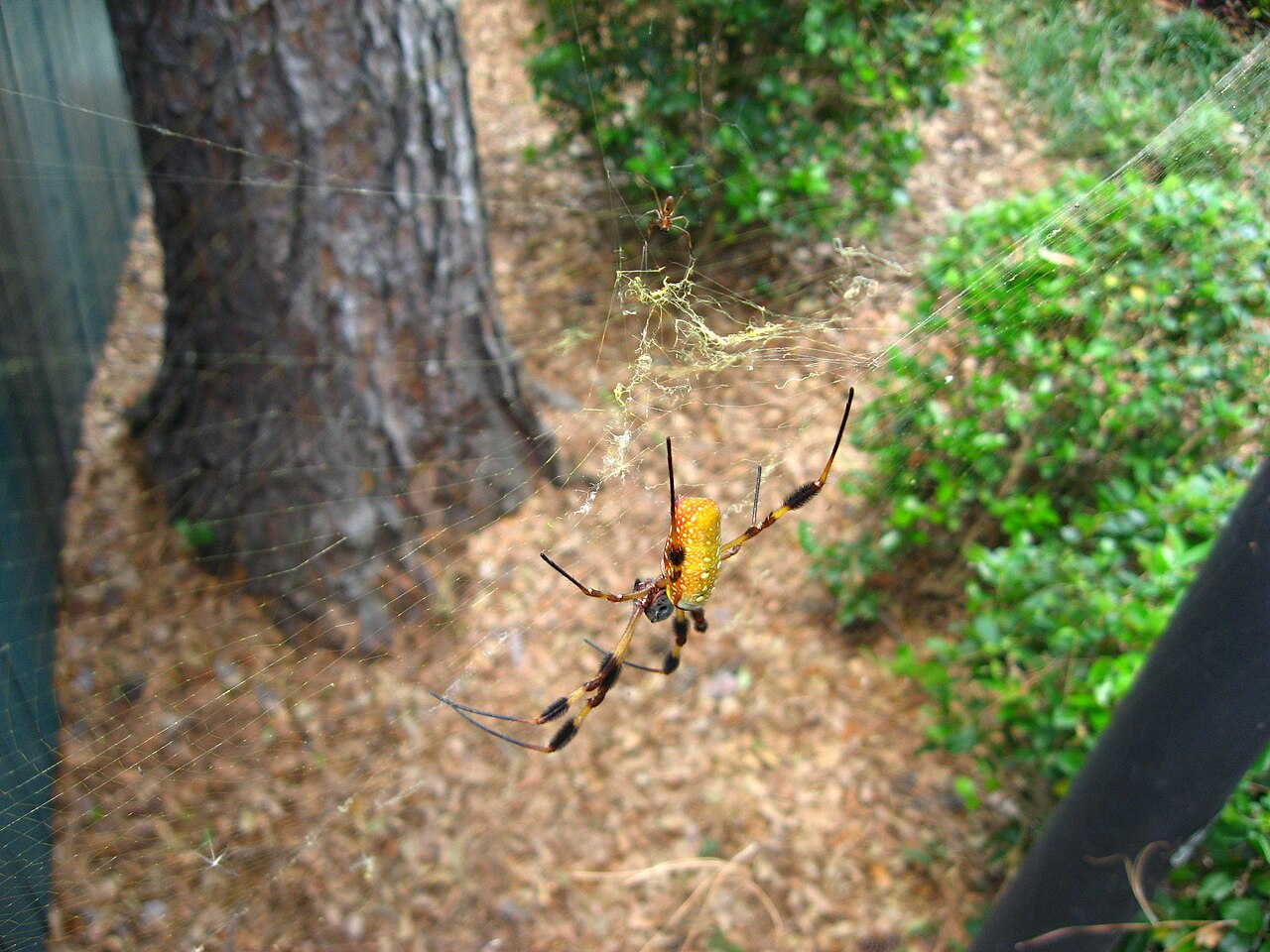
The Joro spider, Trichonephila clavata, is a close relative of the banana spider that has spread across the Southeast after arriving from East Asia. The two are frequently confused because both are large golden orb-weavers in the same genus. The clearest difference is color. The Joro female has a bright, boldly striped yellow and blue-black body with red markings underneath, while the native banana spider is more muted silver, gold, and brown with the distinctive feathery leg tufts.
Both build big golden webs, and both are harmless to humans, so a mix-up is not a safety problem. Range and season overlap in states like Georgia and the Carolinas, which is why searches for Joro spider vs banana spider have become common. If the spider is vividly striped and colorful, it is likely a Joro; if it is subtle gold and brown with leg brushes, it is the native banana spider.
Compared with smaller garden orb-weavers, the banana spider is set apart mainly by its sheer size and the golden tint of its silk. A small flying insect problem in the yard often supports many of these spiders at once, since orb-weavers thrive wherever gnats, flies, and moths are abundant. Their presence is usually a sign of a healthy insect food web rather than a cause for concern.
Life Cycle: Egg Sacs, Babies, and Seasonality
Banana spiders follow an annual cycle tied to the warm season. Spiderlings hatch in spring, disperse, and grow through summer, with females molting repeatedly as they enlarge. By late summer the females are at full size and highly visible in their prominent webs, which is when most people notice and photograph them.
In fall the female produces one or more egg sacs, which are wrapped bundles of golden silk containing hundreds of eggs and usually tucked into nearby foliage rather than the main web. After laying, the adult females decline and die with the first sustained cold weather. The eggs overwinter and produce the next generation of tiny baby banana spiders in spring.
This seasonality explains why the spiders seem to vanish in winter and reappear each summer. It also means the giant female you see in September has only weeks left, while the barely visible spiderlings of spring are the same species at the start of their lives. The insects these spiders remove are the same ones that insect-eating songbirds and other small backyard birds rely on, so orb-weavers are part of the same backyard food web that also supports birds that hunt larger insects.
Related reading: Potato Bug.
Related reading: Potato Bug.
Related reading: Potato Bug.
Related reading: Potato Bug.
Related reading: Potato Bug.
Related reading: Potato Bug.
Related reading: Potato Bug.
Related reading: Potato Bug.
Related reading: Potato Bug.
Related reading: Potato Bug.
Related reading: Potato Bug.
Related reading: Potato Bug.
Related reading: Potato Bug.
Related reading: Potato Bug.
Related reading: Potato Bug.
Related reading: Potato Bug.
Related reading: Potato Bug.
Related reading: Potato Bug.
Related reading: Potato Bug.
Related reading: Potato Bug.
Related reading: Stink Bug Eggs.
Related reading: Jumping Spider Enclosure.
Related reading: Fuzzy Caterpillar.
Related reading: Earwig Bite.
Related reading: Blue Butterfly.
Related reading: Orchid Mantis.
Related reading: Hummingbird Moth.
Related reading: Baby Dragonfly.
Related reading: Southern House Spider.
Related reading: Murder Hornet.
Related reading: Crane Fly.
Related reading: Cricket Sounds.
Related reading: Cicada Sounds.
Related reading: Clover Mite.
Related reading: should i kill a black widow spider.
Related reading: Types of Bees.
Related reading: No See Ums.
Frequently Asked Questions
Is a banana spider poisonous?
The US banana spider, the golden silk orb-weaver, is venomous in the technical sense that it uses venom to subdue insects, but it is not dangerous to people. A bite is rare and no worse than a bee sting. The only banana spider with medically serious venom is the Brazilian wandering spider, which does not live in the United States.
Do banana spiders bite?
They can bite if grabbed or squeezed, but they almost never do. These orb-weavers are not aggressive and will retreat from people. On the rare occasion a bite happens, it causes brief local pain and redness that fades within a day and needs no special treatment for a healthy person.
What does a banana spider look like?
Look for a large female with a long silver to yellow-brown abdomen, long banded legs with feathery tufts of hair, and a big golden-tinted orb web. The male is tiny by comparison. That combination of size, leg tufts, and golden silk is the reliable signature of the golden silk orb-weaver.
Can banana spiders be in bananas?
The spiders occasionally reported in banana or fruit shipments are usually harmless Cupiennius species, not the dangerous Brazilian wandering spider that headlines suggest. Genuine venomous stowaways are extremely rare. The golden silk orb-weaver that Americans call a banana spider lives in gardens and woodland, not inside fruit.
How long do banana spiders live?
In the United States, golden silk orb-weavers live for a single warm season. Spiderlings hatch in spring, mature over summer, reproduce in fall, and the adult females die with the first hard cold. The eggs then overwinter and hatch the following spring, so the population persists year to year even though individuals do not.
What do banana spiders eat?
They eat flying insects caught in the web, including flies, gnats, moths, mosquitoes, wasps, and beetles. A large female can handle surprisingly big prey. By removing swarms of small flying insects, banana spiders provide natural pest control in gardens and along woodland edges.
What is the difference between a banana spider and a Brazilian wandering spider?
The US banana spider is a web-building orb-weaver that is harmless to people, while the Brazilian wandering spider, Phoneutria, is a ground-hunting spider from South America with genuinely dangerous venom. They differ in behavior, appearance, and range, and the two should never be confused despite sharing a nickname.