Octopus Symbolism: Good or Bad Omen? Spiritual Meaning
Is the octopus a good or bad symbol? Mostly good, as long as it stays in the open. A calm octopus means intelligence and adaptability, while one that hides, clouds the water or grabs on is a warning.
An octopus is a good omen of intelligence and adaptability, and a reminder that you can slip out of nearly any tight spot. The warning side belongs to the hidden octopus, whose ink and tight grip stand for hidden motives, a clinging relationship, or the feeling of being stretched in too many directions at once.
What Does an Octopus Symbolize?
An octopus symbolizes intelligence, adaptability, camouflage, flexibility, regeneration and the mystery of the deep. The animal changes color and skin texture to vanish against rock, so it stands for disguise and self-protection. A lost arm grows back, so the octopus became a symbol of healing after loss, a reading it shares with the lizard that drops and regrows its tail. A body without bones, whose only hard part is the beak, squeezes through gaps that look far too small for it, so the animal means escape and the refusal to be boxed in.

The eight arms mean multitasking and reach, several goals or relationships held at once. About two thirds of an octopus’s neurons sit in its arms, so each arm can explore and grab with some independence.
The deep sea home adds the last layer. Water hides what lives in it, so the octopus stands for the unknown and for what moves below the surface of a person. For how other animals are read, see our guide to animal symbolism.
Is the Octopus a Good or Bad Omen? Positive and Negative Meanings
The octopus is a good omen when it appears calm and in the open, and a warning when it hides, clouds the water or holds on too tight. On the positive side stand resourcefulness, because the animal uses shells and coconut halves as shelter, healing through the regrowing arm, and emotional intelligence, because it watches and adjusts before it acts.
The negative side draws on the same body. The ink cloud stands for deception and for a person who muddies the truth to get away. Camouflage turns into masking feelings. Eight arms wrapped around something become manipulation or a situation that will not let go. A giant octopus means a problem with too many parts, and the dark water around it holds fear of the unknown.
The warning reading mostly comes from the sea monster tales covered under the kraken below. Another animal read as both protector and danger is the alligator.
Octopus as a Spirit Animal, Totem and Power Animal
The octopus spirit animal belongs to problem solvers who think around obstacles instead of pushing through them. People with this guide are described as private, quick to adapt and comfortable running several projects at once.
As a totem, the octopus describes lifelong traits. The strengths are flexibility and recovery from setbacks that would stop other people. The blind spots are hiding feelings behind a cloud, scattering energy across too many arms, and retreating into a den when a conversation gets uncomfortable. The totem shares its healing side with the axolotl, another animal that regrows what it loses.
As a power animal, the octopus is called on for a career change that needs a new shape, a deadline that needs eight hands, or a loss after which something has to grow back. These categories come from recent spiritual practice, not from any old tradition.
What It Means When You See an Octopus
An octopus seen in person means something different from one seen in a dream. Most octopuses are shy and many hide by day, though the day octopus hunts in daylight, so a close encounter is rare enough to count as a sign.

While diving or snorkeling. A close encounter under water asks whether your approach to a current problem could bend the way the animal fits itself to the rock in front of it.
Washed up or dead on the beach. A dead octopus marks the end of a phase, since the animal that spent its life hidden now lies in full view. A live octopus stranded by the tide is read as survival out of its element.
At an aquarium. An octopus that follows you along the glass means curiosity and the value of observing before acting.
Repeatedly in images or conversations. An octopus that keeps turning up on screens, shirts and in other people’s stories is a recurring call to flexibility.
In a dream. Dreams follow the same rule as sightings. Attack or wrapping is the warning, free swimming is the good reading, and the table below sorts the rest.
| Situation | Common reading | Good sign or warning | Question to ask yourself |
|---|---|---|---|
| Octopus while diving | Adapt, try a new approach | Good sign | Which rule am I treating as fixed that is not? |
| Alive on the beach | Out of its element, survival | Mixed | Where am I stranded and still coping? |
| Dead or washed up | End of a phase, no more hiding | Warning | What have I kept hidden that is surfacing now? |
| At an aquarium | Curiosity, observe first | Good sign | Who is studying me while I study them? |
| Repeated images | Recurring call to flexibility | Good sign | What message have I dismissed three times? |
| Dream octopus attacking | Trapped, controlled | Warning | Whose grip would I loosen first? |
| Dream octopus hugging | Devotion, closeness | Mixed | Does this closeness feel safe or heavy? |
| Octopus releasing ink | Avoidance, clouded truth | Warning | What am I not saying out loud? |
Octopus in Native American and Northwest Coast Traditions
The octopus appears in the art of Northwest Coast peoples of British Columbia and Alaska, including the Haida, Kwakwaka’wakw and Tlingit. Carvers and painters show it with round suckers lined along curling arms, a form that suits the flowing formline design of the region, beside the raven, the killer whale and the bear.
In Kwakwaka’wakw masks and dances the octopus appears as one of the beings of the undersea world, linked to the wealth that the sea provides. The specific stories belong to the families that own them.
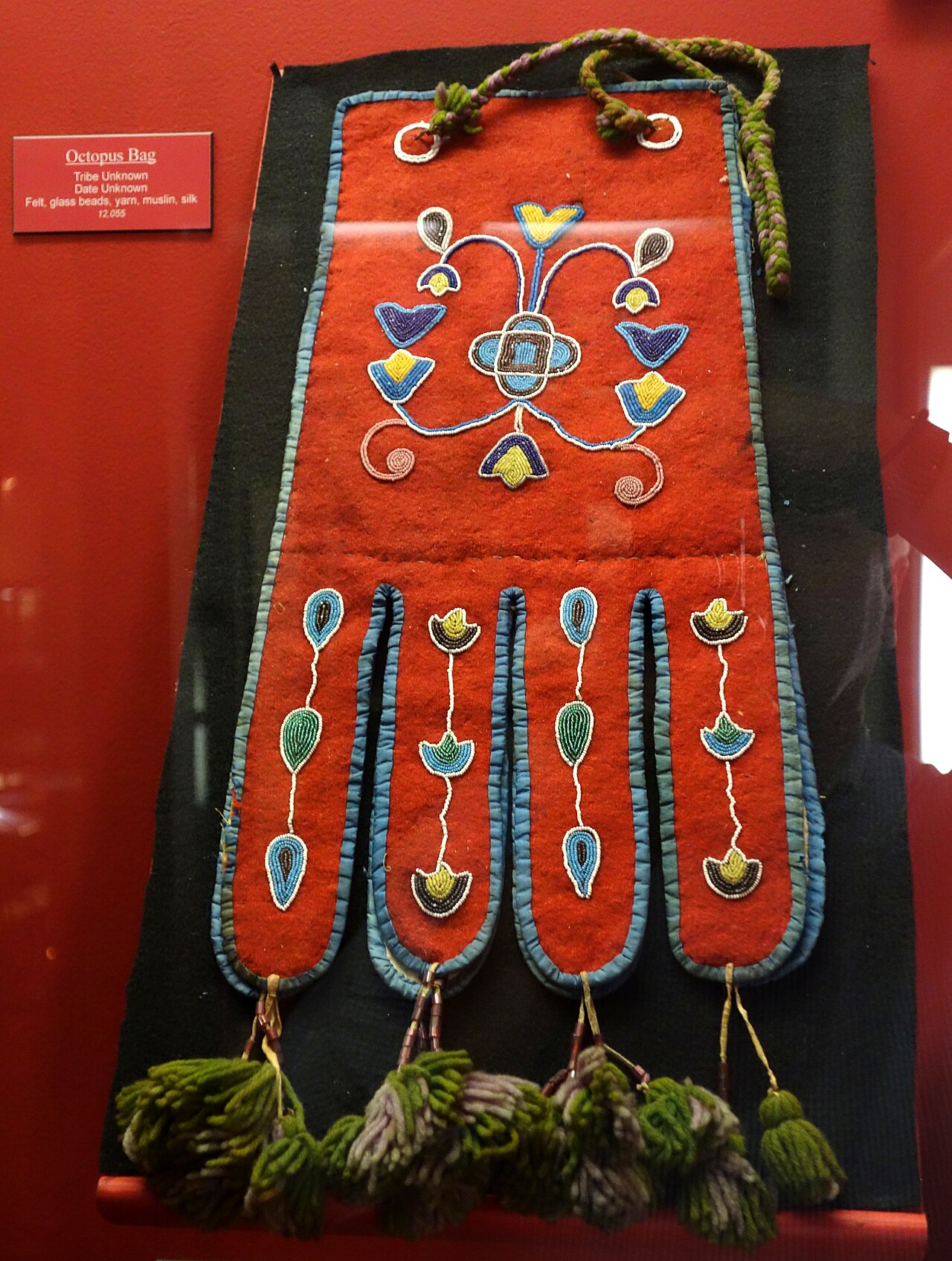
Far from the coast, the beaded octopus bags of the Métis, Cree and Ojibwe are named for their eight tab-like legs and carry no single symbolic meaning.
Octopus Spiritual Meaning in the Bible and Christianity
The Bible does not name the octopus, but it classifies it. Leviticus 11:9 to 12 and Deuteronomy 14:9 to 10 declare every water creature without fins and scales unclean and forbidden as food, and an octopus has neither.
Leviathan is a looser connection. Job 41 and Isaiah 27:1 describe a sea monster that no human can tame, and some modern Christian readers picture Leviathan as a many-armed creature in the kraken mold. The text gives Leviathan scales, fire and armor, so the link belongs to illustration rather than scripture.
Christian devotional writers pull the animal in two directions. One group uses the arms as an image of sin and temptation, wrapping around a person one limb at a time. Another turns the same arms into a picture of ministry, reaching out on every side without letting go of the center. Both are interpretations offered in sermons, and neither is doctrine.
The Kraken and North Atlantic Sea Lore
The kraken of Norwegian lore is a sea monster so large that sailors mistook its back for an island, and it pulled ships under when it sank. Bishop Erik Pontoppidan described it as a real animal in his natural history of Norway in the 1750s, drawing on fishermen’s accounts.
The picture that fixed the octopus monster in European minds came from the French naturalist Pierre Denys de Montfort, who published an illustration of a colossal octopus rising out of the sea to drag down a sailing ship. Many later images of a ship-wrecking octopus echo it.
Octopus in Japanese and Ainu Folklore
Japanese and Ainu folklore read the octopus both as a monster and as a healer. Akkorokamui is a giant red octopus-like being of Ainu lore in Uchiura Bay on the coast of Hokkaido. Fishermen feared it as a creature that could swallow boats, and people prayed to it for healing, since its body was believed to restore itself like an octopus regrowing an arm.
Takoyakushi-do in Kyoto turns the animal into an act of devotion. The temple legend tells of a monk named Zenko who broke his Buddhist vows to buy an octopus for his gravely ill mother. When townspeople demanded to see what he carried, the octopus turned into eight sutra scrolls, and later a healing light from the Medicine Buddha cured his mother. The temple is still visited for prayers for recovery.
The darker Japanese figure is Tako Nyudo, the octopus monk, a yokai with a bald octopus head, an old man’s face and eight tentacles in human clothing, painted in the 1666 Bakemono Emaki scroll and said to drag fishermen off their boats.
Octopus in Ancient Crete and Hawaiian Myth
Minoan potters on Crete painted octopuses across entire jars more than three thousand years ago. The Marine Style flask from Palaikastro, now in the Heraklion Archaeological Museum, shows a single octopus whose arms curl around the whole pot. Many archaeologists read the motif as a celebration of the sea’s abundance for a people who lived from trade and fishing.

In the Kumulipo, the creation chant of the Hawaiian royal line, the octopus is named among the earliest creatures of the sea, and a contested older reading by 19th century scholars treats it as the lone survivor of an earlier world. The octopus, he’e in Hawaiian, is also associated with Kanaloa, the god of the ocean, and counts among his body forms.
Octopus Meaning in Love and Relationships
In love, the octopus stands for devotion first. A female octopus guards her eggs for weeks or months, depending on the species, and does not leave them, and that image gives the animal its reputation for total commitment. After the eggs hatch the mother dies, so the same image also carries sacrifice.
The warning reading is the clingy or controlling partner. Eight arms can hold or they can trap, and a relationship where one person cannot let go takes the octopus as its symbol.
Octopus Tattoo Meaning
An octopus tattoo means adaptability and survival through hard times, and for divers and sailors it marks a love of the sea. People choose it after a period in which they had to reinvent themselves, because the animal that changes color and shape to survive is the clearest image for that experience.
For a woman, the octopus tattoo adds protective motherhood, feminine strength and mystery.
Style changes the meaning. A Japanese irezumi octopus, in red with heavy black water, draws on the tako of folklore as a creature of transformation. An American old school octopus with bold lines belongs to nautical tattooing, beside anchors and swallows. An octopus wrapped around an anchor sets chaos against stability, and an octopus crushing a ship recalls the kraken and means victory over something that tried to pull the wearer under.
Is an octopus a regret-prone motif? Rarely. The meaning is positive and works in many styles. The usual regret is technical, because fine arm detail blurs over the years, so ask for bold outlines and enough size that the arms stay readable.
Octopus Symbolism in Jung and the Shadow Self
In Jungian dream work the sea is the unconscious, and the octopus is a content rising out of it. The animal lives in the dark and has no fixed shape, so analysts in this tradition treat it as material from a person’s depths that has not yet been given a form.

The shadow is the part of a person they refuse to see in themselves, and the octopus with its hidden den, its ink and its grasping arms is a natural image for it. The dream octopus asks the dreamer to admit the impulse to control, cling and hide rather than project it onto others.
Jungian writing also describes the devouring mother, the side of care that smothers and will not let a child grow up, and some modern dream interpreters picture it as an octopus that embraces and swallows at once. An octopus that keeps surfacing in dreams asks what you are hiding and whom you are holding too tightly.
Frequently Asked Questions
Is devil fish another name for the octopus?
Yes. Devil fish was an older English name for octopuses, and also for manta rays, given for the animal’s strange shape. Victor Hugo’s novel Toilers of the Sea, with its hero’s underwater fight against an octopus that nearly drowns him, cemented the devil fish as a monster in the English-speaking world.
Is the octopus a symbol of greed?
Yes, in political cartoons the octopus means monopoly and a power that reaches into everything. The best-known example is Udo Keppler’s 1904 Puck cartoon “Next!”, which shows Standard Oil as an octopus with its arms around the steel, copper and shipping industries, a state house and the U.S. Capitol, and one tentacle reaching for the White House.
Is an octopus grab a sign of danger?
No. An octopus that touches you is typically tasting you. Its suckers carry chemical receptors, so the animal learns what something is by holding it. Even so, any octopus can bite and a large one grips hard, so let go gently rather than invite the contact. Symbolically, the touch means being examined closely before being accepted.
How many hearts does an octopus have, and what does that symbolize?
Three. Two pump blood through the gills and the third drives it through the body, and the blood is blue because it is copper based. Readers of animal symbolism tie the three hearts to resilience and to a large capacity for love, more room for feeling than a single heart allows.
Is an octopus tattoo a good idea?
Yes. The meaning is positive in every style, and the arms can follow the shape of a shoulder, forearm or back. The one common regret is fine detail that blurs with age, so choose bold outlines and a size that keeps the suckers readable.
Is an octopus charm lucky?
Yes, in Japan an octopus charm is a luck token for exams. Students receive octopus figures before entrance exams because the English word octopus, spoken in Japanese as okutopasu, sounds like “oku to pasu”, meaning “put it down and you pass”. The native Japanese word for octopus is tako. The charm is a modern pun rather than an old belief, and the best known version, Octopus-kun from Minamisanriku, is sold as figures, ema plaques and straps.
Sources
- Encyclopaedia Britannica, Octopus
- Encyclopaedia Britannica, Kraken
- Bible Gateway, Leviticus 11 (NIV)
- Japan Society, To Pass the Exam
- Theodore Roosevelt Center, Next! (Puck, 1904)