Southern House Spider: ID and the Recluse Confusion
The southern house spider (Kukulcania hibernalis) is a harmless crevice weaver common across the southern United States, and it is one of the most frequently misidentified spiders in the country. The long-legged brown males are mistaken for brown recluses constantly, which sends people into unnecessary panic and gets a beneficial spider killed on sight.
The two sexes look so different that they are often reported as separate species. Females are stout, velvety black, and stay hidden in their retreats, while males are slimmer, tan to brown, and wander openly across walls and floors. This guide covers identification, the brown recluse comparison that matters most, the distinctive webs, whether they bite, and what their presence in a house actually means.
| Quick Facts | Southern House Spider |
|---|---|
| Scientific name | Kukulcania hibernalis |
| Female | Stout, velvety black, up to 0.8 in body |
| Male | Slim, tan to brown, long legs, similar body length |
| Web | Radiating messy sheet from a crevice retreat |
| Venom | Not medically significant |
| Range | Southeastern US west to California, and the tropics |
Identifying the Southern House Spider
Start with the fact that the sexes look almost nothing alike, because this causes most of the confusion. Females are heavy-bodied and velvety charcoal to black, with a body up to 0.8 in and relatively short thick legs, and they rarely leave the crevice where their web is anchored.
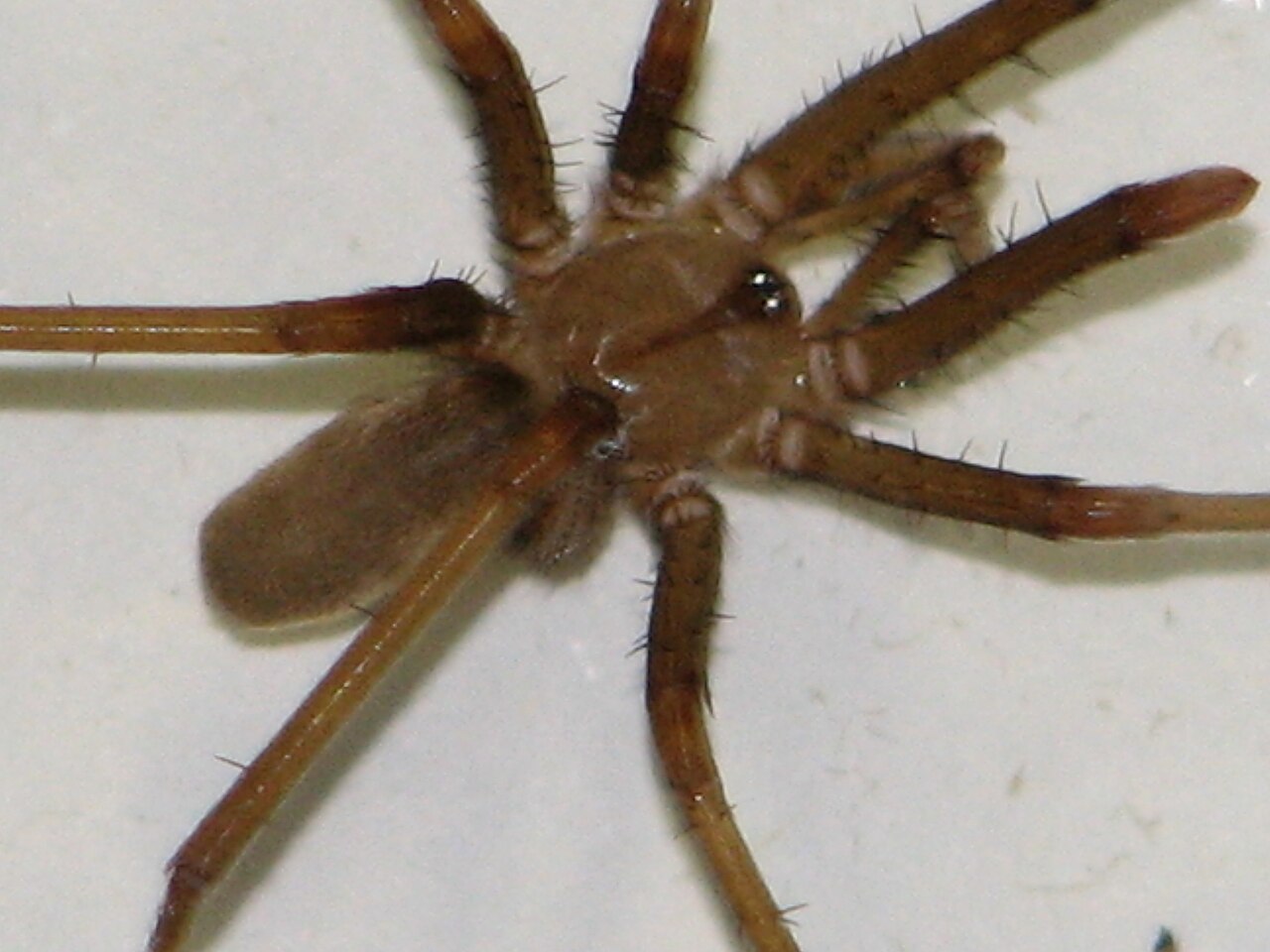
Males are slender and tan to grey-brown with noticeably longer legs, giving them a leggy appearance and a legspan approaching 2 in. They have enlarged pedipalps at the front, which look like small boxing gloves and are the reproductive structures all mature male spiders carry. Males wander widely searching for females and are the ones people encounter.
Both sexes belong to the family Filistatidae, the crevice weavers, and share a distinctive feature worth knowing: they are cribellate spiders, producing woolly silk combed out with a specialized structure rather than the sticky droplet silk of orb weavers. That silk gives their webs a characteristic fuzzy appearance up close.
Southern House Spider vs Brown Recluse
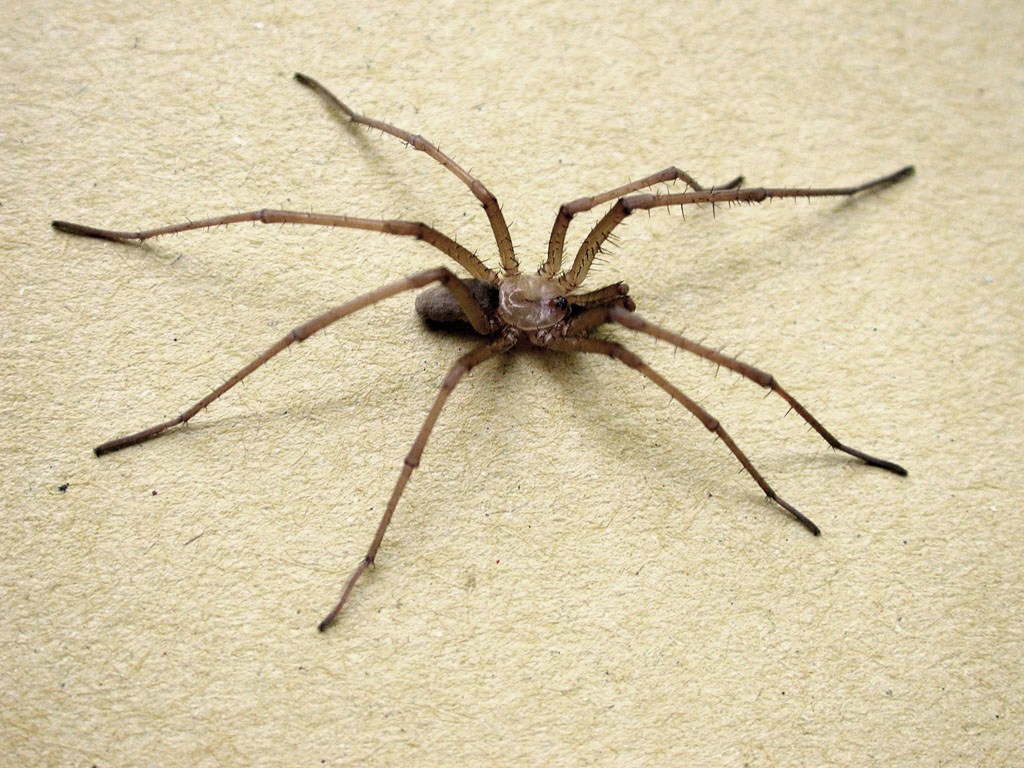
This is the comparison that matters, and it is worth getting right because the two are genuinely confused several thousand times a month based on search volume alone. Male southern house spiders are brown, long-legged, and about the right size, which is enough to trigger the alarm.
Count the eyes if you can get a photograph. Brown recluses have six eyes arranged in three pairs, which is unusual and diagnostic. Southern house spiders have eight eyes clustered together in the normal spider arrangement. This is the single most reliable check and it works from a decent phone photo.
The violin marking is less reliable than its reputation suggests. Brown recluses have a dark violin-shaped mark on the cephalothorax with the neck pointing backward, but many unrelated spiders have vaguely violin-like markings, and worn recluses can show it faintly. Better supporting checks are that brown recluses have uniformly colored legs without banding or spines and a body under 0.4 in, while male southern house spiders are larger and leggier. Our guide comparing the brown recluse and house spider works through the full set of distinctions.
The Web and Where They Live
The web is the best identification feature and is visible from a distance. A southern house spider anchors itself in a crack, gap, or hole and spins a messy sheet radiating outward from the entrance, so the structure looks like a ragged starburst with a dark tunnel at the center.
Favored sites are architectural. Cracks in brick and stucco, the gaps around window and door frames, under eaves and soffits, behind shutters, in weep holes, and in the corners of porches and garages. On older masonry buildings in the south, dozens of these radiating webs across a single wall are a common sight.
They also colonize interiors, particularly in garages, sheds, crawl spaces, and behind furniture in undisturbed rooms. Females may remain in the same retreat for years, and the webs accumulate dust and debris, which is why an occupied crevice often looks grubby rather than freshly spun.
Do Southern House Spiders Bite?
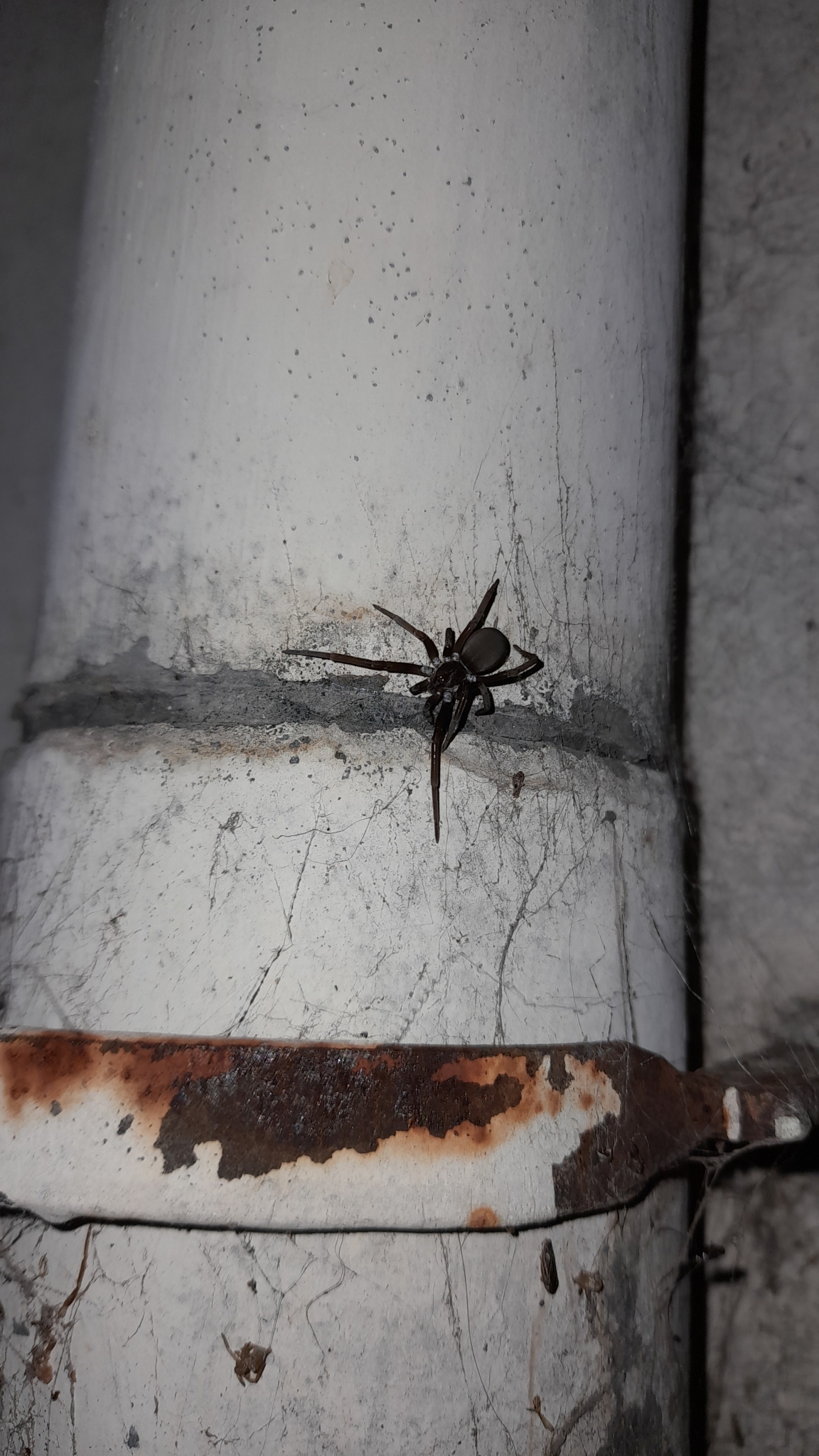
Almost never. Females stay in their retreats and have no reason to encounter human skin, and the wandering males are focused entirely on finding mates rather than defending themselves. Documented bites are rare enough that most sources describe them as exceptional.
When a bite does occur, the venom is not medically significant. Reports describe brief local pain and mild redness resolving within a day, with none of the tissue damage associated with a genuine recluse bite. The spider has no medical importance to humans.
Females also have relatively small fangs for their body size, and both sexes flee rather than confront. The realistic risk from this species is zero, and the practical concern is entirely cosmetic, since the webs collect dust and look untidy on a wall.
What They Eat and Why They Are Useful
Southern house spiders are sit-and-wait predators that ambush whatever walks onto the web sheet. Prey includes cockroaches, crickets, beetles, ants, moths, flies, and other spiders, and the size range extends to prey substantially larger than people expect from the spider’s build.
Cockroach predation is the part worth appreciating in the south. A wall of southern house spider webs around a building perimeter intercepts a meaningful number of roaches, crickets, and other insects before they get indoors, which is genuine free pest control on the exact species most households want gone.
Their cribellate silk is what makes this work. Rather than sticky droplets, the woolly combed silk entangles prey mechanically through sheer fiber structure, snagging on the hairs and spines of an insect walking across it. It is an older evolutionary approach to web building than the sticky silk of orb weavers, and it works well on the ground-level insects this spider targets.
Life Cycle and Longevity
Females are unusually long-lived for a spider of this size, with documented lifespans of several years and reports of individuals occupying the same crevice for close to eight. That longevity is why an established web on a wall can persist season after season with the same occupant.
Egg sacs are placed inside the retreat rather than in the open, and the female guards them. Spiderlings disperse after emerging, and juveniles of both sexes look similar, being brownish and moderately built, so the dramatic difference between adult male and adult female appears only at maturity.
Males undergo a final molt that changes them substantially, developing the long legs and enlarged pedipalps that make them look like an entirely different species. After maturing they abandon web building altogether and spend their remaining weeks wandering, which is a common pattern across spider families and one that university extension services regularly explain to homeowners reporting sudden spider invasions.
Range and Season
The species occupies the southeastern United States broadly, from Florida and the Gulf states north to roughly the Carolinas and west through Texas into Arizona and southern California, and it extends south through Central America and into South America.
Warm climates suit it and it does not tolerate hard freezes, which sets the northern limit. Within its range it is abundant in both urban and rural settings, and it has spread with human building, since masonry and siding provide exactly the crevices it needs.
Male wandering peaks in warm months and produces most sightings. A male has a shorter life than a female, dying after mating, while females can live several years and remain in one retreat throughout. That difference in lifespan and behavior is why almost every spider people photograph and ask about is a male.
Should You Remove Them?
Outdoors, leaving them is the better choice. The webs are unsightly, but each occupied crevice represents ongoing interception of roaches and crickets around your foundation, and removing the spiders removes that service without removing the insects that attracted them.
If webs on a porch or entryway bother you, brushing them away with a broom is enough. The spider will usually relocate or rebuild elsewhere, and physical removal without pesticide is both simpler and more effective than spraying, since the spider sits inside a crevice where surface treatments do not reach.
Indoors, catch and release works well. A container and a piece of stiff card move a wandering male outside in seconds, and given that these spiders are harmless and beneficial, killing them accomplishes nothing that release does not. For anyone dealing with the roaches they eat, our guide to telling a bed bug from a baby cockroach covers the identification side of that problem, and our guide to the cricket versus grasshopper question covers another of their main prey groups.
Other Spiders People Confuse With It
Grass spiders build funnel webs and are fast ground-level hunters with prominent spinnerets projecting behind the abdomen, and their webs are sheets with a distinct funnel retreat at one edge rather than a radiating starburst. Our guide to the grass spider covers them in detail.
Wolf spiders are hunting spiders that build no capture web at all, running down prey on open ground, and they are stockier and hairier with a distinctive three-row eye arrangement including two very large forward-facing eyes. A brown spider running across a floor rather than sitting in a web is more likely a wolf spider, as our guide to the baby wolf spider explains.
Cellar spiders, often called daddy longlegs, have extremely thin legs and small bodies and hang upside down in loose tangles in corners and basements. None of these, nor the southern house spider, poses any danger, and the only medically significant spiders in most of the United States are the brown recluse and the widow spiders, both of which look quite different once you know what to check.
Related reading: Black House Spider.
Related reading: Red House Spider.
Frequently Asked Questions
Is a southern house spider dangerous?
No. Its venom is not medically significant to humans, bites are rare because females stay in their retreats and males are focused on finding mates, and reported bites cause only brief local pain and redness resolving within a day.
How do I tell a southern house spider from a brown recluse?
Count the eyes. Brown recluses have six in three pairs, southern house spiders have eight clustered together. Recluses also have uniformly colored legs and a body under 0.4 in, while male southern house spiders are larger and leggier and build conspicuous radiating webs.
Why do male and female southern house spiders look so different?
They are strongly dimorphic. Females are stout and velvety black with shorter legs and stay in their crevice retreats, while males are slim, tan to brown, long-legged, and wander in search of mates. Almost every one people photograph is a male.
What does a southern house spider web look like?
A messy sheet radiating outward from a crack or hole, like a ragged starburst with a dark tunnel at the center. They anchor in brick and stucco cracks, window frames, eaves, and weep holes, and the webs collect dust over time.
What do southern house spiders eat?
Cockroaches, crickets, beetles, ants, moths, flies, and other spiders, ambushed when they walk onto the web sheet. Their woolly cribellate silk entangles prey mechanically rather than with sticky droplets, which works well on ground-level insects.
Should I kill southern house spiders around my house?
No, they intercept roaches and crickets around your foundation, which is free pest control on exactly the species most households want gone. If webs bother you, brush them away with a broom. Indoors, catch and release a wandering male with a container and card.
Where do southern house spiders live?
Across the southeastern United States from Florida and the Gulf states north to the Carolinas, west through Texas to Arizona and southern California, and south through Central and South America. They cannot tolerate hard freezes, which sets the northern limit.