Red House Spider: ID, Venom, and Look-Alikes
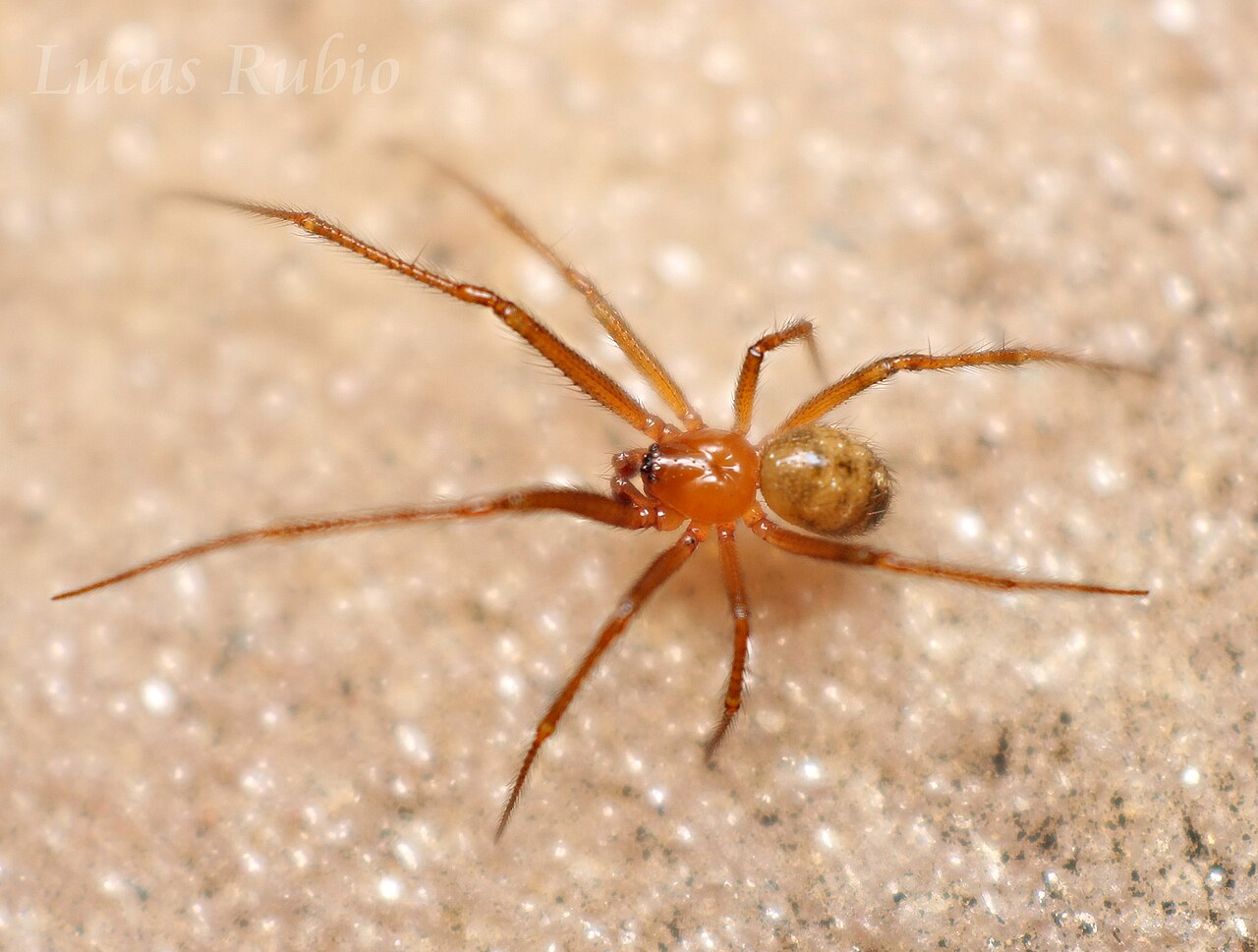
The red house spider is a small reddish-brown cobweb spider, Nesticodes rufipes, about a quarter of an inch in body length, with a glossy round abdomen and long thin reddish legs. It builds tangled webs in corners, under furniture, and in garages and sheds, and it is found in warm regions worldwide including the southern United States, Hawaii, and Florida.
It is a relative of the black widow, which is why the question of whether it is dangerous comes up so often, and the honest answer is that it is not. Bites are rare, the venom is not medically significant, and the spider retreats rather than confronts. Most reddish spiders found indoors are something else entirely. This guide covers identification, the venom question, the look-alikes, and what to do about them.
The red house spider, Nesticodes rufipes, is a quarter-inch reddish-brown cobweb spider found in warm regions worldwide. It is a black widow relative but is not dangerous: bites are rare and cause only local pain and redness. Most red spiders found indoors are something else, often a woodlouse spider or a clover mite.
| Feature | Red House Spider |
|---|---|
| Scientific name | Nesticodes rufipes |
| Body length | About 0.2 to 0.25 in |
| Colour | Reddish-brown, glossy round abdomen |
| Web | Tangled cobweb in corners and under furniture |
| Danger | Not medically significant; bites rare |
| Range | Warm regions worldwide, southern US, Hawaii |
| Family | Theridiidae, same as black widows |
What Is a Red House Spider?
A small cobweb spider in the family Theridiidae, the same family that contains black widows and the common house spider. It has a shiny, globular abdomen, a small cephalothorax, and long slender legs, and the whole animal is reddish-brown to orange-brown with darker leg joints.
Size is modest. Females run about a fifth to a quarter of an inch in body length, males smaller, and with legs extended the spider spans perhaps half an inch. It is easy to overlook and is usually noticed because of the web rather than the spider.
The web is a tangled three-dimensional cobweb with no obvious pattern, built in corners, under furniture and appliances, in window frames, and in garages, sheds, and outbuildings. The spider hangs upside down in it and drops or retreats when disturbed. The black house spider guide covers a similar indoor web builder.
Is the Red House Spider Dangerous?
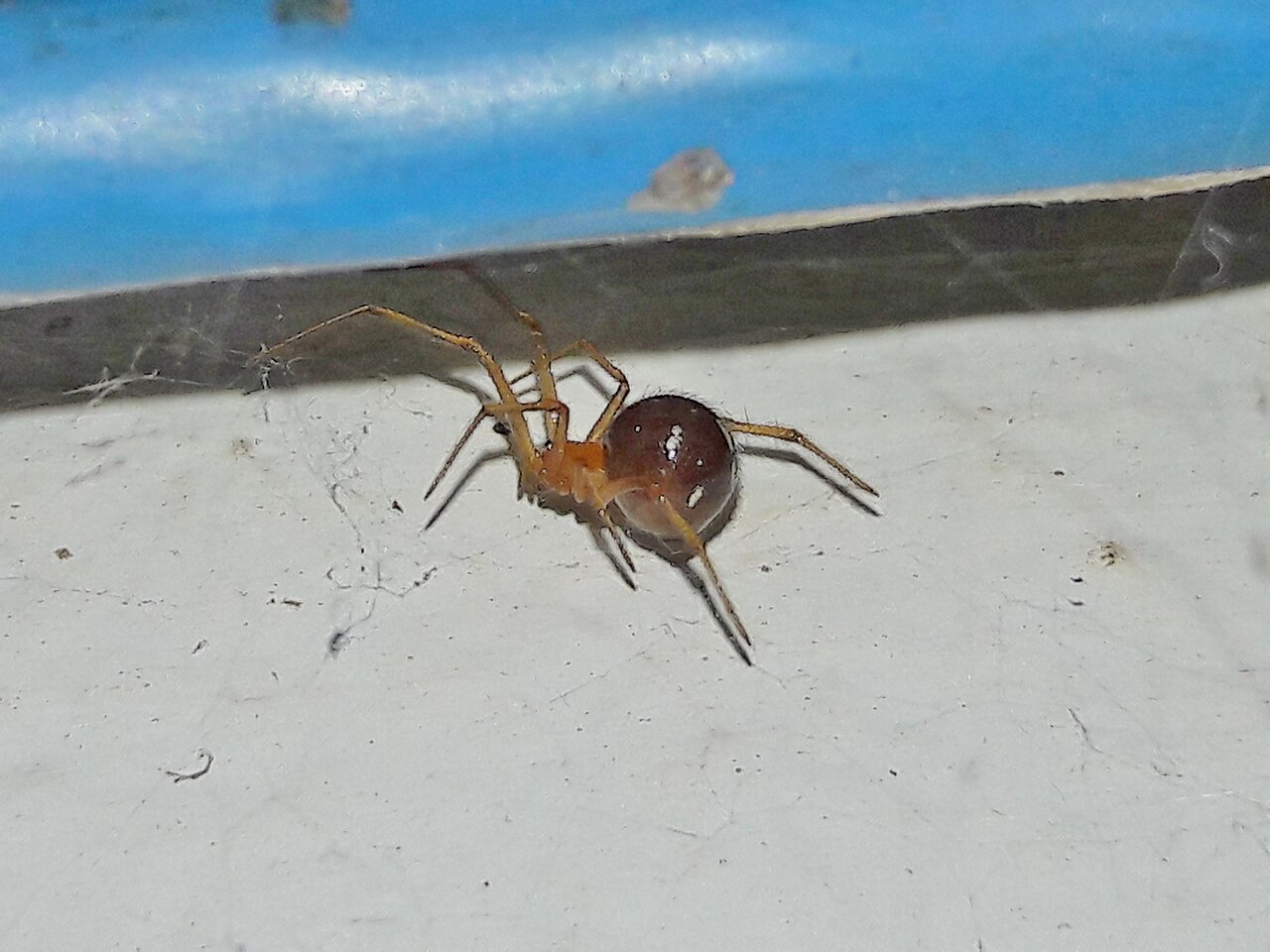
No. Despite being related to black widows, Nesticodes rufipes is not considered medically significant. Bites are uncommon because the spider is small, shy, and retreats from disturbance, and the reported effects are local pain, redness, and swelling that resolve without treatment.
Some sources describe the bite as painful relative to the spider’s size, and there are scattered reports of more pronounced local reactions, but there is no established pattern of systemic effects and no antivenom or specific treatment exists or is needed. Washing the site and applying a cold pack is the whole response.
The family relationship is what drives the concern. Being in Theridiidae puts it alongside widows, but venom potency varies enormously within the family, and the vast majority of cobweb spiders including the common house spider are harmless. The brown recluse vs house spider guide covers the comparison people actually need.
What Red Spiders Are Found in Houses?
Several, and most reports of a red spider indoors turn out to be one of these rather than Nesticodes. The woodlouse spider is the most striking: a shiny orange-red cephalothorax and legs with a pale grey abdomen, large forward-pointing fangs, and a habit of hunting woodlice under pots, logs, and in damp basements.
Clover mites are the other very common answer, and they are not spiders at all. They are tiny bright red mites, smaller than a pinhead, that appear in large numbers on windowsills and walls in spring and autumn, leave a red smear when crushed, and are entirely harmless and plant-feeding.
Red jumping spiders, small red orb weavers that wander in, and juvenile forms of larger species also account for sightings. In the southern United States the most consequential red-brown spider is the brown recluse, which is uniformly tan-brown rather than red, with a violin marking behind the eyes and six eyes rather than eight. The southern house spider guide covers another commonly misidentified species.
What Does a Red Spider Mean in the House?
Symbolically, spiders generally are read as creativity, patience, and building something deliberately, drawn from web construction, and red adds energy, passion, and urgency in most colour symbolism. A red spider in the house is commonly interpreted as a prompt to act on a project rather than as a warning.
Folk traditions about spiders indoors are overwhelmingly positive. Killing a spider in the house is held to bring bad luck or rain in numerous European traditions, a money spider landing on you means money coming, and in several cultures a spider in the home is a sign of good fortune or protection.
Practically, a spider indoors means there are insects indoors. Spiders go where the food is, so a rising spider population points to flies, gnats, moths, or other prey rather than to anything about the house itself. The guide to birds that eat spiders covers what keeps outdoor populations in check.
How Do You Get Rid of Them?
Remove the webs and the food supply. Vacuuming webs, egg sacs, and spiders from corners, ceiling edges, behind furniture, and in garages and sheds is the most effective single action, and it needs repeating for a few weeks since spiders rebuild.
Then reduce what they are eating. Spiders indoors track insect populations, so switching outdoor lights to yellow bulbs or motion sensors, screening windows and vents, sealing gaps around doors and utility penetrations, and reducing clutter in garages and basements does more over time than any spray.
Insecticides are of limited use against spiders. Contact sprays kill what they hit and residual sprays work poorly because spiders walk on leg tips and pick up little residue, and treating a whole room to kill a few spiders is disproportionate. Sticky traps along skirting boards are useful for monitoring which species are present.
Should You Kill House Spiders?
Generally no, and the practical case is stronger than the folklore one. A resident spider population removes flies, mosquitoes, gnats, moths, cockroaches, and other spiders continuously, and clearing them out simply makes room for the insects they were eating.
Most house spiders are also permanent indoor residents rather than visitors. Common house spiders and cellar spiders live their whole lives indoors and cannot survive outside in cold weather, so putting one out in winter kills it rather than relocating it. If a spider must be moved, a garage, shed, or basement is better than the garden.
The exceptions are the two North American species with medically significant venom: brown recluse and widow spiders. Both warrant removal from living areas, particularly in bedrooms, garages, and storage where people reach into dark spaces, and both are worth learning to identify properly rather than treating every brown or dark spider as one. The wolf spider vs brown recluse guide covers that identification.
Will a Spider Come Near You While You Sleep?
Almost certainly not, and the widely repeated claim that people swallow several spiders a year in their sleep is invented, with no source behind it. Spiders avoid large warm moving objects, are deterred by breathing vibration, and have no reason to approach a bed.
Spiders found in beds have usually fallen from a ceiling or wall, or were on clothing or bedding brought in from storage. Web-building species in particular do not wander, since leaving the web means leaving the food supply, and a cobweb spider like the red house spider stays put.
Bites attributed to spiders during sleep are usually something else. Bed bugs, fleas, mites, and skin conditions account for the overwhelming majority of unexplained overnight bites, and medical literature consistently finds that lesions diagnosed as spider bites are far more often infections, particularly MRSA. A genuine spider bite almost always comes with the spider being seen.
What Do They Eat?
Whatever the web catches, which indoors means flies, gnats, mosquitoes, ants, small moths, and other spiders. Cobweb spiders build tangled three-dimensional webs with sticky gumfoot lines running to the floor, and an insect walking into one gets stuck and hauled upward.
That gumfoot design is why the family is so successful indoors. It works on crawling prey as well as flying prey, needs no open flight path, and fits in a corner behind a cupboard, which is exactly the kind of space a house offers in quantity.
Feeding is infrequent. A cobweb spider can go weeks between meals and slows its metabolism when prey is scarce, which is why a spider can appear to sit motionless in the same corner for a month. A web with no spider in it usually means the spider is tucked into a retreat at the edge rather than gone.
Where Do They Come From?
Warm climates, and increasingly wherever heated buildings extend the range. Nesticodes rufipes is pantropical, found across warm regions worldwide, and it has spread with human transport, which is typical of the synanthropic spiders that live in buildings.
In the continental United States it occurs mainly in the south and in Florida, and it is common in Hawaii, where it is one of the more frequently encountered indoor spiders. Elsewhere it turns up in heated structures, greenhouses, and shipments.
Entry is usually passive: through gaps around doors and windows, on plants, in boxes and furniture, and in deliveries. Spiders do not seek out houses in the way rodents do, and most indoor populations descend from a small number of accidental arrivals that found insects and stayed. University extension entomology programmes such as the University of Florida (ufl.edu) maintain identification keys for the indoor species. The spider poop guide covers the other sign of a resident population.
Frequently Asked Questions
What is a red house spider?
A small reddish-brown cobweb spider, Nesticodes rufipes, about a quarter of an inch long, that builds tangled webs in corners and under furniture in warm regions worldwide.
Is the red house spider poisonous?
It has venom but is not dangerous to people. Bites are rare and cause local pain, redness, and swelling that resolve on their own. No treatment beyond washing and a cold pack is needed.
What red spiders are found in houses?
Woodlouse spiders with orange-red bodies and large fangs, tiny bright red clover mites which are not spiders at all, red jumping spiders, and juveniles of various larger species.
What does a red spider in the house mean?
Symbolically, creativity and a prompt to act, with red adding urgency. Folk traditions treat house spiders as lucky. Practically, it means there are enough insects indoors to feed one.
How do you get rid of red house spiders?
Vacuum webs and egg sacs repeatedly, then reduce the insect supply by changing outdoor lighting, sealing gaps, and clearing clutter. Sprays work poorly against spiders.
Will a spider come near me while I sleep?
No. Spiders avoid large warm moving objects, and the claim that people swallow spiders in their sleep is invented. Overnight bites are far more often bed bugs, fleas, or an infection.
Should you kill house spiders?
Generally not. They remove flies, mosquitoes, gnats, and cockroaches continuously. Many cannot survive outdoors, so a garage or shed is a better relocation than the garden.

Similar Posts
Hercules Beetle: Size, Strength, Life Cycle, and Care
The Hercules beetle is the longest beetle in the world. Here is the truth about its strength, plus the eastern species found across the United States.
Snake Poop: Identification & What It Looks Like
How to identify snake droppings, why they have a white chalky cap, and how to tell them apart from bird and rodent droppings.
What Is a Group of Foxes Called? Skulk, Leash, and Earth
A group of foxes is called a skulk or a leash. Where both names came from, why foxes barely form groups at all, and what vixens, dog foxes and kits are called.
Baby Wolf Spider: Spiderlings That Ride on Mom’s Back
Wolf spider mothers carry their egg sac on their spinnerets and then their young on their backs. Here is what spiderlings look like and what to do indoors.
Green Butterfly: Species, Rarity, and Why Green Is Hard
Butterflies have no green pigment, so every green butterfly builds the color another way. Here are the species you can find and what they mean.
Spicebush Swallowtail Butterfly: ID and the Snake Caterpillar
A large black swallowtail with a blue-green sheen whose caterpillar mimics a snake. Host plants, why the adult is black, and how to tell it from similar species.