Beaver Poop: How to Identify It and 3 Common Look Alikes
Beaver poop is a loose cluster of rounded, sawdust colored pellets that sits in shallow water rather than on the bank. Each pellet is about the size of a large marble and looks like compressed wood shavings barely holding together, because that is essentially what it is. Beavers (Castor canadensis) live on bark, twigs and aquatic plants, and the undigested fiber comes out as coarse, chip filled droppings.
That underwater habit is why most people never find beaver scat even where beaver sign is everywhere. You need a shallow, clear margin near a lodge, dam or feeding spot, ideally in late summer when water levels drop. The reward is one of the easiest scat calls in North America: no other mammal here leaves droppings that look like wet sawdust.
Beaver droppings are oval pellets 0.8 to 1.3 inches (2 to 3.3 cm) across, light to dark brown, and made almost entirely of coarse wood fiber. They are deposited in water, usually in loose clumps near a lodge, dam or feeding area, and they fall apart into chips when disturbed.
| Feature | Beaver scat |
|---|---|
| Size | 0.8 to 1.3 in (2 to 3.3 cm) across, pellets roughly as wide as long |
| Shape | Oval to nearly round, blunt ends, no taper or tail |
| Color | Light tan when fresh in clear water, darkening to chocolate brown |
| Contents | Coarse wood chips and bark fiber only. No fur, bones, seeds or insect parts |
| Texture | Like a pressed ball of sawdust, crumbles at a touch |
| Where found | In water: shallows at lodges, dams, canals and feeding platforms |
| Grouping | Loose scatter of 2 to 10 pellets, never a tidy latrine pile |
What Does Beaver Poop Look Like?
Beaver poop looks like a ball of damp sawdust that someone squeezed in one hand. The surface is visibly fibrous, with wood chips up to a quarter inch long pressed into the pellet, and there is no smooth coating or mucus film. Color runs from pale tan to dark brown depending on the wood the animal has been cutting and how long the pellet has been submerged.
The giveaway is what is missing. Carnivore and omnivore droppings carry fur, bone fragments, berry seeds or insect shells, and deer pellets are smooth and uniform. Beaver scat is pure plant fiber with a shredded look, closer to compacted mulch than to any other animal dropping you will find at the water’s edge.
How Big Is a Beaver Dropping?
Individual pellets measure 0.8 to 1.3 inches (2 to 3.3 cm) in diameter, with most falling near an inch. That makes beaver scat larger than any other North American rodent dropping by a wide margin, which fits an animal that can weigh 35 to 60 lbs (16 to 27 kg). Kits produce noticeably smaller pellets, down to about half an inch.
Because the pellets are nearly spherical, length and width are close to equal. If you are looking at an elongated, tapered dropping more than twice as long as it is wide, you are not looking at beaver scat. Size alone separates it from the rodent droppings people compare most often, such as the pairing in rat and mouse droppings.
Where to Find Beaver Poop, and Why You Rarely Do
Beavers defecate in water almost exclusively, which keeps their scat out of sight and out of the places trackers usually search. Look in calm shallows beside the lodge, along the upstream face of a dam, in dug canals, and around feeding platforms where peeled sticks collect. Water that is knee deep and clear, with a silt bottom, gives the best view.
Pellets rarely last. Current rolls them, fish and invertebrates work them over, and the fiber disintegrates into a drift of chips within days. A site with no visible scat can still hold a full colony, so judge beaver presence by cut stumps and dams, not by droppings.
What Is Inside Beaver Scat?

Break a fresh pellet apart underwater and it separates into wood fiber, shredded bark and bits of aquatic vegetation. Willow, aspen, cottonwood and birch dominate in most of the range, with pond lily roots, cattail and sedge added in summer. There is no fur, no bone and no insect chitin, because beavers are strict herbivores.
Seasonal diet shows up in texture. Winter scat from a colony living on a cached pile of branches is coarser and paler, while summer scat with soft greens in it holds together slightly better and looks darker. If you want the diet side of the picture, see what beavers eat through the year.
Beaver Poop vs Otter Poop
River otter droppings, called spraint, are the single most common mix up, because otters use the same ponds and often the same banks. Spraint is loose, dark and smelly, and it is packed with fish scales, crayfish shell fragments and small bones. Otters also deposit it on land, on rocks, logs and grass rolls above the waterline, where it is very visible.
Beaver scat is the opposite on every count: dry fiber, almost odorless, no animal remains, and sitting under water. If you find a stinking black smear with glittering scales on a streamside boulder, that is otter. If you find marble sized sawdust pellets in the shallows, that is beaver.
Beaver Poop vs Muskrat Poop
Muskrats share beaver ponds and are the closest match in habitat, but their droppings are far smaller. Muskrat pellets run about 0.4 to 0.6 inches (1 to 1.5 cm) long, are distinctly oblong rather than round, and are usually dark brown to black. Crucially, muskrats leave them out of the water, on logs, rocks, floating mats and the tops of their push ups.
So the two questions that settle it are size and placement. Small, dark, sausage shaped pellets on a dry log mean muskrat. Large, pale, round, fiber packed pellets in the water mean beaver. Both species may be in the same pond, so check both kinds of sign before you decide who built what.
Beaver Poop vs Deer Poop
Deer pellets are the comparison people reach for because the size overlaps, but the texture does not. White tailed deer droppings are smooth, shiny when fresh, slightly tapered at one end, and deposited in tight piles of 20 to 100 on land. They are made of finely ground browse, so they look homogeneous rather than chipped.
Beaver pellets are bigger, rounder, dull, obviously woody, and in water. If you are sorting through pellet type droppings on a trail, the deer and rabbit pairing is the more useful study, and deer and rabbit pellets separate on size and shape in much the same way.
Do Beavers Have Giardia?
Beavers can carry Giardia duodenalis, the parasite behind the nickname beaver fever, and they can shed it into water that people later drink untreated. The parasite is not exclusive to beavers. Livestock, dogs, deer and infected humans all contribute, and backcountry outbreaks are usually traced to a mix of sources rather than to one colony.
The practical rule does not change with the suspect: treat all surface water. Boiling, a filter rated for protozoa, or chemical treatment used as directed will handle Giardia cysts. The CDC publishes current guidance on giardiasis symptoms and water treatment, and state wildlife agencies post local advisories for popular watersheds.
How to Clean Up Beaver Droppings Safely
You will seldom need to clean up beaver scat, since it is in water, but pellets do wash onto docks, boat ramps and flooded lawns. Wear waterproof gloves, lift the material with a shovel rather than your hands, bag it, and rinse the surface with water and household detergent. Keep dogs away until the area has dried.
Wash your hands afterward even though you wore gloves, and do not pressure wash the spot. Spraying aerosolizes whatever is in the material, which is the one step that turns a low risk cleanup into an avoidable exposure. The same gloves and shovel approach applies to any wildlife scat, including heavier cases such as alligator droppings near southern waterways.
Other Beaver Signs to Look For
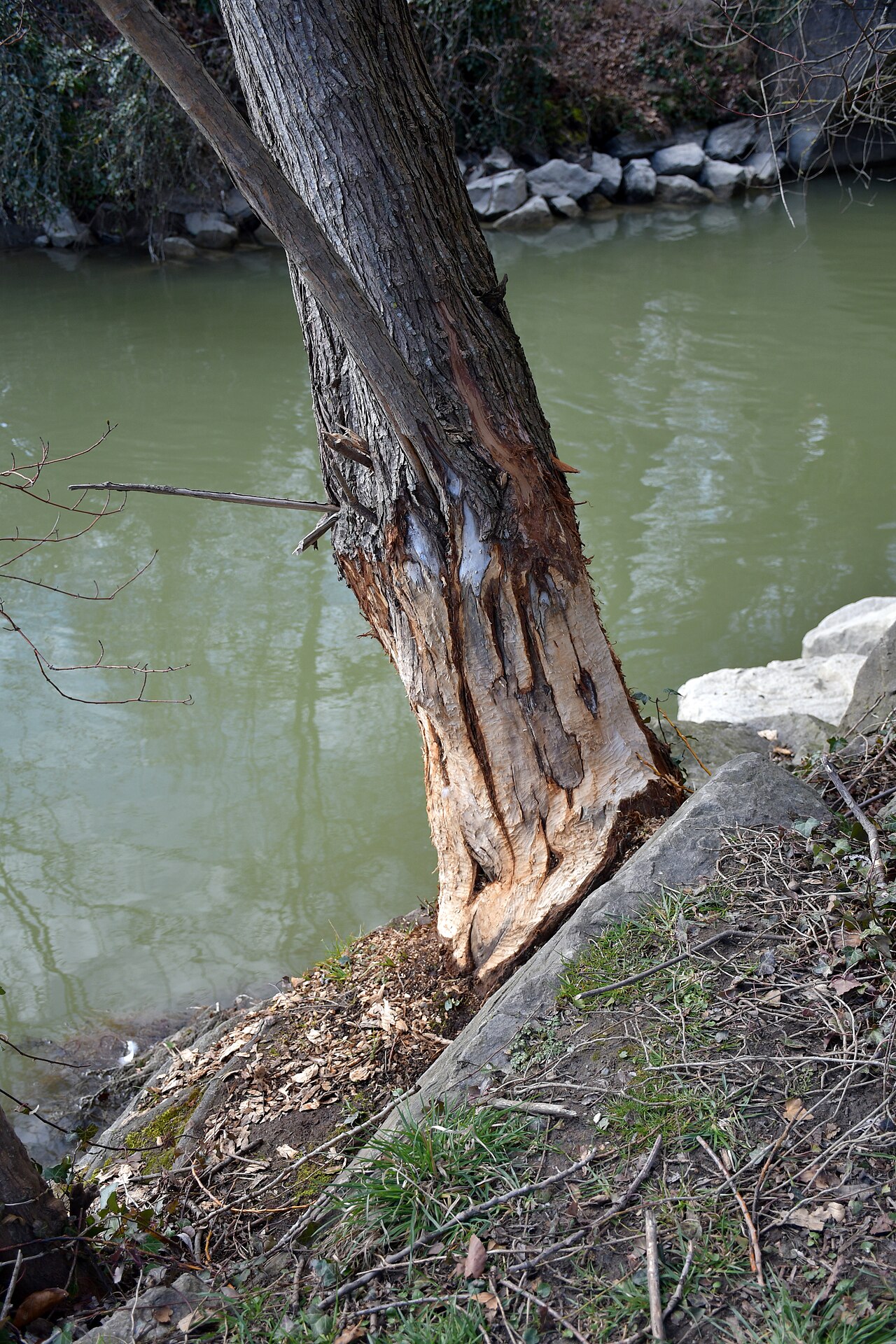
Because scat is so hard to find, identification usually rests on the rest of the sign. Look for pointed stumps with chisel cuts, peeled sticks stripped white, drag trails from cutting sites to the water, mud and stick dams, and lodges of piled branches. Scent mounds, small heaps of mud daubed with castoreum, mark colony boundaries and carry a sweet, musky smell.
Tracks help too, though they are often blurred by the dragging tail. The hind foot is large and webbed, up to 7 inches (18 cm) long. Trackers who read these muddy margins regularly also learn the five toed prints of other shoreline mammals, such as opossum tracks.
Is It Bad to Have a Beaver in Your Yard?
A beaver on your property is a mixed bag rather than a disaster. The ponds they create store water, recharge groundwater, filter sediment and support fish, amphibians and waterfowl. The cost side is real as well: flooded driveways, plugged culverts, and ornamental or fruit trees cut down overnight.
Non lethal fixes usually work. Wrap valued trunks with wire mesh to a height of 3 to 4 ft (0.9 to 1.2 m), install a pond leveler or culvert fence to keep water at a set height, and check state rules before moving or removing any animal. Sightings of young animals in spring often mean an established colony, described in the beaver kit account.
Frequently Asked Questions
What does beaver poop look like in the water?
It looks like pale, marble sized balls of sawdust resting on the pond bottom, often in a loose scatter rather than a pile. Within a day or two the pellets slump and spread into a small drift of wood chips, which is often all you see.
What gets mistaken for a beaver?
Muskrats and river otters, mainly. A muskrat swimming with its thin tail held above the surface is the usual case of mistaken identity, and nutria fill that role in the Gulf states. Beavers show a broad back and a flat tail that slaps when they dive.
Is beaver poop dangerous to touch?
Treat it as you would any wildlife droppings. The main concern is Giardia, which spreads by swallowing contaminated material or water, not through intact skin. Gloves, a shovel and handwashing cover the realistic risk, and untreated pond water is the greater hazard.
What time of day do beavers come out?
They are mostly crepuscular and nocturnal, active from late afternoon dusk through the night until early morning. Sit quietly downwind of a lodge in the last hour of daylight for the best chance, and expect more daytime activity in fall when the food cache is being built.
Why do beavers build dams?
Dams raise water deep enough to hide the lodge entrance, keep it from freezing to the bottom, and float branches to and from feeding areas. Deeper water is protection from coyotes, bobcats and wolves, so a dam is less a construction project than a moat.
What US state has the most beavers?
No agency publishes a hard state by state census, but Alaska, Minnesota, Wisconsin, Michigan and New York are routinely cited among the largest populations, and estimates put the continental total in the 10 to 15 million range. Beavers now occupy nearly every state except Hawaii.