Luna Moth: ID, Tails, and Why Adults Cannot Eat
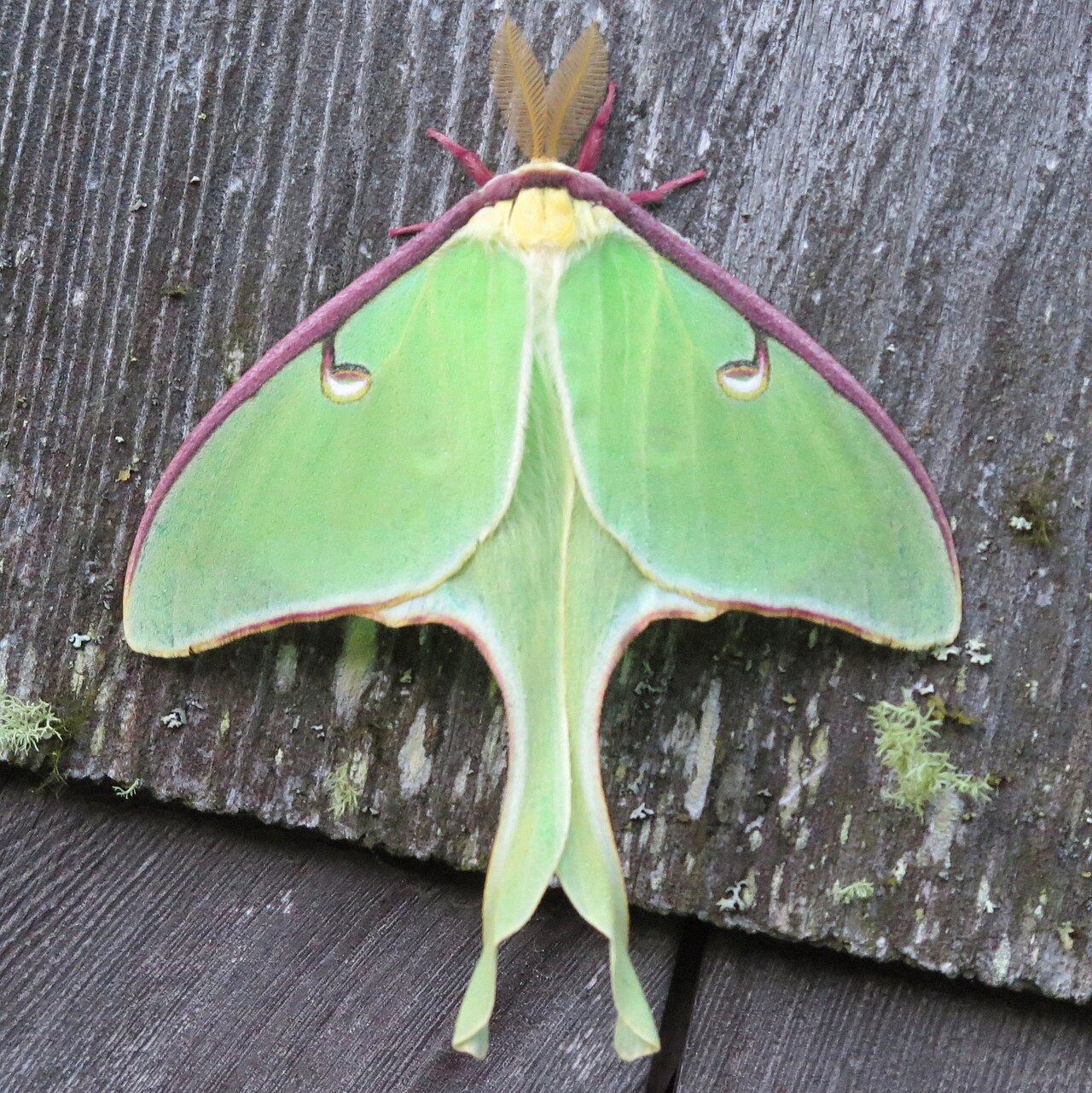
The luna moth is a large pale green silk moth of eastern North America with long twisted tails on the hindwings, transparent eyespots on all four wings, and a wingspan of three to four and a half inches. Adults have no mouth and no digestive system, cannot eat at all, and live about a week, existing solely to mate and lay eggs.
That is the fact that explains most of what people notice about them. A luna moth found on a porch is on a very short clock, it is not hungry, and it cannot be helped by feeding. This guide covers identification, the tails and what they are for, rarity, whether they can be touched, and how to attract them to a garden.
The luna moth is a pale green silk moth with a three to four and a half inch wingspan and long twisted hindwing tails. Adults have no mouthparts, cannot eat, and live about a week. The tails deflect bat attacks by disrupting echolocation. They are not rare but are seldom seen because they fly only at night for a few days.
| Feature | Luna Moth |
|---|---|
| Scientific name | Actias luna |
| Wingspan | 3 to 4.5 in |
| Colour | Pale green with a purple-brown leading edge |
| Tails | Long and twisted; deflect bat echolocation |
| Adult lifespan | About 7 days |
| Feeding | None; adults have no mouthparts |
| Host trees | Walnut, hickory, sweetgum, birch, persimmon |
What Does a Luna Moth Look Like?
Unmistakable. Large pale green wings, a purple-brown or maroon band along the leading edge of the forewing, a translucent eyespot on each of the four wings, a white furry body, and long curving tails trailing from the hindwings, sometimes an inch and a half or more.
Colour varies with the season and latitude. Spring-brood moths tend toward a deeper green with a stronger purple margin, while summer-brood individuals are often paler yellow-green with a yellow margin, and freshly emerged moths are more vivid than ones that have been flying for a few days.
Males and females differ in the antennae. Males have large, broad, deeply feathered antennae used to detect female pheromone from a considerable distance, while females have narrower ones. Females also have a heavier abdomen when carrying eggs. The luna moth meaning guide covers the symbolism people attach to a sighting.
Why Do They Have Tails?
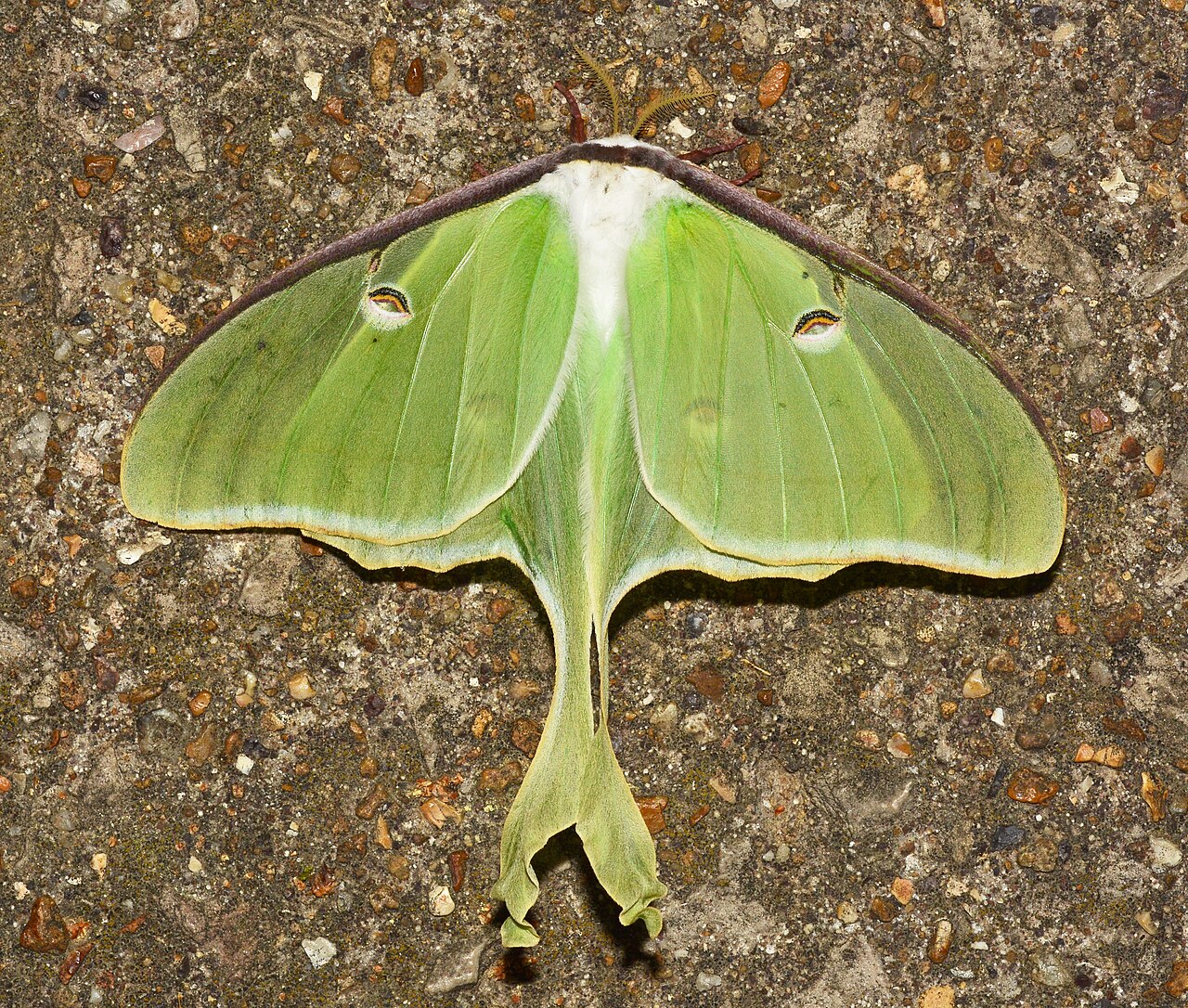
To confuse bats. Research using tethered moths and hunting bats found that luna moths with intact tails survived bat attacks far more often than moths with the tails removed, and the difference was substantial rather than marginal.
The mechanism is acoustic rather than visual. The twisted tips spin as the moth flies and reflect echolocation calls back in a way that creates a misleading echo, so the bat strikes at the trailing tails rather than the body. A moth that loses a tail flies on unharmed; a moth struck in the body does not.
Similar tails have evolved independently several times in the silk moth family, which is strong evidence that the function is real rather than incidental. It is one of the clearer demonstrations of an anti-predator adaptation targeting a sense other than sight. The polyphemus moth guide covers a relative that uses eyespots instead.
Why Do Adults Not Eat?
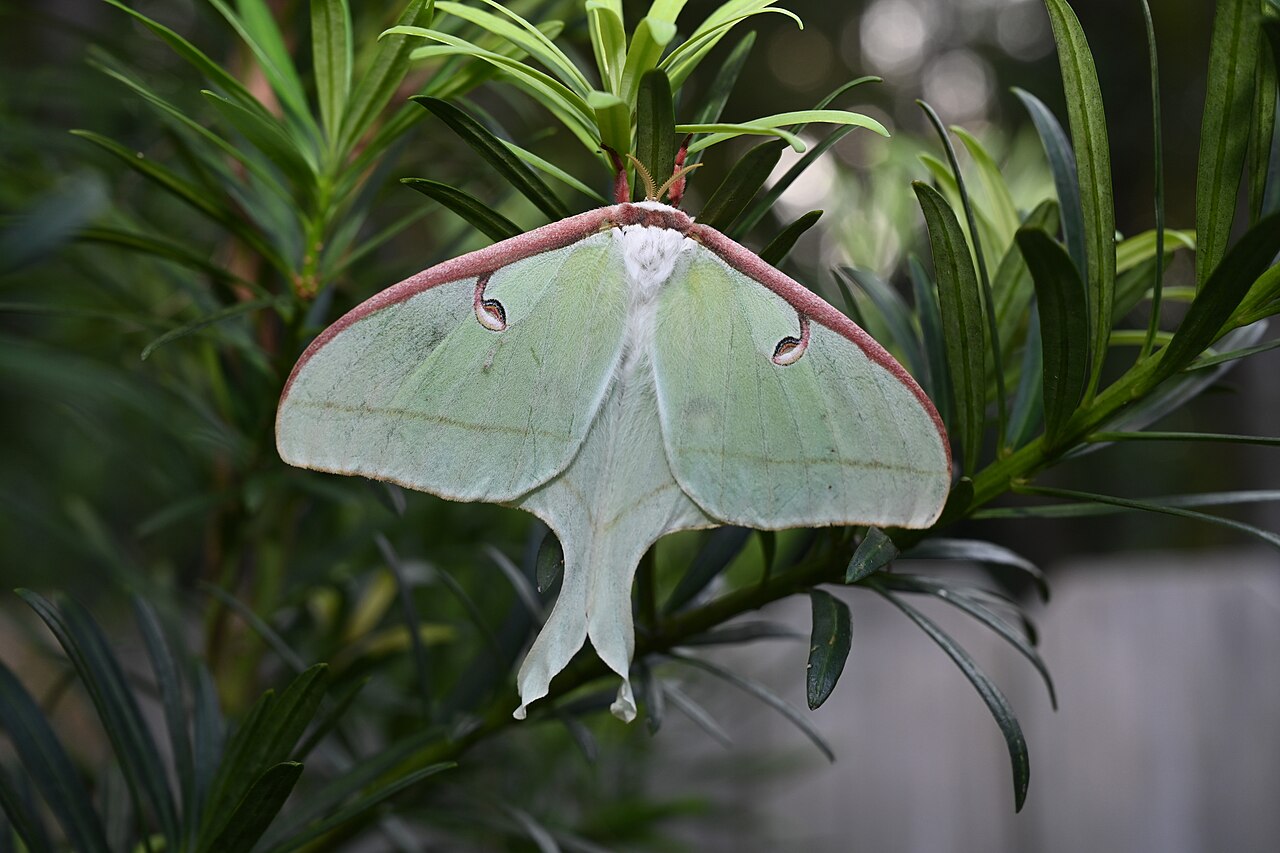
Because they have no way to. Adult luna moths have vestigial mouthparts and no functional digestive system, and everything they need was stored during the caterpillar stage, which spends about a month doing nothing but eating tree leaves.
That trade-off makes sense given the timescale. An adult that lives a week and exists only to find a mate and lay eggs gains little from a feeding apparatus, and the energy saved goes into flight muscle and eggs instead. Silk moths generally follow this pattern, including cecropia, polyphemus, and promethea moths.
The practical consequence is that a luna moth found indoors or on a porch cannot be helped with sugar water, fruit, or anything else. The kind thing is to move it gently to a tree or shrub away from lights, which addresses the actual problem: artificial light disrupts the short window it has to find a mate. The guide to what moths eat covers the species that do feed as adults.
How Rare Is a Luna Moth?
Not rare, but genuinely seldom seen. Luna moths occur across eastern North America from Nova Scotia and Quebec south to Florida and west to Texas and the eastern Great Plains, and they are common in areas with mature deciduous woodland.
The reason people go decades without seeing one is behavioural. Adults fly only at night, live about a week, and spend the day motionless under leaves where the pale green wings are effectively invisible against foliage. Most sightings happen at porch lights or on walls near lights, which is where the moths end up rather than where they want to be.
Numbers do vary regionally and there is concern about declines, driven mainly by artificial light at night, which disrupts navigation and mating, plus habitat loss, pesticide use, and in the northeast the parasitic fly Compsilura concinnata, introduced a century ago against spongy moth and now attacking native silk moths. The cecropia moth guide covers a relative under similar pressure.
Is It Okay to Touch a Luna Moth?
Better not to, though it is harmless to you. Luna moths do not bite, do not sting, have no venom, and have no mouthparts at all, so there is no risk to a person from handling one. The risk runs the other way.
Moth wings are covered in microscopic scales that come off on contact and cannot be regrown. Losing scales damages the wing surface, affects flight and thermoregulation, and a moth with only a week to find a mate cannot afford impaired flight. Handling also removes the wing’s water-repellent quality.
If one needs moving, coax it onto a leaf, a piece of card, or the back of a hand and let it walk rather than grasping the wings. Never pick a moth up by the wings. If it is on a wall under a light, moving it to a tree in a dark part of the garden is a genuine kindness because it releases the moth from the light trap.
What Do the Caterpillars Eat?
Tree leaves, and a fairly wide range of them. White birch, walnut, hickory, sweetgum, persimmon, sumac, and paper birch are the main hosts, with regional variation: northern populations lean heavily on birch, southern ones on sweetgum, persimmon, and hickory.
The caterpillar is bright green with a faint yellow line along each side, small orange or red tubercles along the back, and a reddish-brown head, growing to about two and a half inches. It passes through five instars over roughly three to four weeks, eating steadily throughout.
Pupation happens in a thin papery cocoon spun in a leaf and dropped to the ground, where it overwinters in the leaf litter. That is why autumn leaf clearance matters: raking and bagging leaves removes the overwintering cocoons of luna moths along with a great many other insects. Leaving leaf litter under trees is the single most effective thing a garden can do for them.
How Many Generations Are There?
One in the north, two or three in the south. In Canada and the northern United States luna moths emerge in a single brood in late May and June. Further south there are two broods, roughly April and July, and in the deep south three, from March into September.
Emergence is synchronised within a population, which is why sightings cluster. Moths from a local area emerge within a few days of each other, mate, lay, and are gone, so a garden may see several in one week and none for the rest of the year.
Timing follows temperature, so a warm spring brings the brood forward and a cold one delays it. Eggs hatch in about a week, the caterpillar stage takes three to four weeks, and pupation runs two to three weeks in summer broods or the whole winter in the final generation.
What Is Confused With a Luna Moth?
Very little, which is unusual for a moth. Nothing else in North America combines pale green wings, eyespots on all four wings, and long twisted tails, so a luna moth is one of the easiest large insects to identify with certainty.
Other large silk moths get grouped with it by size rather than appearance. Polyphemus moths are tan-brown with two large blue-and-yellow eyespots and no tails, cecropia moths are reddish-brown with white crescents and are the largest moth in North America, and imperial moths are yellow with purple-brown blotches.
Green confusions are minor. Various emerald moths in the family Geometridae are green but are small, thin-bodied, and tailless, and the Chinese moon moth and Indian moon moth sold in the pet trade are close relatives from Asia rather than anything a person finds outdoors. The giant moth guide covers the large species as a group.
How Do You Attract Luna Moths?
Plant or keep the host trees and reduce the lighting. Sweetgum, birch, walnut, hickory, and persimmon are all substantial native trees, so this is a long-term proposition, but an existing mature specimen of any of them means luna moths may already be breeding nearby unnoticed.
Lighting is the change most people can actually make. Turning off outdoor lights during the flight period, switching to motion sensors, using warm amber bulbs rather than white or blue-white LEDs, and shielding fixtures so light points down all reduce the disruption. Blue and white wavelengths attract night-flying insects most strongly.
Leave the leaves. Cocoons overwinter in litter under host trees, so autumn clearance destroys them, and leaving an unraked area beneath a birch or sweetgum is directly protective. Avoiding broad-spectrum insecticide, including mosquito fogging, protects the caterpillars. The Xerces Society (xerces.org) publishes guidance on light pollution and moth conservation. The imperial moth guide covers another large silk moth with the same needs.
Frequently Asked Questions
What does a luna moth look like?
Large pale green wings spanning three to four and a half inches, with a purple-brown leading edge, a translucent eyespot on each wing, a white furry body, and long twisted hindwing tails.
Why is the luna moth so special?
Adults have no mouthparts and cannot eat, living about a week on energy stored as a caterpillar, and the long tails deflect bat attacks by disrupting echolocation rather than by looking like anything.
Is seeing a luna moth rare?
The moth is not rare across eastern North America, but sightings are because adults fly only at night for about a week and rest invisibly among green leaves by day.
Do luna moths bite?
No. They have no mouthparts at all, no sting, and no venom, and they are completely harmless to handle. The risk runs the other way, since handling damages their wing scales.
Is it okay to touch a luna moth?
Better to let it walk onto a leaf or hand than to grasp it. Wing scales come off on contact and cannot be regrown, and a moth with a week to live cannot afford impaired flight.
What do luna moth caterpillars eat?
Leaves of birch, walnut, hickory, sweetgum, persimmon, and sumac, with northern populations favouring birch and southern ones sweetgum and persimmon.
How do you attract luna moths?
Keep native host trees, leave leaf litter beneath them where cocoons overwinter, and reduce outdoor lighting during the flight period using amber bulbs, shielding, and motion sensors.

Similar Posts
Black Beetle Identification: Species Guide
How to identify the most common black beetles found in homes and yards, and which ones actually warrant concern.
Baby Hedgehog: Hoglet Facts, Growth, Diet, and Care
A baby hedgehog is called a hoglet. Here is how they develop, what they eat, why there are none in the wild in North America, and how care works.
Hercules Beetle: Size, Strength, Life Cycle, and Care
The Hercules beetle is the longest beetle in the world. Here is the truth about its strength, plus the eastern species found across the United States.
Black Caterpillar: Identification Guide by Markings
Black caterpillars are identified by what accompanies the black. Here is how to tell leopard moth, swallowtail, spiny elm and tent caterpillars apart.
Bat Sounds: Echolocation, Roost Noises, and Wall Scratching Decoded
Most bat sounds are above human hearing. What you can hear, chittering, clicks, sunset scratching, and how to tell bats in walls from mice, squirrels, and birds.
Baby Iguana: Size, Diet, Care, and How Fast They Grow
A baby iguana hatches at 6 to 12 inches and reaches 4 to 6 feet within a few years. Size, herbivore diet, UVB and heat needs, health risks, and wild hatchlings.