What Is a Group of Squirrels Called? Scurry and Dray
A group of squirrels is called a scurry when they are running about on the ground and a dray when it refers to a nest of squirrels, usually a mother and her young. Collective noun lists also give a colony of squirrels, and biologists simply say a group or a family. What is a group of squirrels called therefore has two main answers, scurry and dray, and neither describes a lasting social unit, because squirrels are not social animals in the way the terms imply.
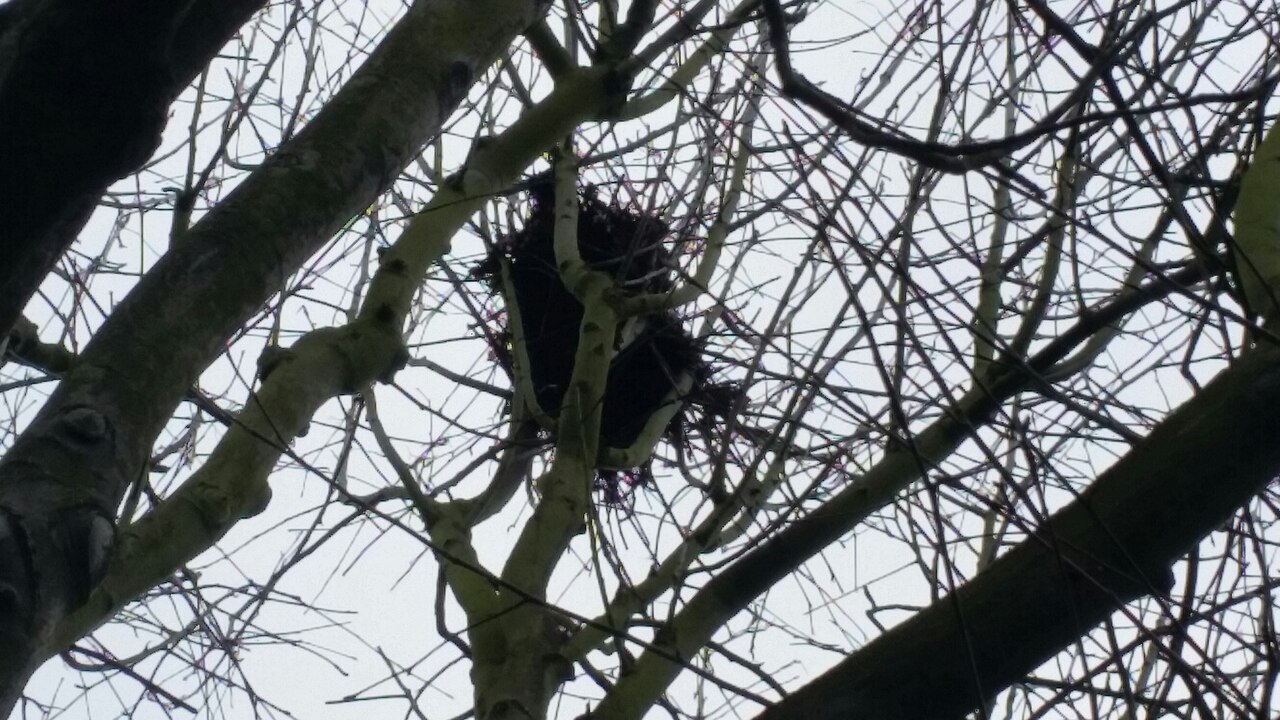
Dray is the more technically useful of the two, because it is a genuine term in wildlife biology for the leafy nest a tree squirrel builds, the untidy ball of leaves and twigs visible high in bare winter branches. By extension it means the squirrels occupying that nest. Scurry is the fanciful one, coined to describe the way several squirrels move when they scatter. This guide covers both terms, explains what a dray actually is, and describes how squirrel social life really works.
A group of squirrels is called a scurry when moving about, and a dray when referring to a nest and the squirrels in it. A dray is also the actual name for the leafy nest tree squirrels build. Squirrels are largely solitary and territorial, so real groups are limited to a mother with her young, or squirrels sharing a nest for warmth in winter.
| Question | Answer |
|---|---|
| Main collective nouns | Scurry or dray |
| What a dray also means | The leaf nest itself |
| Other listed term | Colony |
| Real social unit | Mother with young; winter nest sharing |
| Baby squirrel | Kit or kitten; a group is a litter |
| Litter size | 2 to 5, usually twice a year |
| Group of chipmunks | Also a scurry; chipmunks are solitary |
Why Is a Group of Squirrels Called a Scurry?
A group of squirrels is called a scurry because of how they move: in quick, jerky bursts with abrupt stops, darting across a lawn or spiraling around a tree trunk. The word scurry has meant to move hurriedly with short quick steps since the early nineteenth century, and applying it to squirrels is straightforwardly descriptive rather than metaphorical. Several squirrels chasing each other around a trunk is exactly a scurry.
The movement pattern is a predator response. Squirrels are prey for hawks, owls, foxes, coyotes, cats, and snakes, and a straight-line run at constant speed is easy for a raptor to intercept. The stop-start, direction-changing dash makes interception far harder, and the frequent pauses let the squirrel scan for threats. The same logic explains the maddening habit of darting into the road and then reversing, which works well against hawks and disastrously against cars.
Scurry is a modern collective noun rather than a medieval one. Squirrels were hunted, but they did not attract the elaborate vocabulary that deer, hares, and game birds received in the terms of venery, and scurry appears in later lists compiled by writers extending the tradition. It sits alongside a kaleidoscope of butterflies and a waddle of penguins as a term invented because the animal deserved one.
What Is a Dray of Squirrels?
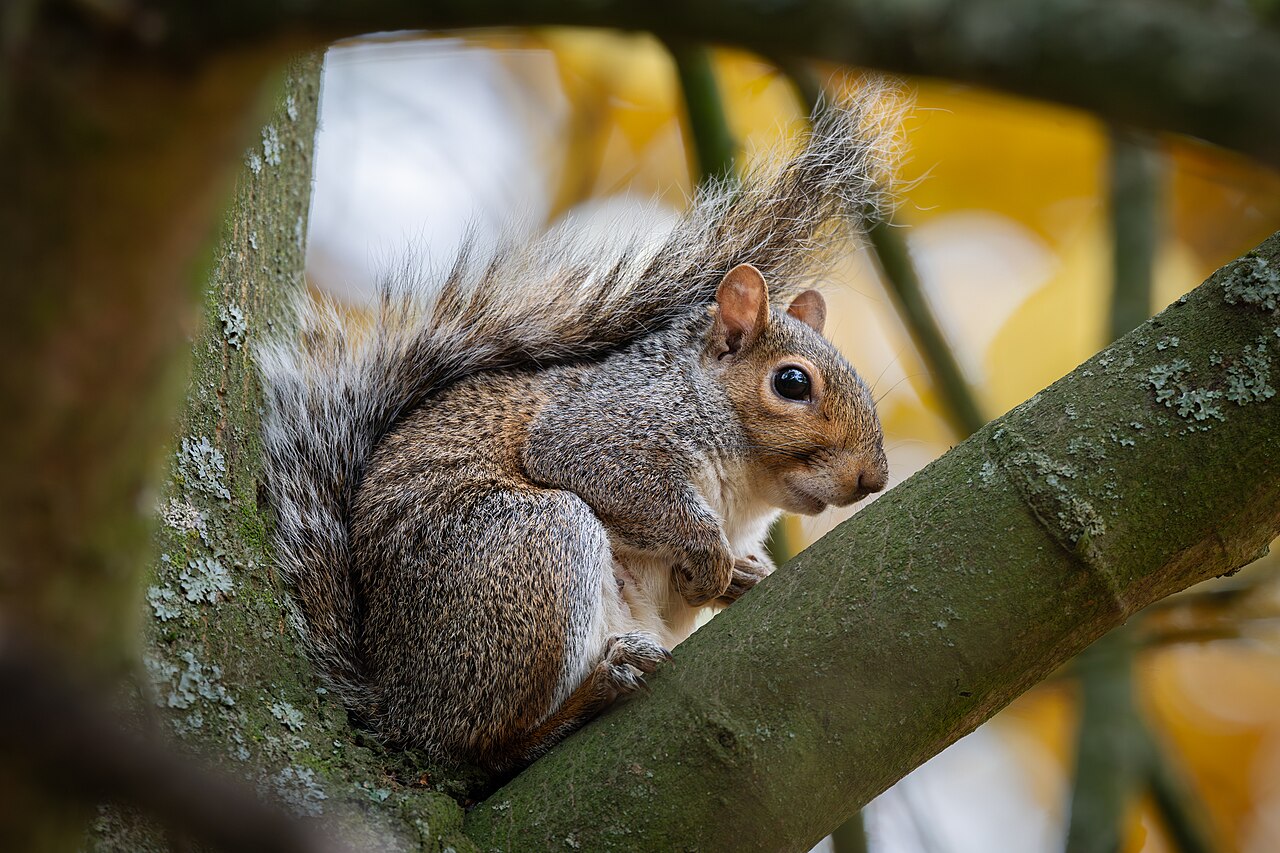
A dray is the leafy nest a tree squirrel builds, and by extension the group of squirrels living in it. This makes it the more substantial of the two terms, because dray is genuine wildlife vocabulary used by biologists, foresters, and wildlife rehabilitators rather than a trivia entry. The word appears in field guides and research papers describing squirrel nesting ecology.
A dray is the untidy ball of leaves and twigs you can see high in a bare oak or maple in winter, typically 20 to 45 feet up and tucked against the trunk or in a fork. It is far more sophisticated than it looks from the ground: a squirrel builds a twig frame, weaves in a shell of leaves, lines the interior with moss, grass, shredded bark, and fur, and leaves one or two entrances positioned to face away from prevailing wind. A well-built dray sheds rain and holds internal temperatures well above outside air.
Squirrels prefer tree cavities to drays when they can get them, because a hollow gives better insulation and predator protection. Cavities are limited, though, so most squirrels build drays and maintain several within their range, moving between them and abandoning any that becomes flea-infested. A single gray squirrel may maintain two or three drays plus access to a cavity, which is why finding drays does not tell you how many squirrels are present.
Do Squirrels Live in Groups?
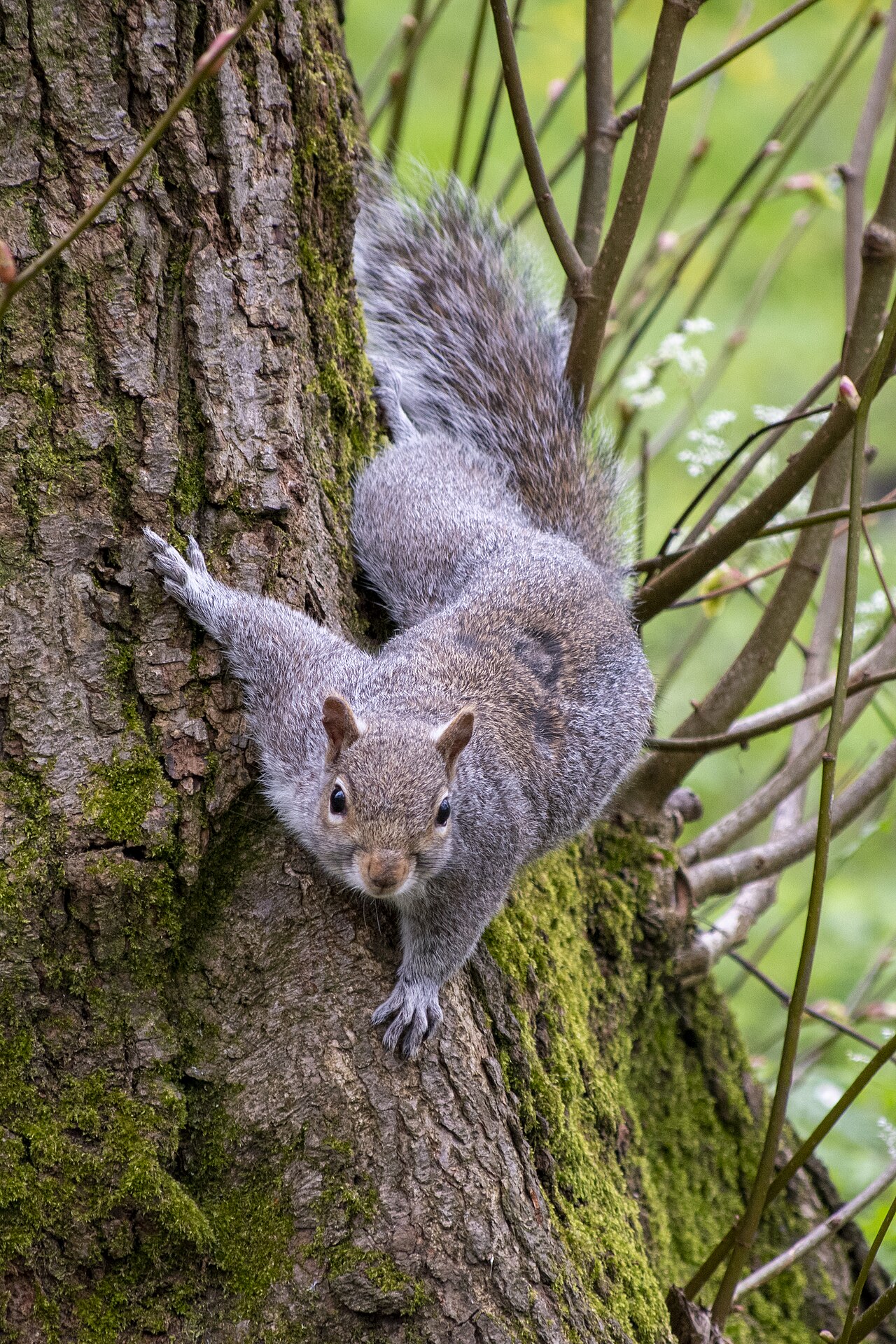
Tree squirrels are largely solitary and do not live in groups. Gray, fox, and red squirrels each occupy overlapping home ranges, forage individually, and cache food individually, and there is no cooperative behavior of the kind wolves or meerkats show. Red squirrels are outright territorial and will chase off any intruder aggressively, defending a food cache called a midden with a rattling scold that carries a long way through the woods.
What looks like a group is usually one of three things. It may be a mother with her nearly independent young, which stay together for a few weeks after leaving the nest. It may be several squirrels drawn to the same food source, a bird feeder, an oak dropping acorns, or a nut tree, which is competition rather than company. Or, during the breeding season, it may be a mating chase, in which several males pursue a female in season in a noisy, spiraling pursuit that people often mistake for play or fighting.
Gray squirrels do have a loose dominance hierarchy where they overlap, with older, larger animals getting priority at food sources, and they recognize individual neighbors. This is closer to the tolerance system among red foxes than to a genuine society. The squirrel sounds guide covers the chattering, barking, and tail-flagging that make up most of that communication.
Do Squirrels Share Nests in Winter?
Yes, and this is the one genuine exception to squirrel solitude. In cold weather, gray and flying squirrels will share a nest or cavity with several other individuals, huddling together for warmth. This is a real energy-saving behavior: a squirrel sharing a cavity loses far less heat overnight than one alone, and in a hard winter that difference matters for survival.
Southern flying squirrels take it furthest. They regularly aggregate in tree cavities in groups of five to ten, and winter aggregations of twenty or more have been documented, which for a nocturnal solitary forager is remarkable. The huddle can raise the internal cavity temperature dramatically above ambient, and members of an aggregation are frequently related, though unrelated animals join too.
These groups dissolve in spring. Nest sharing is a response to cold rather than a social preference, and once temperatures rise the same animals go back to foraging and nesting alone. Squirrels also do not hibernate, unlike the ground squirrels and chipmunks they are often lumped with, so they must remain active and find cached food all winter, which is exactly why conserving heat matters so much. The baby squirrel guide covers the nesting season on the other side of that winter.
What Is a Group of Baby Squirrels Called?
A group of baby squirrels is called a litter, and individual young are called kits or kittens, with pups also used. Gray squirrels typically produce two litters a year, one in late winter and one in midsummer, with two to five young per litter after a gestation of about 44 days. Fox squirrels and red squirrels follow similar patterns, and litter size tracks food availability closely.
Newborn squirrels are entirely helpless: hairless, pink, blind, deaf, and about an inch long, weighing roughly half an ounce. Eyes open at around four to five weeks, fur develops over the first month, and the young first leave the nest at ten to twelve weeks. The mother raises them alone, since males play no part in rearing, and she will move an entire litter one by one to a backup nest if the original is disturbed or infested.
Finding a baby squirrel on the ground is common in spring and late summer. A furred, alert juvenile is usually fine and should be left alone, since the mother will retrieve it, and placing it in a box at the base of the tree and watching from a distance for a few hours is the standard recommendation. A hairless, cold, or injured infant needs a licensed wildlife rehabilitator, and squirrels are notoriously difficult to raise correctly on an improvised diet.
What Is a Group of Chipmunks Called?
A group of chipmunks is also called a scurry, borrowing the squirrel term, and chipmunks are equally unsuited to it. Chipmunks are aggressively solitary and territorial, each defending a burrow system and the area around it, and adults tolerate each other only during the brief breeding periods in spring and midsummer. A chipmunk that enters another’s territory is chased out with a rapid chipping call and a pursuit.
Unlike tree squirrels, chipmunks do hibernate, though not deeply. They enter a state of torpor in winter and wake periodically to eat from the food cache stored in their burrow, rather than living off body fat like a true hibernator such as a groundhog. This is why a chipmunk burrow contains a dedicated larder chamber and why chipmunks spend autumn frantically filling their cheek pouches, which can hold a startling volume relative to their head size.
Burrow systems are elaborate and entirely individual. A chipmunk digs tunnels up to 30 feet long with separate chambers for nesting, food storage, and waste, and carries excavated soil away in its cheek pouches to keep the entrance inconspicuous, which is why chipmunk holes have no telltale mound. The chipmunk sounds guide covers the chipping and trilling territorial calls, and the chipmunk poop guide covers the sign they leave.
Do Ground Squirrels Live in Colonies?
Yes, and this is where the collective noun colony becomes genuinely accurate. Ground squirrels, including prairie dogs, are far more social than tree squirrels, and several species live in large, structured colonies. Black-tailed prairie dogs are the extreme case, forming towns divided into territorial family groups called coteries, and historic prairie dog towns covered enormous areas, with one nineteenth century Texas complex estimated at hundreds of millions of animals.
Colonial ground squirrels have the social behavior tree squirrels lack. They post sentinels that give alarm calls when a predator appears, and research on prairie dogs has shown their alarm calls encode information about the type of predator and even its size and color, which is one of the more sophisticated communication systems documented in a mammal. Colony members greet each other with a nose-to-nose contact that resembles a kiss and is used to identify coterie members.
California ground squirrels, Belding’s ground squirrels, and marmots all show intermediate levels of sociality, from loose aggregations to structured colonies. The pattern across the squirrel family follows a familiar rule: species in open habitat where predators are visible at a distance benefit from group vigilance and become social, while species in forest where escape means climbing the nearest trunk do not. That single difference explains why a group of prairie dogs is a genuine colony and a group of gray squirrels is a coincidence.
Collective Nouns for Squirrels and Other Rodents
Rodents received a modest set of collective nouns, most of them modern. Mice get a mischief, rats get a mischief or a colony, beavers get a colony or a family, and porcupines get a prickle, which is one of the better ones. Rabbits, which are not rodents but are often grouped with them, get a colony, a warren, or the modern fluffle.
The pattern that emerges across all these terms is that the functional words, colony and family, attach to the genuinely social species, while the fanciful words, scurry, mischief, prickle, attach to solitary ones. Beavers really do live in family colonies. Prairie dogs really do form towns. Squirrels, mice, and porcupines do not form groups, and their names were invented for effect rather than derived from observation.
Dray is the interesting middle case, because it started as a functional word for a structure and drifted into use as a collective noun for the animals inside it. That is the same path that gave us a warren of rabbits and an earth of foxes, where the name of the home became the name of the group. Those are among the more honest collective nouns in English, since they describe something that physically exists. For the other rodent sign people find in yards, the squirrel poop guide and the squirrel poop vs mouse poop comparison cover identification, and the group of rabbits guide covers the warren system.
Frequently Asked Questions
What is a group of squirrels called?
A group of squirrels is called a scurry when they are moving about, or a dray when referring to a nest and its occupants. Colony also appears in some lists. Biologists simply say group or family.
What is a dray?
A dray is the leafy nest a tree squirrel builds, the ball of leaves and twigs visible high in bare winter branches, and by extension the squirrels living in it. It is genuine wildlife terminology rather than a trivia term.
Why is a group of squirrels called a scurry?
Because of their quick, darting, stop-start movement, which the word scurry describes directly. That movement pattern is a predator response, making squirrels much harder for hawks to intercept than a straight-line run would.
Do squirrels live in groups?
Tree squirrels are largely solitary. What looks like a group is usually a mother with her young, several squirrels competing at one food source, or a mating chase. Red squirrels are actively territorial and drive off intruders.
Do squirrels share nests?
Yes, in cold weather. Gray and flying squirrels huddle together in nests and cavities to conserve heat, and southern flying squirrels aggregate in groups of five to ten or more. These groups dissolve in spring.
What is a group of baby squirrels called?
A litter. Individual young are kits or kittens. Gray squirrels have two litters a year of two to five young, born hairless and blind after about 44 days of gestation, and raised by the mother alone.
What is a group of chipmunks called?
Also a scurry, borrowing the squirrel term. Chipmunks are aggressively territorial and solitary, each defending its own elaborate burrow system, so the collective noun describes something that does not really occur.