Squirrel Tracks: 4 Toes Front, 5 Behind, and How to Tell Them Apart
Squirrel tracks give themselves away with two front prints that land level and side by side, with the longer hind prints planted ahead of them and slightly wider apart. That square-ish group of four, repeated in short hops between trees, is the squirrel snow tracks pattern, and it holds in mud and damp sand as well.
Eastern gray squirrels (Sciurus carolinensis), fox squirrels and red squirrels all leave the same arrangement at different scales. The detail that settles any argument is toe count: four on the front foot, five on the hind.
Squirrel tracks form a group of four prints roughly 3 to 4.5 in (7.6 to 11 cm) long. The two small front prints are about 1 in (2.5 cm) long with four toes and land parallel; the two hind prints are 1.5 to 2.5 in (3.8 to 6.4 cm) long with five toes and land ahead of them. Claw marks are sharp and nearly always visible.
| Feature | Gray squirrel | Red squirrel |
|---|---|---|
| Front print length | 1 to 1.3 in (2.5 to 3.3 cm) | 0.6 to 0.9 in (1.5 to 2.3 cm) |
| Hind print length | 2 to 2.5 in (5 to 6.4 cm) | 1.3 to 1.8 in (3.3 to 4.6 cm) |
| Toes | 4 front, 5 hind | 4 front, 5 hind |
| Claws in print | Distinct, pointed | Distinct, finer |
| Group width | 3 to 4.5 in (7.6 to 11 cm) | 2.5 to 3.5 in (6.4 to 8.9 cm) |
| Stride between groups | 8 to 30 in (20 to 76 cm) | 7 to 24 in (18 to 61 cm) |
| Trail endpoint | Tree trunk | Tree trunk or midden |
What Squirrel Tracks Look Like
The hind foot is long and narrow with five splayed toes and visible claw points, the front foot smaller and nearly square with four toes and a thumb pad that rarely registers. Because a squirrel bounds, both front feet hit together and both hind feet swing past on the outside, so the group reads as a rough rectangle rather than the lopsided triangle a rabbit leaves.
Claws print reliably. Squirrels climb for a living, and the sharp recurved claws cut small dashes at the tip of every toe even in shallow snow. A print with no claw marks at all is more likely a cat.
Squirrel Tracks in Snow
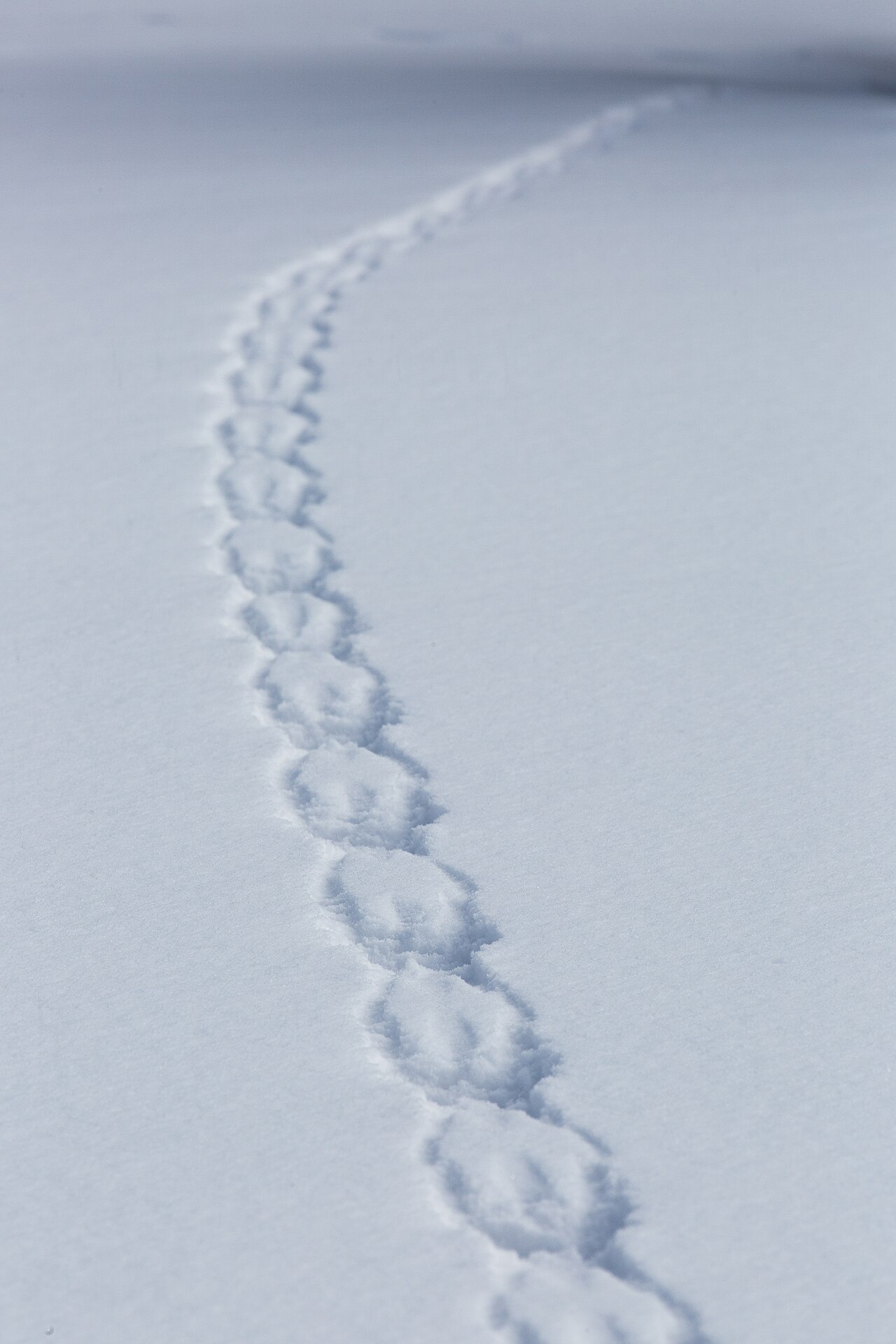
Fresh snow of 1 to 2 in (2.5 to 5 cm) is ideal. Toe splay, claw dashes and the paired front feet all show cleanly, and the trail reads like dotted lines running trunk to trunk across open lawn. Squirrels stay active all winter, so sign accumulates fast after a snowfall; they do not hibernate, a point covered in what squirrels actually do in winter.
Deeper snow produces plunge holes instead of prints. Look for a line of round punches with brush marks between them where the belly and tail dragged. Tail drag is a useful confirmation, since rabbits almost never leave one. A trail that stops dead in open snow usually means the animal went up a trunk, so check the bark for fresh scratches.
Squirrel Tracks in Mud and Sand
Mud is where the five hind toes become undeniable: each prints as a separate elongated pad with a claw point ahead of it. Measure the hind print heel to longest toe and compare against the table to separate gray from red squirrel.
Dry sand collapses and strips detail down to four vague craters, leaving only the arrangement to work with, while damp sand behaves like mud. Around feeders and planters, muddy prints usually appear beside chewed hulls and scattered seed, the raiding pattern addressed in keeping squirrels off bird feeders.
Squirrel Tracks vs Rabbit, Raccoon and Chipmunk Tracks
Rabbits are the usual mix-up. Their front feet land staggered, one behind the other, and all four feet carry four toes, while squirrel front feet land level and the hind foot has five. Side by side comparisons are in the rabbit track guide.
Raccoons differ sharply: five long toes on both front and hind feet, prints 2 to 3 in (5 to 7.6 cm) that look like small human hands, and a walking gait that pairs one front with one opposite hind. Chipmunks use the same four-and-five toe formula at half scale, with groups under 2.5 in (6.4 cm) and trails that vanish into ground holes instead of trees. Flying squirrels land in snow with a faint body impression first, described in the flying squirrel profile.
Where Squirrels Go in Heavy Snow
During a storm squirrels hole up in leaf nests, called dreys, or in tree cavities, living on cached food for a day or two. Tracks stop appearing during heavy weather and explode afterward as animals dig for buried nuts, leaving small cone-shaped pits with shell fragments and droppings at the rim; see squirrel droppings identification for what the pellets look like.
Most tracking happens in daylight because tree squirrels are diurnal, unlike the flying squirrels sharing the same woods after dark. That distinction matters when matching tracks to a sighting, and it is laid out in whether squirrels are nocturnal. For regional wildlife activity and public-land tracking programs, the National Park Service publishes seasonal guidance.
Related reading: Bobcat Tracks.
Related reading: Deer Tracks.
Related reading: Bear Tracks.
Related reading: Turkey Tracks.
Related reading: Mink Tracks.
Related reading: Bison Tracks.
Related reading: Chickadee Tracks.
Related reading: Porcupine Tracks.
Related reading: Alligator Tracks.
Related reading: Duck Tracks.
Related reading: Javelina Tracks.
Related reading: Badger Tracks.
Frequently Asked Questions
What are the key differences between squirrel tracks and raccoon tracks?
Squirrels show four toes on the front foot and five on the hind, in a bounding group of four prints. Raccoons show five long finger-like toes on every foot, print 2 to 3 in (5 to 7.6 cm) long, and walk rather than bound, pairing a front foot with the opposite hind foot along the trail.
Do squirrels know when snow is coming?
Squirrels respond to falling barometric pressure and dropping temperature with a burst of caching and feeding before a storm, which is why feeders empty fast the day before snow. That is reaction to current conditions rather than forecasting, and folk claims that heavy nut hoarding predicts a hard winter are not supported by data.
Where do squirrels go in heavy snow?
They shelter in leaf nests or tree cavities, often sharing body heat with others, and live off cached nuts until the weather breaks. Activity resumes within a day or two, which is when fresh digging pits and dense track networks appear across the snow surface.
How do I tell a fresh squirrel track from an old one?
Fresh prints have crisp rims, visible claw dashes and loose crystals inside the depression. Older tracks round off, glaze over after a thaw and refreeze cycle, and grow larger as the edges melt back. Place a fresh boot print alongside for a direct reference.