Rabbit Tracks: 4 Prints, One Shape, Easy ID in Snow and Mud
Rabbit tracks are easy to call once you know the shape: four prints in a lopsided triangle, with the two long hind feet landing side by side in front of the two smaller front feet. That one detail separates bunny snow tracks from almost every other backyard animal in North America, because a hopping rabbit throws its hind feet past its front feet on every bound.
Eastern cottontails (Sylvilagus floridanus) leave this pattern across most of the lower 48, and snowshoe hares (Lepus americanus) leave an oversized version in northern forests. The prints read differently in snow, mud and sand, and the mistakes are predictable: squirrel, house cat, small dog.
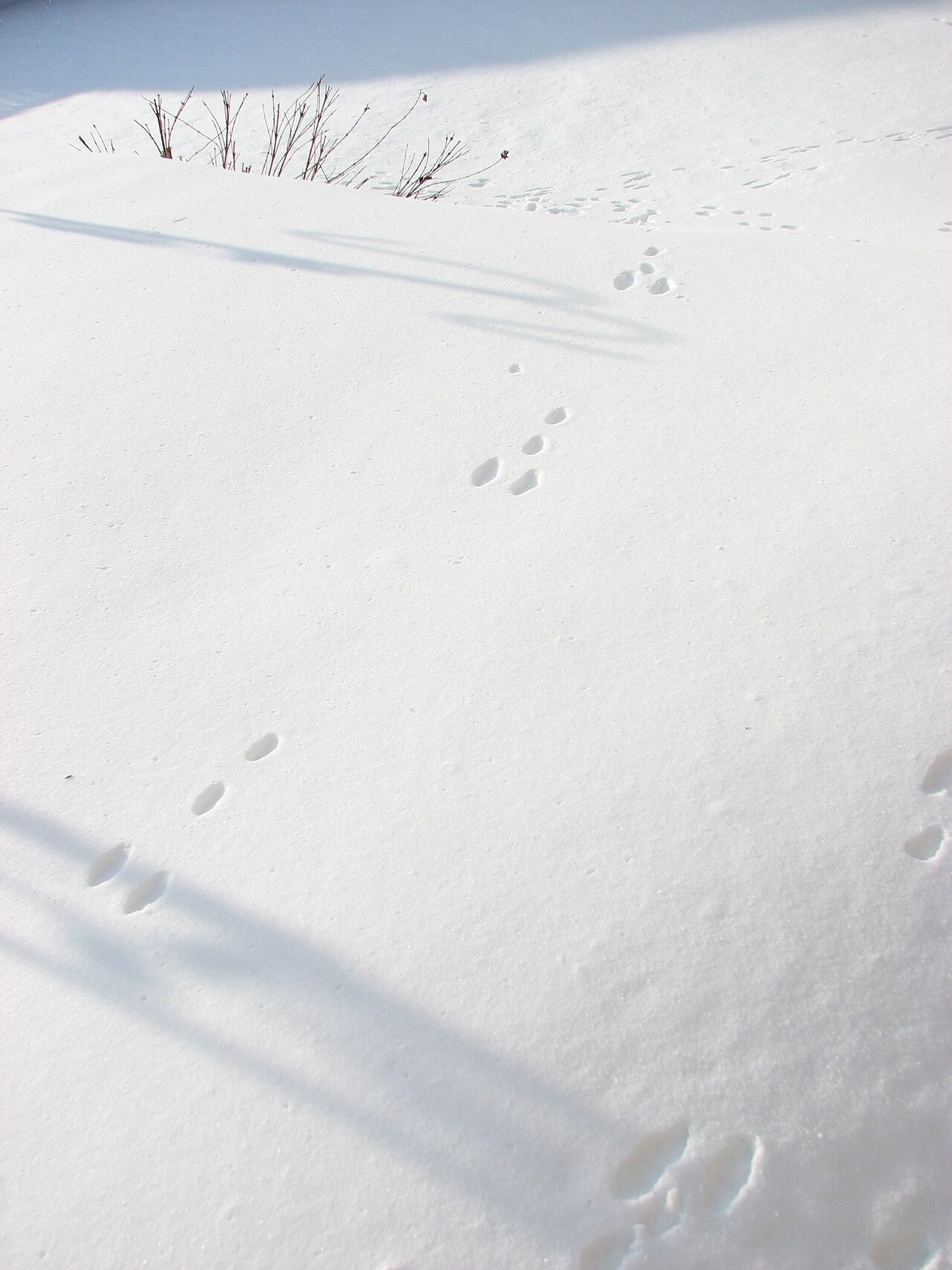
Rabbit tracks appear as a group of four prints in a Y or triangle shape. The two hind feet are 3 to 4 in (7.6 to 10 cm) long and land ahead and parallel; the two round front feet are about 1 in (2.5 cm) wide and land one behind the other. All four feet show four toes, and claw marks are often faint because dense fur covers the pads.
| Feature | Cottontail rabbit | Snowshoe hare |
|---|---|---|
| Hind print length | 3 to 4 in (7.6 to 10 cm) | 4 to 6 in (10 to 15 cm) |
| Front print width | 0.8 to 1.2 in (2 to 3 cm) | 1.6 to 2.4 in (4 to 6 cm) |
| Toes per foot | 4 front, 4 hind | 4 front, 4 hind |
| Claws in print | Faint, often absent | Faint, spread wide |
| Group length | 7 to 12 in (18 to 30 cm) | 10 to 20 in (25 to 51 cm) |
| Stride, relaxed hop | 10 to 16 in (25 to 41 cm) | 16 to 30 in (41 to 76 cm) |
| Stride, fleeing | Up to 8 ft (2.4 m) | Up to 10 ft (3 m) |
What Do Bunny Tracks Look Like?
A bunny track group looks like an exclamation point lying on its side. The two hind prints are long, narrow ovals pointing in the direction of travel, sitting forward of a pair of small round front prints. Those front prints are rarely level with each other, and that is the detail that trips people up against squirrel sign.
Each foot carries four toes, and the pads are buried under stiff fur, so a rabbit print reads as a soft blob rather than the crisp toe beans of a cat. Rabbits also do not walk in any ordinary sense; their travel gait is a bound, so a single isolated print never occurs. Find one and the others are within a foot of it. Background on the species behind most of these trails is in the cottontail rabbit profile.
Front and Hind Feet: Sizes, Toes and Claws
The hind foot is the identification key. A cottontail hind foot measures 3 to 4 in (7.6 to 10 cm) heel to toe tip, and in deep snow the whole foot registers. On packed ground only the toe half prints, which shrinks the apparent size to about 2 in (5 cm) and makes the track look like a different animal entirely.
The front foot is small and nearly round, about 1 in (2.5 cm) across, and it takes the landing weight, so it punches deeper than the hind print despite being smaller. A deep little circle paired with a long shallow oval is a rabbit signature in almost any medium. Claws show up inconsistently: expect them on frozen mud and wet sand, and expect none in powder.
Reading Rabbit Tracks in Snow
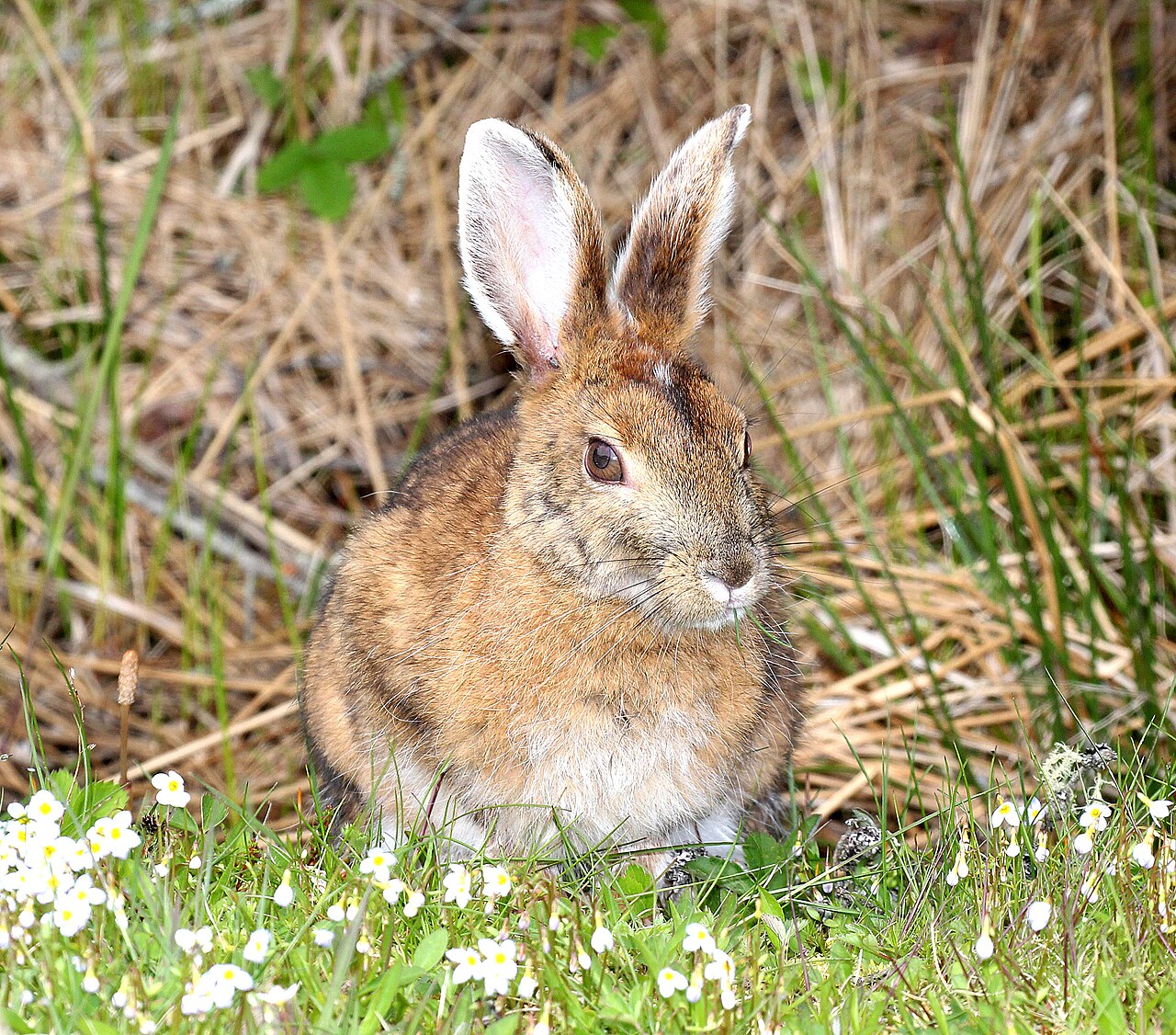
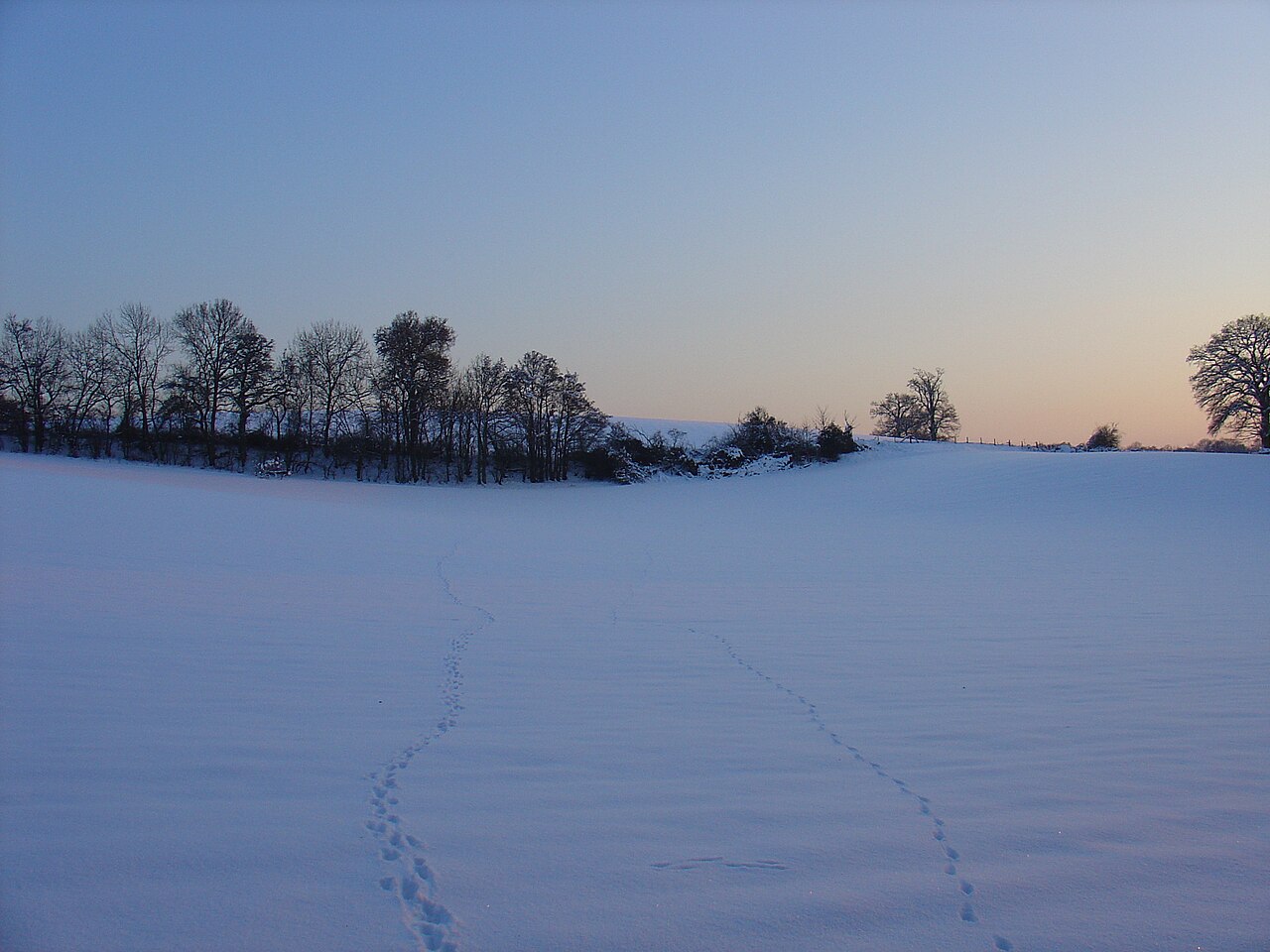
Snow is the best surface for rabbit tracking, and winter is when sign is densest, because rabbits stay active all season. In 1 to 3 in (2.5 to 7.6 cm) of fresh snow you get the full four-print group with sharp outlines, visible heel registration and an unmistakable direction of travel.
Deeper powder changes everything. Past about 6 in (15 cm) the rabbit plows rather than hops cleanly, and the group merges into a connected trough with rhythmic punches along the bottom. Look at the leading end of each trough: the hind feet exit first, so the drag mark trails behind the animal, not ahead.
Snow that has thawed and refrozen enlarges every print, and a melted-out cottontail track can measure 5 in (13 cm) and read as a hare. Judge by edge crispness, not size. Rabbits are most active at dawn, dusk and through the night, which is why a morning snowfield is covered in sign laid down in the dark; more on that in when rabbits are actually active.
Rabbit Tracks in Mud
Mud records toe detail that snow hides. On a soft creek bank or wet trail edge, the front print shows four distinct toes in a tight arc and the hind print shows four longer toes with a narrow gap between the inner pair. This is the surface to visit if you want certainty about toe count.
Mud also holds a print long enough to photograph and measure, so set a coin or ruler beside the hind print before shooting. Missing scale is the single most common failure in track photos posted for identification.
Rabbit Tracks in Sand
Dry sand is the hardest surface for rabbit work because it collapses around the foot. The result is four round craters with no toe detail and no reliable measurement, so the call rests entirely on the arrangement: two forward, two behind, repeating.
Damp sand near the waterline behaves like mud and holds usable detail, and early morning before the surface dries is the window. On dunes, look in the lee of vegetation where sand stays compacted and tracks survive the day.
Rabbit Tracks vs Squirrel, Cat, Dog and Deer
Squirrel tracks are the closest match and the most frequent mix-up. Squirrels bound too, but their two front feet land side by side and level, and their hind feet show five toes instead of four. Rabbit front feet land staggered, one clearly behind the other. The full comparison is in the squirrel track guide.
Cats leave four round toes with no claw marks and walk a near-straight line, placing each hind foot into the front foot’s print. Dogs and coyotes show four toes with blunt claws and a clear trotting line, and neither throws the hind pair forward. A deer print is a split heart, two cloven halves 2 to 3 in (5 to 7.6 cm) long with no toes at all. Opossum, raccoon and skunk all show five long toes on the front foot, which rules out rabbit immediately.
Following the Trail and Reading the Sign Around It
The trail tells you what the animal was doing. A relaxed feeding hop runs 10 to 16 in (25 to 41 cm) between groups and wanders; a flight response stretches to 6 or 8 ft (1.8 to 2.4 m) with deep hind punches and no meandering. Tight clusters under a shrub mark a form, the shallow bowl a rabbit presses into litter or snow.
Follow the line to the browse. Rabbits clip twigs at a clean 45 degree angle below 20 in (51 cm), while deer tear and leave a ragged end. Gnawed bark at the snow line, pea-sized pellets and nipped garden greens confirm the maker, and gardeners usually find the same animal that has been sampling produce, a habit covered in what rabbits can safely eat. In spring, a trail ending at a shallow fur-lined depression in open lawn is a nest; leave it alone, since the doe returns only at dawn and dusk, and the young are described in the baby rabbit guide. Regional species ranges are published by the U.S. Fish and Wildlife Service.
Related reading: Coyote Tracks.
Related reading: Deer Tracks.
Related reading: Bear Tracks.
Related reading: Fisher Tracks.
Related reading: Turkey Tracks.
Related reading: Mink Tracks.
Related reading: Possum Tracks.
Related reading: Chicken Tracks.
Related reading: Wolf Tracks.
Related reading: Bison Tracks.
Related reading: Skunk Tracks.
Related reading: Chickadee Tracks.
Related reading: Porcupine Tracks.
Related reading: Alligator Tracks.
Related reading: Duck Tracks.
Related reading: Weasel Tracks.
Related reading: Javelina Tracks.
Related reading: Badger Tracks.
Related reading: Moose Footprints.
Related reading: hare tracks.
Frequently Asked Questions
What do bunny tracks look like?
Bunny tracks look like a group of four prints in a triangle: two long hind prints 3 to 4 in (7.6 to 10 cm) side by side at the front, and two small round front prints staggered behind them. Each foot shows four furred toes, and claw marks are usually faint or missing entirely.
What are the key differences between a squirrel and a rabbit track?
Squirrel front feet land level and side by side, rabbit front feet land staggered one behind the other. Squirrel hind feet carry five toes, rabbit hind feet four. Squirrel trails also run tree to tree and end abruptly at a trunk, while rabbit trails stay on the ground and lead to cover.
What does a deer print look like next to a rabbit track?
A deer print is a single cloven hoof, two pointed halves forming a heart shape 2 to 3 in (5 to 7.6 cm) long, with no toes and no fur texture. Deer walk in a line of alternating prints. There is no risk of confusion once the four-print bounding group of a rabbit is recognized.
What is the 3-3-3 rule for bunnies?
The 3-3-3 rule is a pet adoption guideline, not a tracking term: three days for a new rabbit to decompress, three weeks to learn the routine, three months to settle fully. It describes adjustment in domestic rabbits and has nothing to do with wild track identification.
How fresh are the rabbit tracks I found?
Sharp edges, visible toe detail and loose crystals inside the print mean the track is hours old at most. Rounded rims, a glazed surface or wind-filled depressions point to a day or more. In snow, compare the print against your own fresh boot track beside it for a reliable reference.