Chicken Tracks: How to Identify Them in Snow, Mud and Sand
A chicken track is a slender three toed print, 2 to 2.75 inches (5 to 7 cm) long, with thin claw points at the toe tips and a short rear toe that often shows only as a small dot behind the center. Chicken tracks come in alternating left and right steps in a nearly straight line, because chickens walk rather than hop.
Snow, mud and sand each hide a different part of that print, and most misidentifications come from judging a track in the wrong substrate. The sections below take the three surfaces one at a time, starting with snow, then line the print up against turkey, pheasant, grouse and crow before working out to the predator tracks people actually find near a coop.
Chicken tracks (Gallus gallus domesticus) are 2 to 2.75 inches (5 to 7 cm) long with three forward toes spread about 100 degrees, visible claw tips, and a stubby rear toe that prints as a dot or not at all. Stride is 6 to 10 inches (15 to 25 cm) and the prints alternate in a single line.
| Feature | Chicken track |
|---|---|
| Length | 2 to 2.75 in (5 to 7 cm) standard breeds, 1.5 in (4 cm) bantams, to 3.5 in (9 cm) giants |
| Width | Roughly equal to length, 2 to 3 in (5 to 7.5 cm) across the outer toes |
| Toes | Three forward, one short rear toe pointing back, no webbing |
| Claws | Thin, sharp points beyond each forward toe, usually printed |
| Stride | 6 to 10 in (15 to 25 cm) walking, alternating left and right |
| Best substrate | Half an inch of wet snow, drying mud, fine dust |
| Look alikes | Pheasant, grouse, crow, young turkey |
What do chicken tracks look like?
The shape is a narrow asterisk. Three forward toes radiate from a small central pad, the middle toe (toe III) is the longest at about 1.5 inches (4 cm), and the two side toes angle out at roughly 50 degrees each. The toes are thin and show distinct segment creases in soft ground, not the fleshy pads of a mammal.
The rear toe is the detail that confuses people. A chicken carries a short hallux high on the leg, so in firm ground it leaves nothing, and in soft mud or snow it stamps a separate dot half an inch (1.3 cm) behind the center. Both versions are normal chicken tracks from the same bird on the same walk.
How big is a chicken track?

Measure from the tip of the middle claw to the back of the central pad, ignoring the rear toe dot. Standard breeds such as Rhode Island Red or Plymouth Rock land at 2 to 2.75 inches (5 to 7 cm). Bantams print 1.5 to 2 inches (4 to 5 cm). Heavy breeds like Brahma and Jersey Giant reach 3.5 inches (9 cm).
Width across the outer toe tips is close to the length, which makes the print almost as wide as it is long. That one to one ratio is useful: pheasant and grouse prints are noticeably longer than wide, and most songbird prints are tiny by comparison. Always record both numbers before deciding.
Reading chicken tracks in snow
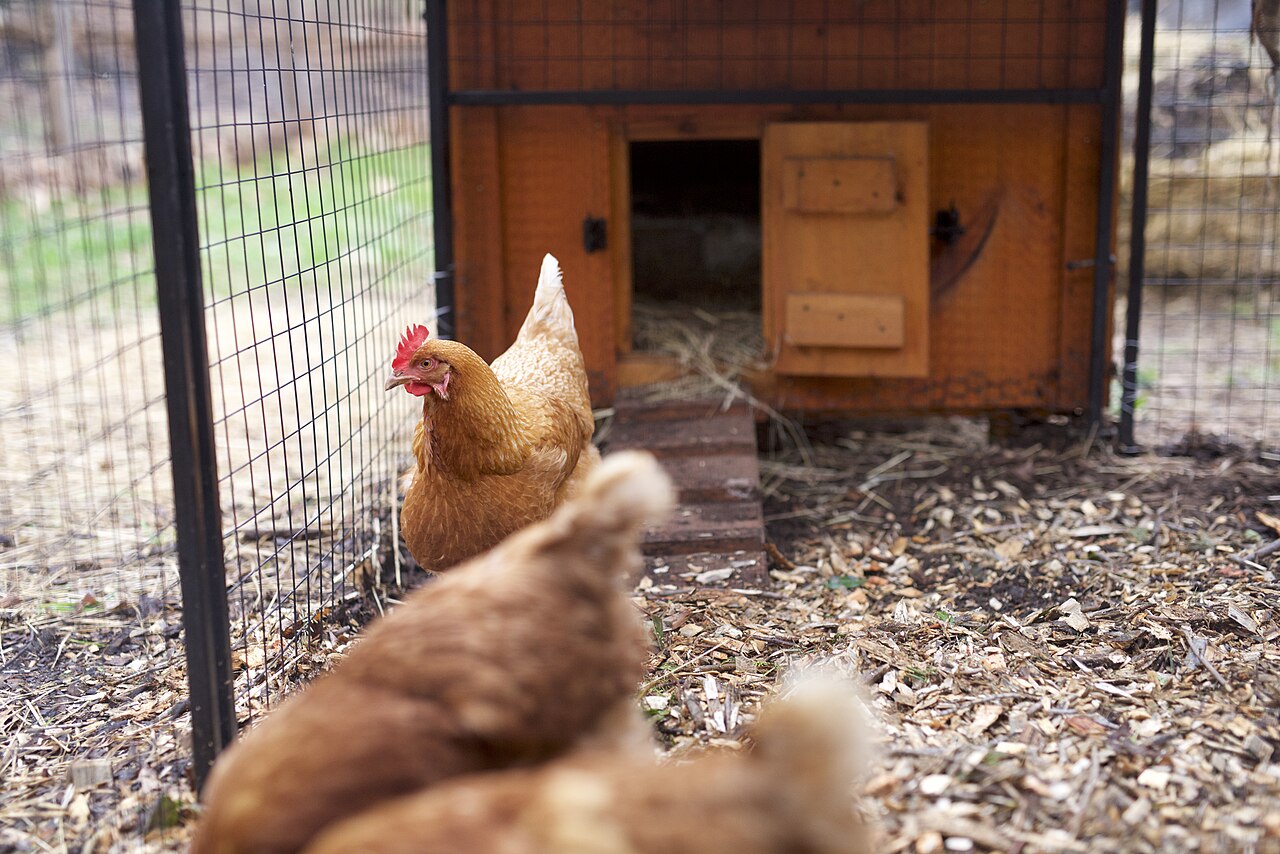
Winter is the best season for chicken tracks and the worst snow is deep powder. In half an inch (1.3 cm) of damp snow over a hard surface you get a clean cast of every toe segment plus the hallux dot, and you can follow a bird for yards. In anything over 3 inches (7.5 cm) the print collapses into a hole and chickens generally refuse to walk at all.
Look for extras that only snow records: feather tip brush marks where the bird braked, breast drag where it pushed through a drift, and tail sweeps at a turn. Chickens also leave a clear trail from coop door to the first bare patch, then mill in that patch, which is why tracks pile up near walls and under shrubs.
Reading chicken tracks in mud

Mud gives the most detail and the most distortion. Drying mud with the consistency of soft clay holds the scale pattern on the underside of the toes and the exact claw angle. Wet, soupy mud slumps inward and makes every print look wider and rounder than the foot that made it, which is how chicken tracks get mistaken for small turkey tracks.
Depth also tells you weight. A 7 pound (3.2 kg) hen sinks 0.2 to 0.4 inches (5 to 10 mm) in soft ground, far less than any coop raiding mammal of the same length. If a print of chicken dimensions sits twice as deep as the ones around it, suspect a mammal paw that has slid rather than a bird foot.
Reading chicken tracks in sand and dust
In dry sand the toes blur and the claws vanish, so identification shifts from the print to the pattern. Chickens scratch backwards with one foot at a time, leaving paired drag furrows 2 to 4 inches (5 to 10 cm) long with a small pile of loose material behind them. Those furrows beside a shallow print are close to conclusive.
The other sand signature is the dust bath: a bowl 8 to 12 inches (20 to 30 cm) wide and 2 to 4 inches (5 to 10 cm) deep, rimmed by scattered grit and often with a loose feather in it. Wild gallinaceous birds dust bathe too, but a bowl within sight of a run belongs to the flock.
Stride, gait and direction of travel
Chickens are walkers. The prints alternate left and right along a single line with a stride of 6 to 10 inches (15 to 25 cm) at an easy pace, stretching past 14 inches (36 cm) when the bird runs. Each foot angles slightly inward, so the middle toes nearly meet along the trail center.
That alternating line is the single most useful clue in the whole article, because it rules out hopping birds instantly. It also gives you direction: the claw tips point the way the bird went, and the rear toe dot always falls behind. A trail that suddenly widens and deepens marks the moment something startled the flock.
Chicken tracks vs turkey tracks
Wild turkey (Meleagris gallopavo) tracks are built on the same three toe plan but are much larger, 4 to 5 inches (10 to 13 cm) long with a stride of 10 to 16 inches (25 to 40 cm). The middle toe alone can be as long as an entire chicken print.
The trap is a turkey poult in late summer, which prints in the chicken range. Then judge by company and habitat: poult tracks come in groups of a dozen with one adult set among them, in field edges and woodland openings. Chicken tracks radiate from a structure. Our deer track guide covers the hoof prints you will usually find crossing the same field edge.
Chicken tracks vs pheasant and grouse tracks
Ring necked pheasant (Phasianus colchicus) tracks overlap chicken tracks in size at 2.5 to 3 inches (6 to 7.5 cm), but they look stretched: longer than wide, with slimmer toes and a hallux that registers more often. Pheasant trails also run long and purposeful across open ground rather than looping back on themselves.
Ruffed grouse (Bonasa umbellus) prints are about 2 inches (5 cm) long and in winter the toes carry fringed scales that widen the print and soften the outline. Grouse tracks appear in aspen and brush, often ending abruptly where the bird flushed. A print that simply stops with wing marks beside it is not a chicken.
Chicken tracks vs crow and songbird tracks
American crow (Corvus brachyrhynchos) tracks run 2.5 to 3 inches (6 to 7.5 cm), close to a large hen, and crows walk in an alternating line as well. The difference is the rear toe: a crow plants a long, fully printed hallux that reads as a fourth toe nearly as long as the side toes, giving a cross shaped print rather than an asterisk.
Songbirds settle the question by gait. Sparrows, juncos and finches hop, so their prints come in side by side pairs, and they measure well under 1.5 inches (4 cm). Any paired track pattern is not a chicken, no matter how similar a single print looks.
Predator tracks around the coop
Most people reading tracks near a run are looking for the animal that took a bird. Mammal paws break the bird pattern immediately: four or five rounded toe pads, a large heel pad, and either visible claws or none. Guidance on identifying and excluding wildlife around poultry is published by the U.S. Fish and Wildlife Service.
Work through the common raiders in order of frequency: the hand shaped five toe prints in our raccoon track guide, the neat diagonal line in our fox track guide, the larger oval in our coyote track guide, the round clawless print in our bobcat track guide, and the splayed thumb print in our opossum track guide. Paired hind prints in snow that look like a predator are often just the hopper in our rabbit track guide.
How to photograph and cast a chicken track
Photograph with a coin or ruler in the frame and the sun low to one side, because flat midday light erases toe relief. Shoot straight down from about 2 feet (60 cm), then take a second frame along the trail to capture stride and direction. Those two images carry almost everything an identification needs.
For a cast, ring the print with a strip of cardboard, mix plaster of Paris to the thickness of cream, pour from the edge rather than onto the toes, and lift after 30 minutes. Snow casting works with the same plaster chilled first, poured in thin layers. Label every cast with the date and substrate on the back.
Related reading: Bird Tracks.
Frequently Asked Questions
How big is a chicken footprint?
A standard breed hen or rooster prints 2 to 2.75 inches (5 to 7 cm) long and roughly as wide. Bantams drop to 1.5 inches (4 cm) and heavy breeds reach 3.5 inches (9 cm). Measure from the middle claw tip to the back of the central pad and leave the rear toe dot out of the number.
Do chicken tracks show claw marks?
Usually yes. Chickens have sharp, unretractable claws that extend the line of each forward toe, and in mud, dust or shallow snow they print as thin points a quarter inch (6 mm) beyond the toe. On hard packed ground the claws may be the only part of the foot that registers at all.
Can you tell a rooster track from a hen track?
Not reliably. A rooster of the same breed is heavier and prints slightly larger with a longer stride, but the ranges overlap so much that any single track is ambiguous. Leg spurs sit well above the foot and never touch the ground, so they leave no mark to work with.
What is the number one cause of death for chickens?
In backyard flocks it is predation, which is exactly why track reading matters here. Raccoons, foxes, coyotes, hawks, dogs and neighborhood cats account for most losses, ahead of disease and heat stress. Reading the tracks around a run tells you which species to exclude before you lose a second bird.
How long do chicken tracks last in snow?
Hours to a few days. In damp snow near freezing, a print holds crisp detail for a day, then rounds off as the surface sublimates or melts and refreezes into a raised ghost track. Fresh prints have sharp, unglazed edges, so an icy rim means the track is old, not that the bird was heavy.
What bird track looks like a chicken foot?
Pheasant tracks are the closest match in size, with grouse slightly smaller and crow close in length but marked by a long printed rear toe. Young turkeys overlap in late summer. Any track with two toes forward and two back, such as a roadrunner or woodpecker, is not a chicken at any size.