Bobcat Tracks: 4 Toes, No Claws and How to Be Sure
Bobcat tracks are round prints 1.6 to 2.5 in long (4 to 6.4 cm) with four toes, no claw marks and a large two lobed heel pad, set in a narrow trail that hugs cover instead of crossing open ground. A bobcat (Lynx rufus) walks with its nails retracted, so the absence of nail points is the first thing that rules out every dog and coyote in the neighborhood.
These are among the most commonly misread tracks in North America, because a big house cat, a small coyote and a bobcat all leave prints in the same two inch range. The way to separate them is a short checklist: claws, outline shape, heel pad lobes, and the line the animal walked. Snow shows all four at once, mud shows the pad detail best, and dry sand shows almost nothing but the trail.
A bobcat track is a round, four toed print 1.6 to 2.5 in long and nearly as wide, with no claw marks, an asymmetrical toe arrangement, and a heel pad showing two lobes on the leading edge and three on the trailing edge. Walking stride runs 13 to 18 in (33 to 46 cm).
What Do Bobcat Tracks Look Like?
A bobcat track looks like a scaled up house cat print: roughly circular, with four teardrop toes arranged in an arc around a broad heel pad that fills about a third of the print. The front foot registers slightly larger than the hind, and both are as wide as they are long or very close to it. There is no fifth toe mark, because the vestigial digit sits too high on the leg to touch the ground.
Toe Arrangement: Why a Bobcat Print Is Asymmetrical

The toes are not symmetric. As with a human hand, one toe leads, which means a clean print can be assigned to the left or right foot. The two central toes sit ahead of the two outer ones, and the outermost toe falls back and slightly away from the group. That asymmetry is subtle but it holds up in good substrate and it is the detail most often missing from online photo comparisons.
The Heel Pad: Two Lobes in Front, Three Behind

The heel pad carries the diagnostic shape. Its leading edge shows two lobes separated by a shallow notch, and its trailing edge shows three lobes, producing a wavy back line. A canid heel pad is roughly triangular with a single point forward, so the pad alone answers the cat or dog question whenever it prints fully.
Bobcat Track Size and Measurements
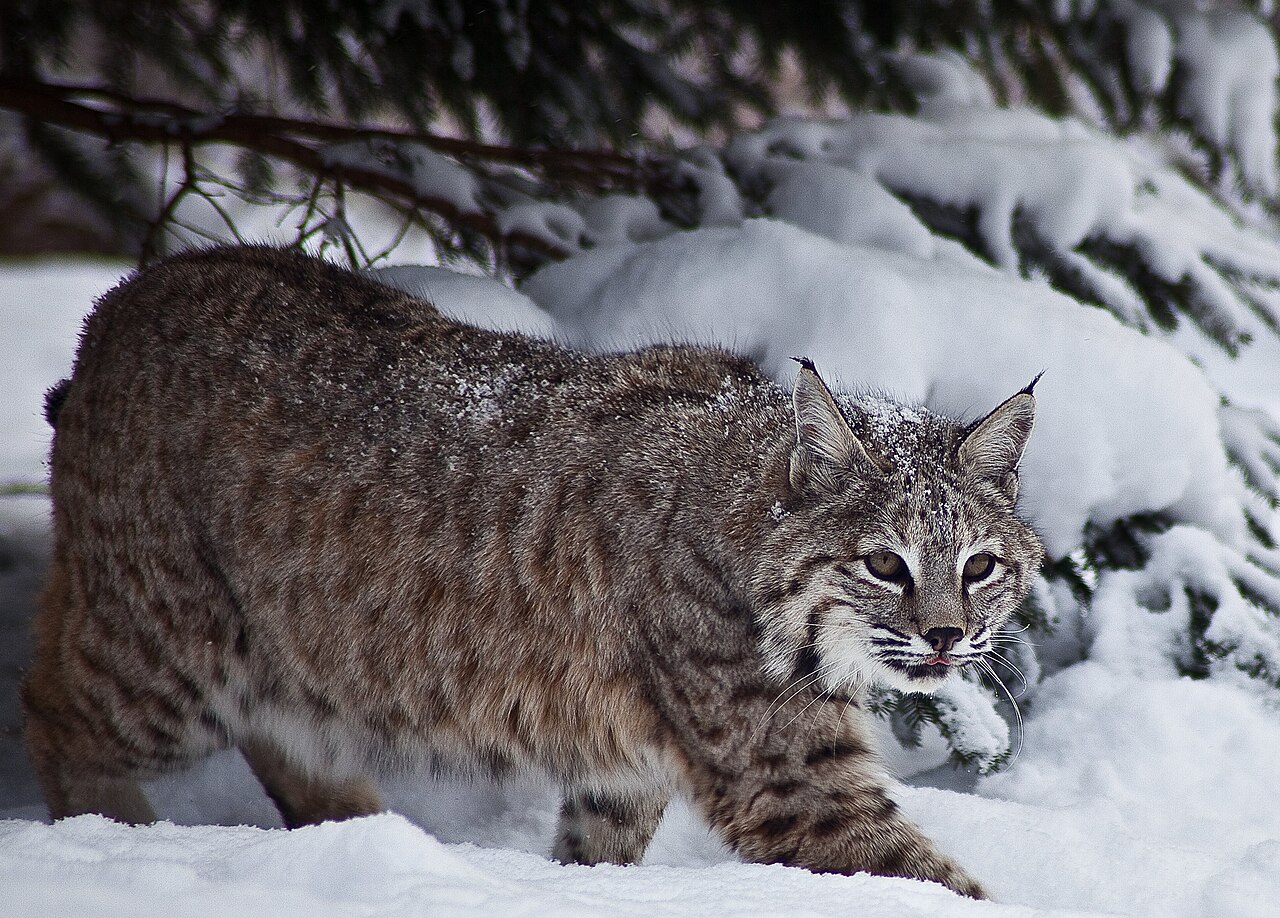
Measure the toes and pad only. Snow collapse, mud spread and the halo of displaced sand around a print routinely add half an inch of apparent length, which is exactly the margin that turns a bobcat into a mountain lion on paper. Bobcats across their range vary with latitude: northern animals reaching 35 lb (16 kg) print at the top of the range, desert bobcats at 15 lb (7 kg) at the bottom.
Use the table below as a field reference, and give more weight to the stride and straddle than to a single print. Track measurements overlap between species far more than trail measurements do.
| Feature | Bobcat |
|---|---|
| Front track length | 1.7 to 2.5 in (4.3 to 6.4 cm) |
| Front track width | 1.6 to 2.4 in (4 to 6 cm) |
| Hind track | Slightly smaller and narrower than front |
| Toes and claws | 4 toes, no claw marks |
| Heel pad | 2 lobes leading edge, 3 lobes trailing edge |
| Walking stride | 13 to 18 in (33 to 46 cm) |
| Straddle (trail width) | 4 to 6 in (10 to 15 cm) |
Do Bobcat Tracks Show Claw Marks?
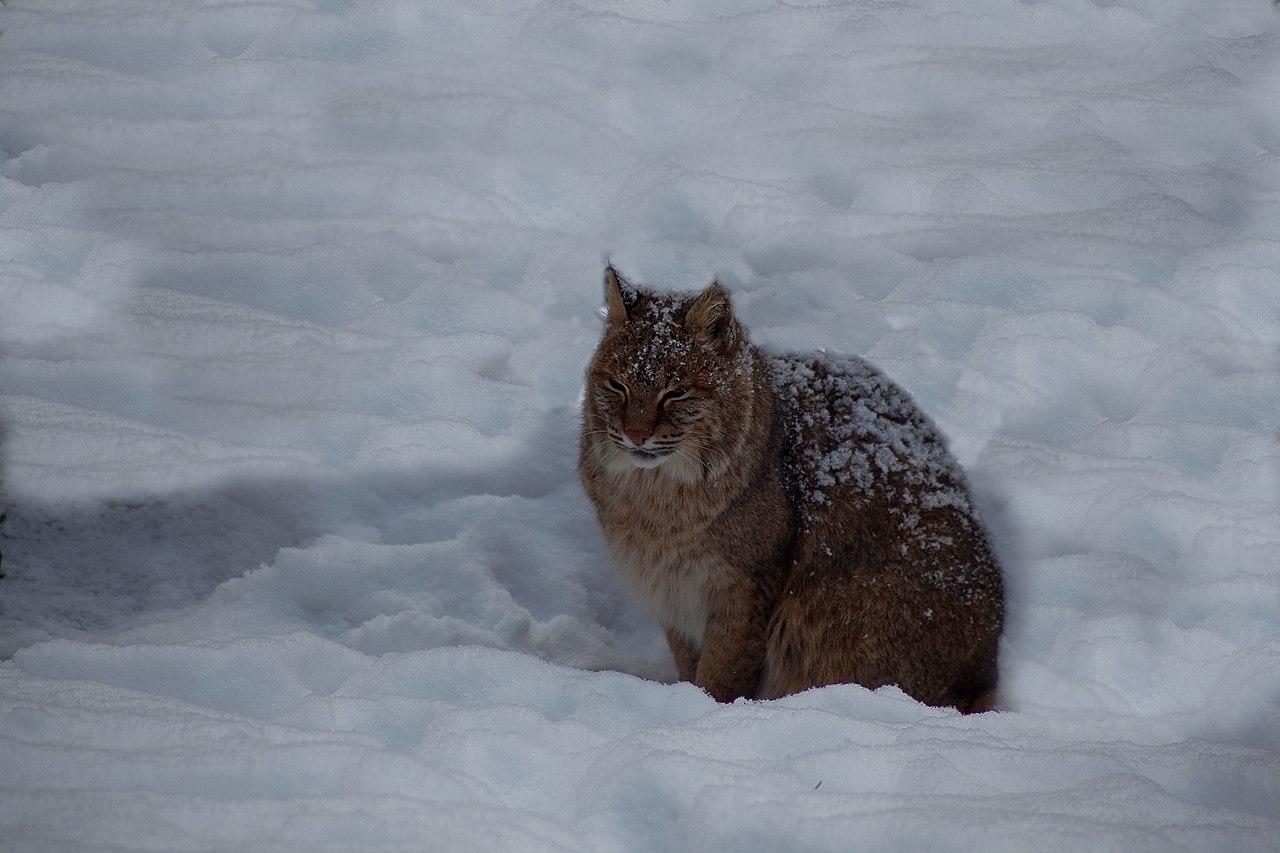
Bobcat tracks normally show no claw marks at all. A bobcat’s claws retract into sheaths when it walks, both to keep them sharp for killing and to soften its footfall during a stalk. In hundreds of ordinary walking prints you will find clean toe pads with nothing ahead of them, and that single feature eliminates coyotes, foxes and domestic dogs immediately.
There are exceptions, and knowing them keeps you from rejecting a correct identification. A bobcat that bounds, climbs a steep bank, brakes hard, or pushes off from loose snow may extend its claws for traction, leaving faint points well ahead of the toes. These marks look different from canid nails: they are fine, curved and often paired unevenly, not the blunt even set of a trotting dog.
When a Clawless Print Proves Nothing
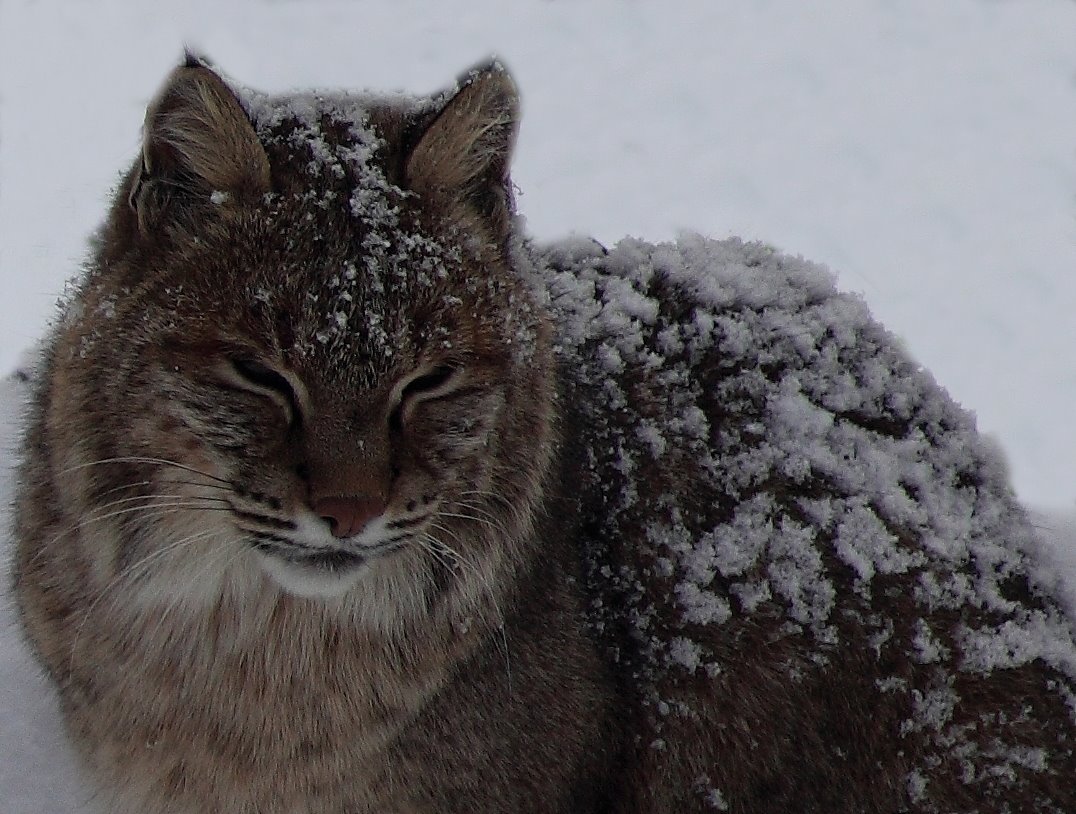
The reverse error is more common. Frozen crust, gravel and dry sand can swallow a coyote’s nail marks, so a clawless print is only evidence of a cat when the substrate was soft enough to have recorded nails in the first place. Check a nearby print in better ground before deciding.
How to Identify Bobcat Tracks in Snow
Winter is the best season for bobcat tracking and the trickiest for measuring. One to three inches of settled snow over firm ground holds the pad lobes and toe outlines; anything deeper rounds the print into a shapeless cup and exaggerates its size. Early morning, before sun and wind work on the edges, is when the detail survives.
Where Bobcats Walk When the Snow Gets Deep
Bobcats dislike deep snow. Their relatively small feet carry high foot loading for their weight, so they avoid open powder and travel instead along plowed edges, snowmobile tracks, fallen logs, stone walls and the bare ground under dense conifers. If you are hunting for tracks after a storm, search the sheltered strips rather than the open field, and check where a trail passes under a low spruce canopy.
In loose snow the animal shifts to a direct register walk, placing the hind foot into the front print, and may drag its feet slightly between steps. The resulting single line of prints with no claw marks and a 13 to 18 in spacing is a near certain bobcat anywhere in the lower 48 outside Canada lynx range.
Bobcat Tracks in Mud
Mud is the substrate that proves a bobcat. Firm, drying mud at the edge of a puddle, a stock tank, a dirt road rut or a creek bar records the two front lobes and three rear lobes of the heel pad clearly, along with the asymmetric toe arc. That is a complete identification from one print, which snow rarely gives you.
Soft wet mud behaves differently. It spreads under the animal’s weight, so toes splay slightly and the print reads up to half an inch longer than the foot that made it. Judge the proportions instead: a bobcat print stays essentially round, while a coyote print in the same mud stays clearly longer than wide even when it is oversized.
Mud also holds a trail for days after snow has melted, which makes dirt roads, trailheads and the margins of farm ponds the most productive places to survey a property for resident bobcats. Repeat visits to the same soft spot often show the same animal using the same route each week.
Bobcat Tracks in Sand and Dust
Dry sand is the hardest surface in tracking. It collapses inward the moment the foot lifts, leaving a crater with no lobes, no toe outlines and no size you can trust. In desert country, where bobcats are common along washes and arroyos, this is the usual situation, so experienced trackers stop reading prints and start reading lines.
Damp sand behaves like firm mud and holds everything. Look for it at the wet margin of a wash after rain, on a beach berm above the tide line, or in the shade under a cutbank where moisture lingers. Dust on a two track road, in a barn alley or on a flat rock also takes a surprisingly crisp print for a day or two in dry weather.
When only dry sand is available, measure the stride, the straddle and the straightness of travel. Those three numbers survive long after print detail is gone, and for a bobcat they combine into a distinctive signature: a narrow trail with moderate spacing that threads along cover rather than crossing it.
Bobcat Gait, Stride and Trail Pattern
A traveling bobcat uses a direct register or slightly overstepping walk, placing the hind foot in or just beyond the front print. Prints fall almost in a single file with a stride of 13 to 18 in (33 to 46 cm) and a straddle of 4 to 6 in (10 to 15 cm). The line is purposeful but not rigid: it curves to follow a wall, a log, a thicket edge or a terrain break.
Hunting changes the pattern. A stalking bobcat shortens its stride to a few inches, places each foot with care, and may leave prints clustered where it paused to watch. An ambush rush shows a bounding pattern with all four feet grouped, strides of 4 to 8 ft (1.2 to 2.4 m), and the only claw marks you are likely to see.
Travel Routes: Why the Same Trail Keeps Showing Prints
Route choice is the habit that gives bobcats away. They reuse travel corridors for years and favor edges over open ground, so a trail that threads a hedgerow, slips under a fence at the same gap and crosses a road at the same culvert is almost certainly a resident cat rather than a wanderer.
Bobcat Tracks vs House Cat Tracks
Size does most of the work here. A house cat print measures 1 to 1.4 in long (2.5 to 3.5 cm), a bobcat 1.7 to 2.5 in, so the bobcat track is nearly double the area. Both show four toes and no claws, both are round, and both carry the two and three lobed pad, because they are built the same way.
Stride separates the two when a very large domestic cat overlaps a very small bobcat. A house cat walks with a stride of 7 to 11 in (18 to 28 cm); a bobcat starts where the house cat ends. Pair that with straddle: a cat trail is 3 to 4 in wide, a bobcat trail 4 to 6 in.
Context finishes the job. House cat trails radiate from a building, follow driveways and porches, and stop at doors. Bobcat trails pass through, enter from cover and leave by cover, and rarely show the aimless looping of a pet exploring its own yard.
Bobcat Tracks vs Coyote and Dog Tracks
Canid tracks are oval, bobcat tracks are round. A coyote front print runs 2.25 to 3 in long (5.7 to 7.6 cm) but only about 2 in wide, with nail marks ahead of the two leading toes and a small triangular heel pad. The toes sit in a tight symmetric pair up front, and you can usually draw an X between them without crossing a pad. Compare the shapes directly in our guide to coyote track identification.
Dogs leave rounder prints than coyotes and are the real source of confusion. Look for blunt, wide nail marks from nails worn on pavement, toes splayed outward, and a heel pad that is large relative to the toes. Then follow the trail: a dog wanders, doubles back and leaves uneven spacing, while a bobcat holds a tidy line along an edge.
Bobcat Tracks vs Fox Tracks
Gray and red fox prints are smaller, 1.5 to 2.5 in, often blurred by foot fur, and still show claws. In winter a red fox hind pad prints a raised chevron bar that no feline track has. When the ground is too hard to record nails, fall back on outline shape and pad lobes rather than claws.
Bobcat Tracks vs Mountain Lion and Canada Lynx Tracks
Mountain lion tracks are unmistakable once you have the measurement: 2.75 to 4 in long (7 to 10 cm), with a heel pad that is enormous relative to the toes and shows three distinct lobes along its trailing edge. A lion’s stride runs 20 to 30 in. Any clawless round print clearly over 2.5 in in the West deserves a careful second look and a photograph with a scale object.
Canada lynx tracks overlap bobcats in body size but not in foot size. A lynx foot is heavily furred and spreads like a snowshoe, printing 3 to 4.5 in across in snow with soft, indistinct edges and often no pad detail at all. Lynx range covers the northern tier states, the Rockies and Canada, so in most of the country the question does not arise.
Where ranges overlap, let the substrate decide. A sharp edged round print with visible pad lobes in mud is a bobcat; a huge, vague, fur blurred print in deep powder in Maine, Minnesota, Montana or Colorado is a lynx. Lynx also sink far less in snow, so their trails cross open powder that a bobcat avoids.
Other Bobcat Sign That Confirms the Track
Tracks rarely stand alone. Bobcats mark travel routes with scrapes, small piles of leaves, needles or snow pushed back with the hind feet and then urinated on, usually against a log, rock or bank beside the trail. These scrapes are 6 to 12 in across and they sit where the trail passes a landmark, so finding one next to a print line is strong confirmation.
Bobcat Scat and Cached Kills Along the Trail
Scat is the other confirmation. Bobcat droppings are segmented, blunt ended and often buried or partly covered, and they contain fur and bone from rabbits and rodents; see bobcat scat identification for the details. Cached kills matter too: a bobcat covers a deer carcass or a large rabbit with leaves and snow and returns to it, leaving a concentration of tracks around the site.
Prey Sign That Keeps a Bobcat on a Property
Prey sign tells you why the cat chose that route. Rabbit tracks in a bounding pattern along brush edges and squirrel tracks running tree to tree mark the hunting ground that holds a bobcat on a property. Evening and night calls add a final layer; bobcat vocalizations peak in the late winter breeding season. For regional status and management, the National Park Service publishes bobcat information by park and region.
Frequently Asked Questions
How can you tell if a bobcat is around?
Look for four signs together: round clawless prints 1.7 to 2.5 in long along cover edges, scrapes of pushed back leaves with urine beside the trail, segmented scat holding fur and bone, and missing small livestock or poultry. Trail cameras at a fence gap or culvert usually confirm a resident cat within two weeks.
What time of day are bobcats most active?
Bobcats hunt mainly at dawn and dusk and through the first hours of darkness, with a second burst before sunrise. They shift later and more nocturnal near houses and roads. Fresh prints found in the morning were almost always laid down overnight, which helps you age a trail.
How big is a bobcat’s paw?
An adult bobcat’s foot measures about 1.7 to 2.5 in across the toe and pad area (4.3 to 6.4 cm), roughly twice the span of a house cat’s foot and much smaller than the furred snowshoe foot of a Canada lynx. Northern bobcats average larger than desert populations.
Will a bobcat attack a dog or cat?
It can. Bobcats weigh 15 to 35 lb (7 to 16 kg) and take prey up to the size of a small deer, so unattended cats and small dogs are at real risk at dawn and dusk. Keep pets indoors overnight and feed them inside rather than relying on deterrents.
Do bobcat tracks look like dog tracks?
Only at a glance. Both can print round, but a dog leaves blunt nail marks ahead of splayed toes and a triangular heel pad, while a bobcat leaves no nails, an asymmetric toe arc and a pad with two front and three rear lobes. The trail differs too: dogs wander, bobcats hold a line.
How can I tell a fresh bobcat track from an old one?
Sharp rims, crisp pad lobes and loose snow crystals still sitting in the print mean under 12 hours in cold weather. Rounded edges, a glazed or refrozen surface, wind filled toe holes or debris in the print mean a day or more has passed since the cat walked through.