Mink Tracks: Size, Gait and 5 Lookalikes Ruled Out
Mink tracks are small five toed prints about 1 to 1.5 in (2.5 to 3.8 cm) long that almost always appear as angled pairs along the edge of water. If you are looking at two prints side by side in fresh snow, spaced roughly a foot apart from pair to pair, and the trail keeps returning to a stream bank, you are almost certainly looking at an American mink (Neogale vison, formerly Neovison vison).
The hard part is not finding mink tracks but separating them from weasel, fisher, muskrat and otter prints, which share the same habitat and a similar bounding pattern. This guide covers the print itself, the measurements, the gait, and how the tracks read differently in snow, mud and sand.
Mink tracks have five toes on both front and hind feet, show small claw marks, and measure about 1 to 1.5 in (2.5 to 3.8 cm) long. They usually appear as paired prints in a 2×2 bounding pattern with a stride of 10 to 26 in (25 to 66 cm), nearly always within a few feet of water.
What Do Mink Tracks Look Like?
A mink print is star shaped rather than round. Five toes spread outward from a small central pad, and in a clean substrate the toes splay widely enough that the print looks more like a tiny hand than a dog paw. The fifth inner toe is the one most often missing, so many real world mink tracks register only four toes.
Claws show as fine points just ahead of each toe pad. They are much less prominent than the blunt nail marks of a raccoon and far smaller than canine claws. On soft mud the toe pads are clearly separated; on hard packed ground the print can collapse into a shapeless oval.
Front and Hind Tracks: What Changes

The front and hind feet of a mink are close enough in size that beginners often cannot tell them apart, which is itself a useful clue. The front track is slightly smaller and rounder, with the toes arranged in a tighter arc. The hind track is marginally longer and shows a slightly larger heel pad when the animal is moving slowly.
In the standard bounding gait the hind feet land almost exactly where the front feet were, so the two prints overlap and you see a single blurred pair. If you want clean front and hind prints, look at the first few steps where the animal slowed down or stopped to investigate something.
Mink Track Size: Measurements in Inches and cm

Mink tracks run 1 to 1.5 in (2.5 to 3.8 cm) long and roughly 1 to 1.4 in (2.5 to 3.6 cm) wide, with males at the upper end and females noticeably smaller. That sexual size difference is large in mink, so two sets of tracks from the same stream can differ by a third in size and still both be mink.
Measure the print without the claw marks when comparing against a field guide, since most published figures use pad to pad length. In snow the print will read 20 to 30 percent larger than the actual foot because of melt and collapse, which is the single most common source of misidentification.
Mink Gait and Stride: The 2×2 Bound
Mink move almost everywhere in a bounding gait that leaves paired prints set at a slight angle to the direction of travel. The distance from one pair to the next, the stride, runs 10 to 26 in (25 to 66 cm) and stretches to 30 in (76 cm) or more when the animal is moving fast across open ground.
When a mink slows to hunt along a bank it switches to a loping or walking pattern and the pairs break up into groups of three or four prints. Long even stretches of perfectly paired tracks mean the animal was traveling, not foraging, and following them downstream usually leads to a den or a feeding site.
| Measurement | Mink | Long tailed weasel | Fisher | River otter |
|---|---|---|---|---|
| Track length | 1 to 1.5 in (2.5 to 3.8 cm) | 0.5 to 1 in (1.3 to 2.5 cm) | 2 to 2.5 in (5 to 6.4 cm) | 2.5 to 3.5 in (6.4 to 8.9 cm) |
| Toes registering | 5, often 4 | 5, often 4 | 5 | 5, webbing visible |
| Typical stride | 10 to 26 in (25 to 66 cm) | 8 to 20 in (20 to 51 cm) | 20 to 40 in (51 to 102 cm) | 10 to 30 in (25 to 76 cm) |
| Usual gait | 2×2 bound | 2×2 bound | 3×4 lope | bound plus slides |
| Habitat tie | Always near water | Fields and woods | Mature forest | Water, with slides |
Mink Tracks in Snow
Snow is the best season for mink tracking and the easiest substrate to be fooled by. In 1 to 2 in (2.5 to 5 cm) of fresh powder the paired bounds are unmistakable, and you can follow a single animal for hundreds of yards along a creek. Look for the trail to vanish at an open hole in the ice and reappear downstream.
In deeper snow the mink tunnels and plows instead of bounding, leaving a trough with occasional belly drag rather than discrete prints. Sun melted tracks widen every hour, so a mink trail photographed in the afternoon can measure out at fisher size. Track in the morning and measure the crispest print you can find, not the most obvious one. The same melt effect inflates bobcat tracks and squirrel tracks on the same bank, so measure everything before naming anything.
Mink Tracks in Mud
Mud gives the most accurate prints of any substrate. On a soft stream bank or exposed pond margin the five toes, the claw points and the chevron shaped interdigital pad all register clearly, and this is where you can confirm the fifth toe that snow usually hides.
The giveaway in mud is location. Mink work the first few feet of bank, weaving between rocks, root tangles and water entry points, so the trail wanders rather than running straight. A straight muddy bank trail with similar sized prints is more likely to be a raccoon working the same shoreline.
Mink Tracks in Sand
Dry sand is the worst substrate for mink identification. The grains collapse inward, the toes merge, and all that survives is a round depression with no claw detail. Damp sand near the waterline holds detail far better, so work the wet margin rather than the dry upper beach.
In sand, rely on the pattern rather than the print. The paired bounds, the consistent stride and the trail that repeatedly touches the water are diagnostic even when no individual print is readable. Photograph the trail line from above with a scale object before you examine single prints.
Did I See a Mink or a Weasel? Separating the Two
Size settles most cases. A long tailed weasel track is 0.5 to 1 in (1.3 to 2.5 cm) long, roughly half the area of a mink print, and a short tailed weasel or ermine is smaller still. Both use a 2×2 bound, so the pattern will not help you, but the stride relative to print size is longer in weasels.
Habitat is the second filter. Weasels hunt fields, stone walls, brush piles and woodland edges and will cross open ground freely. Mink stay tied to water and rarely venture more than 100 ft (30 m) from it. A set of small mustelid tracks in the middle of a dry hayfield is a weasel.
Did I See a Mink or a Fisher? Separating the Two
Fisher tracks are the most common upward misidentification, especially in melted snow. A fisher print runs 2 to 2.5 in (5 to 6.4 cm), roughly double the mink in linear measurement and four times the area, and shows five robust toes with heavy claws. Fishers also favor a 3×4 loping pattern rather than clean pairs.
Where the two overlap in the Northeast and Upper Midwest, use the habitat. Fishers move through mature forest and cross ridges; mink hug water. Side by side comparisons with fisher tracks make the size gap obvious once you have measured both.
Mink Versus Muskrat, Raccoon and Otter Tracks
Muskrat tracks share the water margin but look entirely different. The hind print is 2 to 3 in (5 to 7.6 cm) with long splayed finger like toes, and a tail drag line usually runs between the prints. Mink leave no tail drag except occasionally in deep snow.
Raccoon prints are the classic hand shape with long toes and a flat sole, clearly larger and never bounding in pairs. Otter tracks are bigger again, show webbing between the toes, and come with the unmistakable belly slides that no mink makes. If the trail includes a slide, it is an otter.
Where to Look and What States Minks Live In
American mink occur in every state except Arizona and most of Hawaii, with the densest populations in the Northeast, Great Lakes, Pacific Northwest and the Mississippi drainage. They are absent from true desert and from the driest parts of the Southwest, which is simply where the water is not.
Productive places to search are beaver pond outlets, culverts, bridge abutments, undercut banks and the ice edges of slow creeks. The U.S. Fish and Wildlife Service manages many of the wetland refuges where mink are most numerous. Public boardwalks over marsh are good vantage points, and the same walk often turns up fox tracks and coyote tracks on the dry approach trail.
Related reading: Muskrat Tracks.
Frequently Asked Questions
How do you tell a weasel from a mink?
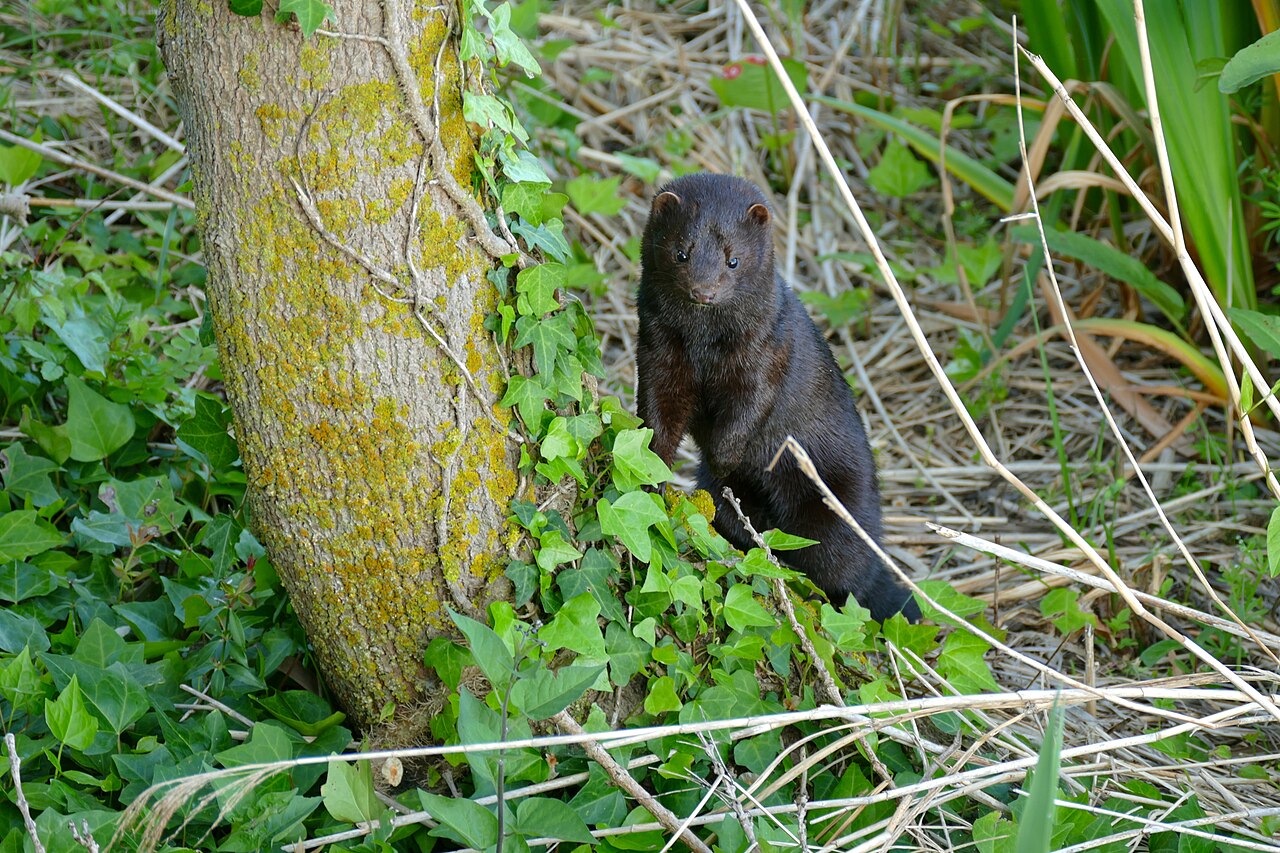
By size and habitat. Mink tracks are 1 to 1.5 in (2.5 to 3.8 cm) long and stay within a short distance of water. Weasel tracks are 0.5 to 1 in (1.3 to 2.5 cm) and turn up in fields, stone walls and brush. The animals themselves differ too, with mink uniformly dark brown and weasels showing white bellies and often turning white in winter.
What animal looks similar to a mink?
River otters, fishers, martens and the larger weasels are the closest lookalikes, all members of the same family. In poor light a mink is most often mistaken for a small otter near water or a large weasel away from it. Muskrats get confused with mink by shape in the water, though their tracks are nothing alike.
What animal is a cousin of a mink?
Mink belong to the family Mustelidae, so their closest relatives are weasels, ermine, martens, fishers, badgers, wolverines and otters. The ferret is a domesticated European polecat and sits in the same family, which is why people assume the two are the same animal.
Is a mink basically a ferret?
No. They are separate species in the same family. Ferrets are domesticated polecats bred for handling and kept as pets; American mink are wild semiaquatic predators that do not tame reliably. Mink are also stronger swimmers, with partially webbed feet and water repellent fur that ferrets lack.
How rare is it to see a mink?
Mink are common across most of their range but hard to see. They are mostly active at night and at dawn, they move fast, and they stay in bank cover. Most people who spend time on creeks see one every few years, while their tracks turn up on any decent snow day. The tracks are the reliable evidence, not the sighting.
What is the most effective bait for catching minks?
Licensed trappers generally use fresh fish, muskrat or chicken, often paired with a fish oil or gland based lure at a pocket set near water. Trapping mink is regulated by season, license and method in every state, so check your state wildlife agency rules before setting anything. For observation only, a trail camera at a culvert works better than bait.