Marginated Tortoise: Size, Lifespan, Price and Care Guide
The marginated tortoise (Testudo marginata) is the largest tortoise native to Europe, and it is recognized by the flared, skirt like rear shell that gives the species its name. Adults reach 12 to 14 inches (30 to 36 cm) and can weigh 11 lb (5 kg), which makes them noticeably bigger than the Hermann’s and Russian tortoises they are usually compared with. They come from the rocky hillsides of southern Greece and have been kept in captivity long enough that captive bred hatchlings are widely available in the United States.
For keepers, the appeal is a calm, cold hardy, long lived animal that grazes on weeds and asks for very little beyond space, heat, and a dry hide. The trade off is the same one every tortoise brings: a 100 year commitment in a 5 lb body. This guide covers size, identification, lifespan, price, housing, diet, hibernation, and whether one of them belongs in your home.
The marginated tortoise is a Mediterranean species from southern Greece that grows to 12 to 14 inches (30 to 36 cm) and 8 to 11 lb (3.6 to 5 kg), the largest European tortoise. It is identified by widely flared rear marginal scutes, lives 100 years or more, and is a hardy, low aggression pet for keepers who can provide outdoor grazing space.
| Quick Facts | Marginated Tortoise |
|---|---|
| Scientific name | Testudo marginata |
| Adult size | 12 to 14 in (30 to 36 cm), rarely 15 in |
| Adult weight | 8 to 11 lb (3.6 to 5 kg) |
| Lifespan | 100 to 140 years |
| Native range | Southern Greece, Albania, introduced in Italy and Sardinia |
| Price (captive bred) | $250 to $600 for hatchlings, $700 plus for adults |
| Temperament | Calm, active grazer, males spar in spring |
What Is a Marginated Tortoise?
The marginated tortoise is a member of the genus Testudo, the same group that contains the Hermann’s, Greek, and Russian tortoises. It was described in 1789 and takes its name from the marginal scutes along the back edge of the shell, which flare outward in adults like the hem of a skirt. No other European tortoise develops this feature to the same degree, which makes adults one of the easier Mediterranean species to identify on sight.
In the wild the species occupies dry, rocky hillsides and scrubland in the Peloponnese and mainland Greece, usually below 4,300 ft (1,300 m). It is a strict herbivore that grazes on grasses, legumes, and broadleaf weeds, and it spends the hottest hours of summer inactive under shrubs. Populations were introduced to Sardinia and parts of Italy centuries ago, most likely by people moving animals as food or curiosities.
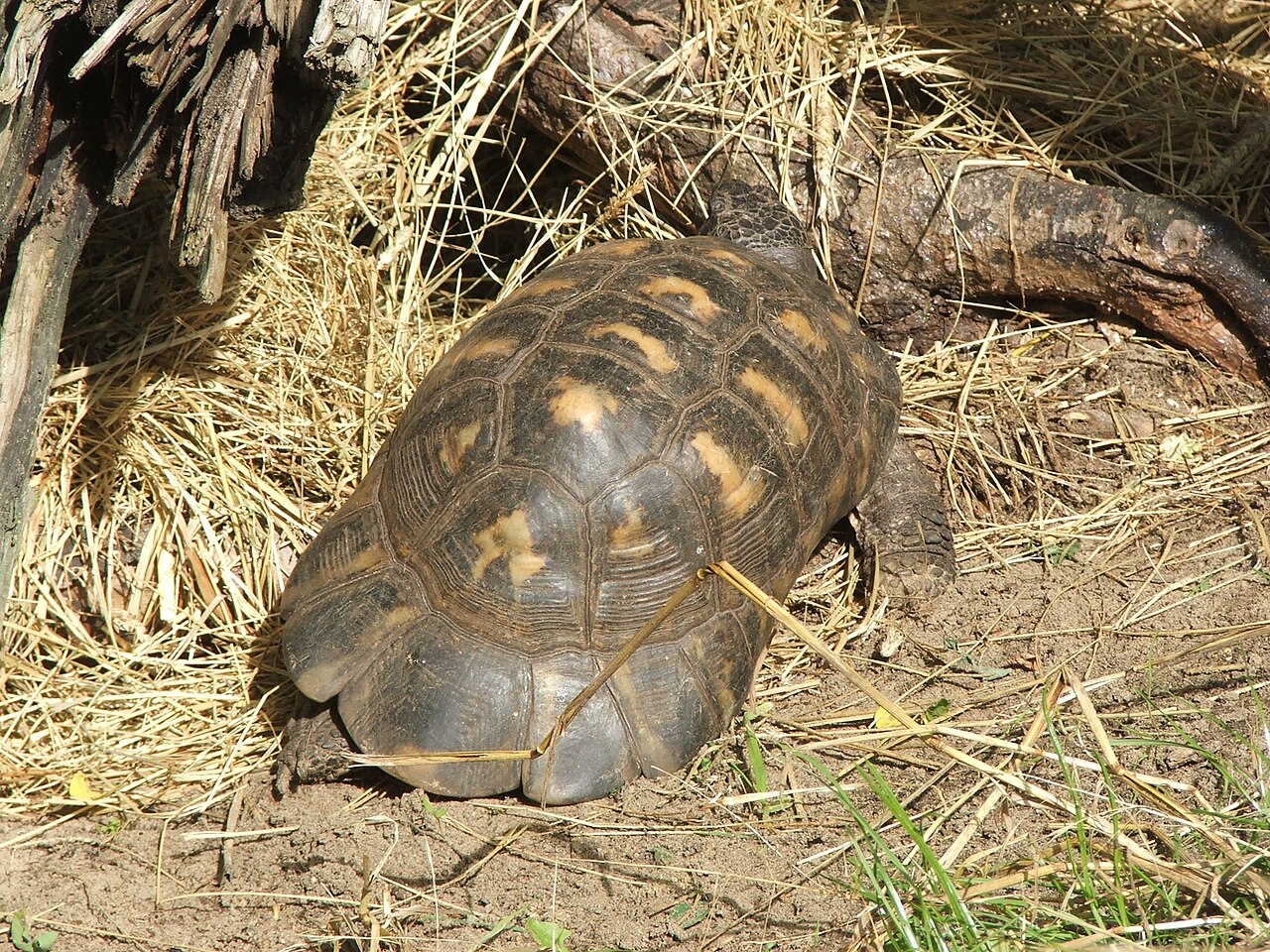
Marginated tortoises darken with age. Hatchlings show a yellow shell with black blotches, while old adults often turn almost entirely black with pale patches on each scute. That darkening is thought to help them absorb heat in the cool Greek spring, and it is one reason keepers sometimes mistake an old marginated for a different species entirely. If you are comparing Mediterranean species side by side, our guide to the Greek tortoise covers the closest relative you are likely to meet in the pet trade.
How Big Can a Marginated Tortoise Get?
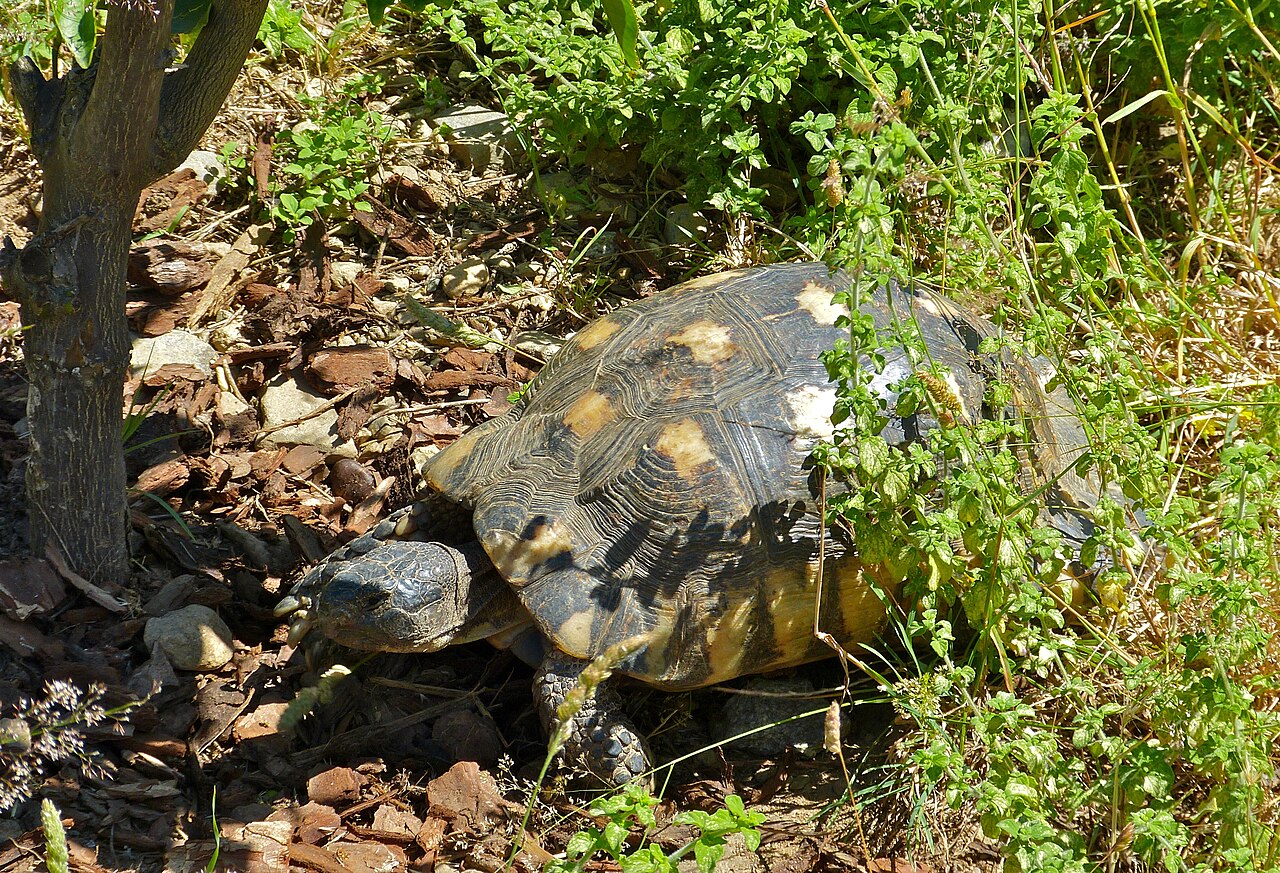
A marginated tortoise can reach 12 to 14 inches (30 to 36 cm) in shell length and 8 to 11 lb (3.6 to 5 kg), and exceptional animals pass 15 inches (38 cm). That makes it the largest tortoise native to Europe, though it is small next to the African giants kept in the same hobby. Females are usually a little shorter and heavier bodied than males, while males have longer tails and the more dramatic rear flare.
Growth is slow and steady rather than explosive. Hatchlings emerge at roughly 1.5 in (4 cm) and reach 4 to 5 in (10 to 13 cm) by the end of their second year under good conditions. Full adult size arrives somewhere between 12 and 20 years, and animals kept too warm and fed too richly will hit that size faster with a lumpy, pyramided shell to show for it.
Size matters for planning because the enclosure has to match the adult, not the hatchling you buy. A pair of adults needs a minimum footprint of about 4 ft by 8 ft (1.2 by 2.4 m) outdoors, and more is always better. Keepers who start with a tabletop enclosure almost always rebuild within three years. For a sense of how much larger things can get, compare the sulcata tortoise, which reaches 30 in (76 cm) and 100 lb (45 kg).
How to Identify a Marginated Tortoise
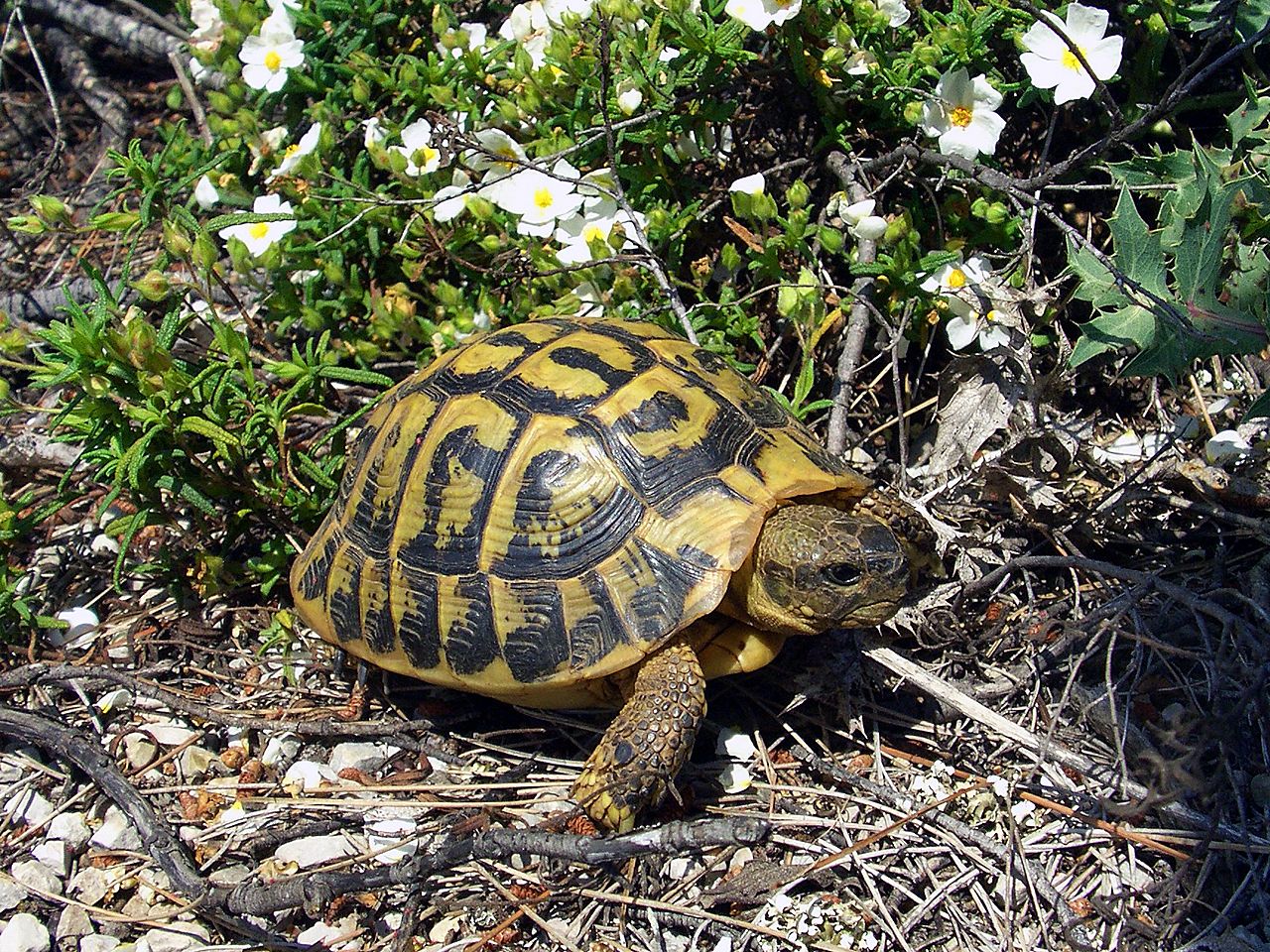
The decisive field mark is the rear of the shell. In adults the marginal scutes above the back legs flare outward and downward into a bell shape that you can see clearly from the side, and the effect is strongest in mature males. Hatchlings and juveniles do not show it yet, which is why young marginated tortoises are so often sold under the wrong name.
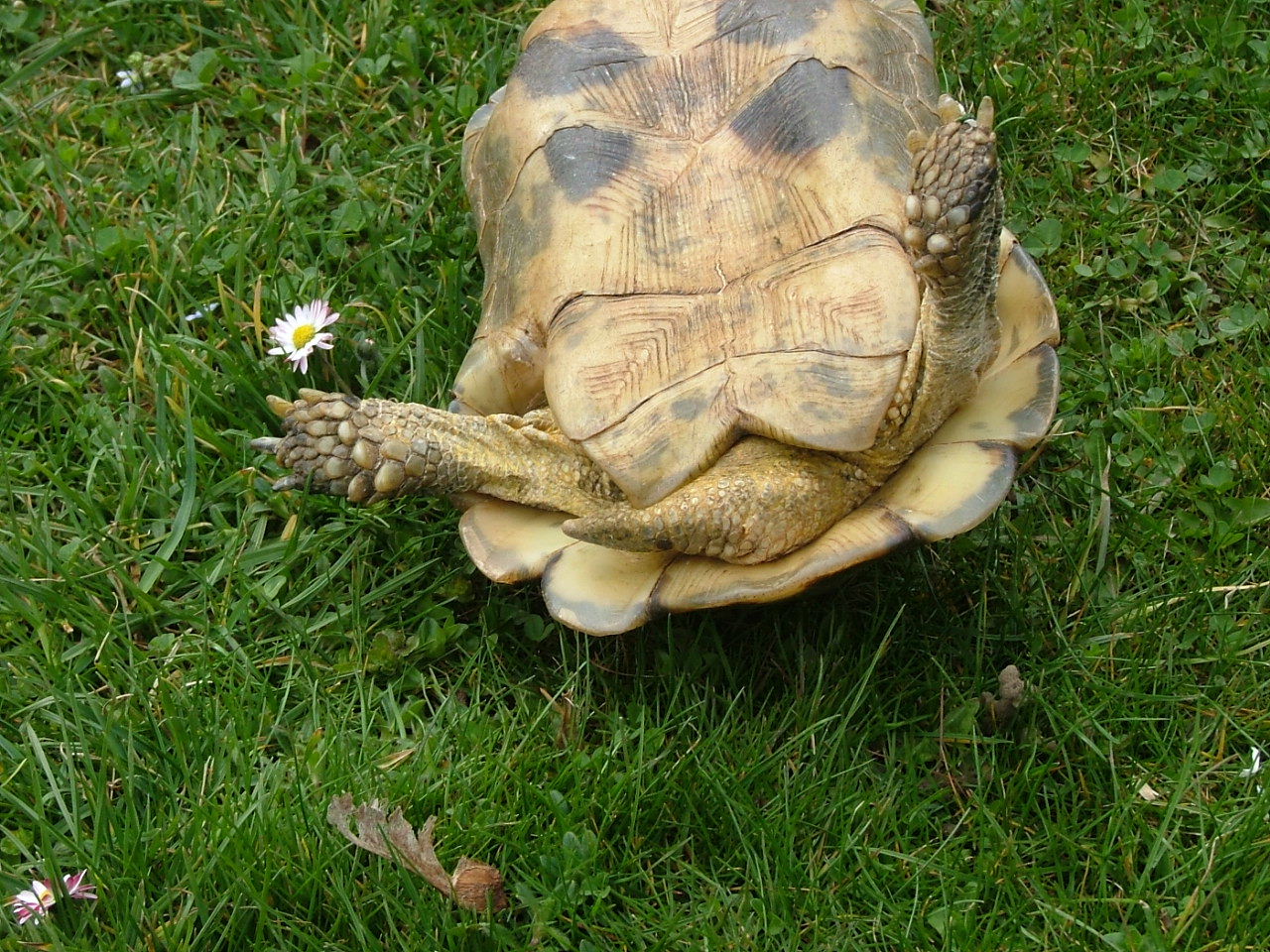
Look next at the plastron, the underside. Marginated tortoises show paired dark triangles on each abdominal scute, arranged in two roughly parallel rows running front to back. The carapace is elongated rather than domed, with a distinct step where the flare begins. Adults tend toward a near black shell with a pale central spot on each scute, while the head and limbs are dark with yellow flecking.
Three details rule out lookalikes quickly. The marginated tortoise has a single undivided supracaudal scute above the tail, no enlarged thigh tubercles, and a hinge free plastron in males. Anyone buying a juvenile should ask for the parents’ photographs, because at 3 in (8 cm) the species is genuinely hard to separate from a young Hermann’s. Similar identification logic applies to the boldly patterned Indian star tortoise, where the shell pattern rather than the shape carries the identification.
Marginated Tortoise vs Hermann’s Tortoise
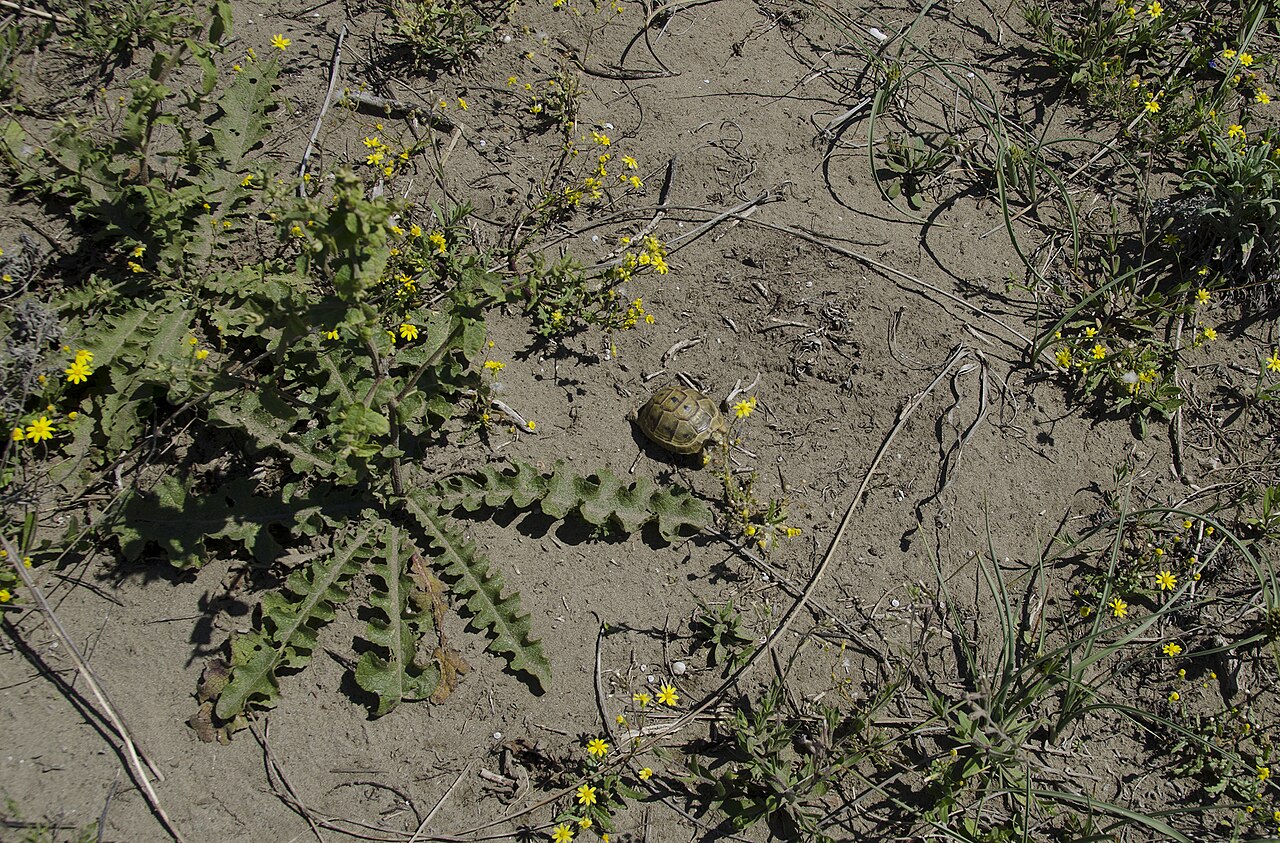
The fastest way to separate the two is the tail tip and the rear flare. Hermann’s tortoise (Testudo hermanni) has a horny spur at the very tip of the tail and a divided supracaudal scute, while the marginated tortoise has no tail spur and an undivided one. Add the flared rear skirt of an adult marginated and the two species stop looking alike at all.
Size separates them as well. Hermann’s tortoises top out around 8 in (20 cm) for the western subspecies and 11 in (28 cm) for the eastern, so a 13 in adult is almost certainly a marginated. Hermann’s also keeps a brighter yellow and black pattern into adulthood, while marginated tortoises darken. In behavior the marginated is the more active grazer and the more determined digger of the two.
Both species come from the same climate and want nearly identical care, which is why the comparison matters more for buyers than for keepers. If you have space for a bigger animal and want the more striking adult shape, the marginated is the better pick. If your outdoor pen is small, the Hermann’s stays within it more comfortably for the animal’s whole life.
Where Marginated Tortoises Live in the Wild
Wild marginated tortoises live on dry, sun exposed slopes in southern Greece, with scattered populations in southern Albania and introduced groups in Italy, Sardinia, and a few Mediterranean islands. The habitat is open scrub and rocky pasture with thorny shrubs, seasonal grasses, and very free draining soil. Summers are hot and dry, winters are cool and wet, and nothing about the year is tropical.
That climate shapes the annual cycle. Animals are active in spring and autumn, estivate through the worst of the summer heat under vegetation or in shallow scrapes, and hibernate through winter. A wild tortoise may be visibly active for only five or six months of the year, which is exactly what a healthy captive should do when kept outdoors in a temperate climate.
The species is listed as Least Concern globally but faces habitat loss from development and fire in parts of its range, and international trade is regulated under CITES Appendix II. Detailed range and conservation data for Mediterranean tortoises is maintained by the Smithsonian’s National Zoo and Conservation Biology Institute at nationalzoo.si.edu. Almost every marginated tortoise sold in the United States is captive bred, and wild caught animals should be refused on both legal and welfare grounds.
How Long Can a Marginated Tortoise Live?
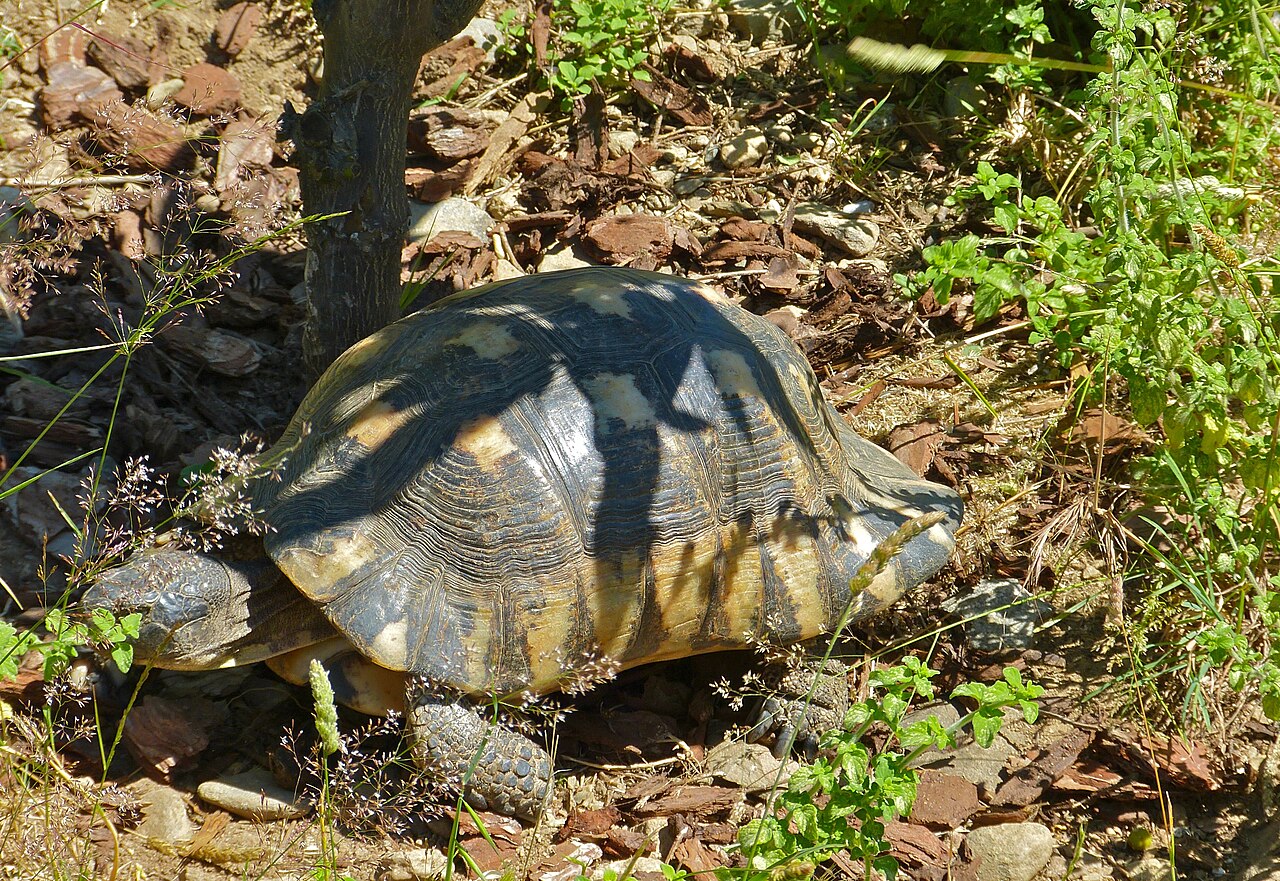
A marginated tortoise can live 100 to 140 years, and a well kept captive routinely passes 50 without any sign of old age. This is not a decade long pet. It is an animal that will very likely outlive the person who buys it, which is why experienced keepers write tortoises into wills and why rescues are full of adults whose owners moved, aged, or lost interest.
The main killers in captivity are not old age but husbandry failures: respiratory infection from damp, cold enclosures, bladder stones from chronic dehydration, and metabolic bone disease from poor UVB and a calcium deficient diet. Each of these is preventable, and each is far more common in indoor only animals than in tortoises with outdoor access to real sunlight.
Longevity also means growth mistakes are permanent. A shell that pyramids in the first three years stays pyramided for a century. Slow growth with high humidity in the hide, daily soaking of hatchlings, and a high fiber, low protein diet is what produces a smooth adult. Long lifespans are a family trait in this group, as the figures in our guide to sulcata tortoise lifespan show.
Do Marginated Tortoises Make Good Pets?
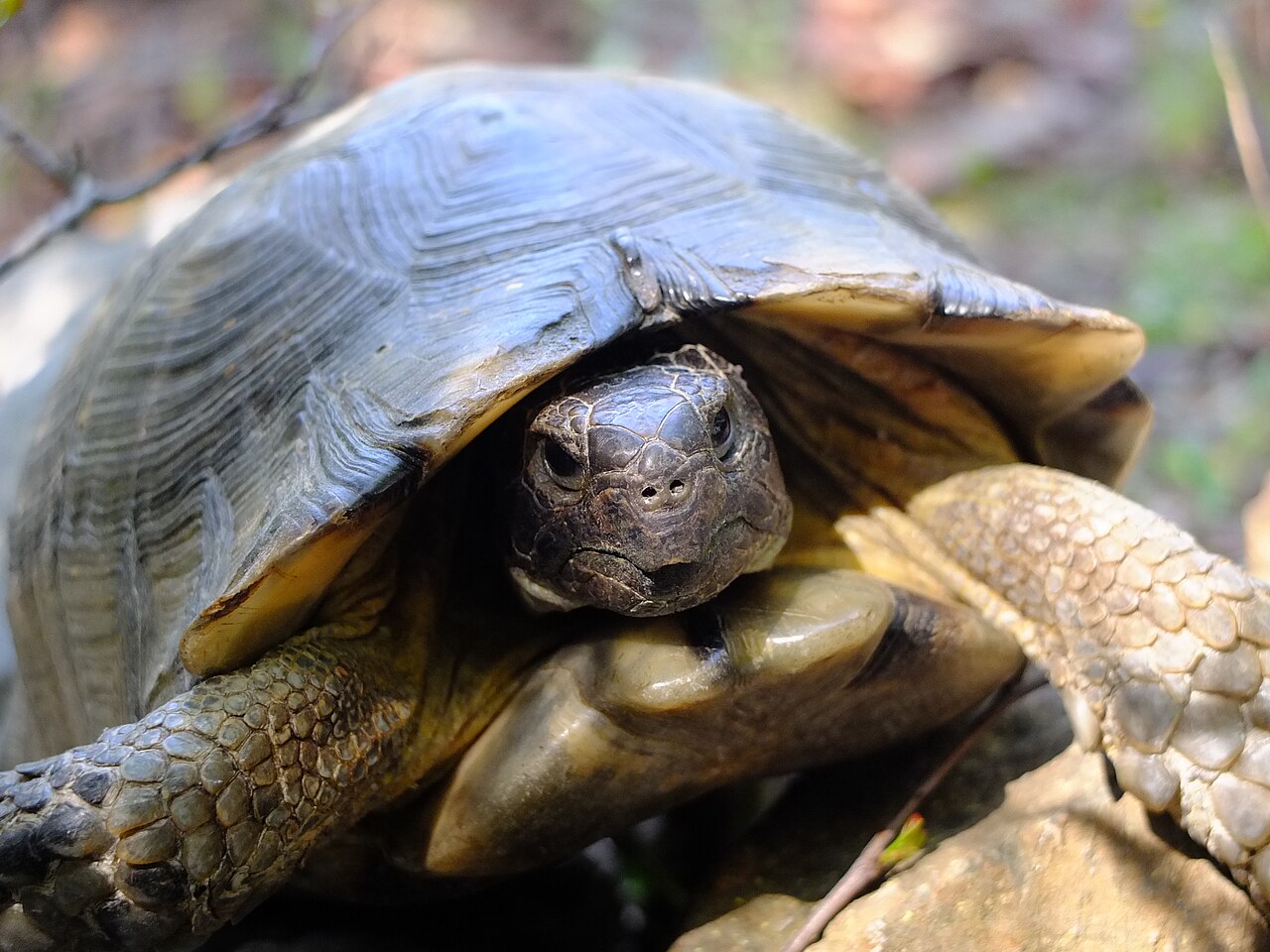
Marginated tortoises make good pets for keepers who can give them outdoor space and accept a century long commitment, and poor pets for anyone who wants an animal to handle. They are calm, rarely bite, tolerate cold better than most tortoises, and become confident enough to approach a familiar keeper at feeding time. They are also strong diggers and climbers that will test a weak enclosure wall repeatedly.
Day to day care is genuinely simple: fresh weeds, a shallow water dish, a warm basking spot, and a dry, draft free hide. There is no feeding of live prey, no misting schedule, and no delicate temperature window. The complexity sits in the enclosure build and in the hibernation decision each winter, not in the daily routine.
Where they disappoint is interaction. A tortoise does not want to be picked up, and handling stresses it even when it does not struggle. Households with young children who expect to hold the pet should look elsewhere. Households who want an animal to watch graze in a garden for the next 60 years are getting one of the best species available.
How Much Does a Marginated Tortoise Cost?
Captive bred marginated tortoise hatchlings cost $250 to $600 in the United States, well started juveniles run $500 to $800, and adults or proven breeding pairs reach $700 to $1,500. Price rises with size and with documented captive breeding, and it varies by season because most hatchlings come out of the nest in late summer.
The purchase price is the small number. An outdoor pen with a secure wall, a heated hide box, and predator proof mesh typically costs $400 to $1,200 in materials. Indoor setups for winter need a tortoise table, UVB lighting, a ceramic heat emitter, and a thermostat, which adds $200 to $400. Budget another $150 to $300 a year for food, substrate, bulb replacement, and a veterinary check.
Then there is the veterinarian. Reptile experienced vets are not everywhere, and a single visit for a respiratory infection or a bladder stone can cost $150 to $600. Anyone who cannot name a qualified exotics vet within driving distance should solve that before buying the animal, not after.
Enclosure Setup for a Marginated Tortoise
An adult marginated tortoise needs at least 32 sq ft (3 sq m) of floor space, and an outdoor pen of 4 ft by 8 ft (1.2 by 2.4 m) is the practical minimum for one animal. Outdoors is strongly preferred wherever the climate allows it, because natural sunlight solves the UVB and vitamin D3 problem that indoor keepers spend money fighting. The pen needs sun, shade, a dry hide, and planted grazing.
Substrate should drain. A mix of topsoil and play sand, or topsoil with cypress mulch, holds a burrow shape without staying wet. Indoors, aim for a basking spot of 95 to 100 F (35 to 38 C) under the lamp, an ambient of 75 to 85 F (24 to 29 C), and a night drop to 65 to 70 F (18 to 21 C). A 10 to 12 percent UVB tube across a third of the enclosure covers lighting.
Humidity should stay moderate overall but high inside the hide, especially for hatchlings, because that combination is what prevents pyramiding. Provide a shallow water dish the animal can walk into and out of without tipping, and soak hatchlings in lukewarm water for 15 minutes two or three times a week. Keepers coming from lizards will find the heat gradient logic familiar from our albino leopard gecko care notes.
What to Feed a Marginated Tortoise
Marginated tortoises are grazers, and the correct diet is high fiber, low protein, and calcium rich: broadleaf weeds, grasses, and leafy greens, with almost nothing from the fruit bowl. Dandelion, plantain, clover, chicory, hibiscus, mulberry leaves, and grape leaves are all excellent. Romaine, endive, escarole, and dandelion greens from a grocery store fill in during winter.
Keep protein and sugar out. No dog food, no cat food, no beans, and no more than an occasional bite of fruit, because sugar disrupts gut flora and excess protein drives fast, lumpy growth and kidney strain. Cabbage family greens and spinach should stay rare because of goitrogens and oxalates. Dust food with calcium carbonate two or three times a week and leave a cuttlebone in the pen year round.
Volume matters less than composition. A tortoise grazing a planted pen regulates its own intake well, while a tortoise fed a bowl of chopped salad once a day tends to eat richly and grow too fast. Keepers comparing feeding regimes across species will find the same principles applied in our sulcata tortoise diet guide and in the Russian tortoise diet breakdown.
Hibernation and Winter Care
Marginated tortoises hibernate, and healthy adults benefit from 8 to 14 weeks of it at 40 to 50 F (4 to 10 C). The cycle supports normal breeding behavior and appetite, and animals kept warm year round often become sluggish feeders by their third winter. Hibernation is a managed process, not an accident, and an animal that goes into it sick usually does not come out.
Preparation runs about a month. Stop feeding for two to four weeks depending on size so the gut empties completely, keep the animal warm and hydrated through that period with regular soaks, then weigh it and move it to a ventilated box of dry substrate in a stable, cold, predator safe space. A refrigerator dedicated to the purpose gives the most reliable temperature control.
Check weekly. A tortoise should lose no more than about 1 percent of body weight per month, and any animal that urinates, wakes repeatedly, or loses weight faster than that must be warmed up and returned to normal care. Hatchlings under two years and any animal with a recent illness should skip hibernation entirely.
Behavior and Temperament
Marginated tortoises are diurnal grazers that are busiest in the hours after sunrise and again in late afternoon, and they spend the hot middle of the day under cover. They dig shallow scrapes, push under shrubs, and patrol a fence line persistently, which is why keepers describe them as more restless than Hermann’s tortoises.
Aggression is limited almost entirely to males in spring. Rival males ram shells, bite at the legs and head, and try to flip each other, and a male will pursue a female for days with the same ramming behavior. Toward people they are calm to the point of boldness, and a settled adult will walk over to a keeper who arrives with food.
Common Health Problems
The three conditions keepers meet most often are respiratory infection, metabolic bone disease, and bladder stones. Runny nose, bubbling at the nostrils, open mouth breathing, and a wheeze point to a respiratory infection, usually triggered by a damp or cold enclosure, and it needs a veterinarian rather than a heat increase alone.
Metabolic bone disease shows as a soft, flexible, or deformed shell and comes from insufficient UVB or calcium during growth. Bladder stones develop from chronic dehydration and a high oxalate or high protein diet, and they often present as straining, lethargy, or a tortoise that has stopped passing urates. Check the mouth and nose weekly and weigh the animal monthly, since a slow weight trend catches most problems long before symptoms do.
Should I Get 1 or 2 Tortoises?
One tortoise is the safer choice, and two males is the one combination to avoid outright. Tortoises are not social animals and get no benefit from company, while males ram, bite legs, and flip each other during the spring breeding season. A flipped tortoise in summer sun can die within hours.
If you want more than one, a group of one male with two or three females in a large outdoor pen works better than any pair, because attention from the male gets divided. Females kept together are usually peaceful but should still have multiple hides and separate feeding stations so a dominant animal cannot monopolize either. Plan roughly 32 sq ft (3 sq m) per additional adult.
Quarantine any new arrival for a minimum of three months in a completely separate enclosure with separate tools. Tortoise herpesvirus and mycoplasma spread between animals easily and can wipe out a collection, and an infected tortoise often looks healthy for months. Adding a second animal is an increase in risk and workload, not a favor to the first one.
Frequently Asked Questions
Can I leave my tortoise alone for 3 days?
A healthy adult marginated tortoise can be left alone for 3 days if it has a full water dish, a secure enclosure, and reliable heat and lighting on timers. Grazing tortoises in a planted outdoor pen handle the gap easily. Hatchlings, sick animals, and anything longer than 3 days need a sitter who can check water and temperatures daily.
What is the cheapest tortoise to own?
The Russian tortoise is usually the cheapest to buy and to keep, with hatchlings around $150 to $250 and a smaller adult footprint than a marginated. Long term costs are driven by enclosure size, heating, and veterinary care rather than the purchase price, so a small species stays cheaper for its whole life, not just at the point of sale.
What is the friendliest tortoise to have as a pet?
Red footed and sulcata tortoises are generally considered the friendliest, since both readily approach people and tolerate contact. Among Mediterranean species the marginated tortoise ranks well: it is calm, bold at feeding time, and rarely aggressive toward keepers. No tortoise enjoys being held, so friendliness here means confidence, not a desire for handling.
How much does a tortoise cost at Petco?
Petco stores that stock tortoises usually carry Russian or Greek tortoises priced from roughly $200 to $400, and marginated tortoises are rarely available there. Specialist captive breeders are the better source for this species: they offer hatch dates, parent photographs, and feeding records, none of which a general pet chain can reliably provide.
Do marginated tortoises need to hibernate every year?
Healthy adults do best with an annual hibernation of 8 to 14 weeks, and skipping it occasionally causes no harm. Tortoises under two years old, underweight animals, and any tortoise recovering from illness should be kept warm and fed through the winter instead. The decision belongs to a pre hibernation weight and health check, not to the calendar.
Are marginated tortoises legal to own in the United States?
Marginated tortoises are legal to own in most US states, and captive bred animals are widely traded under CITES Appendix II documentation. Some states require permits for non native reptiles, and a few restrict sales of turtles under 4 in (10 cm) shell length. Check state and municipal rules before buying, since regulations vary and change.